
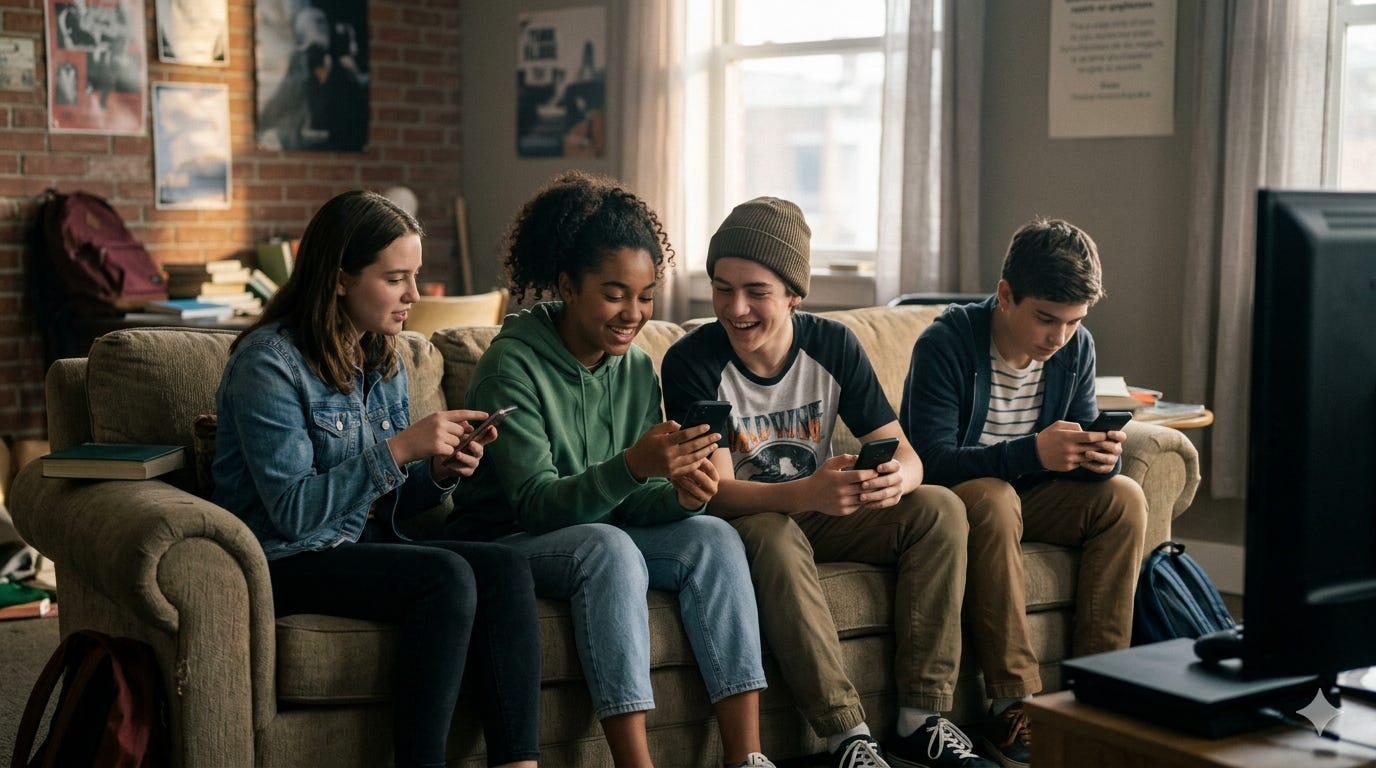
Australia was the first government to introduce a ban on under-age use of social media platforms. Though the ban, introduced last December for under-16s, likely had some positive effects, overall teenagers had little difficulty outwitting the systems designed to lock them out.
The whole saga should serve as a warning to other governments across the world of the folly of attempting to micro-manage childrens’ access to a widely accessible communications technology. Governments need to take a step back and ask themselves how they can support, rather than supplant, the supervisory role of parents.
But this will not be easy. For one of the hallmarks of modern national governments is their deluded conception of their own power over the social fabric. Their delusions of grandeur are not accidental: our modern governments are built on an ideology that displaces the divine authority of absolutist kings with the secular authority of democratic parliaments. Absolutist monarchs dismantled the authority of civil society, making the king “sovereign” over the social order; democratic parliaments filled that vacuum of authority with the power of “the people” and its delegates to shape the social order at will.
The delusions of grandeur of democratic parliaments are manifested in three recurrent features: first, their tendency to arbitrarily usurp the functions proper to non-State actors, such as churches, local communities, and families; second, their failure to acknowledge the unintended harms of their benign interventions; and third, their tendency to vastly underestimate the power of citizens to evade their regulations.
Each of these features is on display, rather dramatically,in the attempt to use legislative authority to stop teenagers from using social media.
First, advocates of State-imposed age limits on social media use tend to assume that parents are not competent to educate their own children in the responsible use of social media; or if they are competent, that State coercion is a necessary complement to their efforts and is likely to be more effective than leaving it up to parents. For example, instead of focusing attention on information campaigns and technological innovations to help parents do their job better, the discussion is heavily centred on the need to legally “ban” social media use.
Second, those enthusiastically demanding a ban on under-age use of social media typically display minimal awareness of the multiple downsides of these sorts of coercive interventions in the digital sphere. If you impose age restrictions on social media use, you risk destroying digital anonymity, an important tool for resistance to unjust regimes; you also open the door to enhanced government and private surveillance of citizens’ communications, by compelling citizens to feed a central database with bio-markers and other personal information.
The easier it is for government to track citizens’ social media accounts and identities, the easier it is for them to criminalise and prosecute speech they don’t like. And let’s not forget that teens seeking to evade the bans may migrate to darker corners of the web, completely defeating the purpose of social media regulation. Indeed, in a recent YouGov poll, 27% of parents reported that their children moved over to alternative, less regulated platform after the social media ban was introduced in Australia.
Third, regulators appear to underestimate the capacity of teenagers to outwit government-imposed controls. According to a recent compliance report by the Australian eSafety Commission, the organization responsible for enforcing the ban on underage use of social media in Australia, many children are able to game the system by adapting the information they input, changing their appearance to look older, or using false IDs or VPNs. Seven in ten parents reported in a survey quoted in the report said their children retained access to their social media accounts after the ban came into effect.
This was all amply predicted by critics of the ban, including myself, yet State officials and many supporters of social media bans have just stuck their heads in the sand. Some people are simply unprepared to accept that there are some social problems the State cannot solve.
Advocates of government-imposed bans on under-age use of social media will undoubtedly react to the predictable failure of their regulatory efforts by attempting to tighten up regulations, banning VPN use, or imposing yet further restrictions. And a generation growing up in the age of AI will just keep getting smarter at gaming the system.
It is time for regulators to grow up and admit that their best course of action is not to compete with parents or attempt to outsmart tech-savvy kids, but to offer parents meaningful support by providing the knowledge and the tools they need to make informed choices and help their children derive the benefits rather than the harms of a more digitally connected world.
The Freedom Blog offers a thoughtful voice in defence of freedom at a time when the pillars of a free society are coming under attack across the West from our very own institutions and governments.
If you appreciate my blog posts and the careful work that goes into them, please consider supporting my work with a paid subscription, by clicking here.
My academic profile and publications are listed at my website, davidthunder.com.
Click here to download the preface and introduction to my book, The Polycentric Republic, for free. Click here to purchase the book.
No posts
Comments
Nothing yet. Say the first thing.
Sign in to join the conversation.