
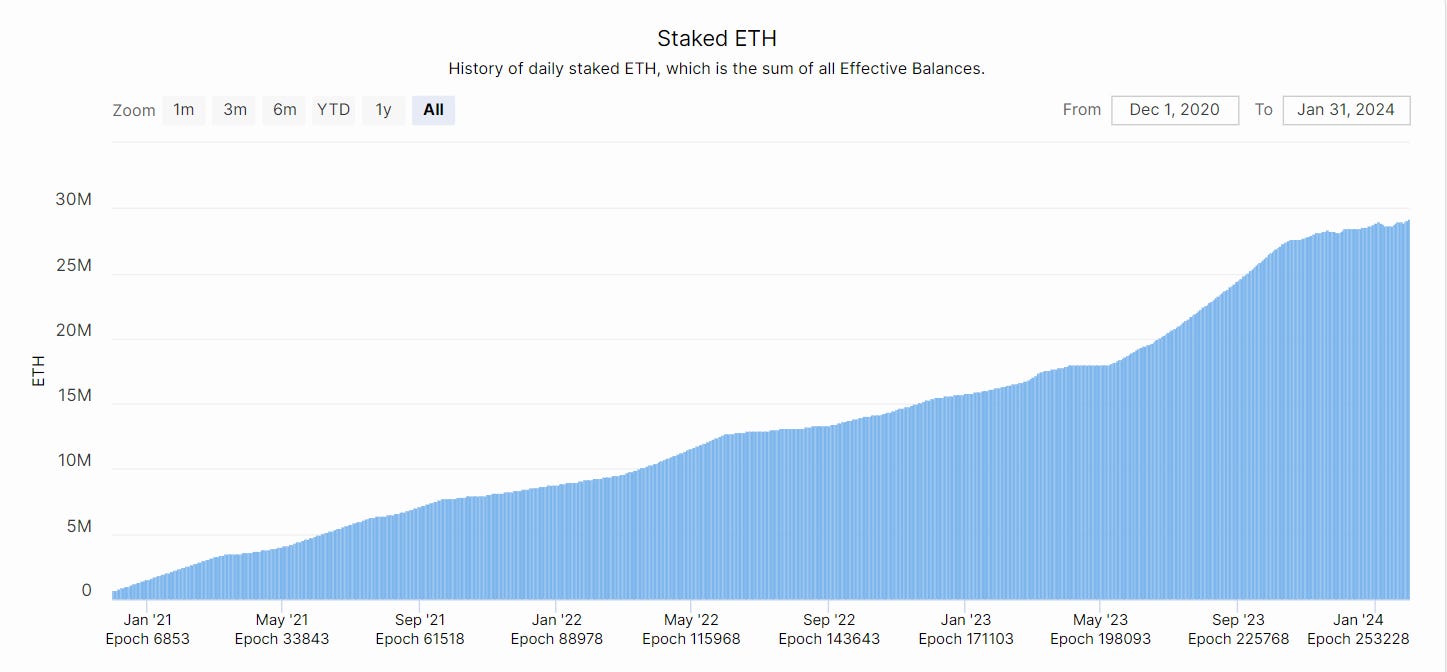
By mid February 2024, more than 30 000 000 of ETH is staked, and providing security for the network. At the current prices that’s more than 75 billion USD. No doubt the Ethereum network is getting increasingly more secure. Perhaps it may even surpass Bitcoin’s security in the future. This offers also great security to the smart contracts running on it because an attack on Ethereum's consensus system would require lots of ETH.
Staking is already retro though. Enter Eigenlayer and restaking. With EigenLayer's innovative restaking feature, Ethereum validators have the opportunity to extend their security services to other protocols without the need to withdraw their initial stake or inject more funds. Plus, they stand to earn an additional yield. This groundbreaking approach enables non-smart contract protocols to benefit from Ethereum's robust security measures through restaking, an option that was not available before.
EigenLayer distinguishes itself by not being a DeFi protocol but rather a foundational platform that kick-starts new proof of stake (PoS) systems. Atop EigenLayer lie decentralized services known as AVSs (Actively Validated Services). These entities might operate as DeFi applications or enhance critical features within other DeFi protocols, operating independently from the core EigenLayer contracts.
Additionally, EigenLayer serves as the base for a unique subset of protocols referred to as liquid restaking protocols (LRT), which are developed in a permissionless fashion on EigenLayer. These protocols are particularly appealing to the crypto degens seeking some juicy yield. Among them are Swell Network, Ether.fi, Genesis, Puffer, and Kelp, to name a few.
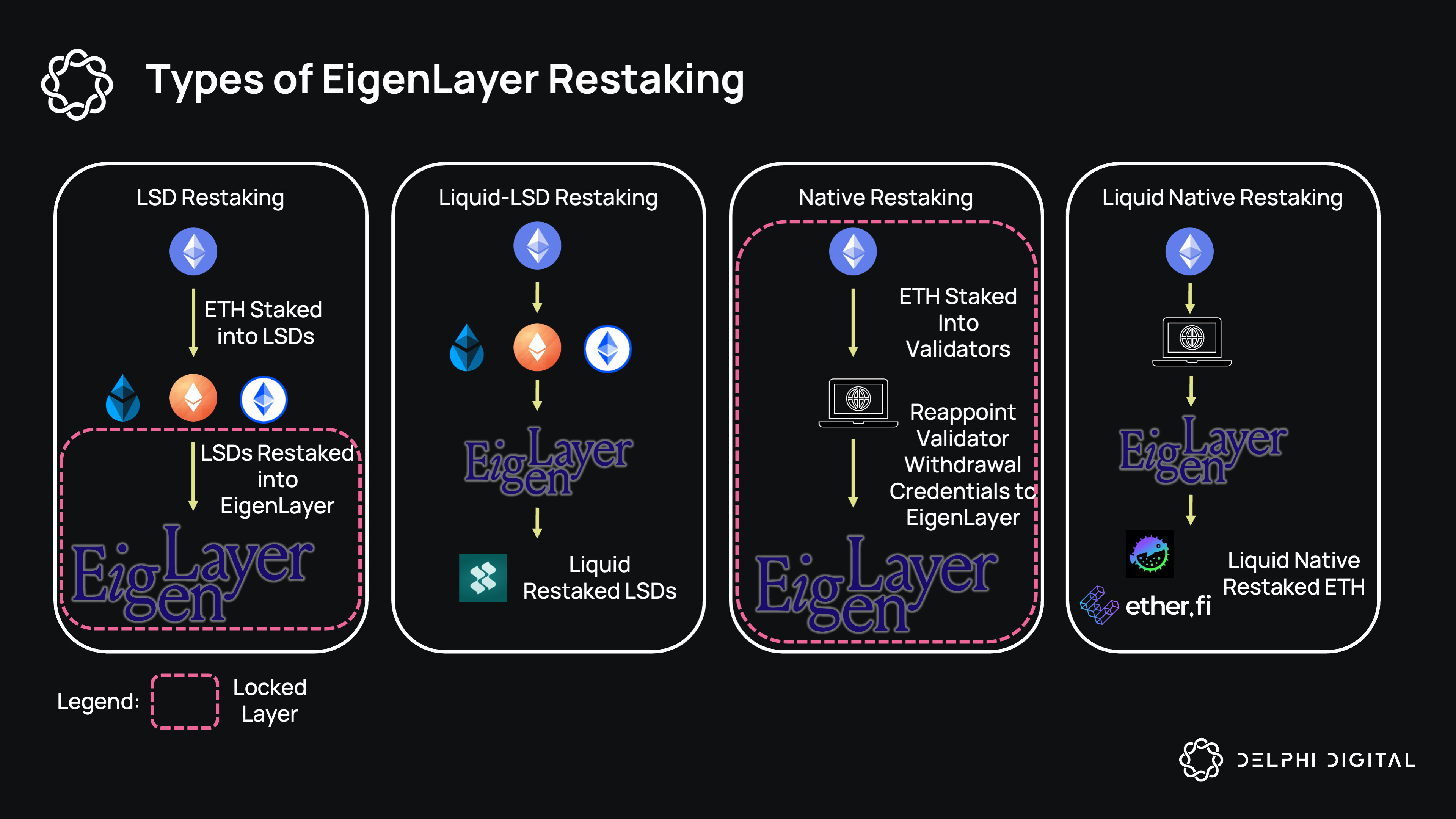
Let's start by clarifying the distinction between liquid staking and its newer cousin, liquid restaking.
The essence of traditional staking is pretty straightforward: you lock up your digital assets in a smart contract, contributing to the blockchain's functionality, and in return, you're rewarded.
Liquid staking, however, adds a twist to the tale. Here, you entrust your assets to a liquid staking protocol and receive a liquidity token in exchange. This token represents your staked assets, offering more flexibility than traditional staking.
Then comes liquid restaking, a technique where holders of Liquid Staking Tokens (LST) take a further step by moving their tokens into the EigenLayer smart contracts.
For those hungry for more details, check this post outlining the nuances between these two methods.
A peek at the DeFiLlama screenshot below reveals the key players in the liquid restaking arena.
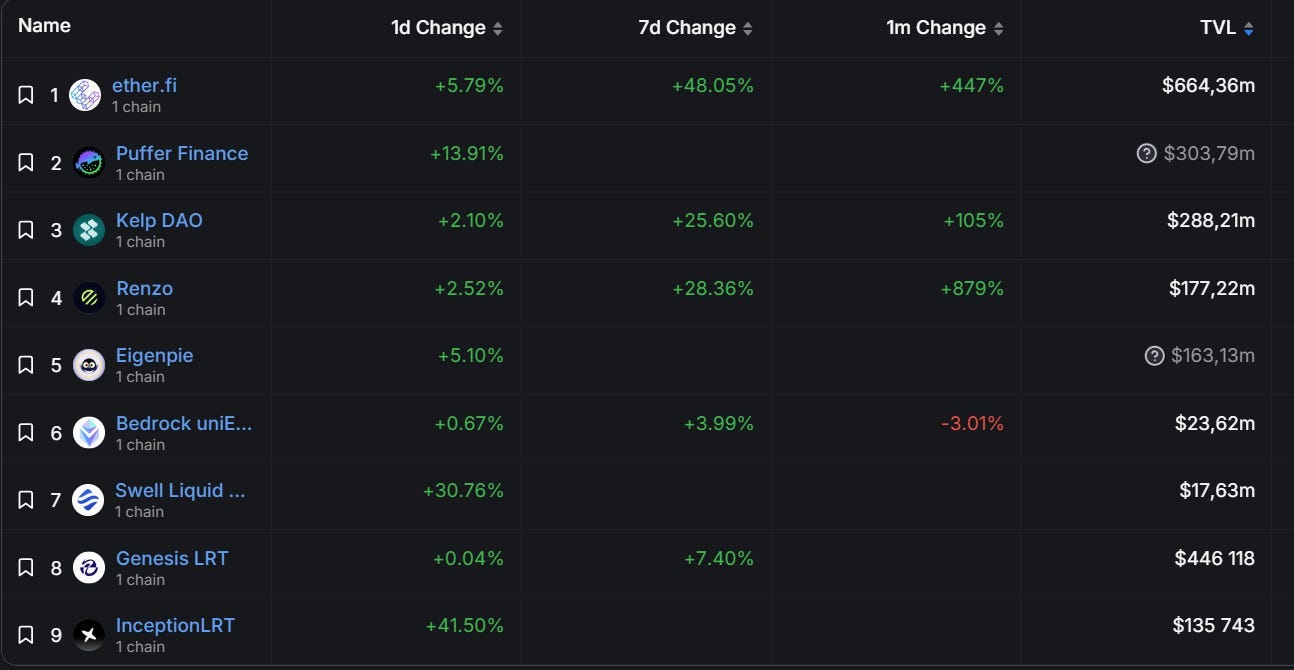
Naturally, as liquidity in DeFi is never too sticky. All the protocols try to attract as much of it as possible by summoning the almighty Degen capital. So what is the possible math.
EigenLayer points are being sold for $0.10-0.15 per point OTC on Whales Market.A single one ETH deposited per day may bring you around 24 EigenLayer points. TVL now stands at over 7 billion USD. By the time of the still uncofirmed yet awaited airdrop, in the upcoming months, the TVL could be doubled. Based, on the most recent valuations, the fully diluted valuation around 15 billion is not unrealistic. An airdrop in the range of 5-10% of the token supply could be nice pocket money.
If you are one of those who keep their mind, and their wallet open, the most promising yield opportunities currently available in the Liquid Staking Token (LST) and Liquid ReStaking Token (LRT) landscape include the following:
EtherFi (eETH)
By depositing ETH, you can generate eETH and earn both EtherFi Loyalty Points and EigenLayer points. This eETH can then be utilized across various DeFi protocols to secure additional yields, such as with Pendle.
Swell (swETH/rswETH)
Depositing ETH with Swell converts it into swETH LST. Re-staking this swETH into EigenLayer then produces a liquid rswETH LRT. It's expected that the Pearls rewards system will continue, offering "Pearls"/points for airdrops plus extra bonuses for referrals and further engagement with EigenLayer and its DeFi partners.
Mantle ETH (mETH)
Depositing ETH with Mantle's liquid staking protocol yields a 7.2% APY for the next two months, with a potential extension. This gives you mETH, which you can keep or deposit into EigenLayer for additional yield come Monday. While there's no airdrop with Mantle, the double yield plus EigenLayer points make it an attractive option.
Kelp (ETHx)
Kelp offers a choice between stETH, ETHx, and sfrxETH, each providing EigenLayer points and Kelp Miles for airdrops. ETHx is particularly rewarding as Stader (the team behind Kelp) has restaked ETH from their treasury in EigenLayer, passing on extra EL points to you.
Renzo (ezETH)
Staking ETH with Renzo grants you ezETH, along with EigenLayer points, Renzo ezPoints for airdrops, and the standard ETH staking yield.
EigenPie
For every 1 ETH worth of LST deposited, users earn 1 Eigenpie point per hour, with a 2x point boost in the first 15 days as an incentive for early depositors. These points are your ticket to a share in 10% of the total EGP supply through an airdrop and a significant portion of the EGP token IDO.
Puffer (pufETH)
Depositing stETH & wstETH with Puffer not only earns Puffer and EigenLayer points but also locks in double points before February 9th. PuffETH is a native LRT that earns restaking rewards directly on EigenLayer, setting it apart from LRTs that tokenize restaked LSTs within a Liquid Restaking Protocol (LRP).
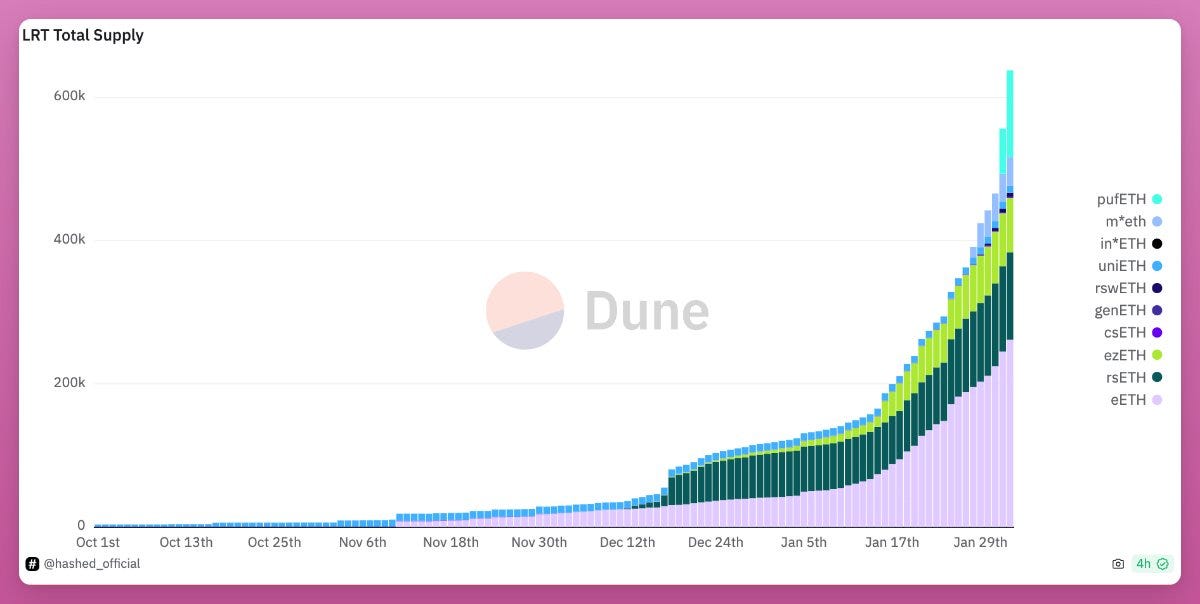
Each option has its own tradeoffs and risks. Deciding among these options is no easy task, as each comes with its own set of benefits and potential pitfalls—it all depends on your perspective and whether you want to chase the highest yield or the airdrops.
If you are chasing airdrops: Swell, EtherFi, Kelp, Puffer, EigenPie, and Renzo could be your best bets.
If chasing the highest returns: Mantle ETH (mETH) offers a tempting 7.2% APY on your ETH plus additional EigenLayer points. For the “die hard” degens there is also on option to use Pendle.
If looking for “safety”: To be clear - there is no safety in the crypto degen realm.
Yet, among the relatively safer bets, based on their established presence, are Lido, RocketPool, and Binance Staked ETH.
If you like living on the edge: And are bullish on ETH, consider leveraging wstETH as collateral on AAVE to borrow 50% ETH, and then spread that ETH across swETH, mETH, ETHx to maximize airdrops and EigenLayer points.
Pendle is also offering some high-risk, high-reward strategies that could yield up to 30%.
In crypto, as in life, often less is more. It is easy to fall into the trap of chasing the highest returns. If you have 32 ETH and more, I recommend you to set up a full validator via Staked.us. You keep the keys, they run a server. Low-effort, and relatively safe given the track record of the company.
If you have less than 32 ETH, then I recommend you to do liquid restaking via Etherfi. With my personal link you get some extra points and therefore get bigger airdrop. It’s relatively low effort, and the one of the safer options that will give you certainly some reward.
One of the most recent projects that caught my attention and brought some interesting innovations is Manta. Manta is revolutionizing the way users bridge assets in the crypto world with an innovative approach that not only addresses a significant issue but does so with a dash of engaging, and slightly competitive, marketing flair.
At the heart of Manta's innovation is a solution to the inefficiency of traditional asset bridging to Layer 2 networks, where ETH locked up in the process remains idle on Layer 1, serving no productive purpose. Manta disrupts this by staking the ETH (or USDC) used in bridging, allowing the original asset holder to earn yield on their staked assets, a first of its kind. Additionally, users receive a receipt token (STONE), which they can leverage within Manta’s DeFi ecosystem to earn extra yield, with an initial lock-up period of 69 days.
Manta Pacific aims to construct a modular, scalable zero-knowledge (zk) infrastructure to enhance web3 application development. This mission includes adopting cutting-edge technologies such as Polygon zkEVM and Celestia for data availability, significantly reducing gas fees and improving the overall developer experience. Currently, with a global network of over 60 developers, Manta is on the forefront of innovative market entry and liquidity strategies.
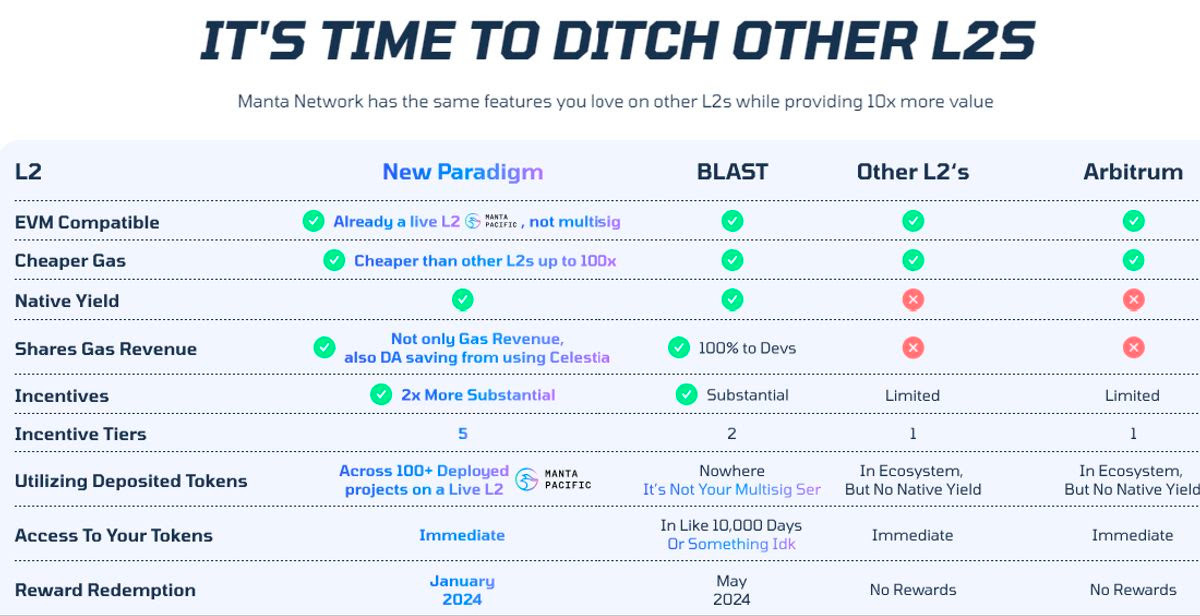
Kenny Li, a co-founder of p0x Labs (the brains behind Manta), champions the modular tech stack as crucial for app developers who prefer a simplified deployment process across L2 ecosystems without the hassle of maintaining code on multiple networks. Manta’s infrastructure aims to become a "plug and play" solution for web3 developers, emphasizing zero-knowledge technology for enhanced privacy and scalability.
Key points in the Manta’s journey include:
1. A strong emphasis on zero-knowledge technology for superior user experience.
2. The provision of “universal circuits” that ease the deployment process for app developers.
3. Manta's pioneering role as the first L2 to deploy on Celestia, offering significant gas fee reductions.
4. Compatibility with Ethereum-based applications, allowing them to benefit from Celestia’s data availability and lower gas fees.
5. A strategic pivot towards Polygon zkEVM, reflecting Manta’s forward-thinking stance.
Definitely a project to watch in the future!
Stakefish, a premium ETH staking provider, hires a Web3 full stack engineer
They hire also for general role so make sure to check it out
Nethermind, a Web3 security firm, hires for Business Development role
P0X Labs, creting the Ethereum’s L2, Manta Network, hires for a product manager.
If you want to level up your crypto education be sure to check University of Nicosia’s Masters in Digital Currency. As a proud Alumnus and Ambassador of UNIC I highly recommend their courses. They recently launched also a great new Masters in Metaverse. If Master’s is not what you are looking for then you could check their Academic certifications for developers, regulators or other professionals.
Last but not least, I cant recommend enough UNIC´s free MOOC that has been taught now for a decade already and attracted more then 100 000 students worldwide! It is truly the number one educational resource I recommend to most people as it navigates through all the key topics in crypto including the Bitcoin protocol, Ethereum, Smart Contracts, DeFi, NFTs and more!
That’s all for me for now! I will be grateful for your feedback on this issue, as well as ideas on what kind of topics you would be interested in seeing in the future!
Don’t forget to subscribe and share with friends 🙏 and see you soon!
Links for your convenience:
Coinstory Book | My Youtube
Twitter | Instagram | My Web
Introduction to Cryptocurrency Course (Slovak)
Ethereum, DeFi, NFTs & Metaverse Course (Slovak)
No posts
Comments
Nothing yet. Say the first thing.
Sign in to join the conversation.