
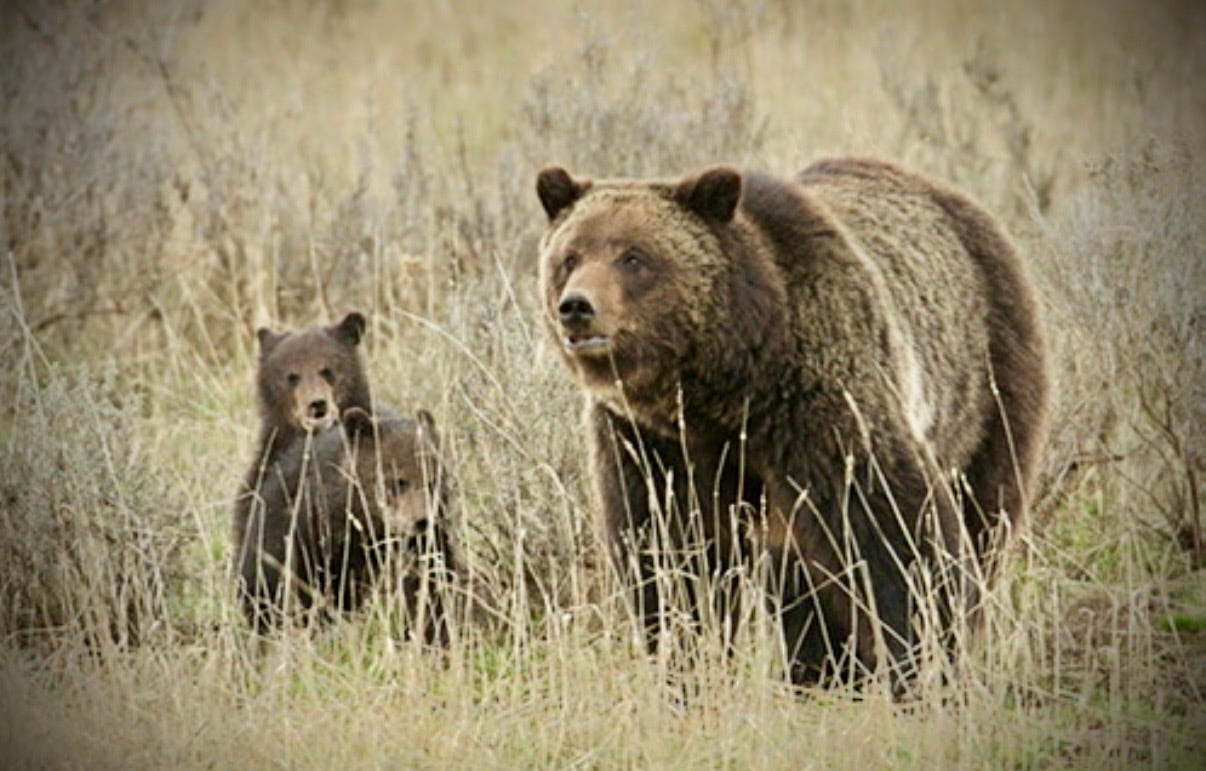
by David Stalling
There is something deeply disturbing about the way grizzly bears are being talked about today.
It isn't simply that people disagree about grizzly bear management. Disagreement is healthy. Debate is necessary. Science should be questioned and management strategies should be examined. But that is not what we are watching.
We are watching a growing willingness to disregard science, experience and reality when they get in the way of what some people have already decided they want.
The governors of Montana, Wyoming and Idaho, the director of the U.S. Fish and Wildlife Service and the U.S. Secretary of Interior don’t even seem to pretend to be honest about the issue. They just spout easily refuted bullshit and arrogantly think people will believe whatever they say — because, unfortunately, a lot of people do. To paraphrase Mark Twain, they don’t let facts get in the way of what they choose to believe.
They want grizzly bears removed from the federal protections of the Endangered Species Act and have management turned over to the states — not because they care about grizzly bears (obviously they don’t) but because they want to dominate and control a species we can’t completely dominate and control. Simply put, they want to kill grizzlies. They’ll say anything to get what they want.
Apparently, we are supposed to believe that habitat standards intended to provide meaningful habitat for grizzly bears have somehow been reduced to one acre. One acre. For a grizzly bear. You cannot make this stuff up.
A grizzly can range across enormous landscapes. Its survival depends upon food, security, connectivity and functioning habitat. Pretending that an acre represents meaningful habitat for an animal like this is not serious wildlife management. It is an insult to common sense.
We hear the same argument that grizzlies should simply be "managed locally," as though living in Montana automatically makes someone an expert.
It doesn't.
Being born in Montana does not make someone a wildlife biologist. It does not give someone an inherited knowledge of bear behavior. It does not make personal opinion more credible than decades of research by federal, state, Tribal and university scientists who spend tons of time in the field studying grizzlies.
If merely living near wildlife made someone an expert, we wouldn't need biologists, field studies, population monitoring or science at all.
And after spending an enormous amount of time around wild grizzlies myself, I can tell you something: the more some local fellow-Montanans talk about grizzlies, the more clearly they reveal how little they understand them.
They insist populations are exploding. They insist there are too many bears. They insist killing bears will make the remaining bears fear and "respect" people.
That isn't science. That is fear dressed up as expertise.
Before anyone talks about a grizzly "explosion," remember the history. Grizzlies once occupied much of the western United States. By the 1930s, they had been reduced to roughly 2 percent of their historic range in the contiguous United States. Federal protection became necessary because persecution and habitat loss had pushed them toward the edge of extinction.
Grizzlies are not animals whose populations can simply explode overnight. They are among the slowest reproducing mammals in North America. Females invest heavily in their young, and population growth is naturally limited. That means mortality matters. You cannot casually remove breeding animals from a slow-reproducing population and assume nature will replace them next year.
Grizzly bears evolved as an Apex predator with a little predation. They are self regulating in population size. When Apex predators are killed it can disrupt social structures and territorial and breading behaviors and can exacerbate the challenges managers claim to be addressing by killing Apex predators. They are not prey species like deer and elk it shouldn’t be managed like deer and elk. They are grizzly bears.
There is another fact that deserves far more attention: the food landscape is changing. Grizzlies are extraordinarily adaptable, but adaptability does not mean unlimited food. Important food resources have declined or become less reliable in parts of grizzly country, while drought, fire, disease and other climate-related changes are altering ecosystems.
When food changes, bears move. They search. They adapt. Sometimes that means traveling farther or entering areas where people have become unaccustomed to seeing them.
That does not automatically mean the grizzly bear population are exploding and that they have become more aggressive. It means they are trying to survive.
And the idea that killing bears will somehow teach the remaining bears to "respect" humans is dangerously simplistic. Many serious bear encounters are defensive, involving surprise, proximity, cubs, food or carcasses.
A grizzly is absolutely capable of being dangerous. We should respect that. But respecting a dangerous animal is not the same thing as demonizing it.
If the goal is reducing conflicts, let's talk about what actually works: securing attractants, public education, bear-aware recreation, livestock practices, habitat protection, understanding bear movements and responding appropriately to genuinely dangerous or food-conditioned bears.
Fear is not a management plan. Revenge is not a management plan.
And then there is the issue of genetic connectivity.
Wildlife scientists have long recognized that isolated grizzly populations are vulnerable. Connectivity allows bears to move between populations, reproduce and maintain genetic diversity. We need to protect and restore wild corridors that allow grizzly bears to freely move between population segments without being killed.
The question should not simply be, "How many bears can we legally kill?" The question should be: “How do we keep these populations genetically healthy, sustainable and connected for generations?"
The Endangered Species Act does not simply say, "Reach a population number and walk away."
Recovery requires objective, measurable criteria and management capable of addressing the threats that caused a species to need protection in the first place.
Population numbers matter.
But numbers are not the whole story. What happens to habitat? What happens to mortality? What happens when food resources change? What happens to genetic connectivity?
What happens when protections are removed? What happens if state management fails?
Those questions deserve answers before anyone tells the public that grizzlies are "recovered" and everything will be fine.
The grizzly bear is not a prop in a cultural war over who gets to claim Montana. It is wildlife. It is an apex predator. It belongs on this landscape. Its management should be based on biology—not fear, political influence or the loudest voice in the room.
We have already seen what happens when fear, politics and the desire to eliminate predators overpower science. We nearly lost the grizzly once. We should not confuse recovery with completion. We should not confuse a larger population with a secure future. And we should not allow political convenience to become the measure of conservation.
To understand how the states of Montana, Wyoming and Idaho will manage grizzlies all we have to do is look at how they “manage” wolves. They allow hunters and trappers to kill up to 20 wolves year using most any means they want. They shoot wolves from the air, they have extended seasons, in some places it’s legal to use night vision and laser technology, to shoot wolves at night. States help pay bounties on wolves to encourage folks to kill more. Science is completely ignored. Wolf management is based on hate. Grizzlies are next.
We don't need to love grizzlies. We don't need to romanticize them. But if we are going to decide their future, the very least we owe them—and ourselves—is the truth.
Because grizzly bears are not monsters. They are not political enemies. They are wild animals trying to survive in a world increasingly dominated by us.
And if the people demanding more dead grizzlies cannot make their case without exaggeration, mythology and fear, perhaps we should stop asking what is wrong with the bears.
Maybe the problem isn't the bears.
Maybe the problem is the people who have decided they want them dead.
No posts
Comments
Nothing yet. Say the first thing.
Sign in to join the conversation.