
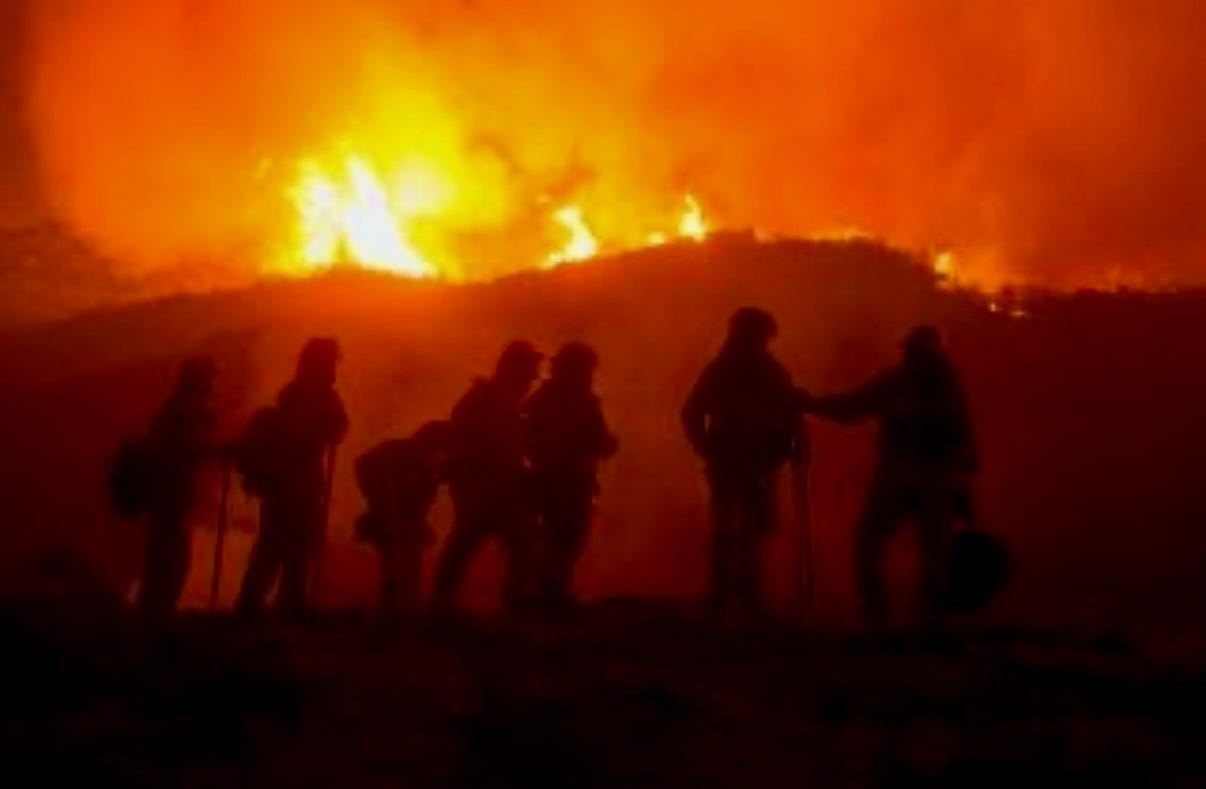
by David Stalling
Wildfire is not the enemy. It is one of the natural forces that created the West—and after more than a century of trying to suppress it, we need to learn how to live with it.Every now and then, politicians come to Missoula, Montana, and visit the Smokejumper Center. They stand beside the airplanes, talk about the extraordinary risks wildland firefighters take to protect human lives and homes, and praise the courage of the men and women who parachute into the wilderness to fight fires most of us would run from. And rightly so. I have enormous respect for wildland firefighters. They do extraordinarily difficult and dangerous work, often under conditions most of us can scarcely imagine.
Then the politicians usually talk about what we need to do to “solve” the wildfire problem. We need to log the forests, they say. We need to build more roads so we can manage the forests better. We need to remove the fuels. We need to “clean up” the forest.
It makes for good sound bites, dramatic television footage and good political photo opportunities. But there is something hypocritically interesting about these visits. None of them ever walk across the parking lot to chat with the experts who best know and understand wildfire and forest ecology and what management actions can and should be taken.
Just next door to the smokejumper center is the U.S. Forest Service’s Missoula Fire Sciences Laboratory, where scientists, biologists and other researchers have spent decades studying wildfire—how it behaves, how forests evolved with it, what happens to soils and vegetation when forests burn, how fire affects wildlife and insects, how smoke behaves and, perhaps most importantly, the natural history and ecology of fire and the role fire has and continues to play in shaping our forests. You would think that would be the obvious place to begin a conversation about wildfire. Instead, we usually begin with fear-mongering politics. And that is part of the problem.
The wildfire situation in the West is far more complicated than most political speeches, newspaper headlines and television reports suggest. There are people who say we need to treat forests to restore forest health and reduce the risk of severe wildfire. Others say we need to log our forests, build roads and remove trees to prevent fires. Others say that because we have excluded fire from the landscape for so long, we have fundamentally altered our forests and made today’s fires worse. Still others say we are experiencing large intense wildfires because of climate change. And there are those who say we should simply leave nature alone and let fires burn.
There are distortions and misconceptions in all of these arguments. There is also some truth in all of these arguments. And there are places where each approach makes sense.
The West does not have one kind of forest. It has many kinds of forests, growing under vastly different conditions, different elevations, different aspects and shaped by very different histories of fire. That distinction is essential.
Our western forests evolved with fire, adapted to fire and, in many cases, depend upon fire. Fire is not an aberration in these forests. It is one of the ecological processes that created them. Think of an old grandfather clock with a glass front exposing its gears. You don’t like the looks of one of the gears, so you remove it. The clock may continue to run for a while, but eventually it won’t. That is essentially what we have done with fire. We removed an important gear from many western forest ecosystems and then wondered why the machinery began to change.
The late Steve Arno, whom I had the privilege of knowing and spending time with, helped me understand this in a way no textbook ever could. Steve was a Forest Service fire ecologist and researcher at the Missoula Fire Sciences Laboratory who spent more than 40 years studying forests and fire. He understood that forests aren’t simply collections of trees. They are dynamic systems shaped by disturbance—fire, insects, disease, drought, wind and, increasingly, human activity.
“Forests are processes, not just trees and plants,” Steve told me.
That may be the most important thing to understand about wildfire. Different forests evolved with different fire regimes.
Take low-elevation ponderosa pine forests. In many of these forests, frequent, relatively low-intensity fires once moved through the understory every several years to a few decades. They burned grasses, shrubs, small trees and accumulated debris while often leaving large, mature ponderosa pines alive. Those big pines have thick bark and other adaptations that make them remarkably resistant to low-intensity fire. The result was often an open, park-like forest—a kind of grassy pine savanna—with widely scattered large trees, bunchgrasses, shrubs and willows. That landscape provided important habitat and forage for deer, elk and other wildlife.
Now compare that with high-elevation lodgepole pine forests. Lodgepole forests in many parts of the northern Rockies evolved with much less frequent but much more intense fires. Large stand-replacing fires created a mosaic of young forests, older forests, openings and patches of dense trees. Many lodgepole pines have serotinous cones that require intense heat to open and release their seeds. In that forest, a huge, hot fire isn’t necessarily an ecological catastrophe. It may be the mechanism by which the forest renews itself.
This is why the argument that we should simply “thin the forests” doesn’t make much sense in all places. Which type of forest? Where? How? Why? And according to what historical fire regime? What makes sense in a ponderosa pine forest may be completely inappropriate in a lodgepole pine forest. A treatment that restores one ecosystem can damage another. The truth is that there is no single prescription for the forests of the West.
Where frequent, low-intensity fires once moved through lower-elevation ponderosa forests, we changed the system. Cattle and sheep grazing reduced the grasses and forbs that once helped carry frequent surface fires. Logging removed many of the largest, most valuable ponderosa pines—a practice known as high-grading. Then the government began aggressively suppressing wildfire. The result was predictable. In many places, open ponderosa pine forests became dense stands filled with Douglas-fir, grand fir and young trees. Instead of a forest with widely spaced, fire-resistant mature pines and a grassy understory, we created forests where trees competed intensely for sunlight, water and nutrients. Trees weakened by competition became more susceptible to drought, insects and disease. The forests accumulated dead wood and other fuels.
And then climate change added another powerful ingredient. Warmer temperatures, drought, declining snowpack and earlier snowmelt have altered the conditions under which western fires burn. Climate change has not created wildfire, but it has made the conditions for large and severe fires more favorable in many parts of the West. The result in some places is a kind of perfect storm: altered forests, accumulated fuels, drought, hotter temperatures and more people living in fire-prone landscapes. Nature, in its seemingly harsh way, is responding to a system we have altered. Unfortunately, people live there now.
It is fashionable to blame today’s fires entirely on climate change. It is equally fashionable in some political circles to blame them entirely on poor forest management. Both explanations are incomplete. The West burned long before European settlers arrived, and soon after they did arrive. Native Americans along the coast of what is now Oregon tell of fires so large and hot that they drove them into the Pacific Ocean to survive. Some fires were so intense and heated bays so much they didn’t produce oysters for many years.
In 1910, the Great Fires—the “Big Burn,” “Big Blowup” or “Devil’s Broom Fire”—burned more than three million acres across northern Idaho and western Montana. Eighty-seven people died, including firefighters and civilians. Towns were destroyed or severely damaged. It was one of the defining events in the history of American wildfire policy. After 1910, the Forest Service increasingly adopted a militaristic approach to fire suppression. Fire became the enemy. The policy was understandable. People had died. Communities had burned. The images were terrifying. But over the next century, suppressing fire also changed the forests. We shouldn’t make the mistake of concluding that every fire today is a consequence of fire suppression. Nor should we pretend that fire suppression hasn’t altered many forests. Both things can be true. And they are.
There were enormous fires long before modern climate change and long before the Forest Service existed.
Native people also understood fire. Across the West, Indigenous peoples deliberately used fire to alter vegetation, improve habitat, encourage desirable plants and maintain landscapes that supported deer, elk, bison and other wildlife. They understood something European settlers largely forgot: Fire isn’t simply destruction. It can be renewal.
Now we are doing something remarkable. We are building more and more homes in forests that have always burned—and then spending enormous amounts of public money and putting people’s lives at risk trying to prevent those forests from doing what they have always done. It is somewhat like building a house in a floodplain and then being shocked when the river floods. The question isn’t whether the flood will eventually come. It is when.
With wildfire, the question isn’t whether a fire will eventually reach many fire-prone landscapes. It is when, where, how and with what consequences.
In this new, modern-day West, many people have little understanding of forest ecology or the risks associated with living in fire-adapted landscapes. Some people want the forest around their homes to remain exactly as it is. They don’t necessarily understand that a forest is not static. It is changing all the time. Trees grow. Trees die. Insects attack trees. Disease moves through forests. Wind blows trees down. Fire burns. New trees replace old trees. Succession happens. The forest they fell in love with is not necessarily the forest that existed 100 years ago—or the forest that will exist 100 years from now.
I have written about this subject for decades, and one thing I have learned is that “forest health” can be one of the most abused phrases in the wildfire debate. Forest health is real. Millions of acres of western forests have been altered by fire exclusion, logging, grazing, development and climate change. But “forest health” can also become a political slogan used to justify almost any kind of logging. That is where we get into trouble.
Some logging can be good. Some logging can be bad. Some logging can help restore a forest. Some logging can make a forest worse. And some forests should not be logged at all. The important question isn’t simply how many trees we can cut. It is this: What ecological process are we trying to restore, and what treatment best accomplishes that goal?
That is where the late Steve Arno’s work was so important.
Steve’s own 60-acre property in the foothills of Montana’s Bitterroot Mountains became a living demonstration of what restoration could accomplish. When he bought the land in 1971, parts of it were thick with young firs and small, unhealthy pines. There was little grass or shrub cover. But scattered among the thickets were enormous, rotting stumps of ancient ponderosa pines. Those stumps told a story. They showed that the forest had once been much more open—a grassy savanna of large pines where elk could graze and people could ride horses through the trees. The annual growth rings contained fire scars showing that fires had once returned at intervals of roughly five to 20 years.
Then we removed the fire. The large pines were logged. Livestock grazed the grasses. The understory filled in. The forest changed.
Steve began cutting some of the Douglas-firs and unhealthy small pines, leaving the larger, healthier ponderosas. He reduced accumulated fuels. Then he brought fire back. He used prescribed burning to help restore the ecological processes that had been interrupted. The result was not a moonscape. It was an open, functioning forest. Pinegrass, bunchgrass, willow, snowbrush and aspen returned. So did deer and elk. Steve called this restoration logging.
It wasn’t logging simply to produce timber. It was using timber harvest, where appropriate, as one tool to imitate an ecological process that had been interrupted. That is an important distinction. Steve was also very clear about something that gets lost in today’s political rhetoric: Logging is not a substitute for fire.
Tom Atzet, a Forest Service ecologist who studied southwestern Oregon forests, made the same point. Mechanical treatment can reduce fuels and, in some circumstances, make it possible to safely reintroduce fire. But logging cannot reproduce everything fire does. Fire changes nutrients. Fire changes soils. Fire changes vegetation. Fire changes insects and microorganisms. Fire smoke feeds lichens. Fire can create and enhance habitat for various wildlife species. Fire affects future forest composition. Fire does things that mechanical treatments cannot.
We still understand only a fraction of the incredibly complex relationships between fire and the organisms that inhabit a forest. That should make us cautious. Instead, we often act as though we have all the answers.
This is where the simplistic “thin everything” argument falls apart. In a lower-elevation ponderosa pine forest historically shaped by frequent surface fires, removing dense understory trees and using prescribed fire can make ecological sense. In a high-elevation lodgepole pine forest, it may not. Lodgepole forests often evolved with infrequent, high-severity fires. Those fires created a patchwork of young stands, old stands, openings and dense forests. Trying to make every lodgepole forest look like an open ponderosa pine savanna would be ecological malpractice. In some high-elevation forests, a large stand-replacing fire isn’t evidence that the ecosystem has failed. It may be the ecosystem functioning as it evolved.
That doesn’t mean we should let every fire burn under every circumstance. There are communities, homes, highways, watersheds and critical infrastructure that need protection. There are fires that must be fought. But there are also places where allowing fire to burn under favorable conditions may be one of the best things we can do for the forest.
One of the most compelling examples I encountered in my research came from Idaho. In 1992, a lightning-caused fire east of Boise burned roughly 257,000 acres. It was a huge, intense fire. But one stand of ponderosa pine near Tiger Creek survived remarkably well.
When the fire reached the stand, it dropped down and burned through the understory rather than racing through the crowns and killing the large trees. Why? The stand had previously been treated to remove dense understory trees and reduce accumulated fuels, and prescribed fire had been used to restore grasses. The lesson wasn’t that logging stopped wildfire. It didn’t. The lesson was that forest structure influenced fire behavior. That is a much more useful lesson than saying “logging prevents wildfire.
Unfortunately, the phrase “forest health” has also been used to justify some of the worst kinds of logging. In 1996, Congress enacted legislation commonly known as the Salvage Rider that expedited certain timber salvage operations on federal lands and limited some administrative and judicial review. In some places, the resulting operations removed dead trees. But live trees were also cut if they were deemed “unhealthy.” Roads were built. Forests were harvested. The assumption sometimes seemed to be that dead trees were simply waste products waiting to be removed. They aren’t. Dead trees are part of healthy forests. Snags provide habitat for some species. Downed wood provides habitat for some species. Decay returns nutrients. Insects and fungi play essential ecological roles.
Fire, insects, disease, wind and decay are not necessarily signs that a forest is failing. They are part of how forests change. A forest with no dead trees isn’t necessarily healthy. It may simply be a forest from which we have removed an important component.
When many people hear the word logging, they envision denuded mountainsides covered with roads. I understand why. We have all seen bad logging. But not all logging is bad. The late Steve Arno believed that good logging should work within the bounds of natural systems. It should emulate natural processes. It should maintain the components of a healthy forest—from large trees and grasses to elk, insects, dead wood and soil. Sometimes that means removing trees. Sometimes it means leaving them alone. Sometimes it means using prescribed fire. Sometimes it means doing nothing. The key is understanding the ecosystem before deciding what to do to it.
Selective logging isn’t automatically good forestry, either. If you selectively remove the biggest and healthiest trees because they’re the most valuable, leaving behind smaller, weaker trees, you’re not restoring a forest. You’re high-grading it. On the other hand, a treatment that removes small, shade-tolerant trees while retaining large, fire-resistant ponderosa pines may be exactly what is needed in a forest historically shaped by frequent surface fire. The difference is ecological intent.
Americans use an enormous amount of wood. We aren’t going to stop using wood and paper products simply because we want healthier forests. There is nothing inherently wrong with producing timber from forests while restoring ecological health, providing jobs and supporting communities. But we need to distinguish restoration forestry from profit-driven logging disguised as restoration. Those are not the same thing. Timber companies are in business to make money. That’s their job. Public land agencies have a different responsibility. They are supposed to manage public lands for a complex mix of ecological, recreational, wildlife, cultural and economic values. Sometimes those interests overlap. Sometimes they don’t.
Modern technology has also changed the equation. Some equipment can remove smaller trees while reducing soil disturbance and the need for roads. Other methods may reduce road construction but create incentives to remove larger, more valuable trees. Every approach has tradeoffs. There is no magic machine. There is no magic treatment. There is no universal prescription.
We Have the Science. Ultimately, I don’t think we have a science problem. We have a human problem. We have an enormous amount of scientific knowledge. The Forest Service’s Missoula Fire Sciences Laboratory has spent decades studying fire behavior, fuels, smoke and fire effects. Scientists know far more about fire today than they did when the Forest Service launched its war on wildfire. What we don’t seem to know how to do very well is agree. People who love forests disagree about what a healthy forest looks like. People who live in forests don’t want forests changed around their homes. Environmentalists and timber interests distrust one another. Conservatives blame government inaction. Environmentalists blame logging and climate change. Politicians simplify the issue. The media dramatizes the flames. And firefighters are sent into the middle of it all.
Meanwhile, more people continue building homes in fire-prone forests. Then we ask firefighters to risk their lives defending those homes. That is a policy problem. It is also a moral problem.
We Need to Accept Some Responsibility. If you choose to live in a forest, you have chosen to live with fire. That doesn’t mean you should simply accept the destruction of your home. It means you should accept responsibility for reducing the risk. Create defensible space. Thin vegetation immediately around structures where appropriate. Use fire-resistant building materials. Maintain access for firefighters. Have an evacuation plan. Pay attention to fire conditions. Understand the forest surrounding your home. And stop expecting government to guarantee that your house will never burn. There is no such guarantee.
We need to think much more carefully about where we allow development, too. Building subdivisions deep into fire-adapted forests and then spending enormous amounts of public money defending them is not a sustainable wildfire policy. And firefighters should not have to bear all of the risk created by somebody else’s decision to build a house in a dangerous place. If we’re going to ask firefighters to protect us, we owe them more than applause. We owe them responsible decisions.
Every summer in Missoula, the smoke returns. Sometimes it is light. Sometimes it is so thick that the mountains disappear. People complain. Visitors are disappointed.
I once met a tourist who had tears in her eyes because she had always wanted to see Glacier National Park and was convinced it was being “destroyed” by fire. I understood her disappointment. But the idea that fire is destroying Glacier is more complicated than that. Glacier is a fire-adapted landscape. Fire has been shaping the park for thousands of years. It creates openings, recycles nutrients and changes habitat. Some fires are small. Others are enormous. Fire is part of the park’s ecology.
At the same time, climate change is altering the conditions under which those fires occur. Warmer temperatures, changing snowpack, earlier snowmelt and drought can contribute to drier conditions and more favorable weather for large fires. And there is a profound irony here. Some of the people most upset about wildfire smoke arrive in these spectacular landscapes by automobile, RV and airplane, participating in a fossil-fuel-driven economy that contributes to the greenhouse-gas emissions warming the planet and altering the conditions under which these fires burn.
The problem isn’t fire alone. The problem is our relationship with fire.
More than half a century ago, Aldo Leopold offered a simple way of thinking about our relationship with the natural world: “A thing is right when it tends to preserve the integrity, stability and beauty of the biotic community. It is wrong when it tends otherwise.”
That seems like a pretty good standard for wildfire policy. We need to stop asking whether fire is good or bad. Fire is neither. It is a process. Sometimes it is beneficial. Sometimes it is destructive. Sometimes it is both. The same fire can be ecologically essential and devastating to a community. The same forest treatment can be beneficial in one place and destructive in another. The same logging operation can restore a forest or exploit it. The same wildfire can create habitat and destroy a home. That is why simplistic solutions are so dangerous.
The first step should be education. People need to learn the ecology and history of the forests where they live. They need to understand the fire regime of their particular forest. They need to understand what climate change is doing to fire weather and fuels. They need to understand what fire exclusion, grazing, logging and development have done to different landscapes. They need to understand what restoration can—and cannot—accomplish. In some places, we should leave forests alone and let natural fire do the work. In some places, we need prescribed fire. In some places, carefully designed restoration logging may be necessary before fire can safely return. In some places, we need to protect communities at all costs. And in some places, we need to stop building altogether. There is no single answer because there is no single forest.
I have enormous respect for the firefighters who climb into airplanes, helicopters and fire engines and walk into the flames. But I think we do them a disservice when we portray wildfire simply as an enemy that courageous humans must defeat. Wildfire isn’t something we invented. It isn’t something we can permanently eliminate. It is one of the oldest forces shaping the West. Our forests evolved with it. Our wildlife evolved with it. Our soils and vegetation evolved with it. And now, after more than a century of trying to suppress it, we are discovering just how difficult—and sometimes dangerous—it is to remove an essential ecological process. Climate change has made the situation more difficult. Past logging and grazing have altered many forests. Fire suppression has altered others. Development has put more people and property in harm’s way. And political slogans have made it harder to have an honest conversation.
We need to move beyond the idea that the answer is simply more logging. We need to move beyond the idea that the answer is simply doing nothing. We need to move beyond blaming everything on climate change. And we need to move beyond blaming everything on poor forest management. The truth is more complicated. And, as is usually the case with nature, more interesting.
The West will burn. It has always burned. The question is whether we are willing to learn how to live with it. We need to restore forests where restoration is appropriate. We need to use prescribed fire where prescribed fire makes ecological sense. We need to allow some wildfires to burn when conditions and circumstances permit. We need to protect communities where people already live. We need to stop putting new homes in places where severe fire is inevitable. And we need to require people who choose to live in fire-prone forests to accept some responsibility for reducing the risks they impose on themselves, their neighbors and the firefighters who may one day come to save them. Most of all, we need to abandon the old war mentality.
Fire is not our enemy. It is a natural force—sometimes gentle, sometimes terrifying, always powerful—that has been shaping the West for thousands of years. We need to learn to live among the forests we love while leaving room for the wildfires that sustain them.
And I often think of the late Steve Arno when I look across the smoke-filled Bitterroot Valley. Steve understood that forests are processes, not simply trees. He understood that fire belongs here. And he understood that our challenge isn’t to eliminate fire. It is to understand it.
As the Steve Arno reminded me, the question isn’t whether our forests will burn.
It is when—and how big. After more than a century of trying to stop fire, perhaps it is finally time we learned how to live with it.
No posts
Comments
Nothing yet. Say the first thing.
Sign in to join the conversation.