
by David Stalling
I have killed and eaten a lot of wild animals in my life. Elk. Mule deer. Whitetail deer. Mountain goat. Moose. Black bear. Pronghorn. Grouse. Ducks. Geese. That is not a confession, and this is not a defense. It is simply a fact.
Those animals became part of me. They gave me strength. They sustained me. Their flesh became my flesh. Their lives, in some strange but very real way, continued in mine.
And someday, perhaps, I will return the favor.
It is entirely possible that someday I will be killed and consumed by a grizzly bear. If that happens, I hope the cycle continues exactly as it should. What becomes of me may pass through that great bear and return to the earth. Eventually, perhaps, I will become part of the soil, helping nourish the grasses and forbs growing in the mountains. Then an elk may come along and eat those grasses. And the cycle will continue.
Or, as I sometimes joke with friends, “I’m going to be your huckleberry someday.”
There is something remarkably honest—and strangely comforting—about that.
I have spent much of my life taking nourishment from the wild. I have eaten what the land provided. I have drank its water, breathed its air, walked through its forests, climbed its mountains, and found myself more at home there than almost anywhere else. Why should I imagine that I am somehow exempt from the same fate as everything else?
That is the wild. Nothing is truly separate. Nothing stands alone.
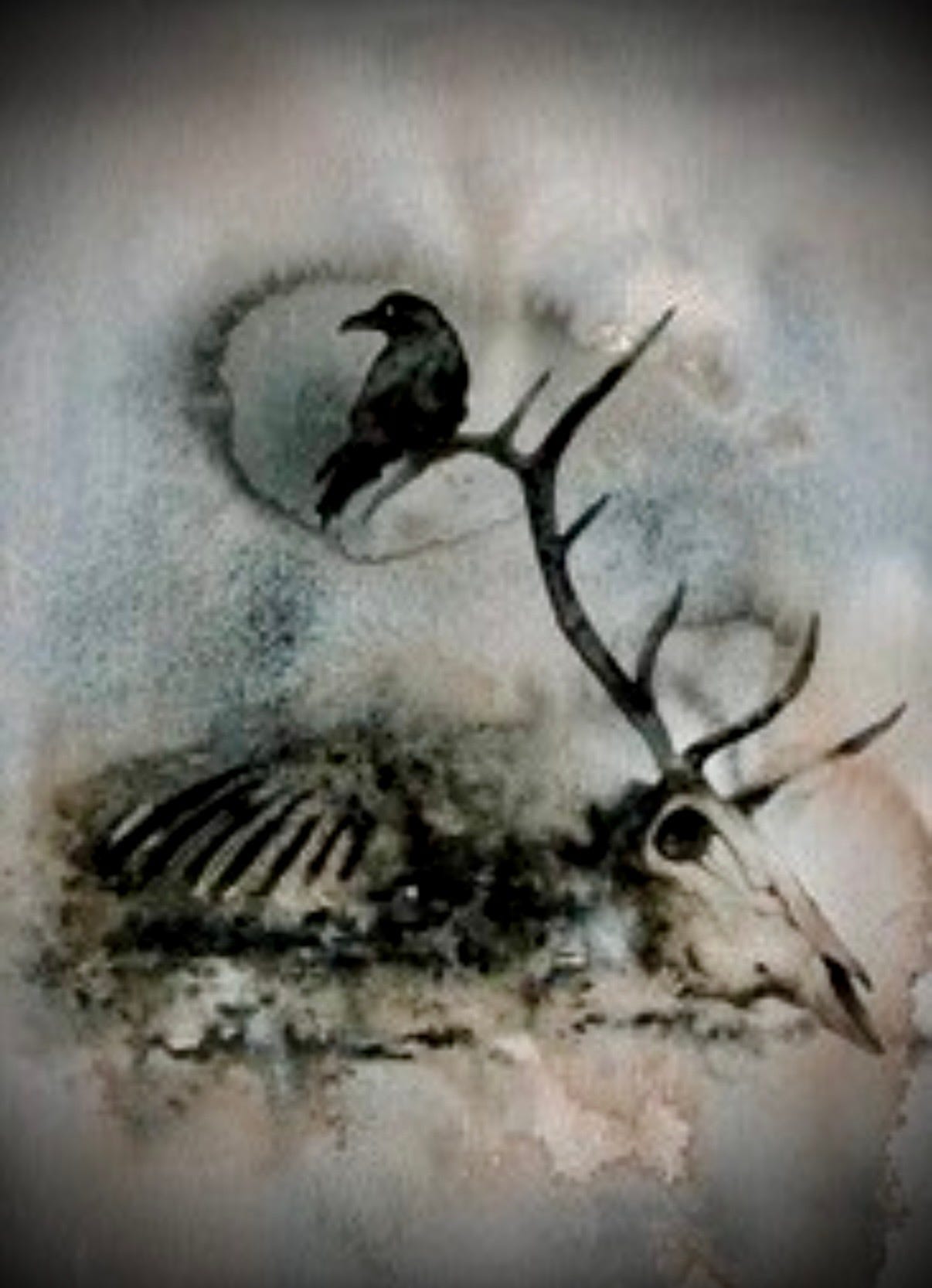
Grass feeds elk. Elk may feed grizzlies. Grizzlies die and return to the earth. The earth grows more grass. A raven finds something dead and eats. An eagle tears apart what remains. Insects arrive. Bacteria begin their work.
What we call death becomes life for something else. The wild wastes very little. It does not sentimentalize death, and it does not fear it. It simply accepts it.
I think that may be one of the great differences between the wild and modern humanity.
We are terrified of death.
We have become so removed from it that we often treat death as an unnatural event—as though something has gone wrong, something has failed, someone must be blamed. We fight it with every drug, machine, procedure, and technology we can invent.
I am not arguing against medicine. I am grateful for it. There is nothing noble about needless suffering, and there are miracles of modern medicine for which we should all be thankful.
But I sometimes wonder whether, in our desperate effort to defeat death, we have forgotten that death cannot actually be defeated.
It can be delayed. Sometimes that delay is a gift beyond measure. More time with someone you love can be the greatest gift imaginable. A few more years, a few more months, even one more good day can matter enormously.
But eventually, every one of us reaches the same place.
The strange thing is that we know this. Every human being who has ever lived has known, somewhere deep inside, that one day they would die. Yet we spend much of our lives acting as if death is something that happens to other people.
Until it doesn't.
Modern society has become obsessed with the length of life, sometimes at the expense of the life itself. We count years. We celebrate longevity. We measure success by how long we can keep a body functioning.
But we do not always ask the harder question: What does it mean to be alive? Is life simply the continued operation of the body? Is a heartbeat enough? Or is life something more?
Is it waking before daylight and stepping into cold mountain air? Hearing a raven somewhere in the timber? Standing on a ridge and realizing both how small you are and how lucky you are to be there?
Is it loving someone, laughing until you cannot breathe, having your heart broken, being terrified, being brave, making mistakes, getting older, and understanding that every one of those moments matters precisely because none of them last forever?
Perhaps our fear of death causes us to miss the point.
The wild has never promised permanence. A flower blooms and dies. A fawn is born and, if it is fortunate enough to survive predators, winter, disease, and all the other hazards of being alive, it eventually grows old and dies.
A great bull elk that once dominated a mountain meadow eventually weakens. Then a winter comes that he cannot survive.
Trees fall. Rivers change course.
Even mountains slowly disappear. Everything ends. And still, every spring, life comes roaring back. New grass. New leaves. New cubs. New fawns. New birds. The world does not stop because something dies. It changes.
That may be the hardest lesson for us to accept. We want to hold on—to people, to youth, to our bodies, to the things we love.
There are people and things in my life I would hold onto forever if I could. But I cannot. The wild teaches us that eventually everything must be released.
I have seen enough death in wild places to know that it is rarely sentimental. Nature can be beautiful, but it can also be brutal. There are no guarantees. Animals starve. Predators kill. Winter freezes the weak. Disease takes the strong. One moment a creature is alive, alert, moving through the world.
Then it isn't.
There is no ceremony. No moment of silence. The forest continues. The wind continues. The snow falls. Eventually, something else is born.
There is a kind of peace in that.
We are always trying to put ourselves outside of nature. We call it "nature" as though it is something over there, somewhere beyond the city limits. Something we visit. Something we protect. Something separate from ourselves.
But there is no real separation. We are animals. We eat. We breathe. We grow. We age. We love. We struggle. We fight desperately to stay alive. And eventually, like every elk, wolf, grizzly bear, bird, and tree, we die.
The atoms that make us who we are have been here longer than any of us can comprehend. The water moving through our bodies has been rain, river, snow, and ocean. It may have moved through countless other living things before becoming part of us.
We borrow all of it for a little while. Then we give it back.
Maybe that is what the wild has taught me more than anything else: I do not own this life. I am only passing through it. The mountains will be here when I am gone. The rivers will keep moving. Ravens will still argue in the trees. Somewhere, an elk will bugle on a cold September morning. Somewhere, a grizzly bear will move silently through the timber, completely unconcerned with whether I ever existed.
There is something wonderfully liberating about that. I don't need to live forever. None of us do. I just want to live. Really live.
I want the cold mornings and the storms. I want the mountains and rivers. I want love and friendship and laughter. I want to be moved by beauty. I want to care enough about something to fight for it.
I want to know the joy of being alive while I am alive.
And when my time comes—and it will come—I hope I can face that final part of the bargain with some of the acceptance the wild has taught me.
I have fed on the wild. I have lived because of the wild. Someday, one way or another, I will return to it.
The wild understands this, even if we sometimes refuse to. We are not outside that great cycle. We are part of it. We always have been. We feed the wild. We live off the wild. And in the end, the wild feeds on us.
We are the wild.
No posts
Comments
Nothing yet. Say the first thing.
Sign in to join the conversation.