
A submitting writer is sick of not receiving replies from editors or agents, until she realises all the power is hers.
She appraised the shopkeeper whilst pretending to take an interest in a jar of pimento olives— a woman busy auditing the dates of cans stacked on the counter; fifty-something, but well enough dressed to look in her forties, spectacles on a rainbow-pride ribbon around her neck.
“We have ordinary olives, if that’s what you’re after,” the shopkeeper said without even looking up.
She felt the way she did when she was caught shoplifting. “No, that’s fine,” she said approaching the counter, putting down the jar of olives, and feeling slightly numb at the prospect of parting with £3.75.
“Staying in the Air BnB? Suzy’s place?”
“Is it so obvious?” When she spoke, it was quietly, trying not to project because she hadn’t brushed her teeth and the only thing freshening her breath was chewing gum.
“Only place to stay in Tawston.” The shopkeeper scanned the olives, “usually the first shop is milk, bread, eggs, coffee. But olives…”
All those things would have been useful if she really had been staying at the Air BnB. “I’m not on holiday, it’s more of a business trip. I’m here to see my editor. You might know him actually, John Dublin?”
The name seemed to knock years off the shopkeeper’s face. “Oh—John, you’re one of his. Maybe I’ve read—”
“—it’s new. Not out yet.”
“Well, what’s the name? I’ll look for—”
“—John’s place, it’s that one, is it? Just off the main road?”
“‘The Cauldrons’? Yes, you can’t miss it. Down by the beck. Gorgeous bougainvillea. John’s so clever with the garden.”
Sitting in soft, fat hills, the village of West Tawston in the Yorkshire Dales turned out to be a single road looped like a noose around a bee-friendly common of long-grasses. She glided down the path mowed through the grass, trailing her fingers over the heads of wildflowers. She had never seen anything like this in her life. It was like walking into one of those Factory Girl romance novels her nan read— when the heroine escapes from the choking exploitation of the cotton mill for a day, to see the world beyond is beautiful. Except this was better, she suspected, because southern wealth had moved in, repaired the dry-stone walls, and painted front doors the same colours as the sky and the hills.
She popped the head off one of the flowers and crushed it in her fist. The shopkeeper was called Annabel, she decided— or perhaps, Nicola. Her accent suggested she wasn’t born local, but might be someone who’d retired from a job down South to play shopkeeper with her wife. The attention you pay to people, is one of your strengths, her writing tutor in college had written in feedback she still remembered word for word, your characterisation is wonderful.
Lesbian Annabel/Nicola was right about the Bougainvillea. It was wrapped plump as a pink cashmere scarf around the farmgate front-door of a picture-postcard cottage. As if she needed any more confirmation, ‘The Cauldrons’ was carved in slate on the garden wall.
On Maps, she had counted thirty-two buildings in the village, making ‘John, who has recently settled with his partner and dogs into the Yorkshire Dales village of West Tawston…” one of the easier editors to find. It was amazing the information successful people were happy to divulge to bloggers.
She stalked past the entrance to the gravelled driveway with only a glance at the house. A stony lane spun off the noose of the main road like a loose thread, dipping down behind the walled garden of the cottage to narrow at a single-track, stone bridge, over a wide stream. A plaque on the stone told her the bridge dated back to the 10th century, and its crossing of Druid’s Beck was part of the ‘Old Drover’s way’. The banks to the copper-red stream were shallow. It was still early enough in the morning there was no-one about, and so she sidled down to the water’s edge and washed her hands and face. She had woken up on the backseat of her nan’s car that morning with only a bottle of sanitising hand-gel to freshen things up and the waterproof Mascara she’d nicked off the picking station. Now, she splashed her face with the frigid water, sucked it up in cupped hands and spat out the stale flavour of chewing gum. Even the streams around here tasted fresher than water from her tap.
“Morning!”
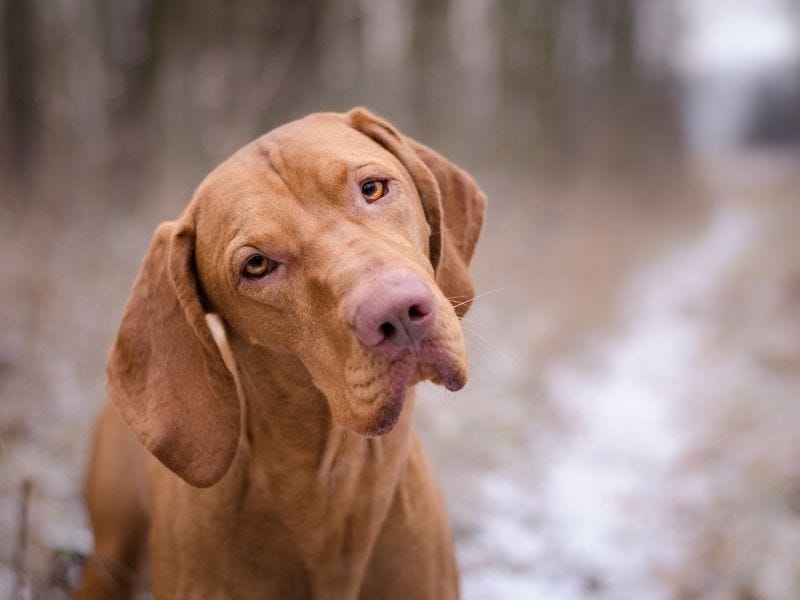
She looked in the direction of the voice to see a man’s silver-haired head bobbing over the high walls of the bridge, greeting tossed over his shoulder. On the other side of the beck, two rust-coloured dogs burst from the bridge and sprinted up the banks of the valley ahead of their owner. “John’s Hungarian Vizslas, Kundera and Borges…”
Her heart quickened. Although the dogs had already disappeared over the brow of the hill, they matched the image search she had done for ‘Vizsla’. Then the man appeared in full— green hunting jacket over plum red chinos. He was swinging a stick demonstratively.
Could she really be so lucky?
Over the years, she’d discovered people who worked in publishing were often abroad, but these weeks after the Hay Festival were slow, far enough away from the Frankfurt and London Book Fairs that seemed to occupy so much of the industry’s precious time. The June half-term was a chance for those with young children to fuck-off to the Turkish coast, or for singletons to take a city-break in Copenhagen or for an older man with two dogs and a cottage in Yorkshire to head back from London and tend to his Bougainvillea.
She waited for John Dublin to reach the crest of the path leading up from the bridge, then followed briskly up the hill behind him. Accustomed only to the expanses of a fulfilment centre and the flats of Northamptonshire, her legs weren’t used to this kind of thing. She was panting when she reached the top, blood pounding in her head with the thrill of the chase.
It was a warm morning, and the jacket she had chosen to keep out the overnight cold was suddenly a burden. She stopped to tie it around her waist then climbed over a stile and followed him down the slope of pasture bitten to stubble by grazing.
Ahead of her, the dogs made crazed orbits around their owner, whose long, bouncing stride filled her with obscure envy. The way she felt when the agency had no work and she discovered people shopping for clothes mid-afternoon or simply sitting in a café drinking a coffee. As for what people did on paid holidays, she could only wonder. Watching John Dublin pick up a stick and throw it for his dogs, she tried to imagine the feeling of releasing it and found herself thinking about childhood weekends. Two whole days without school! How every Friday felt like the end of a year and Monday too impossibly distant to even bother thinking about; a feeling that had lasted until she was 13 and started her first job collecting glasses in her nan’s pub. That must be what paid holidays felt like, picking up the stick on a Friday and releasing it all the way into Monday.
You have a profound empathy for your characters, her writing tutor had written, which is great, because this is something I can’t teach!
She slowed with indecision at the top of the field. The dog play had interrupted John Dublin’s progress and the open field made her conspicuous. Then it was too late. One of the dogs was bounding towards her.
She stiffened, ready to take a leaping hug and hoping the dog swerved at the last second. It stopped about a metre in front of her, barking as it sensed the danger.
Hello, (animals, she presumed, could hear thoughts), who do we have here? Kundera or Borges?
“Sorry!” John Dublin called from the dip below, “he wouldn’t hurt a fly!”
“He’s a sweetheart!” she applied her game smile and shouted. Then to show she meant it, crouched down, and offered the slobbering, barking, literary genius her hand. “Aren’t you a darling?” the dog stopped barking and sniffed at her fingers. It was handsome with eyes of silver pennies. When she looked up, she wasn’t surprised to see John Dublin approaching.
The men always did.
Covering her eyes from the low morning sun, she scrunched up her nose with a squint that had been working for her since she was five. “What’s his name?”
“This one’s Kundera,” the tall shadow above her dropped in his Queen’s English, “don’t ask…”
“Like the writer?”
“That’s right!” John Dublin smiled, “most people don’t know him anymore.”
She stood up to see a handsome face with surprised eyes the same slivery blue of the dog.
Of course, John looked older than any of his online images, but the transition from online to real world always stopped her for a second; nearly always more wrinkles, usually greyer, but more tired was the most common factor.
“I’m a big reader,” she told him.
“Well, thank God someone is! What’s the accent I hear?”
“That’s my party trick.”
“It’s Scotland, somewhere. But I’m afraid I have an appallingly English knowledge of Scotland. Don’t hate me, but a weekend in the Highland’s about as far as I get.”
“Not Scotland!”
“Really?”
“Well, sort of wrong. You’re warm.”
“Borders?”
She shook her head and scrunched up her nose again.
“Then I’m completely lost,” John Dublin admitted like someone who was not used to being lost.
“Corby.”
“Like the trouser press?”
“Have you ever actually used one?”
“Are they the things you get in hotels?”
“People say that, but I’ve never stayed in a hotel that had one.” Never stayed in a hotel, she might have added. Except that one Travel Lodge the night of her parent’s funeral.
“You’re right,” he agreed, “it’s the kind of thing you don’t see much anymore. They tend to just give you an iron, don’t they?”
“I don’t really iron anything.”
“Quite right, life’s too short.”
It stopped her to hear him refer to his own mortality, and without an immediate answer the conversation entered its first, dangerous lull. John grabbed the neck of Kundera and gave his head a shake to re-establish authority.
“Daily walk?” She tried again.
“Yes, keeps me fit, a mile or two in the morning. Holiday?”
She nodded, “Air BnB. Suzy’s place.”
“Oh, Suzy’s a diamond.”
As they followed the enthusiasm of the dogs through the field, she played the charming, bubbly, working-class girl, and told him the story of her grandfather and how he had moved to Corby from Scotland in the 1930’s to work in the steel mills and about the Scottish community who had settled there, (which, now she mentioned it, was something he had vaguely heard about). He told her it would make a fascinating, ‘non-fiction’, with a ‘whiff of the road to Wigan Pier,’ and she had to look away to hide her smile. They all had an idea for how ‘fascinating’ her family story would be. The female editor in a west London suburb who saw it as a story of the uprooted women who came to Corby with their husbands; the agent in Sussex who thought the story of inter-marriages would make a great romantic, pot-boiler…why did they all assume she would want to write about her own life?
“…sorry,” he was saying, “professional habit. I’m in the publishing game.”
She bristled. Game. John Dublin wasn’t doing himself any favours.
“What do you do?” She asked innocently.
“Oh-h…” he sighed as if emerging from the great weight of so many manuscripts. “I’m a commissioning editor for an imprint at Penguin. Sorry – Penguin Random House, we’re supposed to say now. You’re a reader, so you might know that story.”
“Commissioning means you actually get to choose who to publish?”
She watched his face carefully. More often than not, she could tell from the reaction to this question how things were going to go. His eyes widened and he pulled his lips into his teeth, as if the responsibility of choosing was alarming, or it might have been apprehension at the weight of the decisions, a sign of how seriously he took his job. On the other hand, it might also have been fatigue, or disenchantment with his role. More dangerously for John, his expression might even signal resentment for all the writers who continued to write the things they sent to him.
“I suppose I do,” he said— a little too enigmatic for her purposes.
They had reached the brow of the next hill and another stile over another dry-stone wall. He gave her the unspoken ‘ladies first’, and she jumped down into another field of grazing pasture that dipped down and then back up to find another wall. Her chest filled with a sense of possibility, quickly replaced by shame that she really did feel like one of those Factory Girl heroines. The landscape was a crumpled sheet of these green folds beneath a perfectly blue sky, but as she watched John Dublin climb down the stile behind her, he appeared to drag a darkness over the wall— a single, white cloud, fluffy and round as a child’s drawing, almost directly over their heads.
Kundera and Borges were sniffing at a rusted metal trough full of blood-red water in the middle of the field.
“You must get a lot of submissions,” she said, as John dusted mud from the cuffs of his trousers.
“Like you wouldn’t believe.”
“How do you deal with all that?”
Kundera, (or was it, Borges?), dropped a wet stick at John Dublin’s feet, and he grunted as he bent over to pick it up, then grunted again as he threw it. He was older than he looked.
“Fortunately, I only get to see the best,” he said, “which usually comes through an agent. We employ readers to handle the slush-pile.”
Her fists clenched at mention of the slush-pile. She thrust her hands into the pocket of her jeans to hide them.
“Readers?”
“All hands-on deck, to be honest. But my PA’s very good, so are the publicity team. They usually have an eye for what to send on.”
He looked at her, as if to gauge how interested she might be— she communicated great interest.
“You develop an instinct for what works,” he said as they navigated water running through the grass, “if I don’t want to stop reading something, there’s a chance other readers, somewhere, will want to read it too.”
“So, it’s very much down to personal taste?”
“Oh no – no. You need to know the market, know the subjects readers want. We publish upmarket commercial fiction. If it was only about my taste, I’d be publishing experimental foreign language translations. No, I mean, I understand whether writing has quality and is ready to be published. Most of our authors are writing romance of a kind— but with a certain quality to the language and the kind of plotting more discerning readers enjoy.”
“And you call that ‘literary’?”
“These days, yes.”
The way they all spoke was so disappointingly the same. They were pickers, really— not so different to her. Although the fulfilment was of a different kind. “So, by the time it reaches you, a book’s already of publishable quality? You just have to pick the one you like?”
He shot her a look. “It’s got to be good,” he said, “but no, there’s always development work to do. Shaping the thing. It’s— well, there’s a lot of work involved.”
She had over-stepped. He was retreating. Really, she knew better than to be so impatient. It was important not to lose sight of the value of a human life. People aren’t characters in books, her writing teacher had said in one of their last meetings, and characters in books aren’t people. (She had needed a tutorial to have that one explained).
The thing is, her writing teacher had told her, of all the people on this course I think you’ve got the greatest chance of making it. You can really write. And your life experience— the struggles in your life, mean you really understand people. Your characters just leap off the page, they feel so real. What’s more, you’re writing about the kind of lives we need to hear more about. But characters also need to serve a story. It’s the basest thing but— people want plot. Especially today. We’re not in the 19th century anymore. Most people don’t have the time in their lives to really sit with a book and let it into their consciousness and accept its vision unless they’re dragged in by plot. I hate myself for saying it. Sometimes I can’t even believe I’m saying it! But this tension between telling a story and representing reality, it’s always been there. It’s just what we have to work with. And what is plot? When it comes down to it? Plot is one question: what’s next? The reader has to keep asking themselves, has to want to know the answer to the question— what’s next? If you can just get that right, if you can leave the reader desperate to know what comes next, then— really, your work’s going to take off. I promise you.
Because there’s something very unusual, something quite devastating, almost physically powerful about the way you write.
They had reached the next stile. Her feet sank into the grass and watery mud oozed up from a spring beneath the field with an animal smell. If she wanted to keep him engaged, if she was going to come to any decision at all, she would need to re-establish the empathy. “Your inbox must be horrendous,” she said, “I can’t imagine.”
He climbed ahead of her this time and she was annoyed to see his heels muddying the calves of the red chinos again. What a stupid colour to wear on a walk.
He offered a hand as she came down, but she shook her head. Touching him would make the decision harder.
“Most of what lands in my inbox is desperate,” he said before she hit the ground, “you wouldn’t believe how many people think they can write.”
“Bad writing?”
“Like you wouldn’t believe. The fantasy stuff is the worst.”
“I thought the readers you employ kept you away from it. The slush-piles?”
“People find my email address. Or they try to solicit my interest with preposterous synopses. If they can find my email, they can find out what we do. We don’t even publish fantasy!”
“Do you get back to them? the bad ones, tell them where they’re going wrong?”
“Honestly? There isn’t the time of day.”
She looked back at the path they had made together. A dark thread of mud through the grazed stubble of grass leading into the shadow of the cloud that had followed them. The dogs were standing around the edges, sniffing up and down the line where sunlight gave in to shade. They wagged their tales and panted, unwilling to leave the warmth of the sun.
*
Sometimes she wakes in a cold sweat from counting the number of agents and editors she submitted to before she understood what was happening. It was only because one of her course friends invited her to stay at her apartment in Bethnal Green that she found herself in London for the first time. They had drunk too much and spent the evening slagging-off all the people who had never replied to them in nearly two years of submitting; comparing the no-replies and rejections like soldiers showing scars: 5 pro-forma rejection letters and 43 no-responses her tally, ( beating the friend’s 4 rejections and 27).
They both agreed the rejections weren’t a problem, but why didn’t they even have the professional courtesy to answer? Sometimes I think about just marching into their offices in Soho or Bloomsbury or wherever the fuck they are and demanding to see them, her friend had said.
Still half-drunk when she woke the next morning and realised she was actually, really in London, she had reached for Maps and found the offices of one agency within walking distance.
The door of the Georgian townhouse on a London square had been painted the black of freshly setting tar and looked as if it should be knocked with the metal cap of a liveryman’s stick. She hadn’t realised there would be an intercom, and certainly didn’t believe when she pressed the intercom button and told the young woman who greeted her that she had an appointment, (with the agent whose name she had put into an email months ago), that she would be buzzed-in without question, or sympathetically seated by the same young woman on the chesterfield leather couch of a waiting area surrounded by shelves of agented books. It was so easy!
She watched the receptionist walk down a corridor alongside a courtyard to find the agent, mesmerised by the ponytail bouncing over an extravagantly over-sized knitted jumper and capri-pants. Then suddenly she was sitting alone in the offices of a literary agency.
She reached out and grabbed the arm of the couch. A candle made the air thick with a smell like clean sheets, and she had the sensation of falling into a bed from a great height.
This was happening. Why had she even bothered with emails when this was the way in?
“You have an appointment with Laura Pelling?” An older woman looked down at her with concerned eyes that brought her back down to earth.
She cleared her throat. “Yes?”
She sat down on the couch next to her. The shampoo smell was overwhelming. The woman smoothed her skirt and held her own knees— white-tipped nails dotted with pearls, digging into green tights.
“I’m so sorry to tell you Laura passed away, three months ago.”
Did she know, then? Or did she piece it together later as the unanswered months disappeared in the fulfilment centre, in the cool, bright white dream of the picking station where inventory towers glided in on the backs of robots and delivered her next packing job; where she dreamed, within the dream of her life, of the characters in her fiction. The plastic bin that began the evening empty could be full by the time she had written, in her imagination, James’s reaction to the news of Sara’s abortion; or come to understand that Alice would not refuse to go to John’s funeral but attend in the summer dress he had bought her when they were courting and make a show of her feelings by throwing celebratory, yellow carnations on his coffin. Behind the facemask and the plastic goggles, her imagination weaved as seamlessly as the stacked shelves of inventory, lacing stories together with the invisible dexterity of the computers controlling the bots, and when she occasionally looked up from her desk and remembered where she was, the dancing stacks seemed to her no more than the ballet of her mind.
*
“Well, that’s me,” John Dublin said. He was watching the dogs circle the last field, “they get three fields in the morning, then I’m back to work.”
She looked at the stile ahead and the endless rolling hills with a rising panic. He hadn’t given her enough. She couldn’t be sure.
“You live nearby?”
“Yes, just down by the beck.”
“I hope you don’t mind me asking, but— I don’t think I’ll make it back to Suzy’s. Is there any chance I could use your toilet?”
It wasn’t just the way they talked, she thought, as she sat on John Dublin’s toilet without even pulling down her jeans, waiting for a length of time short enough to indicate a pee and not a shit. It was the way they made their houses look inside. All those North London terraces. Everything bigger on the inside than it was on the outside. It had been a shock, the first house. Like she was in some cosy crime, TV drama. Those big kitchens with glass walls over-looking a garden, they actually existed! The editor in one London house had made her tea from a tap that dispensed boiling hot water.
It was funny that she remembered this and not the woman herself.
She opened the cabinet above John Dublin’s sink; turmeric face oil, an electric toothbrush and those mouth cleaners she’d notice getting popular at the picking station. He was taking Codeine and anti-statins. When she shut the cabinet door, she caught her face in the mirror and quickly looked away.
Descending into the smell of coffee, she recognised the covers of several well-known novels in frames on the wall above the uncarpeted stairs. The sound of orchestra strings softened the air. The dogs were trying to get comfortable on beanbags by the front door, circling and prodding, sitting up and sitting down. When she passed them at the foot of the stairs they stopped still, both heads following her into the kitchen.
“I’ve made a quick coffee, if you want one? It’s filter.”
He was holding a glass jug in one hand, a mug in the other, and suddenly she could see the face of the editor who had made her tea from a boiling water tap; the grey pigeon’s feet around her eyes, the skin drawn in to her cheek bones. She hadn’t realised until then exactly how it happened, only pieced together what was happening.
“That’s very kind,” she told John Dublin, and he poured the coffee into the mug. She reached over the farmhouse kitchen table to take it. The table was laden with spiral-bound manuscripts.
“What keeps you busy in Corby then?”
“I work in an Amazon warehouse.”
“Oh—” he said, as if she had just told him she was on her period. He turned his back to her and took a towel from the kitchen top, folding and tucking it into the handle of a drawer to cover his reaction. “I suppose that gives you access to a lot of books to read!”
There were three of them— the manuscripts on the table. The top one was titled The Sea of Forgetting by someone called Charlotte Weaver.
“We don’t actually do many books. It’s everything else. Mostly batteries, plugs, sex toys, protein powders, baby-wipes…”
“I won’t hold it against you,” he turned around having chosen to joke, “working for the enemy!”
“There isn’t much else around Corby.”
“You should get out!” He grinned.
“I look after my nan.”
John Dublin pulled his smile in. “I see, of course. Sorry. Facetious of me. What bothers me about those places is the light. I mean, I haven’t been inside one, but when you drive past— there are no windows, are there?”
“They use daylight bulbs.”
“And the zero-hours contracts, do they have you on those?”
“Officially, they don’t do them. But the agency I work for does.”
“Bastards. I voted Labour,” he said with a note of pride. “Pledged to end zero-hours.”
“Are these books you’re working on?” She put her finger down on The Sea of Forgetting.
“Oh yes, yes! Fresh from the copyeditor. Would you like a sneak peek? Charlotte’s new novel’s wonderful!” John Dublin seemed happy to get off the subject of her job.
“You don’t mind?”
“No, no. Read the first page and tell me what you think. I could do with a fresh pair of eyes.” He turned to the sink and pressed the tap. “I need to sort the dogs.”
She turned the title page of Charlotte Weaver’s novel. The next page was the title again, then the satisfyingly official copyright page. She sighed. It was beautiful…then a blank page. Then, organised by the neat margins of an actual book, Chapter One. She tried to read the opening lines, but the words kept slipping away from her and back into the kitchen, which wrapped all the way around the table. An entire room just for cooking and eating. She should be used to it by now, but the trappings of wealth still formed a fist in her stomach.
She turned to the back of the manuscript and found the author’s biography:
Charlotte Weaver was born in Sussex and studied Anthropology at Cambridge University. A life-long fascination for the variety of human culture informs her historical fiction. She is a literary fellow at Girton College and the author of five novels.
She closed her eyes and counselled herself. People are not characters in books, and characters are not real people. She didn’t write to punish the rich. She wasn’t here to be the class-warrior these so-called liberals would probably applaud even as they choked to death on her words.
“What do you think?”
John Dublin came back into the kitchen holding two empty dog-bowls.
“How do you know what good writing is?”
He smiled wearily and placed the dog bowls in the sink. “You’re asking the million-dollar question.”
She stayed silent. He would have an answer. It wasn’t up to her to write their story for them. She didn’t want the responsibility of deciding whether they would live or die.
“Sometimes it surprises me, what people like, and want to read,” John Dublin said, “the distance between what good writing is, and what people want. Maybe that’s the interesting thing.”
All she had ever wanted to do was write her own stories for readers who would appreciate them. And she had worked so hard at doing that. She had invested herself so completely and utterly and risked what little she had to risk. The debts, she would never pay off. She had done everything right, and the final humiliation was submission. It was the right word. The polite emails that had to communicate just the right amount of professionalism and the right amount of passion. The one paragraph pitches that took several weeks to write— crushing years of work and a lifetime of debt into the tiny icon of a PDF. She wasn’t arrogant. She wasn’t deluded. She knew everyone had to do it. She submitted herself completely. She took the risk of laying herself naked in front of them, and— truly, she understood the letters of rejection. She could accept it when they told her she had not yet earned the world’s attention. But what her writing had never been able to stomach was the vicious carelessness, the sheer, arrogant, unkindness of silence. Her writing couldn’t bear to be ignored.
“Honestly, sometimes I’m not sure it’s about the writing at all,” John Dublin placed the washed dog-bowls on the drainer. “It’s more about the writer, about their relationship with the world and what they have to say. Some people write beautifully but have nothing at all to say.”
He moved to pour himself a coffee and sunlight spilled through the window over the sink and over the words of the manuscript in front of her. It was a good answer. A respectful answer. And what more could she ask for, except respect? She didn’t want to imagine him like the tap woman, wasting in this beautiful house. She didn’t want to think of the dogs, snuffling doe-eyed into the lap of their wheezing owner as they sensed his life ebbing away. But, god bless him, John was a man worth submitting to. She would have to. And if he failed her, it wouldn’t be the fault of the writer. She had tried everything. She had chased every submission as hard as she possibly could, but there was nothing she could do about the power of her writing. About what it did to them.
She didn’t write poetry, but it was a kind of poetic justice. The way it ate away at them slowly, as if the unread words sneaked into their repressed consciousnesses and into their nervous systems, erasing their capacities sentence by sentence, paragraph by paragraph, until there was nothing left but a blank page.
First death, and then utter forgetting. If they failed to reply, if was as if they never existed.
“Thanks for the coffee,” she said, standing up from the kitchen table, “I should leave you to get on with it.”
“My pleasure,” John Dublin said, and showed her out of the kitchen.
The dogs looked up mournfully from their basket as their owner opened the front door. She bent down to pat Kundera (or was it, Borges?) one more time. The dog whimpered, and she scratched behind his ear.
In the place without speech, without words, in the silence of our talking to animals, she told them it wasn’t up to her. It was up to their owner to decide what was going to happen next.
No posts
Comments
Nothing yet. Say the first thing.
Sign in to join the conversation.