
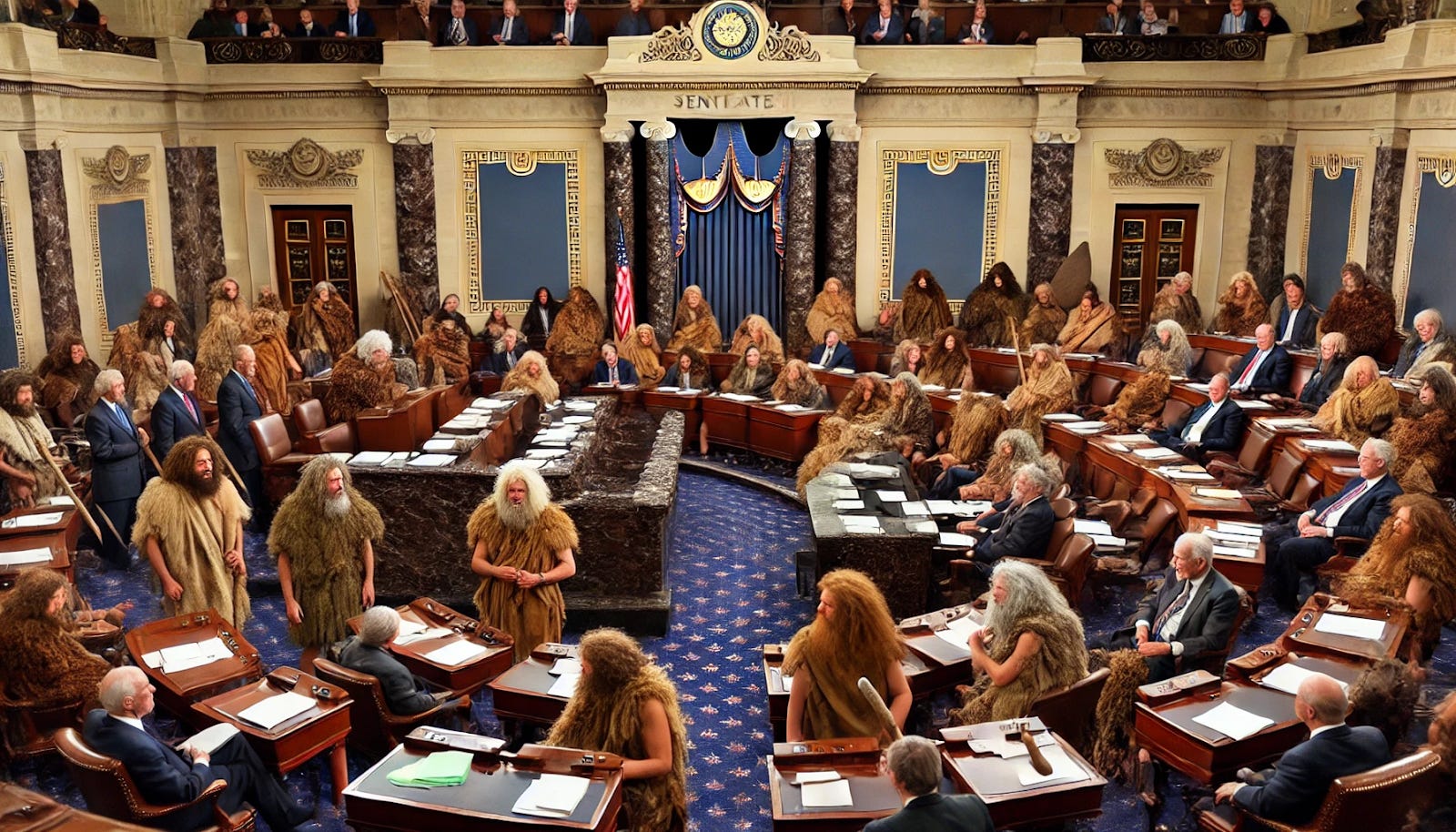
Only a few months ago, I found myself back in my Greater Appalachian home tribe in Evansville, Indiana, after spending time with my best friends I’ve had since I was 12 years old. This group is eclectic and platforms widely diverging ideas. After this event, I was at the dinner table with one of my oldest friends' family. We prayed before we ate and discussed life and world events. My friend’s mom, one of the kindest and most heartwarming people I know, has personally helped my mother through difficult times. She expressed her views on how Biden is destroying the fabric of freedom in our culture and the economy through inflation, believing that Trump will correct it. You can imagine a similar dinner table, perhaps in California or New York, but insert Biden from Trump and you would see and hear the inverse perspective.
For both sides, the thought of the other side gaining ground sounds akin to ushering in an existential threat to humanity. What helped me understand these thought processes was thinking of the four-quadrant model of politics otherwise known as The Political Compass. But before that can help us disentangle the current political moment, we have to address the problem of false polarization.
Our current political climate is marked by increasing hostility and division. Americans’ hostility toward political opponents has intensified beyond what is explained by actual ideological differences. This phenomenon, known as false polarization, occurs when partisans overestimate the prevalence of extreme views held by their opponents. Both liberals and conservatives report high agreement with their party’s moderate issues but low agreement with extreme issues. However, they consistently overestimate their opponents’ agreement with extreme issues.
For example, leftists might believe that most conservatives hold racist views, while conservatives might think that most leftists want to eliminate free speech. In other words, false polarization is when people believe their political opponents have more extreme ideas than they really do — and each side is misdiagnosing the other!
These exaggerated perceptions lead to increased dislike and avoidance of political opponents, further entrenching divisions and preventing constructive dialogue.
Moreover, political polarization has intensified, with people actively despising those with opposing views. Studies, such as those by Victoria Parker and colleagues1 reveal that this animosity is often based on overestimations of the prevalence of extreme views held by opponents. This false polarization fuels dislike and avoidance, preventing meaningful engagement and perpetuating misconceptions.
Is there any reason for hope? A core root of misunderstanding and conflict is not being able to recognize the moral intuitions that guide most, if not all, human moral reasoning. Recognizing the evolutionary roots of our political instincts and addressing false polarization can help us see the validity in different perspectives and reduce hostility. But first we must understand why these intuitions — on any political axis — exist in the first place.
The Political Compass is a graph with two axes that map political ideologies. The horizontal axis represents economic policy, ranging from left to right. On the left side of the axis, there is a preference for a cooperative collective agency to run the economy, advocating for communal support and resource sharing. On the right side of the axis, there is a preference for the economy to be driven by competing individuals and organizations, promoting free-market principles. The vertical axis measures social policy, spanning from authoritarian at the top to libertarian at the bottom. The top of the axis represents a belief in strict authority and obedience, emphasizing the need for order and control in society. Traditionally, social psychologists viewed authoritarianism as a characteristic exclusive to the right wing. However, recent studies2 indicate that it exists on the left as well. While the objectives differ, the fundamental psychological traits are identical. The bottom of the axis represents a belief in maximizing personal freedom and autonomy, advocating for minimal control by external forces.
This two-dimensional model allows for a more nuanced understanding of political ideologies beyond the traditional left-right spectrum, dividing individuals into four quadrants: authoritarian left, authoritarian right, libertarian left, and libertarian right.
Now inspect the graph below and discover that each quadrant is rooted in our evolutionary history and is the product of moral intuitions honed over 1.8 million years of human evolution:
Left (Paleolithic Central-place provisioning): Evolved for central place provisioning and sharing resources.
Right (Paleolithic anti-freeloader): Evolved to prevent freeloading and ensure contribution.
Libertarian Bottom (Paleo autonomy): Evolved for autonomy and freedom from control.
Authoritarian Top (Agrarian super tribes): Evolved for large-scale cooperation and defense.

Thus, we can see how liberals express their moral intuition to share resources, while conservatives express their moral intuition to resist freeloaders that could endanger society. Those with authoritarian tendencies do so out of fear of outgroups destroying their society, and those with libertarian tendencies express a moral intuition to respect personal autonomy and freedom. One hypothesis could be that good governance would balance these competing instincts, keeping away from extremes and optimizing in the center.
In the graph above, the people at the dinner table in Evansville perceive the red dot as the current state of play. They believe Trump brings the red dot closer to the adaptive center of the quadrants. Whether they are right or not is less important than understanding how their response is rational and a product of moral evolution.
This framework helps us understand that everyone navigates these quadrants—shaped by their life history, genetics, personality traits, and tribal affiliations—in ways that make their position feel moral.
And, in a very real sense, it is moral, as these complex moral intuitions were honed by a tumultuous 500-million-year evolutionary process. Recognizing the evolutionary basis of these perspectives helps us see the shared humanity along these spectrums. Ultimately, understanding our evolutionary instincts allows us to bridge divides and appreciate the common roots of our diverse political views.
Thanks for reading The Tribe Drive ! This post is public so feel free to share it.
Parker, Victoria A., et al. "The ties that blind: Misperceptions of the opponent fringe and the miscalibration of political contempt." (2021).
Costello, Thomas H., et al. "Clarifying the structure and nature of left-wing authoritarianism." Journal of personality and social psychology 122.1 (2022): 135.
No posts
Comments
Nothing yet. Say the first thing.
Sign in to join the conversation.