

Note: As I am taking my first real vacation since launching the more intense paid version of my Substack, this week I’m opening the archives and sharing three pieces that remain especially important to me. One benefit of being a paid subscriber is full access to this archive.
This essay was posted on November 30, 2024. It was my first attempt to grapple in print with the election results.
I have been mainly silent since the election, trying to do regular life while processing what happened and what it means – for the US, for the church, for me personally.
Somehow my silence has been met by more and more Substack subscribers. I thank you for continuing to have an interest in my reflections. It has buoyed me up at a time when I needed it.
During this period, I made the decision to shut down my social media other than Substack. Basically, I decided that I do not trust the uses that could be made of my social media presence. Probably none of us ever should have trusted big tech with our personal data, self-expression, and attention. But in a new context, this concern rises to the level of a certainty for me – no more social media.
My processing of the election has not yielded all that much that I think worth sharing so far. However, one thing that seems clear to me is that we would not be where we are politically if we were not where we are culturally.
And we would not be where we are culturally if the US churches, on the whole, had not been so ineffective in communicating and training up Christians in the moral demands of Jesus on those who claim to be his followers. American Christianity, especially white American Christianity, has surely failed.
* * *
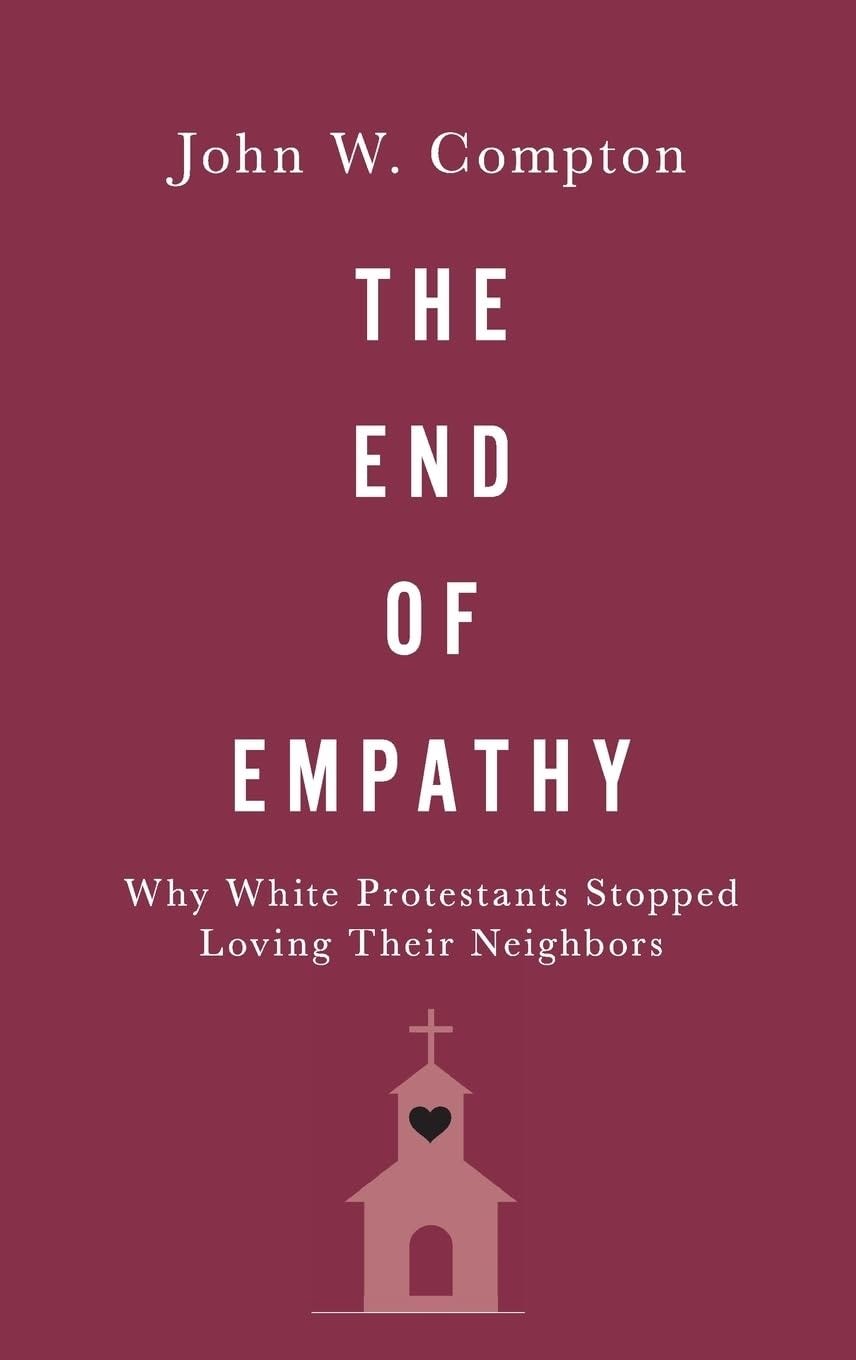
This hunch gained powerful reinforcement in November as I read through a brilliant, dense, compelling, yet somehow largely overlooked 2020 book by political scientist John Compton. The book is called The End of Empathy: Why White Protestants Stopped Loving Their Neighbors. This is not a screed. It is a chart-filled, data-driven study of predominantly white mainline and then evangelical Christianity in the period running from the early 20th century Progressive Era to the 1980s, with a coda speaking to our moment.
Everyone who seeks to understand where we have ended up must read this book.
Compton is mainly interested in the long-forgotten history of a robust mainline Protestantism in America, and its largely salutary effects in addressing key issues of social injustice. He shows how the crucial reforms of the Progressive Era were driven by a Protestant conscience deeply affected by the Social Gospel movement and other Christian-driven reformist impulses — with an organizational headquarters in the Federal Council of Churches, later renamed the National Council of Churches, eventually based in a massive HQ building on Riverside Drive in New York.
He moves the narrative forward historically to show how FDR’s Depression-era legislative push for social security, banking reforms, labor/union rights, unemployment insurance, and other crucial, far-reaching legislative changes was strongly and successfully supported by mainline Protestant leaders and members in the teeth of corporate and other forces of resistance.
In the 1950s, against the pressure of an even more organized corporate and religious right armed with money and the big stick of anti-Communist hysteria, the mainline establishment still held firm on an ethic of stewardship and the common good, resisting libertarian assaults both on this ethic and on the policy structures established during the New Deal. Their efforts help to explain why the social safety net was not shredded during this more conservative period.
The mainline’s “last hurrah,” according to Compton, was in its highly organized, grassroots and grasstops organizing to support and partner with the Civil Rights movement to help pass the Civil Rights Act of 1964, an organizing effort which the author describes in impressive, granular detail. Against considerable, entrenched opposition, much of it straightforwardly driven by racism, the forces of reform triumphed, overcoming a long filibuster in the Senate in a bipartisan vote.
But it was indeed the mainline’s last hurrah. Compton shows how mainline Protestantism’s numerical strength was already beginning to decline in the late 1950s and early 1960s. Declining numbers meant declining money available not just for congregations but also for ancillary activities such as the National Council of Churches, including especially their lobbying offices – which shrank inexorably at the national and the local level. The numerical decline was felt most strongly among young adults, who drifted away earlier than others and left mainline churches with an older – and somewhat more politically conservative – profile.
It was in this context that the late 1960s efforts of the NCC, clergy, activists, and so on to press for continued economic and racial justice reforms foundered so badly. It was a combination of fewer members, weaker organizational infrastructure, and a somewhat more conservative/older membership base, together with some radicalization on the activist side that did not sit well with most of this audience.
Of course, the approaching hoofbeats of modern American evangelicalism need to enter the story at some point, and Compton mainly tells that story beginning in the mid-1950s with Billy Graham, and then with surprisingly intense attention to the magazine he helped to found – Christianity Today.
This is a more familiar story, but here is what surprised me about Compton’s account: he sees the massive growth in the evangelical churches as essentially a response to market demand on the part of politically conservative white Americans for a church product that would support rather than question libertarian economics and white racial retrenchment/backlash.
If they stayed in these mainline churches, conservative members felt freer to push back hard against their clergy members when they spoke of such matters. Compton speaks of a decline of authority in the mainline, a weakening ability to affect the thinking and action of supposed members. This is a major theme in the book, actually — religious authority, the authority of a religious tradition and its leaders to challenge its members to obey its most demanding teachings — and to see their implications in the public square.
Meanwhile, white churchgoers who really, really, really did not want their ministers advocating for open housing, affirmative action, busing for school integration, progressive taxation, and an end to the Vietnam War, could go down the street to an evangelical church whose pastor would NOT make such demands.
Compton’s overall historical hypothesis is that the heyday of mainline Protestantism marked the high point of political progressivism in America, and this was no accident. For decades, a certain kind of love-your-neighbor ethic (imagine that!) was not only taught in multitudes of churches, it was also organized in effective ways at local, state, and national levels. Compton reminds us that it is not just ideas that matter, not just sermons and speeches and books, but also organizational muscle skillfully directed to specific ends, such as the 1964 Civil Rights Act.
In a kind of Niebuhrian-realist vein, Compton argues that most people in a democracy can be counted on to simply vote their self-interest, their biases, and so on. Essentially, people’s votes are predictable based on factors that political scientists have long been able to identify, like employment, social class, income, education level, neighborhood, race, etc.
The miracle, one might say, of white mainline Protestantism at its zenith was that it actually helped a significant number (never all, but many) of middle- and upper-class Christian white people vote in a way that had some altruism to it, that was not purely reflective of their self-interest, narrowly understood.
But when the mainline declined, when its numbers ebbed and its leaders lost what Compton describes as their “prophetic” authority, white Christians generally defaulted to voting based on all the predictable factors. Religion, he says, once again became “epiphenomenal” to white people’s voting behavior.
And there was white evangelical Christianity, ready, willing, and able to scoop up white folks who did not want anyone to challenge them on such matters as racial justice and economic fairness, not to mention gender, the environment, climate change, war…The “prophetic torch” was not successfully passed, Compton says. (Often these pastors were simply silent about “politics” and stuck to “preaching the Gospel.” Of course, it got worse than that, when right-wing religious leaders actively taught a completely opposite moral vision.)
Compton does describe the efforts of some white evangelical leaders from the 1970s forward to advance a nonpartisan, “biblical” evangelical social conscience -- beginning with a (sympathetic, if tragic-figure) treatment of Carl F.H. Henry, extending to familiar evangelical left names like Ron Sider and Jim Wallis, and then to notable politicians such as Jimmy Carter, John Anderson, and Mark Hatfield (if these names are not familiar to some of you young whippersnappers, please look them up). But in the end, these leaders either were marginalized, repudiated, or actively destroyed by the religious and political right.
That story takes us into the vicinity of lots of recent good work on what went wrong with evangelicalism, much of it produced by disillusioned post-evangelical scholars. It also somewhat describes my own story as a person who came into evangelicalism in the early 1990s and thought I had a secure place as a center-left evangelical ethicist. Oh well.
(My story is told in memoir form in Still Christian (2017), and as an analysis with proposals for post-evangelicalism in After Evangelicalism (2020).
So here is how I see a few of the implications of this book for where we are right now.
· Christianity that had a decent social conscience and the numbers and muscle to match once did good things in this country, even among morally challenged white Christians.
· It is very difficult to overcome self-interest, bias, and base instincts, especially when demagogues whip these up. You need juice, power, some transcendent vision for resistance. Christianity has sometimes helped with that. We need more of that kind of Christianity. Religion is not always a problem. Sometimes it is the best resource for doing right and doing good.
· Post-WWII white evangelical Christianity in the US was born in part to bypass/protest/provide an alternative to the social demands of the white mainline clergy and activists and denominations -- and of course to the demands of the Black-led, church-based, civil rights movement, once it started surging in the mid-1950s.
· Though a “prophetic” evangelical social conscience once could be found in the US around issues like race, peace, ecology, and economic fairness, articulated by a handful of visible leaders, it was actively opposed by right-wing religio-economic-political actors, did not find wide support in the predominantly white pews, and by now has been almost totally crushed.
· We do not get the election results of 2024, with the polling numbers we see among white Christians, without this history.
· I hasten to add that the prophetic, justice-committed tradition has been alive and well in large numbers of Black Christian churches, organizations, and figures for centuries. Compton is not telling that story in this book, but it must be said here. The moral weakness of white Christianity -- and ultimately the collapse of the moral witness and practice of the white churches in the US -- was always described and protested by prophetic Black Christianity.
Studying this book leads to a measure of despair – for how does one reverse massive social trends such as this? Where are the signs of any kind of renewal of Christianity in the US, let alone one that has this kind of prophetic witness and organizational muscle?
This story reminds me that a fixation on the politics of the moment risks missing long-term cultural and religious trends that shape our politics.
And it reinforces my sense that my primary contribution in the remaining few years of my career must be in direct local church ministry, in training leaders for a future church with moral integrity, and in providing a few more academic resources that can perhaps be of help to the next generation.
No posts
Comments
Nothing yet. Say the first thing.
Sign in to join the conversation.