
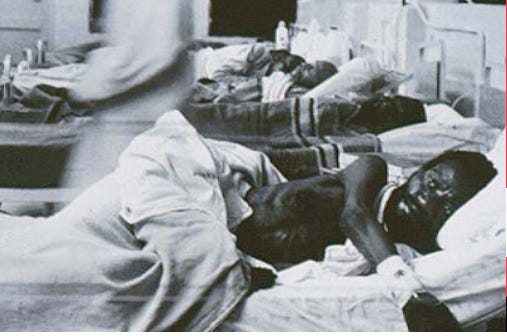
In January 2003, I was a visiting doctor on the internal medicine service at a hospital in Cape Town when the emergency department called us about a 25-year-old man struggling to breathe.
His oxygen levels were dangerously low. His chest X-ray was nearly opaque — healthy black lung fields replaced by diffuse white infiltrates. Thick fungal plaques coated his mouth. His clothes hung loosely from his frame. He had advanced HIV and was dying from end-stage AIDS complications.
We admitted him, but everyone on the team knew the reality: he would be dead within days.
The tragedy was that, by 2003, this kind of death was becoming rare in the developed world. Highly active antiretroviral therapy had transformed HIV from a near-certain death sentence into a manageable chronic disease. Patients who once would have died in their twenties could now expect to live normal lifespans.
But my patient did not have access to those drugs.
Part of the explanation was economic. South Africa was a middle-income country facing an enormous HIV burden. Yet economics alone could not explain what was happening. Just 800 miles north, neighboring Botswana — a smaller and poorer country — had already begun rolling out antiretroviral therapy on a national scale.
The difference was political.
South African President Thabo Mbeki had embraced the fringe belief that HIV was not the true cause of AIDS. He argued instead that poverty and malnutrition were primarily responsible for the epidemic. Influenced by AIDS denialists, his government blocked the distribution of lifesaving antiretroviral medications while promoting “African solutions” like garlic, beetroot, and nutritional remedies in place of real treatment.
The consequences were catastrophic. Researchers later estimated that the government’s refusal to provide antiretroviral therapy contributed to more than 300,000 preventable deaths.
Including my patient.
At the time, I would never have imagined someone with similarly conspiratorial views about medicine rising to major political power in the United States. Yet today, with Robert F. Kennedy Jr. leading the Department of Health and Human Services, here we are.
Kennedy’s history is well known: promoting anti-vaccine misinformation, amplifying debunked claims about autism, and embracing an endless stream of medical fringe theories that collapse under scientific scrutiny.
Will his tenure prove as deadly as Mbeki’s? Hopefully not. The United States has stronger institutional safeguards, a decentralized healthcare system, independent universities, and a far more robust scientific establishment.
But South Africa offers an uncomfortable lesson: when political leaders convince themselves that scientific consensus is a conspiracy, the body count can become enormous.
I do not remember the young man’s name. In a crowded public hospital overwhelmed by AIDS, there were too many patients and too many deaths. But I can remember his face, his labored breathing, and the certainty that he did not have to die.
.
No posts
Comments
Nothing yet. Say the first thing.
Sign in to join the conversation.