
“I’m concerned that students not become passive acceptors of the official doctrine that’s handed down to them from the White House, the media, textbooks, teachers and preachers.”
—Howard Zinn
We are in a Marriott in Cape Town, and it is our fifth location in three months.
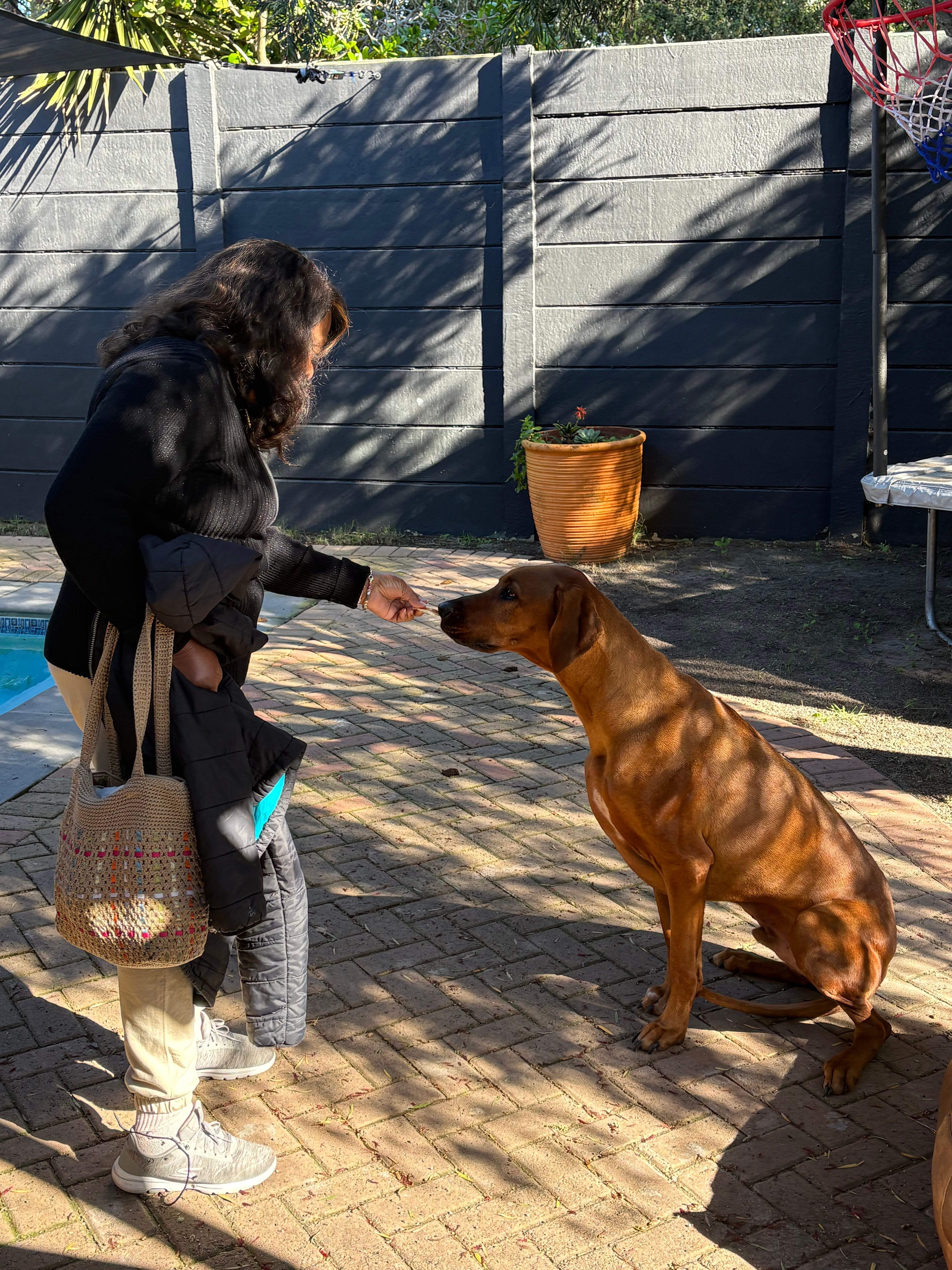
We have also stayed in a couple of apartments, and the Schallert family invited us to house-sit while that beautiful family visited relatives in the United States. We took care of Renegade, their Ridgie—I still stumble over “Rhodesian Ridgeback”—and two cats, all of whom reflect the lovingness of the household.
My laptop is atop my lap because this room has no desk. During our other stops, I sat mostly at dining tables. I look forward to writing from my hillside home office when we move into our house in September.
But I hope you don’t mind the play-by-play, because all of this is the story.
What stands out most so far?
I’m glad you asked.
It is the way Diane is living every moment of this. It is almost as though we are in our twenties again, with all this day-to-day, living-from-our-suitcases stuff.
She has been unbelievably sanguine.
Cheerful.
Escrow closed on our house in California on April 10. Because we had already emptied the place, we stayed in a Santa Barbara hotel on April 9. Before moving on to spend a week at our kids’ house in North Hills, we spent a night in a hotel midway there.
Then we spent another hotel night halfway to our kids in San Diego, where we stayed for two weeks.
Keeping up?
This means that since April, we have lived in ten locations.
I don’t know how many couples in their seventies do this kind of thing, but I would like to meet you and compare notes.
As much as I try to write lightheartedly, never far from my heart are what the Northern Irish might call the world’s troubles.
I am inspired by the hopefulness and strength of podcast voices like Briahna Joy Gray, Amanda Seales, Sabrina Salvati, Krystal Ball and, as always, Marc Lamont Hill.
All have faced ostracism—and, in several cases, have been fired—for speaking out against Israel’s atrocities. They cover other ground as well, and most recognize how much anti-Black politics provide cover for Zionism.
Anti-Blackness in the United States is one thing. But living on the continent of Africa—boy, oh boy—has given me a closer look at how much sway Israel holds over these countries.
I just don’t know what to say.
I lived much of my adult life as a supporter of Israel. By the time my children were in high school, light began to break through.
Even though I had not yet read the leading anti-Zionist thinkers, I began questioning my own support for Israel. I was troubled by the obdurateness and silence of many segments of the Christian communities to which I belonged whenever the subject was white supremacy—or what historian and digital content creator Ashley the Baroness calls “white narcissism.”
I watched white Christians avoid even using the word white.
I watched Black churches adopt white evangelical eschatology concerning “the Rapture” and God’s supposed favoring of Israel—at least until the Battle of Armageddon, when all Jews must become Christians.
That caused me to pull back and begin asking questions.
Only later would I read what June Jordan, Muhammad Ali, James Baldwin and Audre Lorde had to say.
African American thought leaders were not a factor in my change of mind. My withdrawal from Israel-centric thought was based solely on my experience with white evangelical Christians and the engagement of Black churches with them.
I wish I had heard the moral voice of the Rev. Jeremiah Wright when I was young. He is one of the most brilliant preachers of our time.
Wright frequently reminds us that “Jesus was a Palestinian.”
He attracted a young Barack Obama—until he famously became a political liability. But by then, it was too late for Obama to make me unsee Wright.
I had no problem when Wright said:
“We bombed Hiroshima. We bombed Nagasaki. And we nuked far more than the thousands in New York and the Pentagon, and we never batted an eye.”
Nor did I have a problem when he said:
“The government gives them the drugs, builds bigger prisons, passes a three-strike law and then wants us to sing ‘God Bless America.’ No, no, no, not God Bless America. God damn America—that’s in the Bible—for killing innocent people. God damn America, for treating our citizens as less than human. God damn America, as long as she tries to act like she is God, and she is supreme.”
Anti-Blackness—whether leveled against the descendants of enslaved populations, like my own children, or against Somalis or Haitians—is also a diversionary hostility. It is used to turn people against one another while protecting the interests of those who are already wealthy.
I wrote about this at the beginning of July in Don’t Get Too Comfortable, They’re Coming for You Too.
Rev. Wright is an octogenarian, and he has not sold his soul, as many influential people do when they pay too much attention to who pays—or wants to pay—the bills.
The podcasters I listed above are all younger than Wright and younger than I am. And the honorable history-makers I mentioned were younger than we are now when they reached the height of their fame.
We really need to listen to and support these younger fighters, including radical politicians.
I hesitate to be specific because time will test each office-holder.
But Francesca Hong has impressed me.
Howard Zinn, author of A People’s History of the United States, famously said:
“I’m worried that students will take their obedient place in society and look to become successful cogs in the wheel—let the wheel spin them around as it wants without taking a look at what they’re doing.
“I’m concerned that students not become passive acceptors of the official doctrine that’s handed down to them from the White House, the media, textbooks, teachers and preachers.”
In some ways, Diane and I are living as though we are in our twenties, but we are not.
And we are still concerned about becoming “passive acceptors of the official doctrine.”
Comments
Nothing yet. Say the first thing.
Sign in to join the conversation.