
Let’s be real: Google still owns search. Sure, they’re being nibbled at by OpenAI, Perplexity and friends and maybe they will eat away Google’s dominance bite by bite, but all those players are all still building search for humans.
In AI land though, search for humans is old news. The web is undergoing a structural shift: traffic patterns are changing as agents, not humans, increasingly become the primary consumers of online content.
Now there’s a whole new wave of companies building search engines for AI agents.
Lets dive in.
LLMs are cool, but they suck at one critical thing: getting clean, structured info from the web.
The problem is obvious once you look at it:
Current search APIs (think Google, Bing, DuckDuckGo) were designed for humans. You query → you get 10 blue links + snippets. Great for humans. Useless for an AI trying to synthesize reliable context. Snippets are partial, lack structure, and just beg your LLM to hallucinate.
AI Headless browsers (aka next-gen RPA scraping) are even worse. Slow, fragile, blocked easily, and sometimes your “AI agent” ends up rage-clicking cookie banners instead of getting answers.
LLM search companies like OpenAI and Perplexity are basically duct-taping around this problem: they plug into Bing’s or Google’s APIs, grab snippets, and then try to reassemble them into coherent answers on the fly. It works for lightweight consumer Q&A, but it’s still built on the same human-first, thin fragments of info that weren’t meant to be stitched together by machines. The result? Answers that are often incomplete, laggy, or straight-up wrong when the query requires depth, coverage, or freshness.
AI developers know the data for their agents is out there, but there is currently no reliable way to access it at scale in the right format, at high speed and with the right depth.
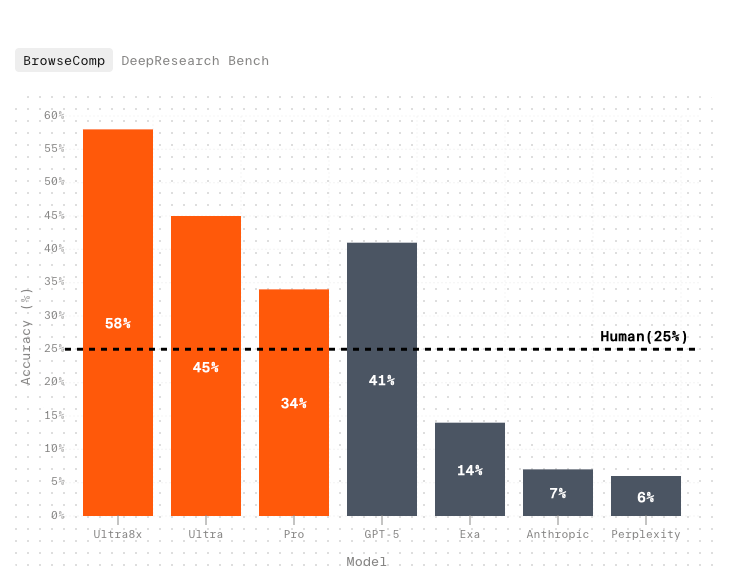
BrowseComp is an OpenAI-created test with 1,266 multi-hop reasoning questions. As an AI system you need to combine time-sensitive facts, contextual clues, and web search to score well.
Across GPT-5, Anthropic, Perplexity and others the results show: even SOTA players struggle, a lot. Speed, accuracy, depth, it’s all mid.
Here is another benchmark, this time from exa.ai that does not include results from parallel.ai, obviously.
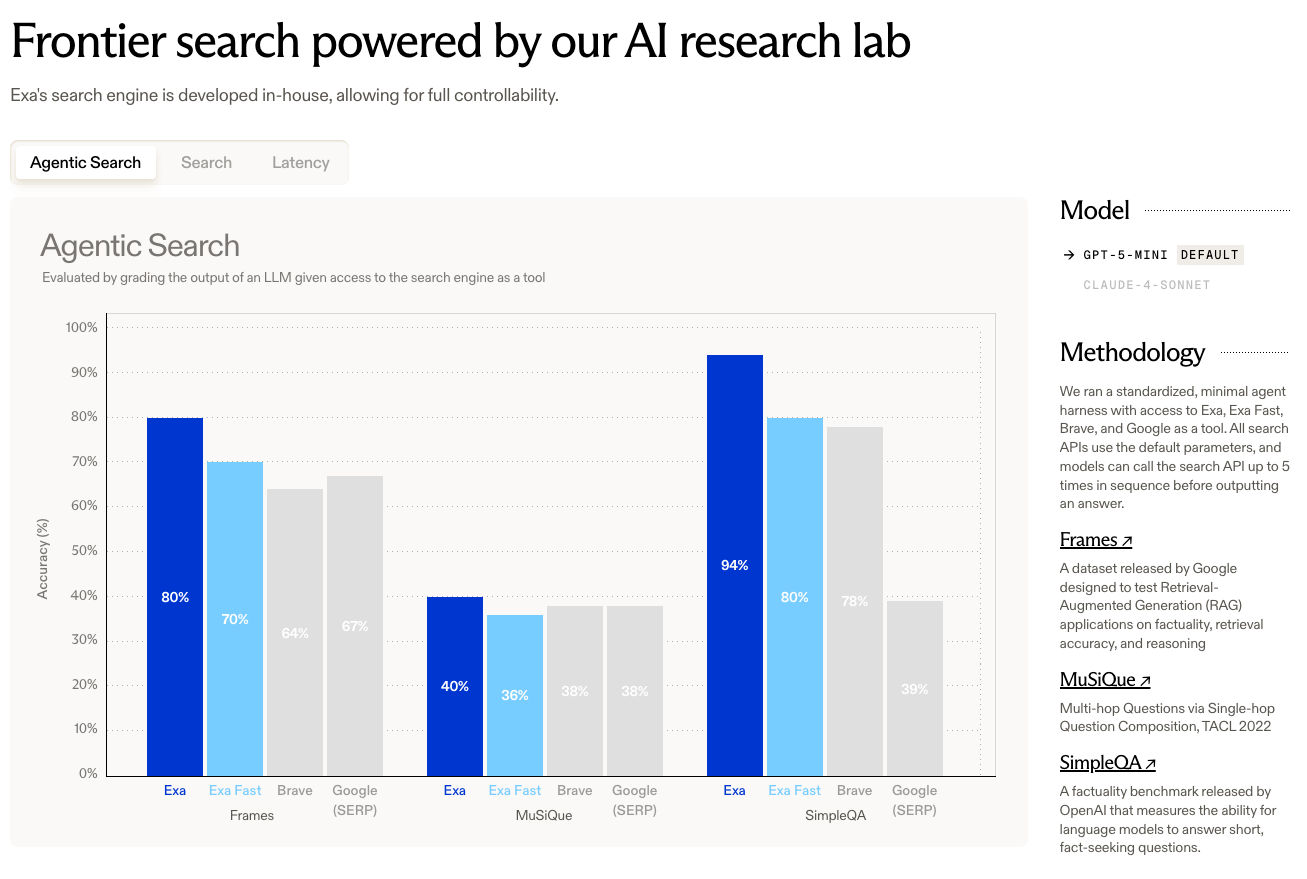
This is the bottleneck holding back the so-called “agentic economy.” Agents are supposed to do serious work: research, coding, analysis, decision-making, but without access to clean, structured, comprehensive web data, they’re flying blind.
A fresh crew of companies is reimagining search as infrastructure for machines, not humans. Think of it as turning the web into a structured knowledge layer AI agents can query at speed, with the right context delivered in the right format.
Here’s the lineup (funding included, because that’s half the fun):
So what do these things actually feel like? Most of them aren’t “search engines” in the classic Google sense. You don’t sit there typing keywords into a box, although you can use them as a consumer too. In the agentic world, they show up as APIs or SDKs that your AI agent can use when it needs context from the web. You send a query, and instead of getting ten blue links or a packaged bundle of web content and hallucinated LLM noise, you get a neat little bundle: structured snippets, cleaned-up context, sometimes even JSON-formatted answers with metadata.
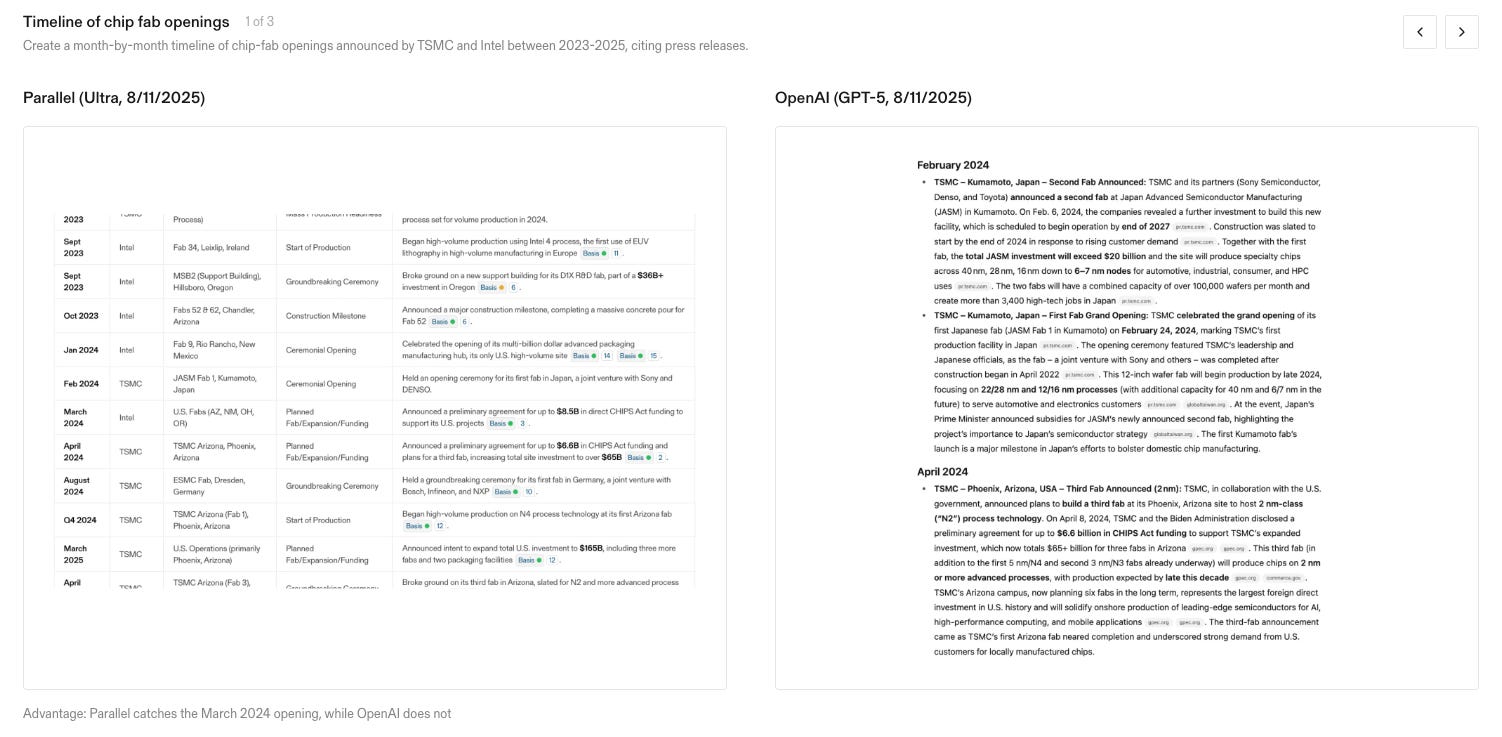
This is an example of how the output from parallel.ai differs from OpenAI (incl. more complete data):
For more advanced systems, the ideal output could be described as “context blocks”: persistent, structured knowledge units containing core facts, supporting content, source provenance (URLs, timestamps, citations), media like tables or plots, and confidence scores. LLMs can query these directly, drastically reducing hallucinations and giving multi-task reasoning agents the reliable context they need to actually get work done.
Key product north stars for most players include:
result accuracy
retrieval speed
agentic task completion effectiveness (likely an input combination of accuracy and depth of context)
Vertical AI search engines? Yeah, there’s room. Think healthcare, legal, finance, domains where deep context quality really matters and companies might choose with a best-of-breed mindset. I believe human search is inherently horizontal, agentic search does not have to be.
Mix internal + external data?: The next generation of AI-native search isn’t just about crawling the web. By combining a company’s internal data—like documents, CRM info, or proprietary research with external web data, you can create holistic knowledge objects that give agents a complete picture. This is what allows multi-task reasoning agents to answer questions or take actions with full context, not just isolated web snippets.
Proprietary data monetization: if you can add proprietary third party data into your index you can drastically increase the value of your offering for vertical use cases. Those search platforms could even integrate licensed, high-value datasets (think Bloomberg) and offer data attribution + licensing based on agentic queries. This would create a new business model where data owners monetize their assets, and agents can tap into verified, specialized content without rebuilding it themselves, positioning those platforms as the “gatekeeper” for vertical knowledge. Wow, VC goosebumps.
Opinionated indexing matters: Not all knowledge is created equal. Opinionated, curated indexing where the system decides what’s most relevant and how to structure it can deliver better context nuggets for agents, this is where players in the market can compete on a product level.
Training AI retrieval models?: Some of these AI-native search engines are GPU-hungry and build custom retrieval models, others don’t. Which approach will win, I don’t know, maybe someone smarter than me can chime in here.
Early architecture shapes long-term moats: Like any complex software infrastructure, small technical design choices early on can lock in advantages or become painful limitations later. A thoughtful, opinionated approach can create a strong market position later. I truly believe this is a category where late followers with outrageous technical talent can win long-term with technology leadership that is based on nuanced differences in how the system is designed.
High-risk, high-reward: If this is a category, its big, probably really big. Its early days but the momentum feels real.
Is this a large lab snack? OpenAI and peers are capital concentrating distribution machines by now, there is an argument to be made that if this is in fact a category and the new players start to capture real value, it would make a lot of sense to buy them and bundle their APIs with the current model offerings. Thank god that by then those players probably have a 1 million trillion gazillion dollar private market valuation and can snack a decacorn easily.
Could Cloudflare and their AI crawling blocker become a big problem for those players and AI search in general?
Comments
Nothing yet. Say the first thing.
Sign in to join the conversation.