
Hello, beloved reader
It’s been a while since I sent out one of these emails, and it’s nice to be back! Towards the end of 2024, Create Define Release commissioned me to speak with six musicians about their working lives. Those interviews took place in late 2024 and early 2025, and I’m glad to be finally sharing their words with you.
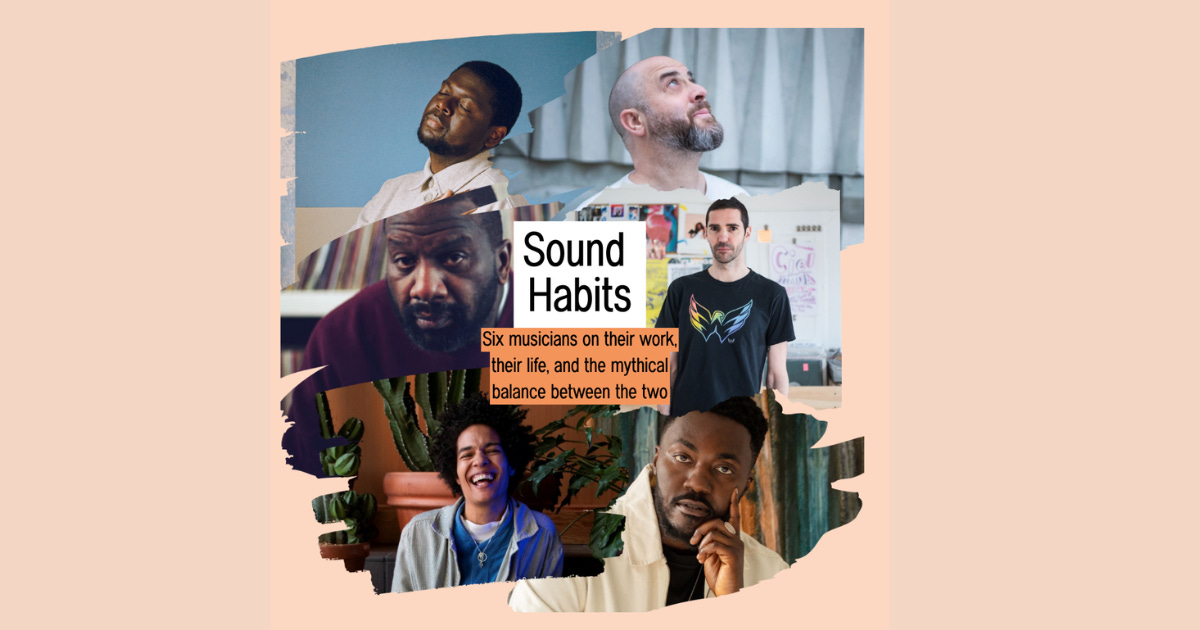
Hobbies? No, not really, not really… I mean, I….
I’m speaking to Tony Nwachukwu, and I’ve just asked him if he considers himself to be a person who has hobbies. He furrows his brow and looks off into the corner of the Zoom screen.
Swimming? No…
Chess?
Knitting? No…
He is silent for a few seconds. I assume he’s running through a mental checklist of all other possible hobbies a person could have. Tony is one of six musicians I’ve asked to talk to me about their experiences of working life.
No! All my spare time is related to music, whether it’s listening to music or writing music. Music is me.
The way Tony describes his involvement in music sounds like a compulsion as much as anything else.
I was immersed in music. If it wasn’t working on remixes or writing, I’d be in the studio myself working on music, learning how to use my equipment, challenging myself technically, setting myself challenges–trying to sync up ten drum machines and a sampler, staying up late, till four or five in the morning, working on music because that’s the thing that drove me.
It started with curiosity, buying records at an early age and trying to understand– ‘I keep on hearing these drum machines or instruments consistently in the music. What do they do? How do they work?’
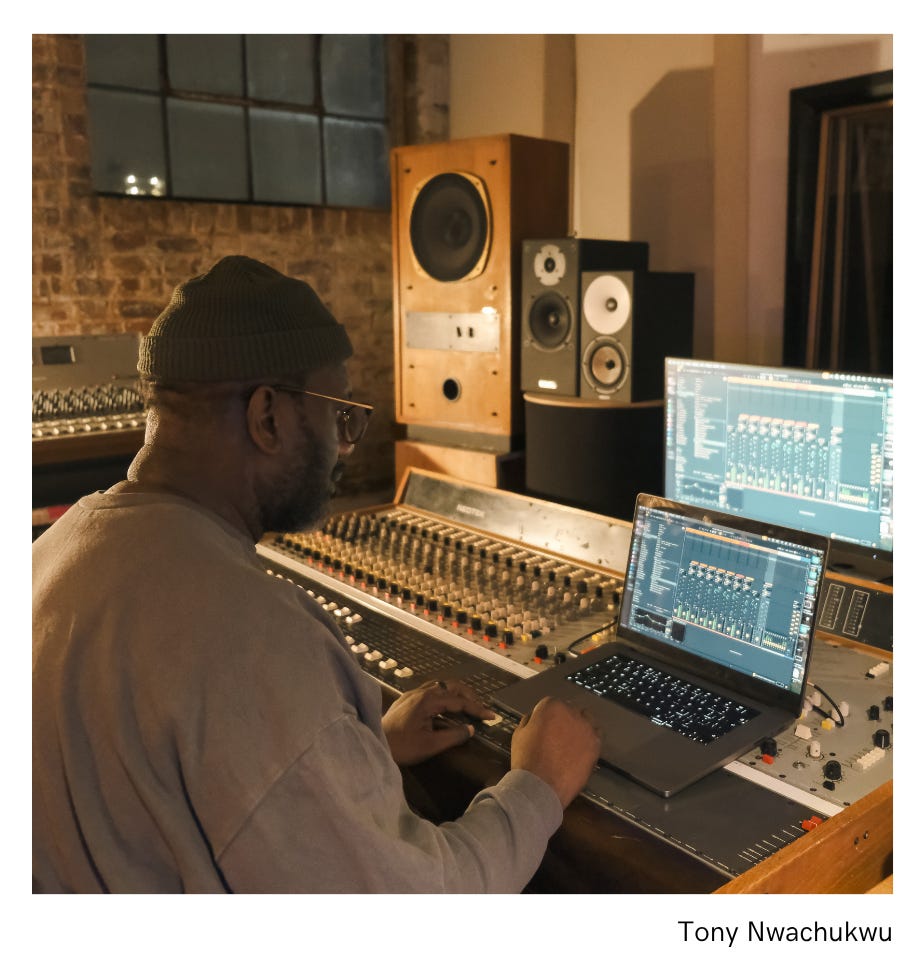
These are in fact the same questions I wanted to find answers to about musicians.
What do they do?
How do they work?
What Tony has described here–an activity done for enjoyment in his free time–would fit the definition of a hobby for a lot of people. But for many professional musicians, the lines between work, life, and free time are very blurry. ‘Do what you love, and you’ll never work a day in your life’ has become a cliché in the creative industries, but the equally possible dark side of this is ‘make what you love into your job, and turn every day of your life into work, with the only clear distinction between your passions and your job being that some of it pays.’
I doubt there are many musicians who are in the job because it makes financial sense. On the other hand, most musicians I know talk about paid work as a way to fund their music habit. And if that paid work comes from making music, or doing something related to music, all the better. In the first UK Musicians’ Census conducted in 2023, Help Musicians and the Musicians’ Union found that a ‘portfolio career’ is very much the norm for musicians–the average professional musician has three to four different paid roles in the music industry. Tony is one such portfolio musician, known to many for his work in trip-hop band Attica Blues, which he co-founded with producer D’Afro in 1994. He now works across multiple roles in music.
I teach across all generations, whether it’s young people, you know, for arts organisations, whether it’s as a consultant for music companies, whether it’s writing library music, I’ve used my skills across a wide spectrum of the industry.
Trying to manage the mental juggling act of switching between jobs so regularly can be a challenge in itself, not just for the energy required to switch contexts, but for the difficulty of explaining exactly what your job actually is. I have seen the question ‘so, what do you do?’, a classic, very normal first date/reunion with a distant relative/in the kitchen at a party icebreaker question, give musicians an instant identity crisis, as they try to describe their work in a way that feels like it communicates what it needs to in that situation. Tony described the struggle to balance jobs, without always knowing where the next one will come from, as ‘like the Wild West’:
This whole idea of a portfolio career–I didn’t even know what it meant until recently. I think most of us, when you’re freelance, part of your career is opportunity. That phone call you get or that email you get, “Hey, we’re doing this project, do you want to blah blah blah…?” And if the diaries work, then you’re in. And then one job leads to another, and before you know it, you’re working in music education, you know, or mentoring people, or writing music for a theatre piece.
Tony’s start in music came while studying for a computer science degree, and finding a way to make music in or around his studies.
Back then, there weren’t any music production or music technology degrees, at least not much outside of places like Kingston University. So, I ended up doing software programming, and shoehorned music projects into systems thinking, and for my final year project, I made a sequencer. It didn’t work, but it showed my enthusiasm for music. I even made a little DAW. I DJed loads, did club nights, and really got into music there. I bought a synthesiser and a drum machine—a Korg K1 Mark II—and had a computer for making music in my spare time.
When I graduated, I worked in a music shop—Turnkey—in London’s West End, Tottenham Court Road, which was famous for electronic music stores. Because I was interested in computers, synths, and samplers, I became the go-to person. If you wanted to get into sample-based music or set up your Akai S1000 with your Creator C-Lab, you spoke to me. From there, I had a chance meeting with Michael Riley, who saw my enthusiasm and nerdiness and offered me a job as a programmer on his remix album for Bob Marley. I was Michael’s programmer for years, carrying around an Atari Stacy, an S1000, and an MPC. My job was anything related to digital sampling and programming.
Dutch producer-DJ Martyn, speaking to me over Zoom, describes a similarly obsessive relationship to music.
I never had hobbies. I had no time. Music was just life. Music is so embedded in me—it was never just a hobby. I was so obsessed with it that I couldn’t separate it from the rest of my being. When people at birthday parties would say, “Oh, so nice you made your hobby into a career”–I hated that! It was never a hobby. It’s just what I am, all my time is organised around this one thing.
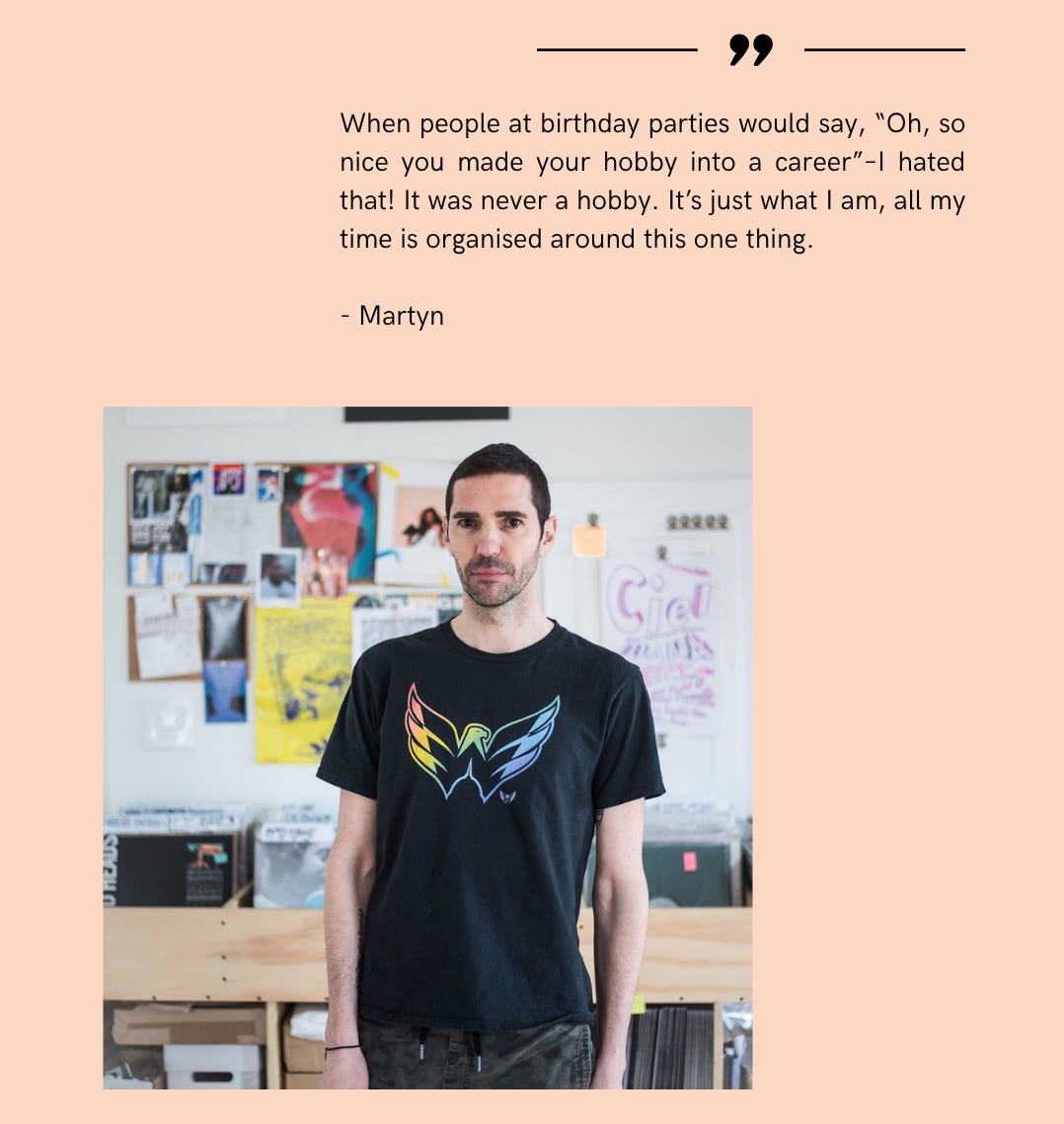
Martyn has had a diverse career in electronic music, releasing records with Ninja Tune, Hyperdub, Ostgut Ton, and on his own label 3024, founded in 2003. He also writes Four Things, a newsletter about music and creativity. Like Tony, his start in music came from his own enthusiasm, and wanting to share that with the people around him.
I think the way I got actively involved in music was as a promoter. This was a long time ago, around 1995. Drum and bass was the thing that sort of pulled me in, and I just wanted to sort of share that enthusiasm, I suppose, by throwing little nights. In the beginning, crowds were very small, just the bartenders, the security guy and three friends. Slowly but surely, that built up to a slightly larger audience. We had no clue how any of this worked. In order to have music on the nights, we started to play our own records that we bought. I learned to DJ in front of the audience immediately–I first touched a Technics turntable when there were already people watching.
I think the first ten years of my career, I was eating crackers with peanut butter and living a super sober lifestyle so all my money could go into buying records and organizing things. I worked at a computer store and did loads of customer service type stuff at different companies. You didn’t need a lot of money to live. When I started to get a couple hundred euros maybe per month from music, I went to a part-time shift job as a customer service person. After a while, the money started increasing, and I stopped the part-time job altogether.
Also in 2001, singer-songwriter Gillian Welch released the song ‘Everything Is Free’, in which she sings:
Everything is free now, that’s what they say
Everything I ever done, gonna give it away
Someone hit the big score, they figured it out
That we’re gonna do it anyway, even if it doesn’t pay
At the time, Welch was responding to the impact of Napster on the music industry–the beginnings of the period we are in now, in which, rather than buying music as a physical copy, anyone can access nearly any recorded song in history for free, on demand. At first, this was through piracy, and now, it’s through streaming platforms.
On top of this, the new and unusual influence of generative AI on music has evolved to risk human musicians being taken out of the picture completely, a significant step down from being paid. Mike Shulman, the CEO of Suno, the biggest AI music generation tool, said on venture capital podcast 20VC:
It’s not really enjoyable to make music now [...] It takes a lot of time, it takes a lot of practice, you need to get really good at an instrument or really good at a piece of production software. I think the majority of people don’t enjoy the majority of the time they spend making music.
Which for me, raises the question: why then are people doing it? As Adam Neely has discussed at length in his video essay on AI music, Shulman said Suno is aiming to offer “meaningful consumption experiences”. What about meaningful ways to express yourself? What about meaningful participation experiences? Thomas Turino, in his book Music As Social Life: The Politics Of Participation, divides music performance into two big categories: presentational, meaning music with a clear divide between the performer and the audience, and participatory, in which everyone in the room is involved somehow. Turino has two sub-categories for recorded music too–recordings of performances, and recordings constructed in the studio through techniques like overdubbing. Ethan Hein, writing about this book in 2014, suggested:
[…] the lack of participatory music in daily American life is a major obstacle to our well-being. Most humans in world history regard social music as a basic emotional vitamin, and our lack of it shows in our collective unhappiness, as clearly as malnutrition shows in stunted bone growth. Children have participatory music opportunities, at home, on the playground, at school, in church and at camp. But as an adult, you really have to make an effort to seek out music-making opportunities. One of the biggest pleasures of having a young kid is all the participatory music-making you do with them.
If Shulman thinks it’s not really enjoyable to make music, perhaps he should go to a baby sensory class. Take a second to picture Shulman shaking his head sadly, having a terrible time, not enjoying making music at all, while he sits in a circle of babies hitting and shaking things, or Shulman playing bass in a band, or Shulman singing in a choir, or around a campfire. One major issue I have with Shulman and Suno is them taking the human out of music consumption. AI-generated music encourages listeners to have a musical experience–historically a way for people to bond, share, and listen to expressions of each other’s experiences–with no human on the other end. But he’s also devaluing the many joys and rewards of the experience of making and taking part in music.
The problem of devaluing music-makers has, of course, been brewing since long before generative AI. Liz Pelly’s book Mood Machine documents how, after Napster ‘took piracy mainstream’, Spotify initially positioned itself as democratising music and levelling the playing field for artists. In reality, it led to an industry where music is increasingly seen as a commodity, musicians as “content creators” rather than artists, and careers are bound to be tangled up with precarity and hyper-commercialisation.
Now, typing ‘Everything Is Free’ into Spotify or YouTube will show you hours of covers of the song, performed by everyone from Phoebe Bridgers to Father John Misty to Courtney Barnett to Sylvan Esso, with performers being paid minimally per stream. Founder Daniel Ek stated in 2018 that Spotify was ‘doing the hard work of helping one million artists to be able to live off of their art’, but Mood Machine documents a world where this is far from the reality, citing U.S. Congresswoman Rashida Tlaib–she estimated that an artist would need over eight hundred thousand streams per month to earn the equivalent of a $15-per-hour job. The UK Musicians’ Census, in 2023, found that “nearly a quarter (23%) of musicians stated they do not earn enough to support themselves or their families and for nearly half (44%), a lack of sustainable income is a barrier to their music career. 17% of musicians also reported being in debt, rising to 30% amongst those with a mental health condition and 28% for Black/Black British musicians.”
While the options for musicians getting paid have changed drastically, average UK rent has more than doubled since 2000. 2001 is also the year Danny, aka Red Rack’em, began an eclectic career producing and DJing, starting his own label Bergerac in 2010 and releasing breakout track Wonky Bassline Disco Banger in 2016. After several years of using friends’ studios, in 2001 he began to produce in earnest, using equipment funded by a grant from the Prince’s Trust. At the time, he was living on unemployment benefits after losing a job as a video editor.
Not having a normal job gave me a huge amount of time on my own, which enabled me to learn how to produce at my own pace. There’s no shortcuts. Unless you’re a genius, you are gonna have to do things again and again to get better at them. You have to be kind of obsessive about your art and your practice.
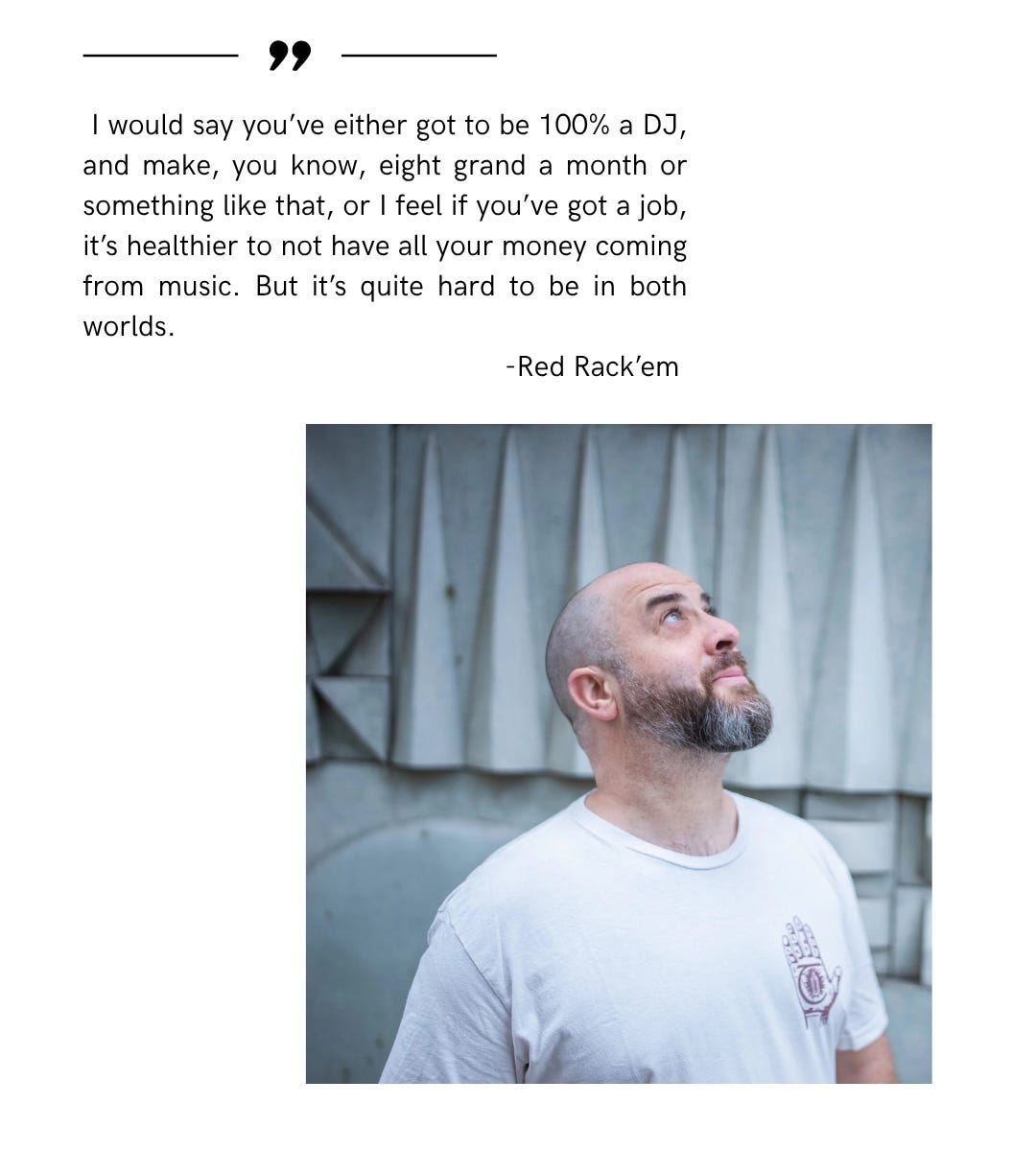
Danny describes a precarious, but lucrative, way of living–and not one he recommends to aspiring musicians.
Bar gigs–sometimes you’d have to play for four or five hours, but a lot of them were like three and a half hours for a hundred quid. Nowadays a hundred quid’s nothing, but I probably needed 250 quid a week in those days to be all right. I didn’t have to work during the week. I was completely free. So that enabled me to spend, you know, six, seven, ten, twelve hours a day producing.
If people have a job, a ‘real’ job, I’m always like, ”Do not leave your job”. Because what I explain to them is that if you’ve got financial stability and money to invest in what you’re doing, you can buy decent equipment, you can pay for PR, you can pay your friend to do an artwork for you. I would say you’ve either got to be 100% a DJ, and make, you know, eight grand a month or something like that, or I feel if you’ve got a job, it’s healthier to not have all your money coming from music. But it’s quite hard to be in both worlds.
Hagan is a musician who does exactly this–a clean split between a career in the world of music, and a career out of it. His DJing and production have roots in UK funky, his Ghanaian heritage, and Pan Africanism, and have expanded from music into visual arts and film-making. Alongside this, he works a 9-5 job, and generously allows me some of his lunch break time to talk to me about it.
I always wanted to make music. It was tough because in my mind, coming from an African home, being African myself, it was almost a taboo to talk about music as your main career. And this was something that I loved, so I was always trying to balance the thought of potentially having music as something I do as a career versus going into something more conventional. So those are the two things I was always fighting against. But to always keep the thought of music being my full-time job, I would do it on the side.
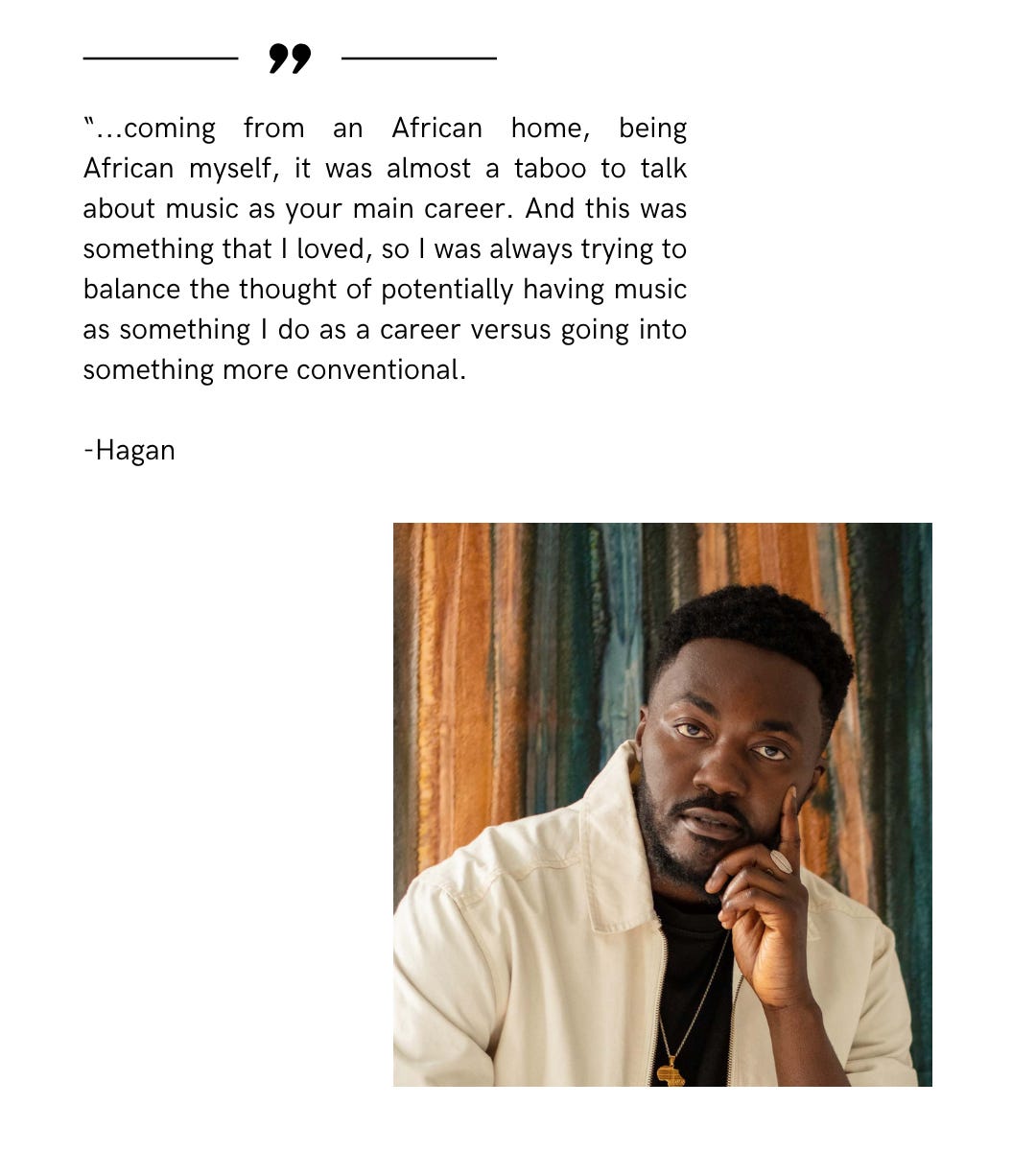
Hagan grew up DJing with his uncle and playing in his church band on the weekends, and first began to find success producing music while studying at university. After that, he began working for the finance department of a music agency. He then changed his daytime career to a job completely outside of music, which has supported his music career ever since.
That was giving me my salary, it was giving me my monthly wage. I haven’t had to make the decision to pick one, just ride with one, and go ahead with just one path yet. I’ve still been able to balance it in a way that I can still do both, and I’m grateful for that.
This way of working does come with challenges, particularly when it comes to coordinating with musicians that have less regular schedules.
There are times I may want to create during the week, or I may be working with another producer or artist that does music full time, and I may have to push back and ask, ‘Can we do it on a weekend or can we do it after five or after six?’ And that might not be the best time to be creative.
Hagan follows a regular routine–he comes home from work, and begins producing. He schedules gigs for Fridays and Saturdays so they don’t conflict with his day job, and takes full advantage of his spare hours. During his Easter and Christmas holiday periods, he prioritises making sure he has a backlog of tracks and demos so that he’s never caught short.
I try to create as much as possible in my free time so that when I’m not free, I’m not stressed with the situation that I have to make music on the fly, because I’ve got a backlog. I know that eventually there’ll be a period where I probably won’t have as much free time as before, so I’m trying to work towards mitigating any issues where I may not have the time to create.
Tony told me he too has ‘gigabytes, terabytes’ of unreleased music. Danny said his ‘tunnel vision’ has left him with ‘at least 150, 200 tracks that are not released’. When I speak to Richard Kankondo, he tells me he finds the idea of keeping music back just for himself brings him a sense of relief from the sometimes high-pressure experience of working in the music industry.
I’ll write songs–do the whole process, finish it–and be like, ‘this one’s mine. And no one’s getting this one. This one’s for me.’ Most of the music I make is just for me. I was a creative kid, so making has always been the way that I do things. And music became just like another way of making something. I started playing guitar and then immediately started writing songs. And so when I got introduced to drum & bass, I was like, okay, how do people perform this? And how do people share this? The most effective way of expressing myself was through creativity. I found it hard to speak about certain things, or process things that I’m going through in my life or my emotions, unless I turned them into music.
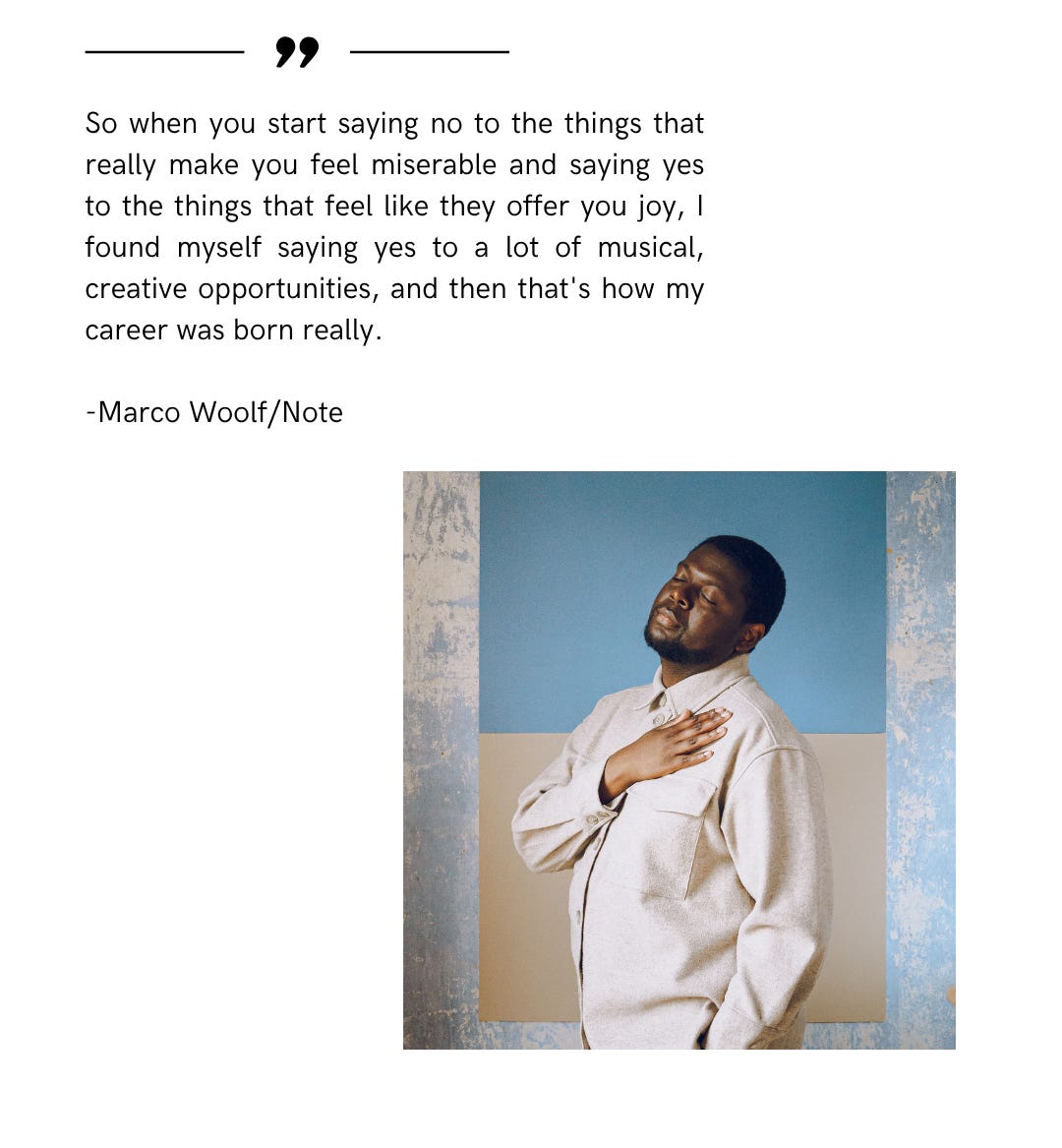
The more opportunities to make and do music, the more complicated my relationship with music gets, and the easier it is to forget what it is and why I do it. Now that I’ve tipped the income balance and my creativity is actually bringing in money and paying bills, that relationship is really exhausting. There’s a lot of expectation on what a career in music looks like, and it’s increasingly becoming more and more impossible to hit that version or that picture of what a career in music should look like.
As a singer-songwriter, Richard goes by the name Marco Woolf, creating performances incorporating music, dance, and improvised storytelling. As a drum and bass producer and DJ, he goes by the alias Note, gaining critical acclaim and support from BBC Radio 1, UKF, and Rinse FM. He also works as a project manager and music workshop facilitator for charities around Greater Manchester. For a long time, music was something Richard did understand as a hobby.
I never set out to be a musician. It’s just something that I kind of accidentally slipped into and have continued to do because it makes me happy. I think for ages I must have called it a hobby because I think that’s what other people were telling me it was, and especially coming from an African family where music is only really seen as a hobby. My options for careers were often very STEM-related as opposed to creative.
Tony had earlier told me that, as for Hagan and Richard, the idea of a career in music came with stigma from his family too.
My parents are Nigerian, and anyone brought up in a classic West African household—or not even just West African—knows there’s a lot of pressure to become a doctor, engineer, or lawyer. I knew early on that music was something I wanted to do, but figuring out how to do it in a way that gave my parents some reassurance—I didn’t figure that out at a young age.
I could see a role in the industry for me that would essentially please my parents, because my parents, old school parents, think of musicians as womanising drug fiends, you know? And this was a skill, in big studios. And in fact, years later, I took my mum to a studio that I was working at with Michael, then once she saw that it was like a profession, I got her seal of approval.
Richard originally began studying for an engineering degree, but found the experience made him miserable. After leaving university, he moved back home and took jobs in hospitality.
I think it was because I had such a bad time at uni, and I hit such a low. I was very careful about not doing anything that didn’t feel good, quite frankly. So when you start saying no to the things that really make you feel miserable and saying yes to the things that feel like they offer you joy, I found myself saying yes to a lot of musical, creative opportunities, and then that’s how my career was born really.
I was fortunate enough to have access to a super musical community like Manchester, where I could go to a jam night, meet somebody, and then chat about music, build friendships, and share music. It’s only been over the last couple of years where I’ve now actually been like, ‘Okay, what is it that I want to do now that I’m in this industry?’ And I’ve been seeking specific opportunities to build my career. But that’s quite a new mindset for me.
Alongside keeping music for himself, Richard also finds peace in his work as a music facilitator.
Facilitation is quite important for me, because if I have a really busy period where I’m doing loads of gigs, or just working on a lot of music, it’s really easy to forget why I’m doing any of it.
The job of a facilitator (which comes from the French word faciliter–to make easy) is to support other people to make music, often people who have never made music before, and may have never considered it. Like teaching a class, facilitating a music workshop is often structured as one person running a session around a particular topic, and a group of people there to take part. Unlike teaching, the role of the person in charge is more a case of helping and supporting people to find their own way, rather than delivering a specific lesson plan or set of learning outcomes.
I feel facilitation is a really practical way of helping people express and touch things they can’t quite touch for whatever reason. That might be a feeling, an emotion, or it might be dealing with something personal. If it’s confidence, if it’s self-esteem, if it’s just to be a better musician, all the things that you can do to help you grow as a human, that’s what facilitation does.
All of the musicians I spoke to benefitted from the ability of music to bring about the kind of growth, expression, and self-understanding that access to music and music-making can help to bring about. I meet Pops Roberts next to the radiator in a café in Manchester on a freezing November day. She’s just come straight from running a one-to-one online mentoring session.
Music was a massive escape for me and I adored it. My family were really into music. My great-grandfather was an opera singer. My family loved classical music and opera, which I loved learning about. I found out later there were musicians on the Caribbean side of my family as well. My mum got me to learn saxophone – it was very important to her that I learn an instrument. So we battled for quite a while, and I learned saxophone from the age of about nine.
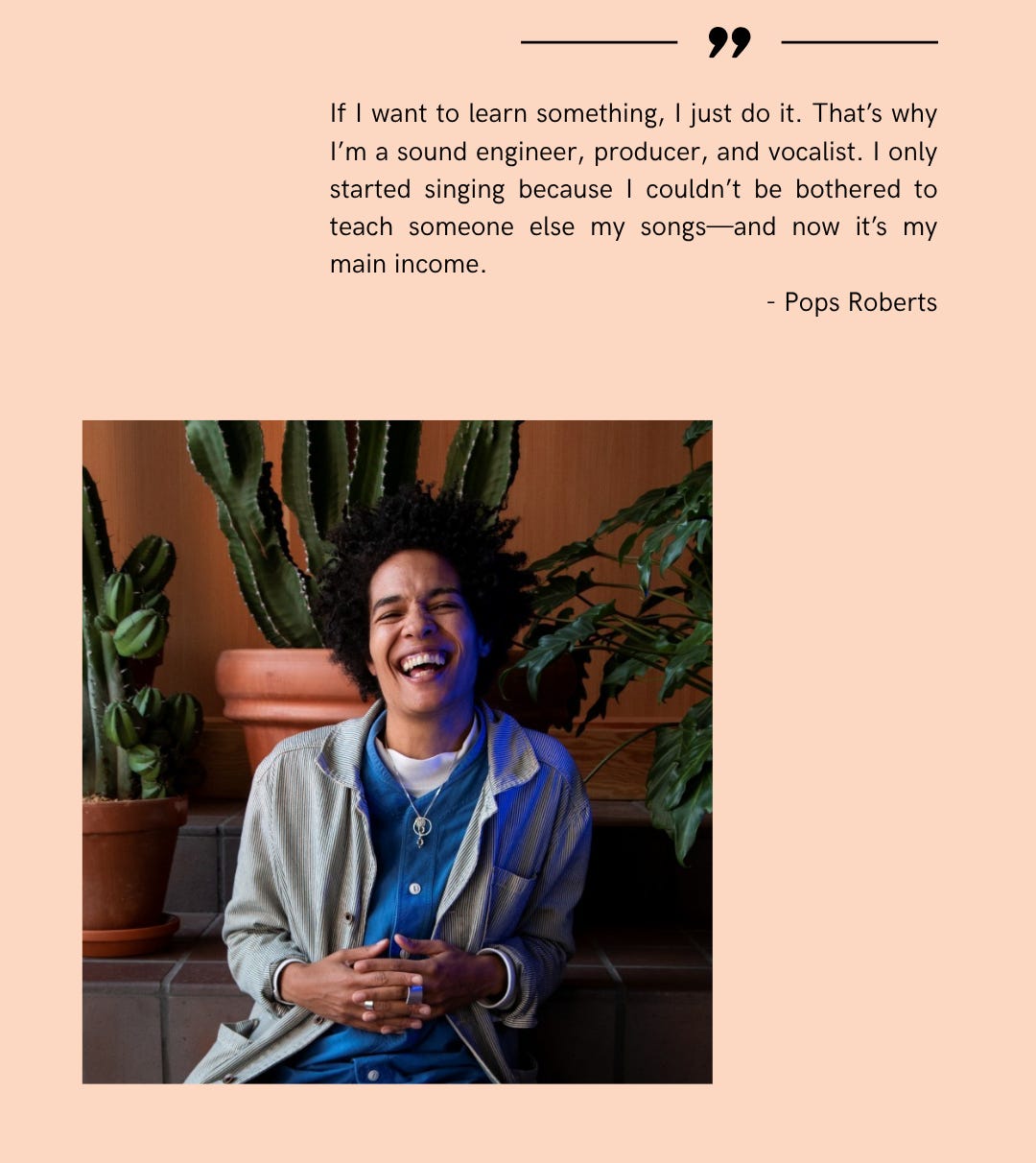
For me, wanting to play guitar was just a reflection of my hormones, and just wanting to attract some romance. And the only way of doing that, as far as I could tell, was learning guitar or drums. It’s hard learning drums when you live in a Buddhist monastery which has a lot of silent retreats. But then, Tibetan Buddhism has the most beautiful music ever. Every single day there was prayer or chanting of some nature around me.
Now, she has an expansive portfolio career. As well as working as a producer, DJ, teacher and facilitator, Pops performs as Private Joy, with her band Lovescene, and as Kae Tempest’s MD and backing musician.
I’m extremely fortunate because I can dot about various different aspects of it, and I love all of them. I don’t do too much of anything. One minute I’ll be working with an artist who wants to be taught how to transition over to Ableton Live. The next day I’ll be working out in the furthest parts of Manchester with young kids who are just starting out, super talented, super up for it. And then I’ll be designing a course for somebody else. So I’m seeing everywhere the music touches. I’m also seeing where music should be touching.
When she left university after studying music, she devoted her spare time to learning Ableton, while working a part-time job in retail.
The thing that I miss about working for them is that I would be in such a state, and need to get so much out of my system by the time I got home that some of the stuff I wrote–lyrically especially–is some of my best work and something I’m still chasing now. Maybe I need to introduce a bit more stress into my life.
I started working with a producer who showed me Ableton, and I just shadowed him. I just used to go around with my days off. I was working full time and all of my time off would be spent going watching what he did as he talked me through it. I was obsessed with learning Ableton Live every single night. Definitely got dumped because of it.
If I want to learn something or if I need something, I’ll just learn how to do it. And become kind of undeniable in that sense. That’s why I’m a sound engineer, I do music production, I’m a vocalist. I was never supposed to sing. I just sang because I couldn’t be bothered to teach someone else how to sing my songs, and now it’s my main income.
Alongside performing and creating her own music, the community and participatory side of her career is very important to Pops.
A lot of my passion is that I love to work with CICs, and I especially like to go and teach or spread information about music production and opportunities in areas of lower income. As soon as I started working with community outreach stuff or with CICs, I was like, ‘Ah, this is actually all that matters.’I teach a lot in a lot of those spaces, and when we start to talk about the hurdles they’re up against, I’m like, ‘Fucking hell, it’s amazing how you guys are even doing it.’ Music for these kids is life and death, just as it was for me. I was an extremely lonely kid and didn’t believe I’d find love, didn’t believe I’d find my place in the world. And there were certain songs or music or artists that gave me hope and made me believe – okay, I’m not alone.’
Skin from Skunk Anansie was one of these artists for Pops.
There was no one else female-identifying that was queer allowed to be in the music industry at that point. And, quite masculine presenting. Her and Grace Jones. That cover of Nightclubbing, that photo – what sad irony, you know, you’ve got this mixed-race child who doesn’t see enough blackness and is immediately frightened at first because it’s like, ‘I don’t see anything like this.’ That kind of androgyny. But then I ended up being so obsessed with her narrative and how she spoke and everything.
Pops tells me she’s gone well beyond the ten thousand hours commonly cited as the amount needed to master a skill.
And I still love it. It doesn’t bore me, ever. It starts as a hobby that’s an obsession. And then if you can take that plunge and invest in yourself and make that obsession your income, then you’ve nailed it. But with freelancing, as we know, you’re gonna have to take some hits financially.
Freelancing, with no sick pay, no paid time off, and no guarantee where the next job is coming from, comes with a high degree of financial unpredictability and instability. Lockdown made this more pronounced than ever, stopping all opportunities for teaching, playing or gigging overnight. For Danny, this triggered a huge change in his career. After his income froze completely overnight, Danny started streaming on Twitch every single day. From there, he decided to combine his teaching, video editing, and music skills to start a Patreon mentorship community, ‘How I Program’, named after his 2010 track of the same name.
The community is run through Patreon, and the whole purpose of the community is to connect and inspire people. I’m trying to motivate people to make music, start their own labels and believe in themselves. Every month, I invite a handpicked masterclass guest. I do a lot of artist development. If you’re in the group mentoring, we have a track feedback session every month, and I give forensic feedback on the tracks. Lots of the music I’ve given feedback on has ended up being released.
He tells me he’s pleased to find his friends have observed he’s ‘quite zen generally’ for the last few years.
I think it’s really healthy for me personally to not be a full-time, “I want to be a famous DJ” anymore. I feel like I’ve managed to help so many people with How I Program, and do something where I’ve really tried to be caring and kind to people all over the world. Not everyone’s ready for that or wants that. Some of the people just say “I want that masterclass. See you later,” and that’s fine. But I feel like I’ve grown so much as a person. It gave me financial stability and mental stability that DJing and dance music didn’t give me, because it’s this fast life and really big highs—one minute you’re the star, and the next minute you’re crying in a departure lounge on your own because you’ve not slept.
Martyn’s approach to how he spends his time has changed too. Like Danny, he started an online mentoring community on Patreon during lockdown, and drew on skills he’d built up in jobs outside of music.
Now I enjoy doing things that aren’t music. I cycle a lot, do hiking, exercising, and stuff like that.
I used to teach way back when I was studying communication science. I interned in a school, taught Dutch and geography. I had an idea of how to ramble on, then chop it into main topics for an hour, talk about them for a bit, do questions and have something semi-structured. That’s how I built the sessions.
I expected ten, fifteen people, just to have something to do until gigs came back. That didn’t happen. The people signing up were way more than I expected. Within a few months, I had 100 people. It became a mini school, my day job. When the pandemic stopped, it became integral to what I do every day.
As with Danny, I asked him what advice he gives to producers in his community about developing their careers.
What’s important is recognising what I did happened in such a different era. You can’t say, ‘I did it this way, do this, it’ll work for you’. Instead of being the old guy saying, ‘just work hard, and things come to you’–that’s not how it works. You have to look deeply at things like privilege, being in the right place at the right time, and the tension between friendship, community, and business decisions. That’s where many answers are, rather than ten steps to career success. My career is only there because of my baggage and experiences. That doesn’t mean it works for everyone.
There is no one easy trick to career success in a line of work so varied, so personal, and so built on chance. And many musicians are putting the work in. But where is the infrastructure to support them? Returns from mainstream streaming services continue to be far below compensating musicians for the time and effort taken to release music, let alone the time and effort to make and record it, much less a living wage. Music venues across the country continue to close at an alarming rate. But the kinds of experiences I spoke to these musicians about, experiences of music having been transformative for one reason or another in their lives, are ones we have all experienced in one way or another, at birthdays, at weddings, on car journeys, in headphones on the bus or the train, and at clubs, venues and festivals across the world.
Perhaps there is another way. There was a time when life without MySpace seemed difficult to imagine, and the world has moved on. Perhaps the same could one day be true for Spotify. In the many months since I began talking to artists for this piece, something has shifted. Artists and fans have begun movements to boycott Spotify. Several high-profile musicians have pulled their music from Spotify altogether.
And perhaps there is a future in which Spotify itself loses interest in music, as it continues its expansion into audiobooks and podcasts. In this panel discussion about imagining a fairer music economy for listeners, Katherine Bassett, co-author of a recent report into inequalities in the music streaming ecosystem, makes an interesting observation from her research into Spotify’s quarterly reports–their use of the word ‘music’ goes down every year. ‘They’re not a music company–they are an advertising and sales company. And that’s much easier to apply to podcasts’. And what could take its place? Alternative streaming platforms? Co-operatively owned music distribution systems? A bare minimum of musicians being paid fairly for their work? Perhaps a movement away from Spotify could become a rare chance to explore or build something different, something that can accommodate the generation of musicians growing into a music ecosystem designed to exploit their work rather than support them.
I will end on this letter from Kurt Vonnegut to a class of schoolchildren, which part of me thinks is a horribly earnest thing to do, and part of me thinks ‘God well at least a human being wrote this’. I hope it’s a meaningful consumption experience for you.
Practice any art, music, singing, dancing, acting, drawing, painting, sculpting, poetry, fiction, essays, reportage, no matter how well or badly, not to get money and fame, but to experience becoming, to find out what’s inside you, to make your soul grow.
Seriously! I mean starting right now, do art and do it for the rest of your lives. Draw a funny or nice picture of Ms. Lockwood, and give it to her. Dance home after school, and sing in the shower and on and on. Make a face in your mashed potatoes. Pretend you’re Count Dracula.
Here’s an assignment for tonight, and I hope Ms. Lockwood will flunk you if you don’t do it: Write a six line poem, about anything, but rhymed. No fair tennis without a net. Make it as good as you possibly can. But don’t tell anybody what you’re doing. Don’t show it or recite it to anybody, not even your girlfriend or parents or whatever, or Ms. Lockwood. OK?
Tear it up into teeny-weeny pieces, and discard them into widely separated trash recepticals. You will find that you have already been gloriously rewarded for your poem. You have experienced becoming, learned a lot more about what’s inside you, and you have made your soul grow.
A huge thank you to Create Define Release and the six musicians I spoke to here. You can find links to their music and learning communities in the text above.
Create Define Release are also currently running a fundraiser to support their excellent work–find out more here.
You can sign up for more from me here:
And if you’ve got thoughts, I’d love to hear them:
…and if you really liked it, here’s a big share button:
No posts
Comments
Nothing yet. Say the first thing.
Sign in to join the conversation.