
Several years ago, I recorded a blog episode, “The Need for Fiscal Analysis,” that I still think about. It was about La Plata, Maryland (population 11,000)—the town where I served on the council (2021-2025)—and a critical issue that had been avoided for many years.
The town wasn’t paying for itself.
The development pattern that had driven growth for decades — subdivisions, strip commercial, infrastructure at the fringe — was consuming more in services and maintenance than it was generating in tax revenue. There was a gap. And the gap was growing.
The idea was simple and serious: if a community can’t honestly account for whether its growth pays for itself, it’s not really planning. It’s hoping.
I’ve moved since then. I’m in Manheim Township, Lancaster County, Pennsylvania, with the same issue and questions.
Like many municipalities in Pennsylvania, Manheim Township is contending with rising costs and declining or stagnating sources of revenue.
Read that slowly. It’s not an alarm bell. It’s the quiet, honest way a community admits it has a structural problem — and decides to do something about it.
On September 24th, 2025, the Board of Commissioners adopted Rooted & Renewing 2035 as the Township’s new comprehensive plan. It’s a serious document — the product of years of public engagement and hard self-assessment.
The plan centers on four major goals: securing fiscal stability, providing affordable housing, improving the transportation network, and updating land-use regulations.
Fiscal stability. First on the list. That’s not an accident.
Refer to Pages 41-53, and Appendix G, Fiscal Sustainability Analysis Page 248, of the 2025 Comprehensive Plan to read why.
A comp plan is only as good as what happens next. Lots of plans sit on a shelf.
Rooted & Renewing is already doing something different. The Board of Commissioners has appointed the Fiscal Sustainability Committee, tasked with developing recommendations on fiscal policies, financial transparency, and other matters with significant impact on the Township.
In partnership with the PA Department of Community & Economic Development, the Committee’s focus areas:
Revenue Analysis: Reviewing real estate taxes, earned income taxes, and fees to ensure a balanced and sustainable portfolio.
Cost Management: Auditing Township facilities and services to identify efficiencies and cost-reduction opportunities.
Sustainable Operations: Identifying “green” services and products that simultaneously lower environmental impact and operational costs.
Transparency: Improving how fiscal information is communicated to both the Board and the public.
This is the work. Not the vision statement — the actual work. The spreadsheets, the hard conversations, the honest reckoning with whether the services residents depend on are financially sustainable over the long haul.
The core lesson from my experience in La Plata (and other places!) was blunt: not all development pays for itself.
Conventional suburban growth — single-family subdivisions at the fringe, disconnected from existing infrastructure — creates long-term fiscal drag. Roads, pipes, and stormwater systems age. They need maintenance. Eventually replacement. If the tax base was built on assumptions that never quite held, the bill comes due later.
It always comes due.
Verdunity, an engineering and planning firm, has been documenting this pattern for years.
“Communities across the country are struggling to address growing needs with limited resources.
In most cities, the development pattern is not generating enough wealth (tax base) to pay for services and infrastructure. There’s a gap between what residents believe their tax dollars should cover, the true cost of these services and amenities, and the actual resources cities have available to meet these expectations.”
Strong Towns has been saying it even longer: the development pattern of the last 70 years has created liabilities disguised as assets. The subdivisions look like growth. On a long enough timeline, many of them look like debt.
“Local accounting must serve the long-term financial needs of the community
When deciding how to steward city finances, Local leaders should ask: What investments will make our place stronger, more resilient, and more livable for the people who are already here? Outside institutions, like bond rating agencies or federal grant programs, often push cities toward growth, expansion, and flashy projects, even when these things don’t serve the people who actually live in the community. The bottom line is this: financial decisions should reflect the values and priorities of the community, not the incentives of outside systems.”
Source: Strong Towns
Fate, Texas, ran the numbers, built policy around the results, and became a national case study. It wasn’t easy. But it was real.
“The City of Fate has adopted a “fiscal sustainability” policy direction in its recently adopted Comprehensive Plan (adopted October 2021). But what does fiscal sustainability mean? For us, it means that over a long-term period the City of Fate will be able to cover its cost obligations and provide high service quality for its residents without major increases in property tax rates, high levels of debt through bond issuances, or degradation of city facilities due to lack of maintenance staff or resources. To maintain fiscal sustainability it is therefore critical that we evaluate new development proposals not only against our adopted development regulations and construction standards but also in relation to the fiscal productivity of the project.
Fiscal productivity is the amount of private wealth created on any specific land area of the city. Productivity is measured in value per acre terms to be fair when comparing parcels of different sizes. As we evaluate the fiscal productivity of a project (which translates, in part, to tax revenues to the city) in our fiscal analysis spreadsheet below, we also estimate the ongoing maintenance costs and the future replacement costs of the infrastructure serving the development and the annual general service (public safety and general administrative services) costs for the project (which are all cost obligations on the city).”
Source: Fate, TX
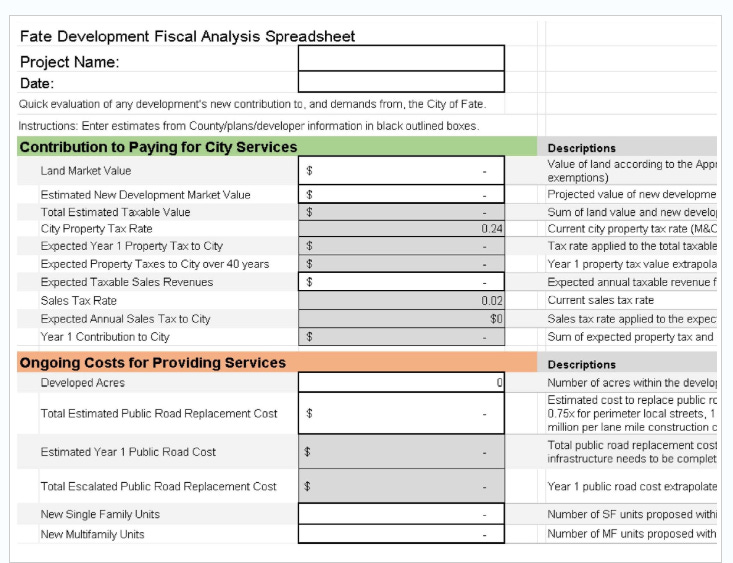
Source: City of Fate, TX
Manheim Township — 44,000 residents, 22 square miles, the largest township by population in Lancaster County — has all the complexity of a small city with the governance structure of a township. It’s figuring out how to pay for schools, parks, fire rescue, public works, and a police department without asking more of taxpayers than they can bear.
That is not a small challenge. It is, arguably, the challenge.
Township infrastructure:
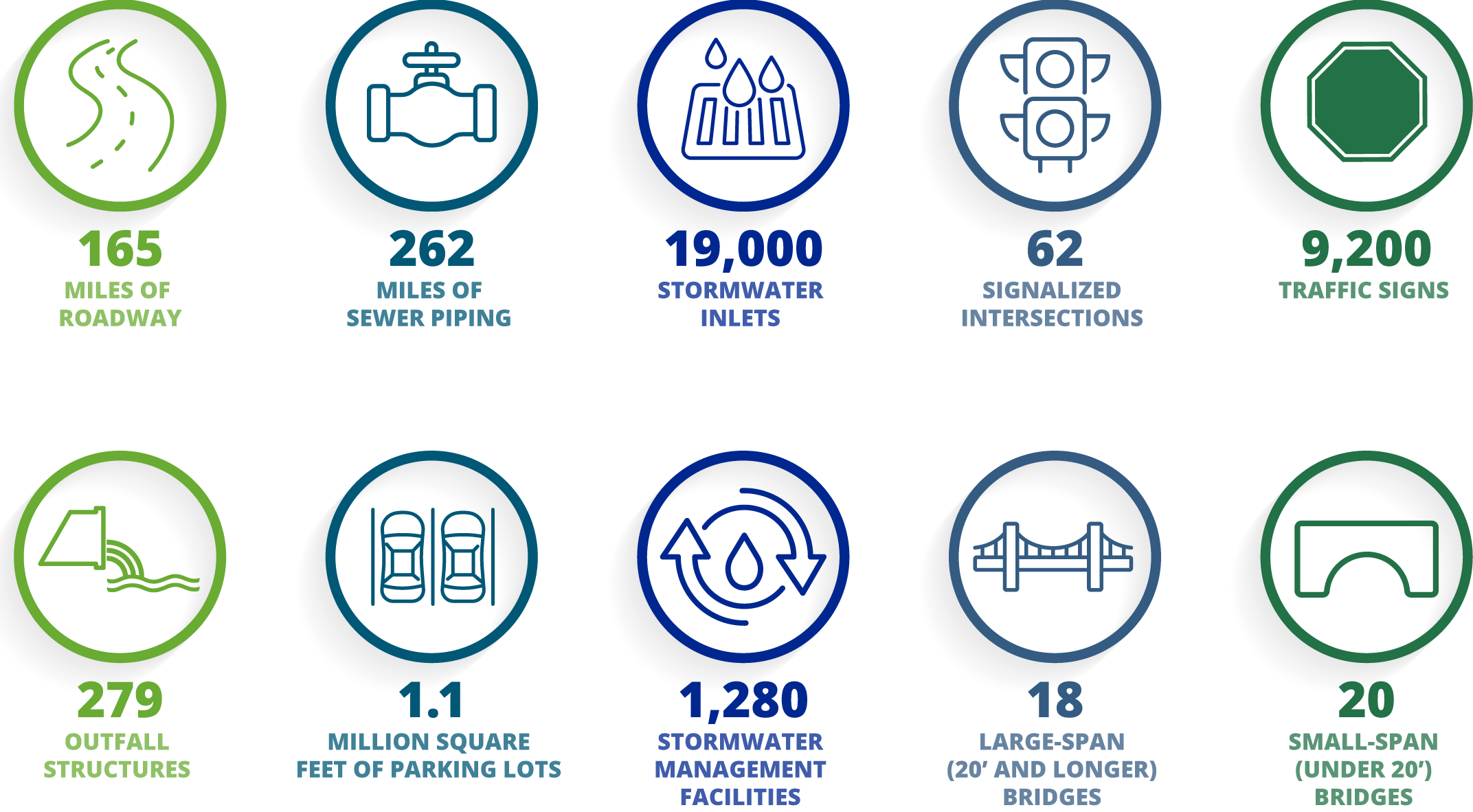
Source: Rooted and Renewing 2025, Page 42
“Goals
To address its financial challenges, Manheim Township will uphold its responsibility to provide quality public services to its constituency. In the short term, the Township accomplishes this by producing enough revenue to pay its bills and cover expenses. In the long term, the Township will make informed, calculated financial policy decisions that maximize the return on investment per tax dollar levied, continue to improve quality of life for residents, and strengthen the Township’s future financial sustainability. An analysis of the Township’s budget and multi-year tax base patterns have guided the goals, tasks, and desired outcomes below, which were considered as the Township developed the final recommendations of the plan.”
Source: Manheim Township: Rooted & Renewing 2035, Page 257
Fiscal sustainability is a planning and design issue. Where development goes, what kind we permit, how dense we allow neighborhoods to be — those decisions have long-term fiscal consequences that most communities never stop to calculate.
A walkable, mixed-use neighborhood built at a human scale generally produces far more tax revenue per acre than a sprawling subdivision with the same number of residents. That’s not ideology. It’s math. The returns on compact, connected development look very different from conventional sprawl when you account for the full infrastructure lifecycle.
This is why smart growth is fiscal responsibility. Communities that build well — that invest in places rather than spreading infrastructure thin — tend to be more solvent. Those who chase growth for growth’s sake often find themselves, a generation later, staring at a gap they can’t close.
Manheim Township has a head start. It has a plan that names the problem. It has a committee doing the work. It has the self-awareness to ask the question before the bill gets too large to pay.
That’s more than most places have.
If you live in Manheim Township, the Fiscal Sustainability Committee is doing work that will directly affect your taxes, your services, and the long-term financial health of this community. Show up. Pay attention.
If you’re a planner or local official elsewhere — the question Manheim is asking is the right one. Does your community’s development pattern generate enough revenue to sustain itself? Have you ever actually run the numbers?
If not, that’s where to start.
I recorded “The Need for Fiscal Analysis” in 2023 because I wished La Plata had asked these questions sooner. I’m glad my new home is asking them now. 📍
David M. Jenkins, AICP, is the host of Crosswalks: Smart Growth in Real Places. He served on the La Plata, Maryland, Town Council from 2021 to 2025 and now lives in Manheim Township, Lancaster County, Pennsylvania.
📚 Sources & Further Reading
Comments
Nothing yet. Say the first thing.
Sign in to join the conversation.