
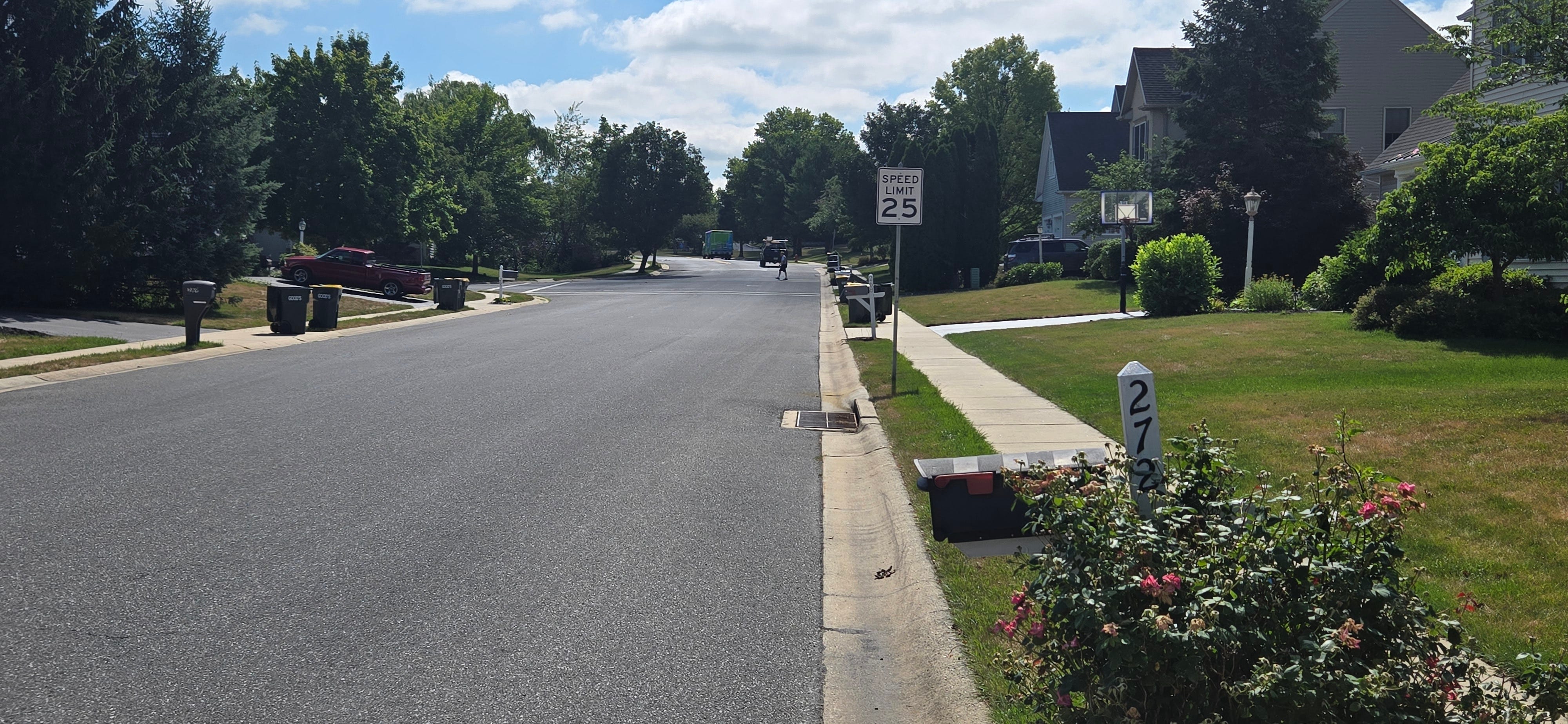
Every day I walk my neighborhood in Manheim Township and watch the same thing happen. The posted speed limit is 25 mph. Almost nobody drives it. Cars roll through at 30, 35, sometimes faster — not recklessly, not maliciously, just normally.
This is what normal looks like when a street is built wide, straight, and forgiving of speed. Drivers aren’t breaking the social contract; they’re following the design cues the street is giving them.
I’ve written about this before, in broader terms — about Walk Score, PennDOT’s Active Transportation Plan, and Lancaster County’s Complete Streets framework.
This isn’t just about policy; it’s personal. During my time in La Plata, Maryland, I nearly became a statistic twice—once while cycling (wearing a helmet, flashing light on my bike and helmet), and again while simply walking in my neighborhood (no sidewalks)
But there’s a difference between writing about walkability as a regional policy question and living it on your own block, watching the same cars not stop at the same pace, day after day.
So I did what I’d do as a planner and a former elected official: I looked at mechanisms residents could use to fix this. In Manheim Township, that mechanism is called the Neighborhood Traffic Management Program (NTMP).
The NTMP was created in 2000. It is, structurally, still a 2000-era program: residents petition the Township, staff evaluate the request, and — if conditions are met — some form of traffic calming gets installed.
The barrier is the petition threshold itself: 80 percent of residents on a street have to sign on before the Township will act.
Think about what that requires in practice. Not a majority. Not even a strong majority. Four out of every five households on a street must be reached, informed, convinced, and willing to put their names on a document — before the Township will even study whether your street has a problem.
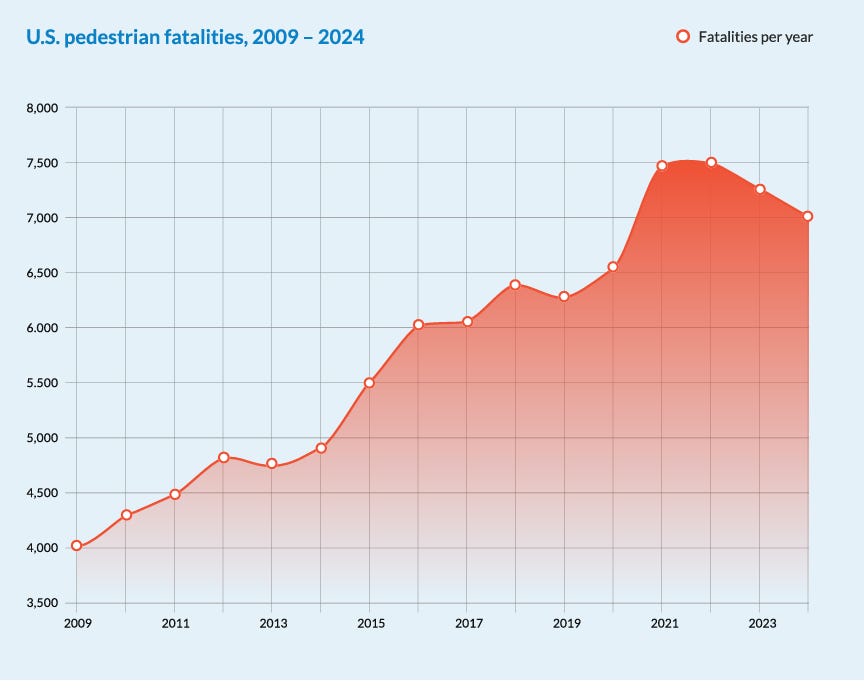
A national perspective from Dangerous by Design, 2026:
The number of people killed while walking has been one of the clearest measures of whether our transportation system is working for everyone. The 7,080 people killed while walking in 2024 makes it clear it is not.
Manheim Township just adopted its new comprehensive plan, Rooted & Renewing 2035. I sit on the committee responsible for implementing it — the Comprehensive Plan Implementation Advisory Committee, or CPIAC.
The plan is not vague about transportation. It calls for a strategy to address congestion and create real opportunities for residents to walk, bike, and take transit.
Transportation was identified as one of the top priorities during the planning process — that residents asked about. The plan also commits the Township to integrating Complete Streets design principles and prioritizing the Active Transportation Plan.
Here’s the problem: you cannot deliver on that mandate using a tool built on an 80 percent petition requirement. The 2035 Plan and the 2000 NTMP are operating from two different theories of how change happens — one says traffic safety is a Township responsibility ( streets they own and maintain), the other says it’s a burden of proof residents have to clear almost unanimously before the Township will engage. You can’t average those two theories together. One of them has to give.
The standard response to neighborhood speeding is usually a call for more police enforcement. But municipal budgets can’t fund a cruiser on every corner, and tickets don’t alter a road’s physical geometry. We need a structural fix, not a behavioral watchdog.
I sent my fellow CPIAC members and Township staff a memo making the case directly: align the NTMP with what the 2035 Plan actually promises. I didn’t just flag the problem; I brought concrete data regarding the physics of speed:
Hit at 20 MPH: 🟢 90% Survival Rate (The design target for safe residential streets)
Hit at 40 MPH: 🔴 10% Survival Rate (The fatal cost of physical design mismatch)
Complete Streets, which the 2035 Plan already references for corridors like Oregon Pike, applies just as directly to ordinary residential blocks — not just commercial arterials. I included two working examples as proof this isn’t theoretical:
Monroe, Washington: Replaced an opaque petition process with a public-facing Traffic Calming Policy and Guidebook, plus an online portal where residents can submit requests directly.
Indianapolis: Uses a Community-Powered Infrastructure program with 50/50 cost-share funding and tactical urbanism — quick-build, low-cost interventions using paint, planters, and temporary materials — to test what works before committing to permanent construction.
Quick-build projects let a Township show residents something changed, fast, instead of asking them to wait years and collect 80 percent of their neighbors’ signatures first. They make the case for the permanent fix by proving the temporary one works.
I also flagged possible funding mechanisms — including a PennDOT ARLE grant for traffic signal and pedestrian safety improvements with a deadline landing this very week, and a Safe Streets for All federal pilot program for low-cost demonstration projects.
I’m not yet sure whether this memo moves anything. That’s the honest answer, and it’s worth saying plainly — committee memos don’t rewrite ordinances by themselves, and my prior experience on a town council ( La Plata, MD) shows the distance between raising an issue and changing a policy.
But here’s what I do know: the gap between what Manheim Township’s residents said they wanted in the comprehensive planning process and what the Township’s existing traffic-calming tool can actually deliver is real, and it’s documented in the Township’s own plan.
That’s the first step. Not the only one.
And every day, walking past the same cars doing over 25, I’m reminded why it matters.
Have you tried to get traffic calming approved in your own neighborhood?
What did the process actually require of you — and did it work?
📚 Sources & Further Reading
Manheim Township, Rooted & Renewing 2035 Comprehensive Plan (adopted Sept. 2025)
Manheim Township Neighborhood Traffic Management Program (NTMP), established 2000
City of Monroe, WA — Neighborhood Traffic Calming Program, Traffic Calming Policy & Guidebook (2024)
Smart Growth America — Pittsburgh, PA demonstration project: Lincoln and Frankstown Avenues
Comments
Nothing yet. Say the first thing.
Sign in to join the conversation.