
Significant changes are happening in the world of municipal planning, and it has nothing to do with sprawling new subdivisions or multi-million-dollar developer agreements.
🛑 Instead, it’s about going back to the basics—the way communities were built for centuries before Euclidean zoning and car-centric communities. 🚗❌
As a member of Manheim Township’s Comprehensive Plan Implementation Advisory Committee (CPIAC), we spend time looking at the Township’s future through the lens of September 2025 Rooted & Renewing 2035 Comprehensive Plan. We all also try to attend the Township’s other committees - Fiscal Sustainability and Zoning Ordinance Rewrite.
🗺️ Two concepts dominate our discussions on how actually to implement this plan: Infill Development and Incremental Development.
While they might sound like interchangeable planning jargon, they represent two distinct, yet deeply intertwined, strategies.
🤝 Understanding the difference—and how they work together—is the key to unlocking the goals for Manheim Township’s fiscal health and housing needs. 📈
To understand how we build a resilient township, we first need to get our definitions and industry frameworks straight. 📋
Our Local Context: Infill is the practice of developing on vacant or underutilized land within existing urban or suburban boundaries, rather than extending outward into pristine farmland or greenfields. 🚜 In Manheim Township, this means taking a long-vacant commercial lot, an oversized parking lot, or an underutilized parcel along our primary corridors and redeveloping it into housing or mixed-use spaces. 🏢 It leverages the public infrastructure—roads, water lines, sewer mains—that we have already paid for and are already committed to maintaining. 🚰🛣️
The Industry Standard: The American Planning Association (APA) describes infill development as redevelopment that “optimizes prior infrastructure investments and consumes less land that is otherwise available.” 📉 It specifically targets bypassed or underused parcels (including “greyfields” like underperforming strip malls and parking lots) to accommodate growth without creating suburban sprawl.
The Smart Growth Standard: State and regional planning guidelines (such as those pioneered by the Maryland Department of Planning define infill as new development or redevelopment on bypassed lands within designated growth boundaries or “Priority Funding Areas” where infrastructure is already in place.
🗺️ This acts as a primary tool for “Smart Growth,” relieving development pressure on agricultural zones while capturing the walkability and transit benefits of mixed-use neighborhoods. 🚶♂️🚍
Our Local Context: If infill is the where, incremental development is the how and who. It is small-scale, gradual, and human-scaled development. 🧱 It is the practice of letting properties grow naturally to the “next increment up”—such as converting a single-family lot into a duplex, adding an Accessory Dwelling Unit (ADU) in a backyard, or building a small “Missing Middle” cottage court or corner three-flat. 🏡🏡
The Strong Towns Approach: As Chuck Marohn and Strong Towns emphasize, incremental development is about making “little bets” (small, localized investments) rather than seeking large, silver-bullet, transformative projects. 🎲 This concept of “Incremental Intensification” allows each lot to redevelop over time as the community’s needs change (from single-family to duplex to small apartment). It serves as a wealth-building tool that keeps land ownership diversified, spreads financial risk, and creates highly granular, resilient neighborhoods. 💰🏘️
The Builder’s Approach: The Incremental Development Alliance (IncDev) defines this as a “generative real estate model” that empowers regular, neighborhood-level residents to invest in their own blocks. 🛠️ They advocate for “Missing Middle Housing” (duplexes, triplexes, live-work buildings) because these projects are too small for massive, conventional developers but are perfect for small-scale, adaptable local builders, retired couples building passive income, or small business owners adding an apartment above their shop. 🏪🏠
In short: Infill is the canvas 🎨; incremental development is the fine, patient brushwork that fills it in without disrupting the neighborhood’s soul. ✨
In Manheim Township, we aren’t just talking about these ideas in a vacuum. They are directly tied to the three interconnected challenges our advisory committees are currently tackling:
The work of the Fiscal Sustainability Committee looks at the long-term balance sheet of the township. For decades, suburban municipalities have grown by chasing “greenfield” development—stretching sewer pipes and paving new roads out to the horizon.
🛣️ This creates a short-term cash infusion from building fees, but leaves the township with a ticking time bomb: the compounding, long-term liability of maintaining that infrastructure forever. 💣
Incremental infill is an alternative escape hatch. 🚪 When we encourage small-scale development on existing lots, we add new taxpayers and increase our property tax base without adding a single foot of new public road or sewer pipe. It’s what Strong Towns refers to as “thickening” our town. 🍲 It maximizes the return on the infrastructure investments we’ve already made, dramatically improving our long-term fiscal resilience.
Our 2035 Comprehensive Plan makes it clear: Manheim Township needs more diverse, accessible housing options. 📊 The standard housing market operates in extremes—either master-planned single-family subdivisions or massive, institutional apartment complexes. This leaves a vast gulf in the middle: duplexes, triplexes, accessory dwellings, and courtyard apartments.
By opening the door to incremental development, we allow the housing supply to expand naturally and organically. 🌿 An ADU over a garage or a small duplex doesn’t just add a unit of housing; it creates a lower-cost rental option for a young professional, a downsizer, or a local teacher, while helping the property owner pay their mortgage. 🤝 It is housing affordability built from the bottom up, rather than subsidized from the top down.
This brings us to the Zoning Rewrite Committee. You cannot have incremental development if your zoning code makes it illegal or cost-prohibitive. 🚫 Currently, many of our traditional zoning districts mandate large setbacks, restrictive height limits, excessive minimum lot sizes, and punitive parking minimums. 🚗🅿️ These rules effectively mandate sprawl and ensure that only large, institutional developers with armies of lawyers can navigate the variance process.
To unlock the goals of the Comp Plan, our ongoing zoning rewrite can focus on:
Legalizing the next increment of density by right: 🔓 Allowing duplexes, triplexes, and ADUs in residential zones without requiring a costly and intimidating public hearing process.
Eliminating or reducing parking minimums: 🅿️❌ Letting local builders decide how much parking their project actually needs, rather than forcing them to dedicate valuable land to empty asphalt.
Streamlining the approvals process: ⏱️ A small, local developer cannot afford to have their capital tied up for two years waiting for municipal sign-offs. We must make the process predictable, transparent, and fast. ⚡
If you want to see where this is mapped out legally, look no further than the Manheim Township Comprehensive Plan (Rooted & Renewing 2035). 📖
The plan specifically utilizes the Future Character Area Map (FCAM) and the Reinvestment Area Map to designate growth boundaries. 📍 It explicitly directs infill and redevelopment into specific character areas to protect our northern agricultural zones from sprawl, focusing resources on existing local corridors. 🌾🚫
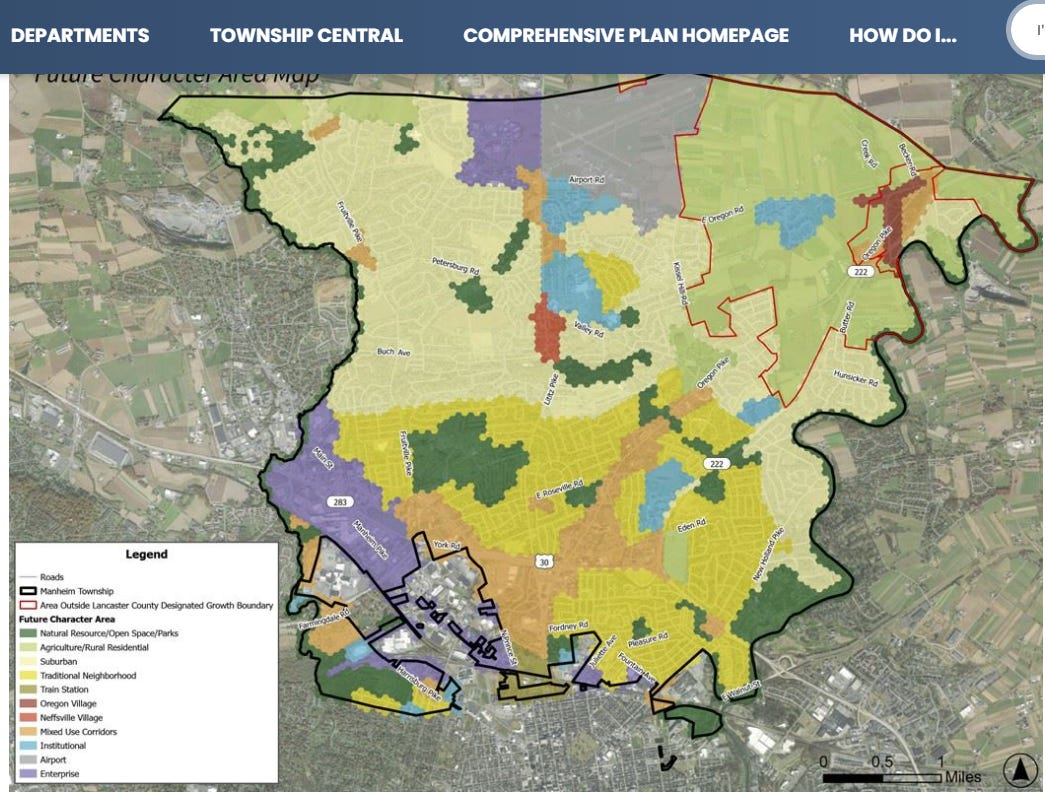
Here is how these goals break down across our specific local Character Areas:
Infill & Redevelopment Vision: Focuses on preserving historic scale while filling in vacant physical gaps.
Role of Incremental Development: Ideal for backyard ADUs, historic home conversions (e.g., single-family to duplex), and cottage courts.
Infill & Redevelopment Vision: Emphasizes walkable, village-scale expansion that respects historical context.
Role of Incremental Development: Encourages small, context-sensitive commercial-residential mix built by local craftsmen.
Infill & Redevelopment Vision: Targets the transition of auto-oriented strip malls and large parking lots into walkable places.
Role of Incremental Development: Perfect for “greyfield” infill, transforming single-story commercial pads into multi-story, mixed-use buildings.
Infill & Redevelopment Vision: High-density transit-oriented development to capture regional commuter growth.
Role of Incremental Development: Promotes rapid but fine-grained multi-family infill, reducing regional automobile dependency.
If we want a Manheim Township that is financially resilient, housing-accessible, and structurally complete, we must move away from the mindset of the “big project”. 🏢❌ We cannot rely solely on mega-developments to solve our structural challenges.
Through the coordinated work of the CPIAC, Fiscal Sustainability, and Zoning Rewrite committees, we have a historic opportunity to reshape our regulatory landscape. 🛠️ By aligning our zoning code with the goals of our Comp Plan, we can empower our own residents to invest in our neighborhoods, block by block, lot by lot. 🧱
Incremental development is not just a planning strategy; it is an act of civic stewardship and sustainability. 🤝 Let’s work to make it happen. 🔓✨
Comments
Nothing yet. Say the first thing.
Sign in to join the conversation.