
On the wall of my office at Asbury Theological Seminary hangs a framed declaration:
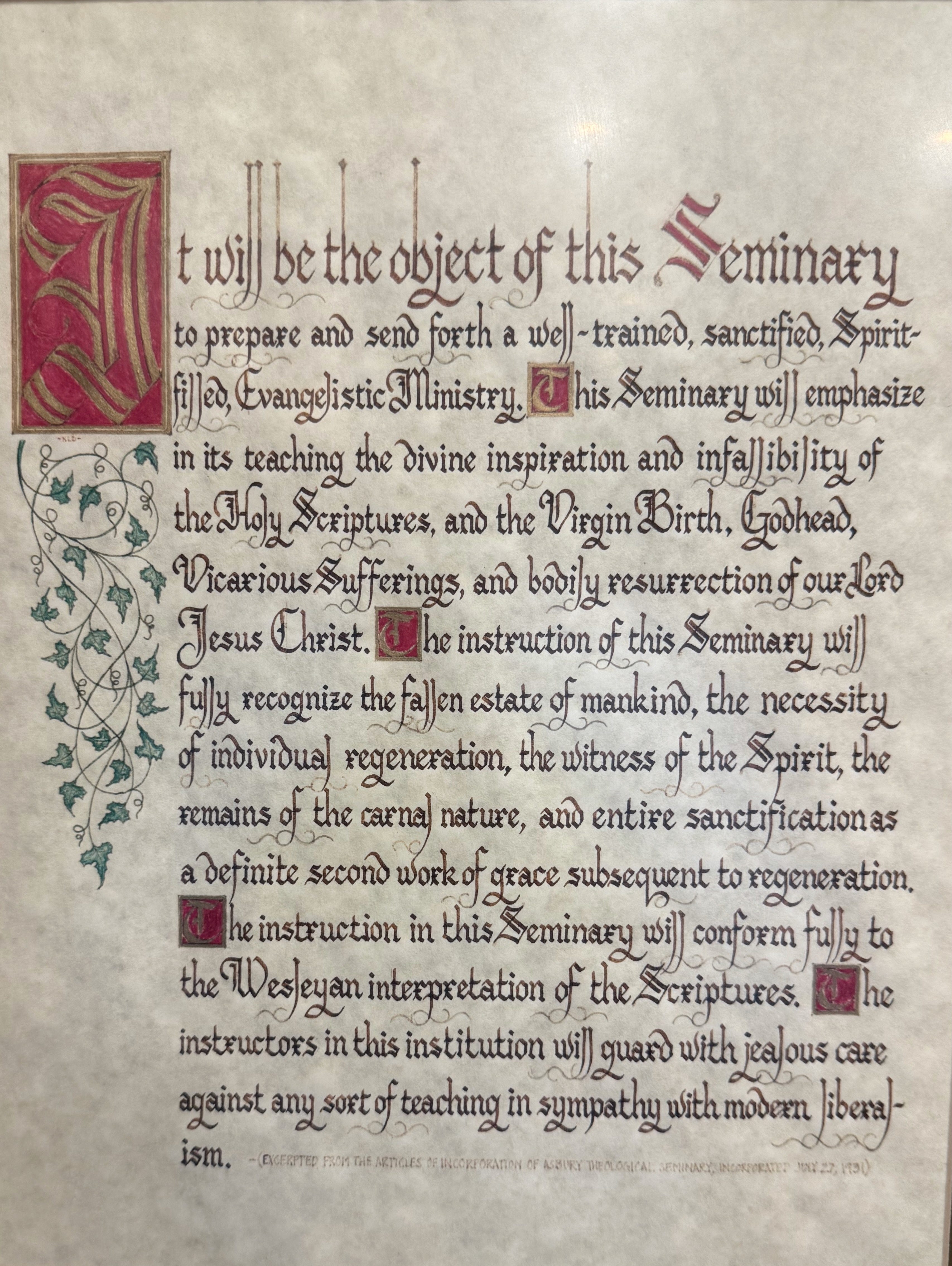
The text reads,
It will be the object of this Seminary to prepare and send forth a well-trained, sanctified, Spirit-filled, evangelistic ministry. This Seminary will emphasize in its teaching the divine inspiration and infallibility of the Holy Scripture, the Virgin Birth, Godhead, Vicarious Sufferings, and bodily resurrection of our Lord Jesus Christ. The instruction of this Seminary will fully recognize the fallen estate of mankind, the necessity of individual regeneration, the witness of the Spirit, the remains of the carnal nature, and entire sanctification as a definite second work of grace subsequent to regeneration. The instruction in this Seminary will conform fully to the Wesleyan interpretation of the Scripture. The instructors in this institution will guard with jealous care against any sort of teaching in sympathy with modern liberalism.
This statement is taken from our articles of incorporation. In A Short History of Asbury Theological Seminary (Seminary Press, 1963; First Fruits, 2013), Howard Fenimore Shipps explains the context behind this statement:
The need for a graduate school of theological education within the Wesleyan Arminian school of thought had become increasingly apparent through all these years from 1890 to 1923. The need for a theological school, which could maintain the faith against the inroads of modern liberalism, was certainly an important consideration in the founding of the Seminary. It was the conviction of some of the leaders that because many of the graduates of Asbury College had no choice but to attend a seminary where the faith of the fathers was neither honored or preserved, the establishing of a conservative and orthodox seminary had become a crying need (18).
Asbury exists to offer scholarship in service to the church. That means, in part, scholarship in continuity with the church’s historic witness.
My morning practice is to spend a time of devotion and prayer, and on Monday morning I returned to a book I’ve been working through, Devotions on the Greek New Testament. Last Monday the day’s devotion was “Fight for the Faith: Jude 3,” by the renowned Greek scholar William D. Mounce.
The NIV renders Jude 3 as follows: “Dear friends, although I was very eager to write to you about the salvation we share, I felt compelled to write and urge you to contend for the faith that was once for all entrusted to God’s holy people.” The word we normally translate as “contend” is epagōnizomai. It consists of the preposition epi plus the verb agōnizomai. Mounce writes that agōnizomai can mean “to take part in an athletic contest (1 Cor 9:25) or, in a more general sense, to fight or struggle (either physically [e.g., John 18:23] or metaphorically, [e.g., Col 4:12; 2 Tim 4:7])” (139). As he notes, however, the preposition epi, “when attached to a verb, intensifies the notion of struggle” (139). He concludes from this that translations that use “contend” are too weak, and he holds that the New Jerusalem Bible, which renders this verb, “fight hard,” offers the best translation:
My dear friends, at a time when I was eagerly looking forward to writing to you about the salvation that we all share, I felt that I must write to you encouraging you to fight hard for the faith which has been once and for all entrusted to God’s holy people.
Fight hard for the faith. It’s a new battle in every generation. I believe the founders of Asbury understood this. They were in the midst of their own struggles as academic study in Methodist contexts was coming under the influence of theological liberalism. They knew it would take not just evangelistic zeal, but strong, well-structured, enduring institutions to shape the hearts and minds of new generations.
The Christian faith is not something we invent. It is something we inherit. The great creeds of the church—Nicene, Apostles’, and Athanasian—are not menus from which we may order à la carte. They represent systems of thought, networks of interdependent ideas. Our Bible is not only a library of books, but a single work consisting of a series of interdependent writings, a canon with a narrative arc. The virtues of the Christian life—prudence, justice, fortitude, and temperance—are woven into the fabric of our faith across the centuries. Likewise from those who have gone before us, we have learned what leads us away from God: pride, greed, lust, envy, gluttony, wrath, and sloth. We stand in a tradition of praxis: baptism, communion, repentance, generosity, worship, and family. The great cloud of witnesses has left us a beautiful, inspired heritage to lead us into the life of God. This orthodox tradition of Christian faith is a saving faith. We neglect it to our impoverishment, even our peril.
Theologians have described this faith in various ways. Sometimes we just call it “orthodoxy.” We might well call it “the faith once delivered,” referencing Jude 3. Some scholars refer to it as the “catholic” faith. Thomas Oden called it “consensual Christianity” (the term I most often use). Billy Abraham referred to it as the “canonical tradition.” Following C.S. Lewis, we might simply call it “mere Christianity.” Of course, these descriptions of the faith carry different shades of meaning, but they all refer back to a commonly shared theological heritage. This is the idea behind the designation of this faith as the “Vincentian Canon.” Vincent of Lérins (5th cen.) wrote of the faith proclaimed “everywhere, always, and by all.” Of course he knew that some people rejected this faith. At times, for example, Arians had the upper hand over the orthodox of the Roman empire in both numbers and power. And yet the orthodox faith persisted over time. That’s the point. In the face of persecutions, wars, imperial opposition, vast cultural changes, and even the ever-changing intellectual fads that inhabit academic life, this faith has persisted across the globe and across time.
The challenges to consensual Christianity have been many, not least over the last 200 years. During the 20th and 21st centuries, many of the voices challenging the orthodox faith have come from within Methodism. Methodism has at times taken forms Wesley would not recognize. In fact, when many people think of Methodism today, they think of its liberal Protestant expressions. Yet those who have studied the Wesleyan revival, who have caught the vision of the early Methodists, understand that those pioneers of revival passed on to us a set of beliefs and practices with the power to renew the church in our own day.
Wesley’s Methodism was a version of consensual Christianity with a strong emphasis on holiness—God’s work of changing us into the people we were always meant to be, people formed after the likeness of Christ. Like other Protestant traditions, we affirm salvation by grace through faith, but, more so than many other Christian traditions, we emphasize the sanctifying work of the Holy Spirit. We even affirm that the believer can be made perfect in love, “love excluding sin; love filling the heart, taking up the whole capacity of the soul. It is love rejoicing evermore, praying without ceasing, in everything giving thanks” (“The Scripture Way of Salvation,” I.9).
Yet even for those who have received entire sanctification, we can always grow in grace. We can always journey more deeply into the love of God. Thus we pray, worship, receive communion, and search the Scriptures. At times we fast or abstain from certain activities. We enter into relationships of accountability. We watch over one another in love. These are the ordinances of God, means of grace, channels by which we open ourselves to the sanctifying work of God. God is faithful, and when we honor him in obedience, he meets us with transforming love.
This orthodox expression of Methodism, however, should not always look to the past. The present and future matter as well. We have to bring the treasury of consensual Christianity to bear on the complex issues of our own day, including AI, the beginning and end of human life, creation care, immigration, and many other issues. Matters such as these require more than casual engagement. They require the kinds of intellectual resources that Christian institutions of higher education can provide. It is crucial that we raise up, train, and support people who can think long and hard about these kinds of issues, who can take a thorny problem, turn it inside out, observe it from different angles, and help us understand it better. As Asbury and other confessional institutions have shown, it is possible to do this kind of work without sacrificing the theological commitments of the orthodox faith.
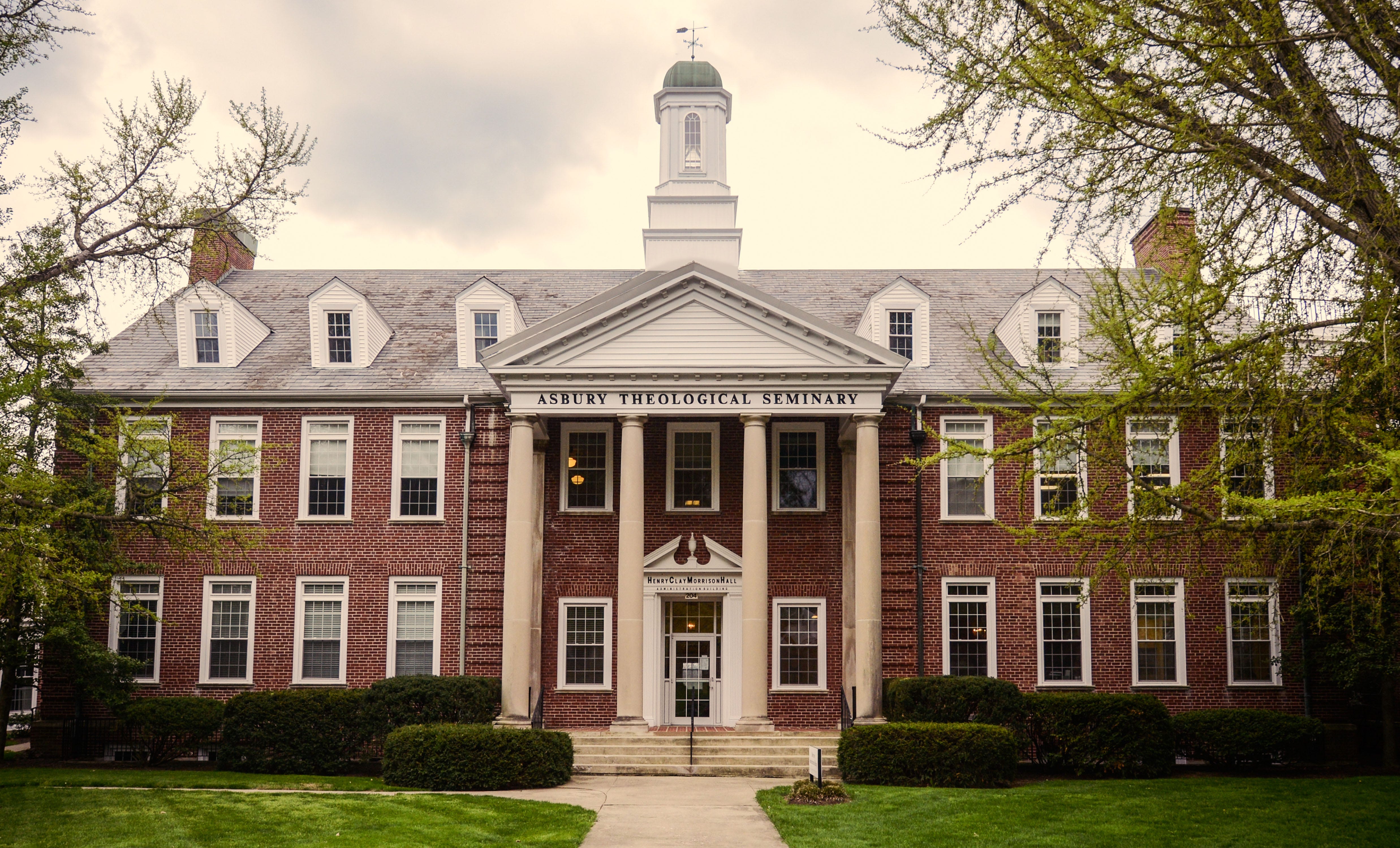
From time to time people ask me where Asbury Seminary is going in years ahead. Of course, I don’t determine the answer to that question by myself. We will begin a strategic planning process later this year, and faculty, trustees, staff and other stakeholders will have their say regarding the direction of the seminary. As far as my leadership goes, however, I will say this: we will serve Christ and his church through ministries of teaching, formation, and scholarship. We will fight hard for the faith once and for all entrusted to the saints. We will double down on the core of our Wesleyan heritage: prevenient grace, justification by faith, the new birth, sanctification, and Christian perfection. We will teach the whole Bible for the whole world. We will love God with all our minds, engaging our faith with the highest level of scholarly work, and laying it all at the feet of Jesus. And if that means that we are loved by some and despised by others, so be it. If that means that long and fruitful partnerships must come to an end, we accept that. We will not sell our birthright for a mess of pottage. The Gospel of Jesus Christ, handed on from the time of the apostles, is too precious, too powerful, too glorious for us to make it a matter of negotiation.
Where is Asbury going? We are continuing forward along the paths carved out by those who have gone before us.
Thus says the Lord:
Stand at the crossroads, and look,
and ask for the ancient paths,
where the good way lies; and walk in it,
and find rest for your souls (Jeremiah 6:16).
In every new generation, people of every tribe, tongue, and nation need to hear the Gospel of Jesus Christ. We will raise up leaders for that purpose. We will labor faithfully to fulfill our mission:
Asbury Theological Seminary is a community called to prepare theologically educated, sanctified, Spirit-filled men and women to evangelize and to spread scriptural holiness throughout the world through the love of Jesus Christ, in the power of the Holy Spirit and to the glory of God the Father.
I hope you will join us along this journey. If you are interested in seminary, I hope you will consider enrolling with us. You can support us through your prayers, your gifts, and your advocacy. If this is a mission that you feel honors God and serves his church well, come along with us and partner in mission. God is doing great things at Asbury, and we hope you will be a part of it.
No posts
Comments
Nothing yet. Say the first thing.
Sign in to join the conversation.