
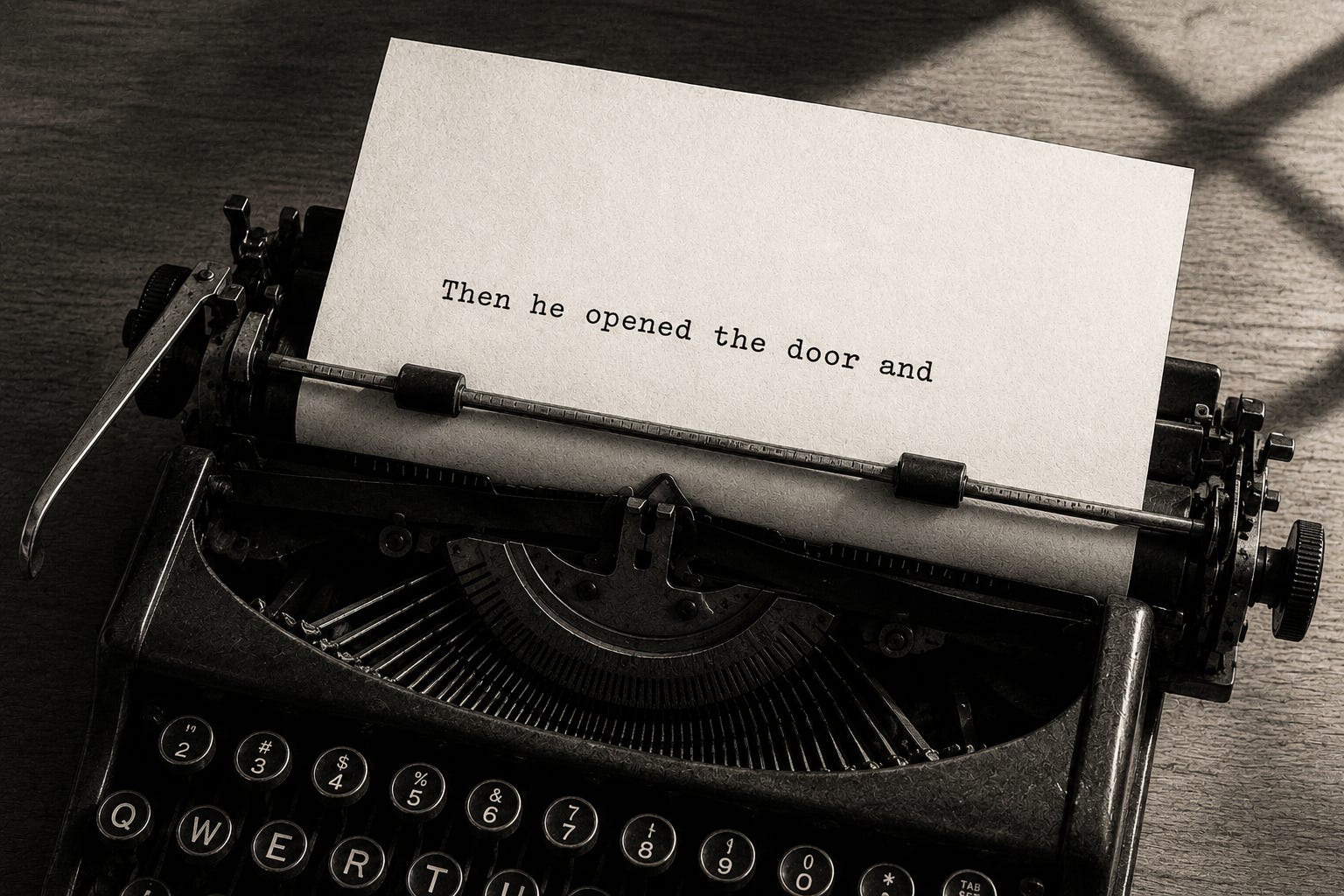
Ernest Hemingway had a rule for ending his writing days: he stopped while he still knew exactly what would come next—sometimes, reportedly, in the middle of a sentence.
As Hemingway told the Paris Review in 1958:
“You write until you come to a place where you still have your juice and know what will happen next and you stop and try to live through until the next day when you hit it again.”
I stole this idea, and you should too. For my last act of each workday, I specify a single important task that I will take up first thing in the morning. As it did for Hemingway, it gives tomorrow a known target. That simple act of specification defends against two of the most reliable ways a workday goes sideways.
The drift to feeds. Your brain is wired for convenience. So when you arrive at your desk with no defined task, you will tend to opt for what some cognitive psychologists have called the “path of least resistance.” That will often be an algorithmic feed or your inbox. A specified starting point gives your attention somewhere to land that isn’t a notification—somewhere that you’ve already designated as important.
The “mere urgency” effect. In a series of experiments, researchers showed that people tend to choose urgent tasks over important ones, even when the important task is clearly a better use of time. Urgent tasks are well-defined and easily actionable—respond to that thing; check that notification. Important work, meanwhile, often feels vague, with a longer or perhaps uncertain timeline. When you follow Hemingway and specify tomorrow’s important task down to the exact next move, you give your important work the quality that normally lets busywork win. You’re making the important thing the easy thing to start.
I should add, this thing with which you choose to start your day, it doesn’t have to be some monstrous work goal in order to be important. For me, one of the ironies of launching a book is that it’s the time in my life when I get the least reading done. I’m too busy traveling and running my mouth. But I love reading books. I learn from it, of course, but just as importantly it centers my focus in a way that I find restorative. Since I haven’t been getting my normal book-reading in, for my Hemingway act I recently started leaving a book open on my desk at the page I want to start the next day, and I’ll read to the end of the given chapter.
I think it’s important to try to be specific in that way. Not, “I’ll read a book.” Rather, “I’m starting on this line when I walk in here in the morning and reading 10 pages.” Or, for something perhaps more relatable, rather than “First thing tomorrow I’ll work on the presentation,” try “I’ll open the slide deck and make the next five slides.” Start with the thing you designated as important before you touch something that is merely urgent, like feeds or email. (Unless, of course, writing an email is the task you designated.)
If you give this a try, I’d love to hear in the comments below whether you find it as valuable as I have.
My new book, Inside the Box: How Constraints Make Us Better, is now a New York Times bestseller. Thank you to everyone who picked up a copy. And it is currently available at a discount from various sellers. You can check your preferred retailer here.
Lastly, I’ve been experimenting with making videos that draw from or build on concepts from Range and Inside the Box. You can see those here.
If you enjoyed this post, please share it.
As always, you can subscribe here.
Until next time…
David
Comments
Nothing yet. Say the first thing.
Sign in to join the conversation.