The Next Climate Change Calamity?: We’re Ruining the Microbiome of the Ocean, According to Human-Genome-Pioneer Craig Venter, Vanity Fair, 2023
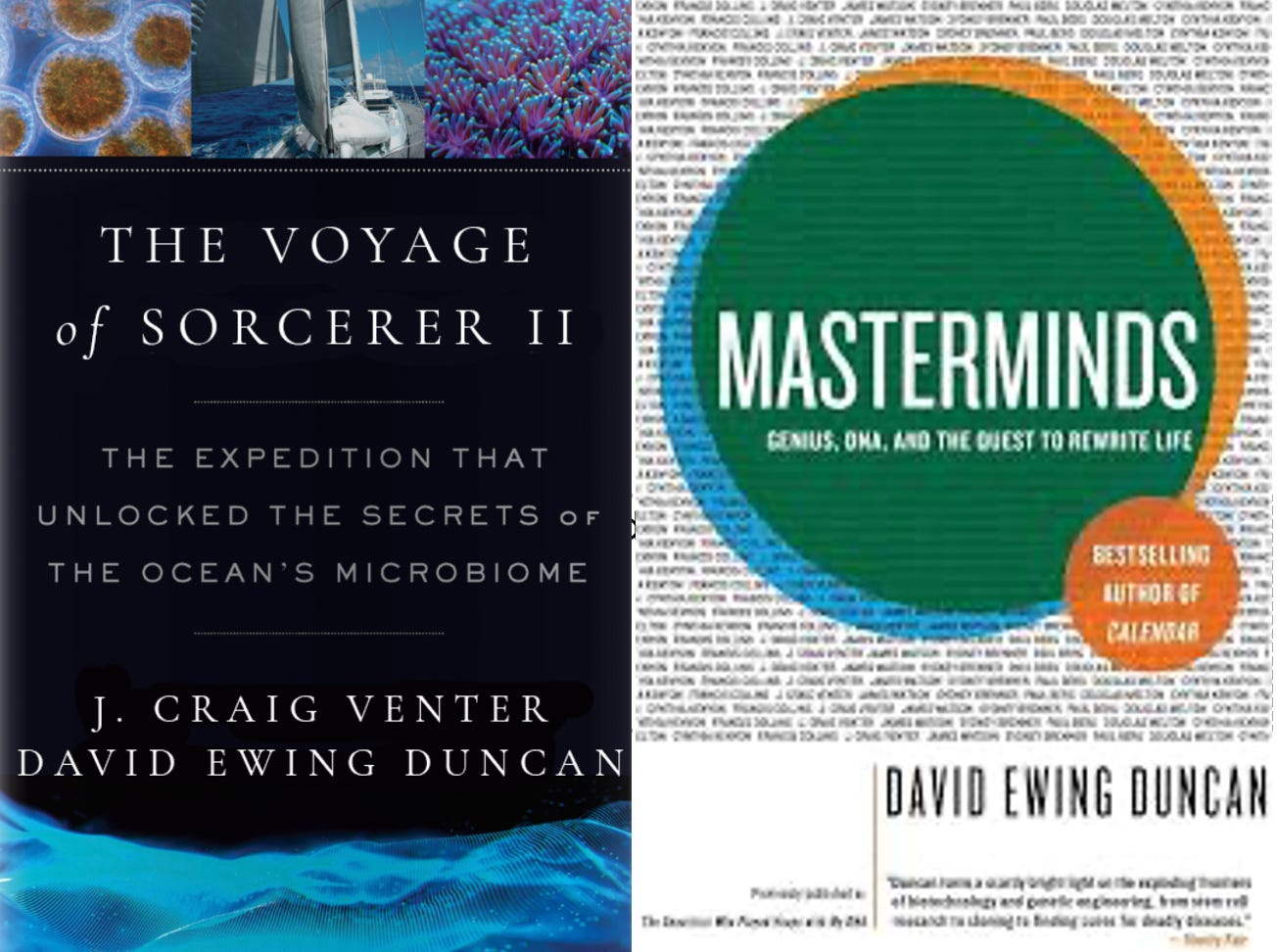
The book I co-authored with Craig Venter:
The Voyage of Sorcerer II: The Expedition that Unlocked the Secrets of the Ocean’s Microbiome, by J. Craig Venter and David Ewing Duncan, Harvard U Press, 2023
FUTURES is a column and a newsletter about possible futures at a pivotable moment in history, where the future could turn out wondrous—or not. I’m profiling interesting people about what they are most excited about and most afraid of for the future. I’m also offering a “skeptical optimist’s” thoughts and commentary on science, technology, politics, and culture and how they may impact the future.
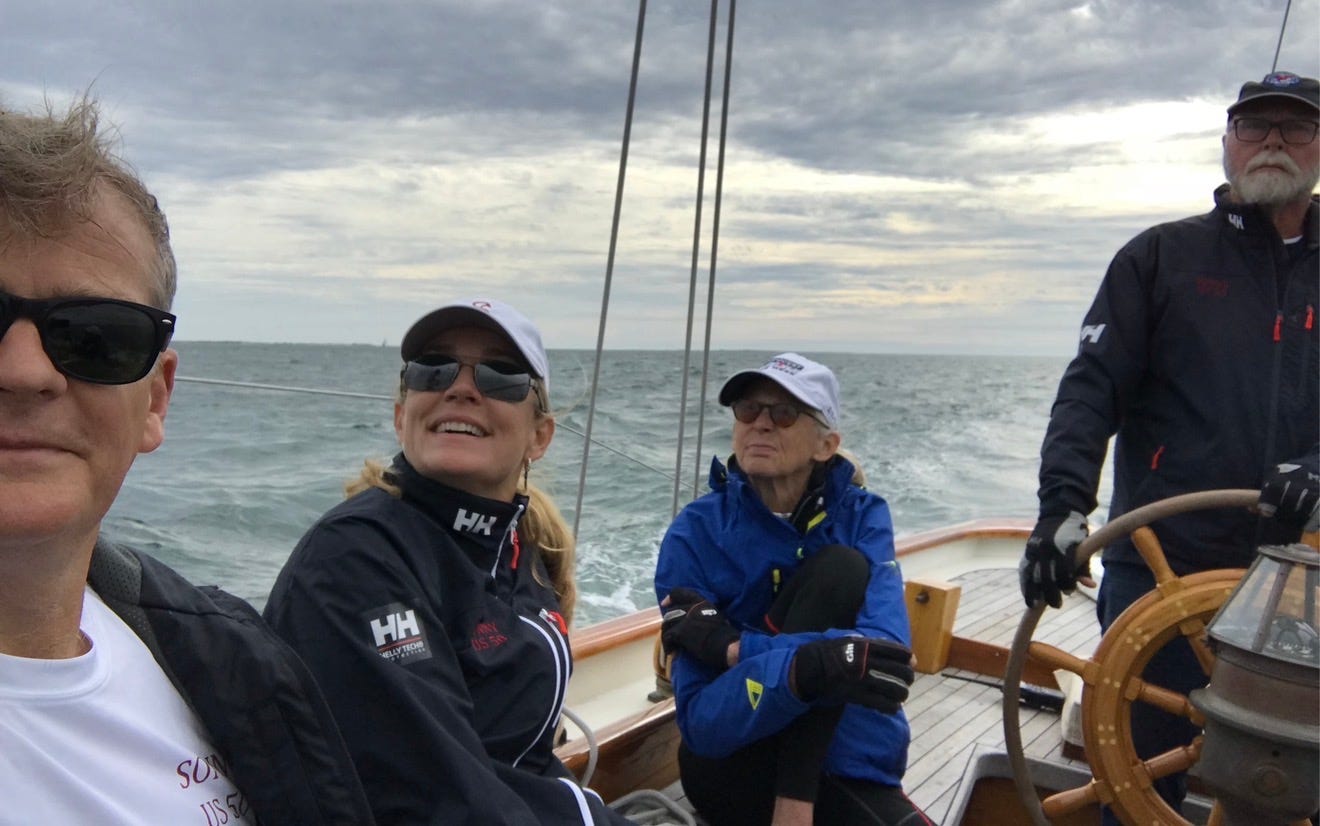
Crewing (not very well) with Craig during a race off Nantucket in 2018.
2 June, 2026
I ask Craig Venter whether he’s a dangerous man, and he laughs. It’s the end of a long day spent with him, and a Maryland thunderstorm is beginning to rage. He shouts over the wind, “Science always has risks.”
“But you are creating life. What if something goes wrong?”
“Look, I won’t tell you that there are no dangers. That’s why this needs to be done out in the open, with careful people making sure that mistakes won’t be made.”
—from Masterminds, by David Ewing Duncan, 2005
__________
I was with Craig Venter in 2002 when he was fired as CEO of Celera, the high-flying company that he founded in 1998 that probably won the race in the early 2000s to sequence the first human genome. Venter had just given Celera’s presentation at the JP Morgan health conference in San Francisco and I was walking with him down a hallway in the Westin-St. Francis hotel when his mobile phone buzzed. Ending the call a few minutes later he looked at me with a mischievous, Cheshire-cat grin and said: “I think I just got fired.”
Turns out that wasn’t entirely true. The actual firing happened a few days later, coming after personality clashes with Celera’s major investor and disagreements over the company’s direction. But Venter clearly knew it was coming and was happy to provide a journalist with a scoop and a moment of Venteresque high drama.
It’s hard to imagine now what a cause célèbre the race to sequence the first human genomewas in the late 1990s and early 2000s. It pitted Venter’s upstart private effort against the multi-billion dollar public sequencing project led by the National Institutes of Health, a competition that was breathlessly covered by the major media like it was a hotly contested sports event.
The race turned Craig Venter into a rock star of science, in part because he was so damn interesting to storytellers like me. We couldn’t help being drawn to a man who wasn’t like other scientists, or most other people. He was loud, brash, brilliant, difficult, charismatic, and larger than life. He refused to accept the status quo and dogmas of establishment science and was driven by a powerful compulsion to expose and ridicule methods and ideas that he thought were wrong or could be done better—while dismissing and sometimes dissing the scientists who advocated them.
Obsessed with speed and competition—he loved to race sailboats, motorcycles, and vintage cars—Venter often outflanked his rivals by his ability to push his science forward at a breakneck velocity that flummoxed those used to a pace more slow, genteel, and deliberate. Venter also refused to play along with the faux humility and denial of ego that tends to be de rigueur in biology, which also left his rivals fuming and probably cost him a Nobel Prize.
Arguably, Venter accomplished at least three Nobel-Prize worthy scientific efforts. First was the DNA mapping and sequencing project that began with his work on ESTs (unique DNA tags) as a researcher at the NIH in the early 1990s and continued with him sequencing the first ever complete bacteria in 1995 and then the human genome in the late 1990s and early 2000s.
Then came Venter’s effort starting in 2003 to collect and genetically sequence billions of microbes from the world’s oceans in a series of expeditions in his 100-foot sailboat, Sorcerer II, which led to a reframing of what biologists now know about the microbiome of the oceans and of the Earth.
Finally was Venter’s announcement in 2010 that his lab had created in a lab for the first time a complete synthetic genome of an organism, Mycoplasma mycoides, a tiny bacteria that sprang to life when booted it up in a cell. This news was so controversial that President Barrack Obama hastily ordered the formation of a Presidential Commission for the Study of Bioethical Issues to investigate ethics and security concerns around synthetic biology.
These projects generated three seminal papers in biology:
This paper was released the same week that the rival public effort released their version of the first draft sequence of the human genome: Initial sequencing and analysis of the human genome, International Human Genome Sequencing Consortium, Nature, 2001, 409, 860–921
Craig Venter accomplished these things and much more as a maverick devoted to a relentless search for truth in science, and by creating and supporting technologies and methods to create the necessary and verifiable proof. He could be reckless and overblown in his pronouncements and attitudes, but in his science he insisted on facts and evidence—which is what kept his critics and enemies from destroying him, because he was often right. But it also was a choice he made that turned his maverick personality into a force for moving science forward even when he upset politicians, scientists, funders, and anyone else whose work, opinions, or strategies he challenged.
This is an important example for us today as we watch big personalities who claim to be mavericks pushing questionable science and dismantling and defunding rigorous efforts, data collection, and findings because they are inconvenient politically. Or because they contradict the unfounded theories and pseudo-scientific claims made by these so-called mavericks. This is a dangerous undertaking for a country and a civilization that needs real science to literally keep the lights on.
Craig Venter didn’t work alone. Part of his story is how he was able to attract powerful allies in the government and in the nonprofit world, despite his many enemies, who supported and funded his brash ideas. Through a series of nonprofits institutes he founded, which were eventually folded into the J. Craig Venter Institute in La Jolla, California, he raised substantial funds from government scientific agencies and major nonprofits based all over the world.
More impressive was the billions of dollars he raised from the private sector for a half-dozen major companies he founded or co-founded including Celera, Synthetic Genomics, and Human Longevity, Inc., money he used as much to further his basic research aims as he did to create products and a return on investment. Most of his companies ended up flying high with wild valuations fueled by excitement and exuberance over his discoveries before dropping back to Earth, often because his ideas and methods were too early to effectively commercialize. Yet he always found investors willing to invest in him again.
Despite his reputation as a provocateur, Venter was a careful scientist who surrounded himself with smart researchers and collaborators, most significantly the Nobel Laureate Hamilton Smith. He also mentored and supported hundreds, possibly thousands of researchers at his institute and all over the world, some of whom I got to speak with over the years and as I was helping to write about the Sorcerer II expeditions. His ship docked in dozens of countries where Venter’s team collaborated closely with local researchers from Bulgaria on the Black Sea to the Galapagos, Fiji, Halifax, Panama, and beyond. Many of the scientists joined funders, supporters, and buddies on board Sorcerer II to sail with Venter and his team as they collected billions of microbes in between sailing, exploring, scuba diving, and drinking Grey Goose martinis (alcohol was forbidden when the ship was at sail between ports).
Starting in 2002, I covered Venter as a science journalist writing for magazines and my own books. In 2017, I was visiting Venter in his office in La Jolla when he surprised me by asking if I would co-author a book with him about the global microbiome project. I had to think about it. I don’t normally write books with other people and Venter was known to be difficult. But how could I say no? For a writer, Venter was like a character out of a Shakespeare play or a Charles Dicken’s novel—a hero to some and a villain to others. He also was a scientist who had accomplished as much in biology as anyone else in the past half-century.
At times Venter wasn’t easy to work with. He could be abrupt and hard to pin down, being addicted to doing and action, and definitely not to sitting around and answering my questions for the book. Typically, I’d start an interview with my recording device and within 30 minutes we were off sailing, four wheeling on the desert, playing ping pong, or drinking one of those Grey Goose martinis. Or he was regaling me with adventure stories about sharks and frightening storms at sea when I wanted to get into the details of his science, like what he was thinking about when he was developing, say shotgun sequencing in the 1990s that greatly sped up the sequencing of DNA.
What amazed me most working with him on our book for 3 years was Venter’s willingness as a scientist to ask simple, but often outrageous questions, and to take up what seemed to be lost causes—like the notion common among scientists c. 2000 that the oceans were largely devoid of microbial life, something that he didn’t believe and set out to prove was wrong.
One stand-out memory is the night that Craig Venter might have cried. We were drinking a very nice Bordeaux in his house in La Jolla when he got a phone call from a close friend that the friend’s wife had just died. Venter’s face fell as he tried to comfort his buddy, and I swear I saw a tear well up in his iridescent-blue eyes. Venter also proved to be supportive to me when I got long haul Covid in 2020 and had to take a break from writing because my mind was in a fog. He told me he had experienced some tough mental health moments early in his life and that he sympathized.
Right now, with the world careening and science and facts under a vicious attack, we could use a few more mavericks like Craig who insist on veracity. Yes, he had a huge ego and a sharp edge, but one wonders if these less savory aspects of his personality were critical to his success. Could he have accomplished what he did if he were nice all the time and had less of an ego? Probably not.
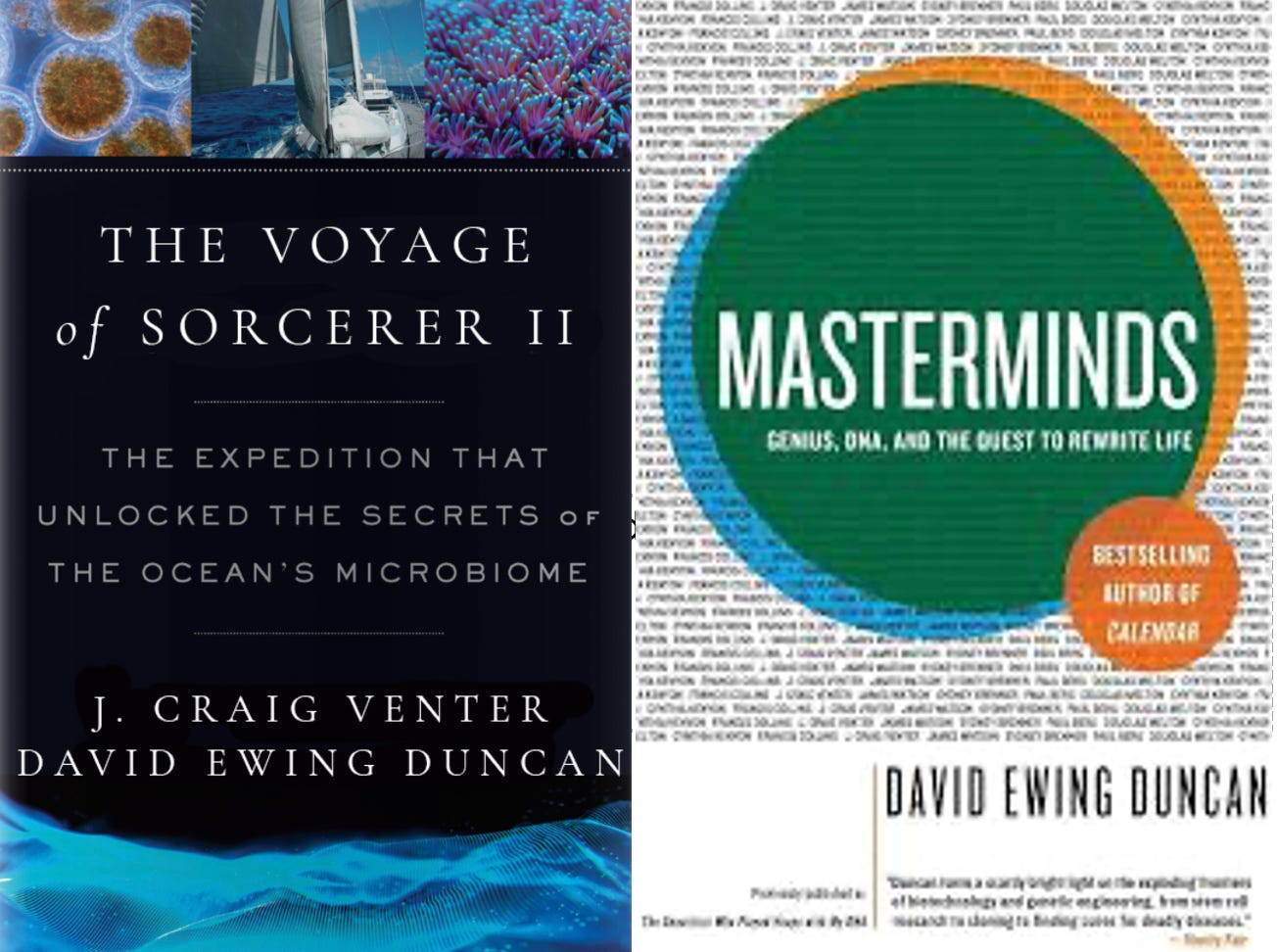
To get a sense of who Craig Venter was and his personality, I’ve excerpted part of a chapter from my 2005 book, Masterminds: Genius, DNA, and the Quest to Rewrite Life that describes Craig at his prime c. 2003-2004.
So… adieu, J. Craig Venter, and thanks for taking so many of us all on the wild, outrageous, grand adventure that was was your life, even if you could at times be a pain in the ass.
___________
Excerpt from my 2005 book, Masterminds: Genius, DNA, and the Quest to Rewrite Life, HarperCollins). I devoted a chapter each to 7 pioneers of genomics in a book the Atlantic called ‘...vivid, memorable portrayals of the scientists working on biology’s most fascinating frontiers.” (This excerpt is slightly edited for space).
______
What would it be like to know the details of your own personal programming, every A, C, T, and G as it swirls along the long, sinewy strands of your own double helix?
J. Craig Venter knows.
He became the first sentient life-form on Earth to possess this intimate self-knowledge when in April 2002 he confirmed what many had already suspected: that the human genome sequenced by Venter’s former company, Celera, largely comprised Venter’s own DNA.
An act of supreme ego, it flouted one of the prime directives of modern science: that a healthy ambition is fine, even desirable, but only if a person does not tout his own greatness and shows the proper awe and sensibility about the scientific enterprise.
To many, Venter’s stunt was the equivalent in audacity of Michelangelo having carved his own head on the statue of David.
“Any genome intended to be a landmark should be kept anonymous,” said Arthur Ca-plan, the University of Pennsylvania bioethicist and former Celera science board member who had helped oversee the selection process for those who contributed to the genome. Caplan and the board set up a meticulous procedure to ensure that donors’ identities were kept anonymous, and that the genome that served as one of the original maps of humanity would be composed of several people. “It should be a map of all of us, not of one,” said Caplan.
A few months before Venter made his announcement, I ran into him at an investors conference in San Francisco and asked whether Celera’s genome is his. Looking like a bulldog with his bald head, thick neck, and wide cheeks, he smiled sardonically, his sharp blue eyes pursed in an expression of devil-ish, slightly menacing glee. “No comment,” he grumbled, though his expression said every-thing—a bad-boy delight at knowing a secret he knew was outrageous and guaranteed to offend the adults once they found out.
Later, I asked Venter if he was trying to be outrageous, wanting to go down in history as the first named person to have his genome sequenced. He tells me they were having a hard time finding people who wanted to donate their DNA for the project. Donors had privacy concerns and worried about finding out they had genes associated with disease. And it wasn’t only his DNA, Venter says. He was one of five people who contributed to the final genome.
“But how much of it was yours?”
“Two-thirds.”
“Which two-thirds?”
He grins and says, “All the good parts.”
I agree in part with Art Caplan. It’s not quite the same knowing that these genes belong to a single man, though in some ways it makes the story of the human genome project more intriguing to be attached to a person whom some scientists consider to be Lucifer for brazenly challenging the often-self-ennobling public effort to sequence the human genome. Call me perverse, but a touch of the devil isn’t always bad. This sort of outrageous behavior has a long tradition in science and philosophy dating back at least to Socrates, who was so outrageously mischievous in exciting the intellectual passions of Athenian youth that the city’s elders put him to death. The audacious Galileo nearly suffered the same fate at the hands of the Inquisition. More recently, Watson and Crick were devilish in their discovery of the double helix.
Craig Venter may or may not be comparable to these famed bad boys, but he would not object to the comparison.
Call these historic figures devils—or curmudgeons, buccaneers, and renegades. But in all cases, they were also extraordinary innovators whose ideas were either too advanced for the establishment to absorb—this is Venter’s claim—or were at some point actually hindered by their own arrogance and less than diplomatic personality. No matter what people think of Craig Venter, he shook things up mightily during the race to sequence the human genome. He had, and continues to have, outrageous ideas that the scientific establishment frequently proclaims are unworkable. Yet Venter has succeeded anyway, drawing on a potent arrogance and self-confidence that have transformed this previously obscure researcher into possibly the best-known molecular biologist in the world after Watson and Crick.
Venter continues to dazzle and to piss off people. Right now, with a nonprofit institute he set up mostly with his own money, the J. Craig Venter Institute, he’s trying to create the first-ever synthetic organism, while also working on a project to catalogue all the genes on Earth in a global sailing expedition that he compares to the voyages of Charles Darwin. Supremely immodest, Venter surges forth like a force of nature that can be awesome to behold. Yet he also possesses an element of danger, a sense that this ex-surfer would leap headlong into riding a maverick wave the size of a skyscraper whether or not he could handle it.
In a man talking about creating a designer life-form, this maniacal energy makes some people nervous that he may one day push over the brink. Some Venter detractors think that he already has, with richer imaginations no doubt wondering if, on a dark and stormy night, they can hear the brouhaha of a classic vaudeville Villain echoing from Venter’s laboratories in Rockville, Maryland, or from his yacht now plowing the Pacific Ocean searching for new life-forms. Except that this is a villain whose ideas have tended to be important and correct, even when the establishment doesn’t initially believe him.
So which will it be? Will Craig Venter save us or ruin us? Or do both...?
*****
During the dash to sequence the human genome Craig Venter’s adversaries called him “Hitler,” “an asshole,” and “an opportunistic maniac and leech.” Francis Collins [the leader of the NIH public genome sequencing effort] sometimes ended presentations with a slide of a double helix made entirely of money, preaching against those who would sell the human genome as a commodity. The public scientists often vilified Venter when talking to reporters, which had its intended effect in the media as newspapers and magazines ran stories about Venter cashing in on human DNA. It was Time magazine that dubbed him the “bad boy of science,” and a playwright in the Netherlands wrote a play about the history of the world that included Venter at the end in the role of the devil. “I don’t mind being bad boy,” Venter retorted; “I just don’t want to be evil boy...”
In Venter’s view the enmity toward him arises from his role as an innovator whose ideas are both novel and a challenge to the powers that be. In his mind, it’s Prometheus against Zeus and the Olympians, Martin Luther against the Catholic Church, and Thomas Jefferson versus King George III and British tyranny. Or to use Venter’s own description, he was Robin Hood up against what he called “the evil sheriff,” with him taking money from the rich—the investors in Celera—and giving it to the poor—the public, when he eventually had Celera release the human genome sequences for no fee into a public database. “Watson and Collins spent so much time building up the Genome Project as the most important thing for humanity,” says Venter, “and with the U.S. government, that I guess it made them look bad that a small group like ours could do it independently, right?”
“We were the underdog” he says, “and we took on the giant and we clearly won. Whether there was a race or not, we won by actually succeeding at what we were doing. They tried to humiliate me when they couldn’t beat me with their science. But we didn’t have to humiliate anyone.” He says that the underdog story was one reason the media gave him so much attention. “The press is one of the few things that gives an underdog attention. If we had a state-controlled press, you never would have heard from me, and the human genome would not be finished yet.”
Venter tells me that he was forced to go the private route of financing. “I had two choices, a very clear bifurcation. Yes or no. I could have done what most scientists have done when they have novel ideas and they get attacked; they pick science out of frustration, and they become bit players. And, in fact, I went ahead and found independent resources to pursue my ideas, and, quite frankly, that’s the only reason we’re having this conversation today. So you have a choice of pursuing your ideas or going out of existence.”
“So you would have preferred to stay on as a researcher at the NIH rather than a CEO?”
“Oh yeah, I probably would have stayed. I really liked being at the NIH.”
Venter says that as an innovator he does not expect to have his ideas welcomed right away. “I don’t object to the onus being put on me as a scientist at the leading edge to have to demonstrate the veracity of what I’m doing,” he says. “There is a lot of hype and a lot of dishonesty out there. What I do object to is people in powerful government positions who use their position in a political fashion. All you have to do is go back and read the press. These were very personal attacks. These weren’t intellectual attacks. They weren’t scientific. They were the kind that were trying to destroy and hurt what we were doing. Why? Because we were competing successfully against them. My idea of science is very fair, but these people weren’t telling the truth. I think science suffered a lot.
“People can offer up bullshit premises in the press and try to change public opinion,” he continued. “But with science, it gets down to reality. It gets to you either have it, or you don’t. All these guys were standing there literally frothing at the mouth, waiting for me to fall flat on my face. Yet it should have been important to them that we were moving forward in the genome sequence faster and making the data available to the world.”
As we talk, Venter ticks off some presumably Nobel-worthy innovations. “There were the strategic breakthroughs with the whole genome shotgun sequencing and the ESTs combined with new computers and new sequencing techniques-randomness, and massive parallelism, you know, the real breakthroughs. Without those, there would not have been a public genome effort,” says Venter. “So there was nothing really invented in the public genome effort. They used commercial sequencers, and they used ultimately the approaches that my team developed.”
His detractors say that others contributed key elements to these breakthroughs. Venter says he is happy to share the credit. “I had a wonderful collaboration with people like Ham Smith, and mathematicians like Gene Myers who really made breakthroughs on their own. They deserve the credit. I could not have built those algorithms. I helped create the situation to help design them, to improve them, but it’s a team effort. I get accused of doing brute force science; the public genome effort was clearly brute force. We used elegance, we used novel mathematical equations, we did it all in one small center…”
Venter also gives credit to the private sector for his successes, offering no apologies for going commercial. “I find it incredibly hypocritical that all of these scientists were saying I was evil for this. Most of them have done this, too. They patent their discoveries, themselves or their universities. But I interfered with their plans, so they came after me. But I did not consider dealing with commercial enterprise to be dealing with the devil. Some of the people involved in those enterprises were not the most upstanding individuals, and their personal motivation was just greed. But that’s okay, that’s how our society works. People that are motivated by pure greed only get their money when they produce something that’s beneficial to society, and society wins if there’s a new treatment for cancer.”
I suggest that Venter’s forays into private industry seem to have paid off for him personally.
“This is another myth. I personally made very little money out of Celera. The stock went to the foundation. A lot of people are confused because at the peak of the irrational exuberance the stock, or the options, that I held made me the first paper billionaire in America, but the fact that I barely made a few million dollars out of my billion dollars’ worth of stock didn’t ever make news.”
“A few million isn’t bad for a Robin Hood.”
“Yeah, but I did what I said I would—I released our data to the public…”
******
In his office, surrounded by his awards and toys, I ask Venter whether he thinks history will view the sequencing of the human genome as a big deal. Was it a Copernican moment, I ask, a Galileo moment, or a Watson-Crick moment?
“It’s none of those,” he says. “If you look past all the press at all the hype statements, you can trace a lot of them back to the NIH. It’s a more important thing than going to the Moon, or Mars, or all of these kinds of things. The techniques that were developed to do the Haemophilus genome and the Drosophila were the scientific breakthroughs technologically. Having the data collectively in genomics there will be a bright line in history before and after, but it’s a change in basic research, not a change in breakthroughs. There have been very few instant cures, and very few instant insights. Most scientists are overwhelmed by the data, and don’t use most of it.
“But I think of the early stages of my own career, spending ten years to find one protein or one gene. And now any student today can do a computer search. And they can look at our latest paper, and we have 1.2 million genes from just one paper. It’s a revolution that has taken place without people realizing that a revolution has taken place. Because genomics overall, starting with ESTs, has changed the whole paradigm of science. And I guess it will be left up to the historians to look at because it’s been so overwhelming real time, most people haven’t had time to look at it.
“The human genome itself I think was an important contribution,” he concludes. “I think it is definitely gonna help in medicine. But it’s the utilization of that information going forward that will hopefully lead to scientific breakthroughs that will be the important thing.”
“Is it just a step on the way?
“Of course. All of the interesting things are still to come.”

Comments
Nothing yet. Say the first thing.
Sign in to join the conversation.