

Back in November 1979, the editors and writers of a little magazine named The Progressive committed treason. At least, that was the risk they undertook when they devoted the entire issue of their magazine that month to revealing the mechanisms of operation behind the most horrible weapon humanity had created to that point, the hydrogen bomb.
Much like when The Washington Post had published the Top Secret Pentagon Papers earlier in the decade, The Progressive undertook the publication of “The H-Bomb Secret” (as the issue came to be known) in large part because they believed it was a matter in which the First Amendment itself was at stake.
As Howard Morland, author of the central article in the issue, put it at the time:
I am telling the secret to make a basic point as forcefully as I can: Secrecy itself, especially the power of a few designated “experts” to declare some topics off limits, contributes to a political climate in which the nuclear establishment can conduct business as usual, protecting and perpetuating the production of these horror weapons.
Similar to the Pentagon Papers case, when the US Government sought injunctions against both the Post and The New York Times to keep them from publishing, the government had taken action to inhibit publication. Unlike the earlier case, however, “Federal District Judge Robert W. Warren issued, at the Government’s request, a temporary restraining order barring publication of Morland’s article … doing what no Federal judge had ever done before in the history of this Republic - impose a prior restraint on grounds of ‘national security.’”
Over two dozen publications and organizations signed an open letter to the court on behalf of The Progressive and its cause, saying
In a time when military policy is closely linked with technological capabilities. debate about military . policy that uses technical informa tion is part of a vigorous system of freedom of expression under the First Amendment. The Government’s tendency to hide widely known technical processes under a mantle of secrecy in the national interest and prevent press commentary on these matters can only result in stifling debate, not in protecting the physical security of Americans.
Beyond the sheer principle at stake (recall that Post executive editor Ben Bradlee asserted the right to publish by execrising the right to publish), Morland also had some practical goals in publishing the H-Bomb secret, claiming that
[k]nowledge of the basic principles of hydrogen weapon design is helpful in understanding the structure of the nuclear weapon production system. It provides insight into the purposes of continued nuclear testing, the nature of new developments in nuclear weaponry such as the neutron bomb, and the devastating effects of nuclear war.
This was summed up well by the subtitle appended to both Morland’s article, and the entire issue itself: To know how is to ask why.
Morland maintained that knowing the secret allowed American citizenry to become informed critics not just of the weapon itself, but to all the industrial processes that surround the weapon. Knowing how an H-bomb works allows us to understand why materials, processes, and testing programs were run in the manner that they have been run. Knowing the secret allows a new form of scrutiny on all aspects of nuclear weapons production. Conversely, the chief effect of secrecy is to stifle debate about nuclear policy.
Morland concludes by suggesting that “[t]he risks of proliferation of hydrogen weapons, such as they are, must be weighed against the public gain that may come from greater awareness of how and why they are already being produced.”
The editors at The Progressive weren’t spilling the secret because they wanted more H-bombs. Indeed, there has not been a proliferation of H-bombs as a result. Rather, the editors thought that by pulling back the curtain on how the H-bomb worked, they would shed light on a whole host of policies and control structures that had been operating for decades under the benefit of shadow.
In the late 1990s I was hired by an internet startup during the first dot-com bubble. For a couple of years, I helped to build a product and a company that eventually became successful. By “successful,” I mean it was acquired by a much larger company, and some of what I helped to build still exists in its functionality today.
(Briefly: we were trying to move law firm recruiting of recent graduates from a messy paper-based format to a less messy web-based format. The core of the company was acquired by Lexus Nexus about a year after the majority of developers—including me—were laid off).
The job title on my business card was “Information Architect and Applied Semiotics.” I really liked that, in part because nobody (including me) fully understood what it meant. For a few months, it was a dream job. I was being paid to be curious and flexible, which is kind of an ideal state for me. I have no idea if I was good at my job (I was laid off on the same day that two thirds of the company was laid off, so who can say) but I learned a lot, and I produced some really excellent white papers that, to my knowledge, were never actually read by any of the executives at the company.
One day, the Chief Technology Officer came to me with a new task to put on my (admittedly ambiguous) portfolio. This was the early days of the search engines, and he said to me, “We want to start showing up as the first result on the search page.”
Okay, I said. What specific terms do you want us to be top ranked for?
“Legal. Law School. Law Recruitment, those kind of terms,” was the reply.
Now, in 2026, we live in an age where the “search engines” we use have been undergoing enshittification for more than a generation. It is hard to imagine, but there was a time where this sort of request from management wasn’t, on its bare face, simply crazy talk.
Yes, we would be competing against tens of millions, it not a few hundred million, search results. Yes, the algorithms being used by (at that time) search engines like Alta Vista were black boxes and constantly changing. Yes, the mechanisms of the algorithms were intentionally hostile to inquiry (in that they would punish you for trying to design pages to maximize visibility). Nevertheless, in 1999, this felt like a somewhat manageable problem.
So I set about the task of trying to study and learn the dark mechanics of gaming the algorithms. I learned how to improve the straightforward quality of our web pages, so that they would be recognized and rewarded. I also began to learn the often hidden tricks that folks were using to cajople and trick the web crawlers and other automated systems to kick certain pages higher in the rankings. To know how is to ask why.
This is all to say that, for better or worse, I have been thinking about algorithms and how to engage with them for more than a quarter of a century. Moreover, I have not merely been approaching these questions as an amateur or an observer, but often as a paid professional.
I’m also an academic, and so I have often been thinking about these questions as a scholar, as well. I developed a course called “Media for Ministry and Mission,” and have taught versions of it a number of times at a few different institutions. One of the aspects of this course is a section that helps students understand the often byzantine permutations of various algorithms.
The goal is to help them understand why they can have a post or a campaign that has wonderful content and quality, and yet it simply does not or cannot compete against the background noise of slop in the social media feeds. From student feedback I have received, this knowledge has been applicable to individuals working for themselves, as well as those working in media relations and brand management at larger organizations.
I first taught that course six years ago (it was developed as an online course during the height of the COVID distancing protocols). Since the launch of the course, almost every aspect of the analysis and techniques I talked about has had to be rewritten. The landscape is constantly changing.
I have also published on this matter. Back in 2017, I was part of an anthology put together by Thomas Jay Oord called Theologians and Philosophers Using Social Media: Advice, Tips, and Testimonials. In my chapter, I focused on the strategies I was using at the time to engage in political discussions on Facebook.
As I wrote at the time:
One of the notable aspects of social media is the use of algorithms to drive user experience. While this has been a developing mechanism, and algorithms have improved over time, the practice has led to some unwanted effects.
In particular, these algorithms have created a series of “silo” effects. Over time, the system tracks the things you “like,” and reinforces your experience with similar items. This creates an ideological echo chamber…
As I increased my capacity to have civil conversations on Facebook, I began to study these algorithms to see if there were ways I could un-silo myself. My first goal was to increase my engagements with folks with whom I had ideological disagreements. My second goal was to use long-form, irenic disagreement as a model for others on the platforms. In other words, I wanted the feeds on which I posted to become laboratories and teaching tools for “deep reasoning.”
The goal is relationship, not conversion. The deepening relationships allow them to venture together into greater disagreement. Over time, as my friend and colleague Nicholas Adams would say, they learn to “disagree better,” and to “make these deep reasonings public.”
I have a large number of Facebook friends. I knew anecdotally that a good number were on the opposite side of the political and ideological spectrum. But I was also aware that I did not see their posts. I knew they were there, but I could not “see” them or their activities.
So I began to practice a version of this engagement across difference on Facebook. To do this, however, I had to find ways to work against the algorithm. The system’s desire was to present me with similar views to my own. I needed to find a way to get it to present me with difference. The solution was nonsense. Dadaism.
For the past three years, my Facebook strategy has been in two parts. One-half of my wall is spent in long, multi-paragraph conversations around political and moral topics. The other half is a steady stream of short, weird, and obtuse random statements.
The purpose of these Dadaist posts is to create a steady bed of “neutral space.” These posts are devoid of political content, and they “provoke” only insofar as they cause readers to scratch their heads and wonder. As a result, these posts tend to attract “likes” and engagement across the full spectrum of my Facebook friends.
Remember, “Likes” drive the algorithm. Hence, as my “opposites” continue to like these neutral posts, the algorithm brings more of my posts into their feed and theirs into mine.
This increases the possibility that we will see a post with political or moral substance. When this occurs, a practice of deep reasoning can begin.
It is not a perfect system, granted. But I have found that the inclusion of regular randomness on my wall has lessened the silo effect in my feeds. My political discussions online have continued and have grown in overall quality (106-107).
My analyses are never perfect, and my techniques are never fully effective. These tactics that worked a decade ago on facebook are no longer the tactics I use in that particular space. I have also branched out into other social media environments, each with their own particular ways of shaping interactions.
I say all this to emphasize my earlier point: I do not engage with social media (or any media) in an improvisational or ill-considered manner. To quote that line from The Bourne Supremacy, I don’t do random. For the past twenty-five years, I have been studying how social media interactions work, where they work, and why (most often) they fail.
To know how is to ask why.
A year ago, I caused a little bit of a stir on a particular social media platform that used to be known as Twitter. It was a stir that garnered notice from the administration at the university where I teach, at least one right-wing talk show host, and somewhere around eight million pairs of eyeballs.
For about 72 hours, I became the “Fuck You” Dad.
As you may recall, within the first day of taking office on January 20, 2025, Donald Trump signed two executive orders. One of them was a rollback of diversity, equity, and inclusion practices at federal agencies. The other declared that the federal government would officially recognize no distinction between the terms “sex” and “gender” (capturing all language under the concept of “biological sex”) and that only two official sexes (sic) — male and female — would be considered valid.
I have family members and people I love who are Queer, who are LGBTQIA+, and who are Trans*. In particular, I am the parent of a nonbinary child, and I have extended family and beloved friends who are Trans*. Trump’s “there are only two sexes [sic]” executive order put people I love under direct threat.
For those who don’t know me, or don’t know me well, I am a cis-presenting, heterosexual-presenting, middle-aged, married person. By all respects I would be considered a middle-class professional. I have advanced degrees. I present as male (I have a beard and I have what the kids today call a “dad bod”) and I present as white. All to say, my public persona carries with it a huge amount of privilege.
For religious and ethical reasons, I believe that I have an obligation to use whatever social capital I have to speak up with those who are vulnerable. That also can mean that, when possible, I try to draw attention toward myself when doing do can help shield more vulnerable folks from attacks or online hate.
The model for this (as I think about it, anyway) comes from the Gospel of John, chapter 8:
3 Then the scribes and the Pharisees brought a woman who had been caught in adultery and made her stand in the middle. 4 They said to him, “Teacher, this woman was caught in the very act of committing adultery. 5 Now in the law, Moses commanded us to stone such women. So what do you say?” 6 They said this to test him, so that they could have some charge to bring against him. Jesus bent down and began to write on the ground with his finger. 7 But when they continued asking him, he straightened up and said to them, “Let the one among you who is without sin be the first to throw a stone at her.” 8 Again he bent down and wrote on the ground. 9 And in response, they went away one by one, beginning with the elders. So he was left alone with the woman before him. 10 Then Jesus straightened up and said to her, “Woman, where are they? Has no one condemned you?” 11 She replied, “No one, sir.” Then Jesus said, “Neither do I condemn you. Go.” [NABRE]
In a situation where all the attention was being directed at the woman in danger of being killed, Jesus “bent down and began to write on the ground with his finger.” Now, I am hesitant to take the role of Jesus in my readings (that’s a danger deserving a whole other essay), but in this case I am learning from the mechanics of his actions. He does something unexpected: he changes the position of his body (he squats down), and he starts doing an unrelated activity (writing on the ground).
All of this is incongruous to the moment. It disrupts the gaze of the authorities, and distracts the attention of the accusers. For a moment, at least, Jesus gives this poor woman some peace, by drawing all the eyes in his direction, rather than hers.
It’s a little thing, I know, and it is a move that can be rightly criticized on a number of levels. Nevertheless, if you want to understand my actions that followed Trumps executive orders on January 20, 2025, you need to understand that this is what I was thinking and praying about — this specific set of verses.
So I posted a tweet about it. It was very simple. It said:
My child is nonbinary — neither male nor female. Fuck Donald Trump, and fuck anyone who wishes to erase my child.
Now, just because I pay close attention to how algorithms work, that doesn’t mean I had any special insight into how this particular tweet would behave once it was “released into the wild.” But I had some hunches.
First, it was brief. It wasn’t a manifesto or a tweet thread. It got in, made its point, and got out again. People who were scrolling could see it and “get it” very rapidly. That was important. It was like a bumper sticker. The algorithms. feed on simplicity.
Second, it had some cussin’. I have had a lot of thought and prayer over the years about the way that I use vulgarity — or don’t — in my writing and teaching. What I have learned from experiment and observation is that a cuss word (and particularly the F bomb) can quickly polarize a room (real or virtual). Most of the time, in my interactions, I am trying to avoid that polarization. This time, I wanted it. The algorithms feed on polarization.
Third, it deployed a very clear “us and them” rage mechanics. This is a little tricky to talk about. There are a couple of different “hooks” built into the phrasing of the tweet. Each one is designed to get a reader to immediately feel (note feel, not think) “I’m with this!” or “I’m against this!” That is to say, I had a suspicion that both pro-Trump and anti-Trump readers would find some reason to quote-tweet and retweet my message. It was rage bait. The algorithms feed on rage mechanics.
That primed the pump. 10/10, it was a solid banger of a tweet.
But just having a good tweet is less than half the battle. I didn’t just want this to fizzle in some forgotten corner of Twitter. I wanted it to go viral. So I enacted what the Maoists might call “party discipline” on myself. As soon as the message was posted, I restricted myself to only three possible responses.
If somebody replied with a positive or affirming message, I replied “Thank you.”
If somebody replied with a message that they were feeling scared or that they felt emboldened in their identity by seeing my tweet, I replied “Solidarity.”
And if somebody tried to reply in any way that was negative or snarky, or that spoke up for bigotry in any manner, I replied “Fuck you.”
Note: In each case, the period after the phrase was important. Partly because of my own idiosyncratic style, but also largely because of The Discourse (ask your Gen Z children or friends). A “Fuck you” with a period hits different.
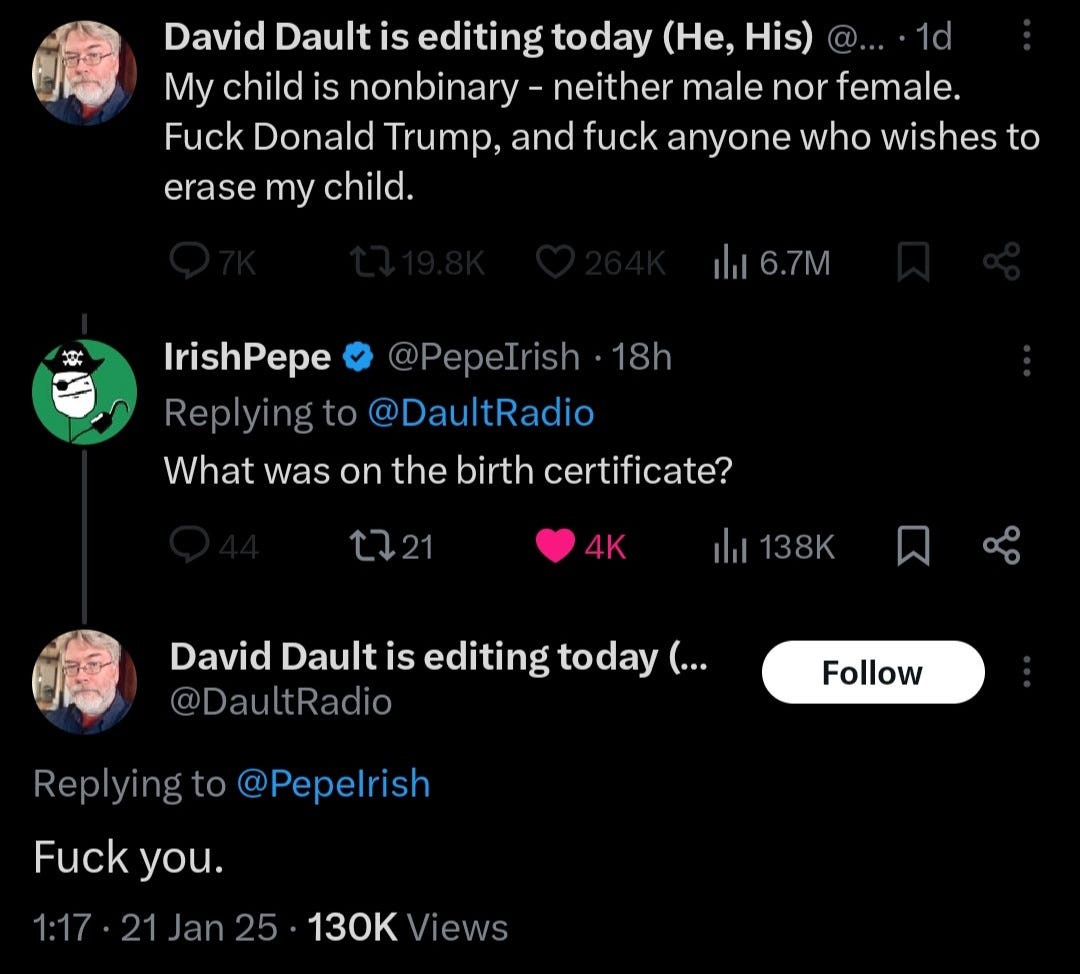
Here’s what started to happen:
The algorithm picked up on the simple and polarizing nature of the initial message, and began to amplify it. But that was nothing compared to what happened when I started replying with the party discipline protocol.
Interaction drives interaction, and the simple nature of both the message and the responses soon became part of the engine itself. Folks were re-tweeting and drawing other eyeballs to the spectacle because of the basic message, yes (because they liked it or they hated it). Soon, however, people were also retweeting and drawing eyeballs to the spectacle with phrases like, “Look at this guy - he’s only answering ‘thank you’ or ‘fuck you’!”
It was like an ouroboros. In no time at all, the engine began feeding on itself.
You cannot plan to go viral. You can only prepare for it.
There is no “magic formula” that makes something break through the social media ionosphere and rocket toward the heavens. What happened over those 72-odd hours was not the result of some secret wisdom I possess. It was simply a matter of knowing a few of the mechanisms, and having a few good instincts.
All to say, when I finally pulled the plug, the post had been viewed over 8 million times.
In this case, going viral was not an accident. I made several very intentional moves to create favorable conditions for the algorithm to amplify the tweet, and then I added some simple accelerants to create a rapid “cloud of witnesses” that were eager to amplify the show, either out of rage, solidarity, or for the lulz. All of those factors made this particular post a viral “success.”
As things were getting started, I reached out to some administrators where I work, to alert them to what I was doing and to advise them to be prepared for what might be coming. I am by no means a spokesperson for anyone but myself in these regards, but when things get heated, those lines often get blurred. I am glad to report that the administrators with whom I interacted were largely supportive, even if they didn’t quite understand what was going on (and it is possible, a year after the event, that some of them still don’t).
And then, I pulled the plug.
Reaching a million or so views accomplished what it was important to accomplish (more on that in a moment), but at around that number of views, we also reached a critical inflection point: influencers started to take notice.
In particular, I began to get attention from a right-wing troll named Ben Shapiro.
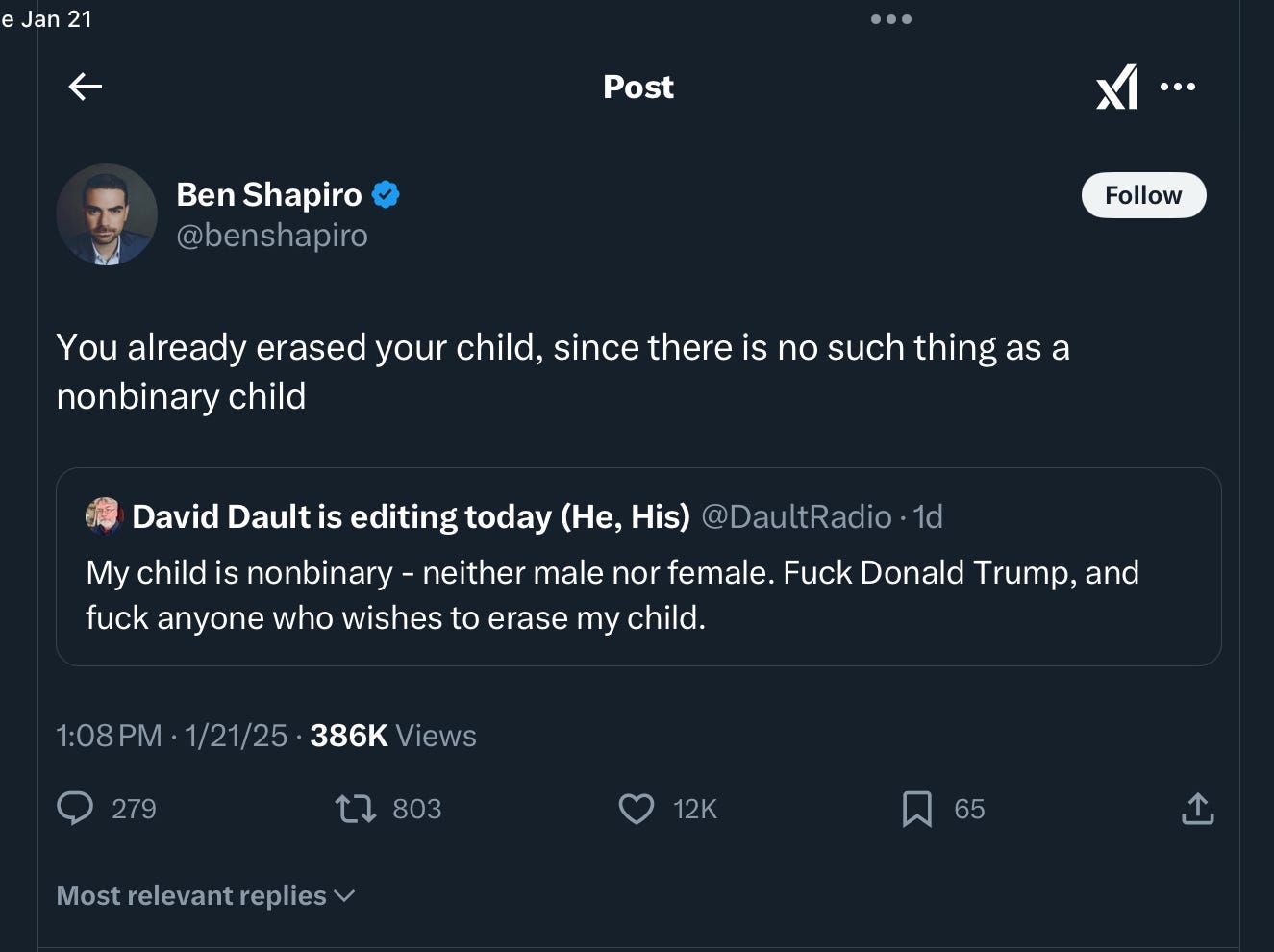
A few minutes after realizing Shapiro had retweeted me, I pulled the original post down.
Why? Because this was not about “going viral” in and of itself. It was, in part, an attempt to draw attacks aways from LGBTQIA+ people, and to keep the trolls and bigots busy attacking me, at least as long as I could. But attention from the “influencers” on social media brings a different level of scrutiny. If I stayed in that orbit very long, I knew that the story might quickly become about “finding the dirt” on the people I love, and that was not a good outcome.
A quick side note: as a result of all this, I did get doxxed, and I did get calls and personal threats. I expected that, and I have handled that, but I didn’t want any of that to blow back toward more vulnerable folks, either because they were associated with me, or more generally.
So I called it quits on this particular experiment, and very soon I went back to being a rather unknown and unremarkable voice on social media.
To know how is to ask why.
I hope folks rading this have a lot of skepticism and criticism of this whole affair, and especially for the way I have recounted it here. I have made myself the center of this story in a manner that deserves criticism. I welcome it.
What I have demonstrated so far is that, when conditions are favorable, I know how to take a message and help it go viral. What I also hope I have demonstrated is that I know when to stop an engine like that, before it begins to generate diminishing or harmful returns.
What I haven’t really talked about yet is why I did it. Why this particular tweet, and not some other tweet around an important policy issue or some other cause?
Well, I mentioned that I wanted to draw attention away from the vulnerable. That was part of it.
But also, on that particular day, I knew that the news cycle was going to be dominated with stories about the executive order. I wanted there to be something on social media that might bring a different message, a little bit of hope. I wanted the possibility that Trans* and nonbinary folks could open their feed and see that there was somebody who maybe looked like a parent who was speaking up and speaking out on their behalf, and who was saying that the bigotry they were facing was wrong.
Furthermore, I knew that if I wrote an essay or a tweet thread, it would get buried by the algorithm, and only a handful of folks would see it. I wanted eyeballs.
To get those eyeballs, I needed to craft the message so that it would cut through, get amplified, and feed on itself in the algorithm. Not for me, and not for the bigots — the rage of the bigots was the rocket fuel — but so that vulnerable folks as far and as wide as could be reached would see that somebody parental cared about them.
It wasn’t about being the “Fuck You” Dad. it was about being the “Fuck You” Dad.
And a lot of folks got the message. A lot of folks replied and said that it mattered to them to see that somebody who looked like a parent (maybe a parent who had rejected them) was speaking up and speaking out, and telling them that they mattered and that they were loved and worth fighting for.
I keep making this about me. I’m sorry. It’s not about me. It’s about them. But their story is not my story to tell. I can only tell you what I did, and what I glimpsed as a result. There are so many folks who needed to hear that they were loved that day, and that we want to keep them safe. I reached as many of them as I could.
I wanted the people who needed it most to hear “Thank you” and “Solidarity.”
I am still getting blowback and fallout from this little adventure. Just last week, I was being interviewed, and the interviewer mentioned in passing, “I wasn’t sure what to expect. I looked you up online, and there were a lot of swear words.”
I laughed, and gave her a shortened version of what I have written here.
If you only view it form a distance, or see it on a search result, the event looks like a fluke, or like it was random. I’m writing this to reiterate that I don’t do random. What happened a year ago was calculated, and it was intentional. I didn’t know for sure that it would work, but I set up all the factors i could to engineer a viral success.
And success looked like this: I wanted to draw as much heat as possble away from those that were under attack. I still do. I wanted those under attack to know they were not alone, and that I am standing with them. I still do.
So this campaign, by my standards, was a success. But there’s institutional blowback, as well. One of the places I work included a version of this episode in a self-study report. It was clear from the way it was worded in the narrative that some of the administrators involved only grasped the most visible parts of the story. Who can blame them? From their perspective, I was creating a public relations problem, rather than an act of radical solidarity. So it goes.
Oh, and I’m up for tenure this spring. If I don’t end up getting it, this very public little escapade might well be a factor. It’s not always good for the brand to be associated with a “Fuck You” Dad. But I have passed all the other hurdles in the process, and I remain hopeful.
A moral of this story is that you should only ever go viral because you really need to, for the best possible of causes. My experience of those hours while it was happening was that it was about the most disorienting social experience I have ever had. I would not recommend chasing this experience for its own sake. Fame of any stripe is super corrosive and probably super dangerous to your soul. The few minutes I was close to it (because having that many eyeballs in your direction is a type of fame, even if a weird type), that much was abundantly clear. I am so glad to be an otherwise overlooked person on the internet.
So, for all of that, it seemed important to be able to tell this other part of the story, and to be able to say, no matter what happens, it was worth it. Having some scared youngster on the internet that I’ve never met say, “Thanks, I wish my dad said things like this,” that makes it worth it.
You know how. Now you know why.
Thanks for reading! It would be wonderful if you shared this with someone who might like to read it. Thank you again.
Comments
Nothing yet. Say the first thing.
Sign in to join the conversation.