
The global economy is being reshaped by a series of powerful, interconnected forces.
Electricity demand is rising, AI is driving a new wave of energy investment, low-carbon technologies are reaching commercial scale, and physical climate risks are changing the economics of assets and supply chains. At the same time, governments and companies are investing in energy security, resilience and the infrastructure needed to support future growth.
These changes are creating significant opportunities for financial institutions. New markets are emerging across power, buildings, mobility, adaptation and digital infrastructure. Clients need capital, advice and financial products that can help them navigate these shifts and invest with greater confidence.
For financial leaders, the strategic question is where these opportunities will develop fastest, and what capabilities their institutions need to capture them.
In this edition of Ask David, I explore five areas where I see some of the strongest opportunities emerging over the next few months and years.
Ask David is an ongoing series where David answers the questions sustainability teams are navigating today and offers actionable advice on demonstrating financial value, strengthening business strategy, managing risk, and driving real organizational impact.
If you want to submit a question to be answered in a future edition, let us know in the comments section.
I see major opportunities emerging as sustainability moves from commitments into execution, because this is the point at which capital is actually allocated.
The commitment phase involved a great deal of learning, target-setting and capacity-building. The execution phase is much more commercially significant. Companies are now investing in the energy transition, strengthening physical resilience and adapting their operations.
That gives financial institutions a clearer basis for engaging clients around specific financing needs and business opportunities.
The most effective conversations are moving beyond asking about a company’s climate target. Banks, insurers and investors need to understand the client’s strategy, planned capital expenditure, operating expenditure and critical dependencies.
Where does the client need to replace equipment, improve energy efficiency or secure cleaner power? Which facilities and suppliers require resilience investment? What new products or markets could support growth?
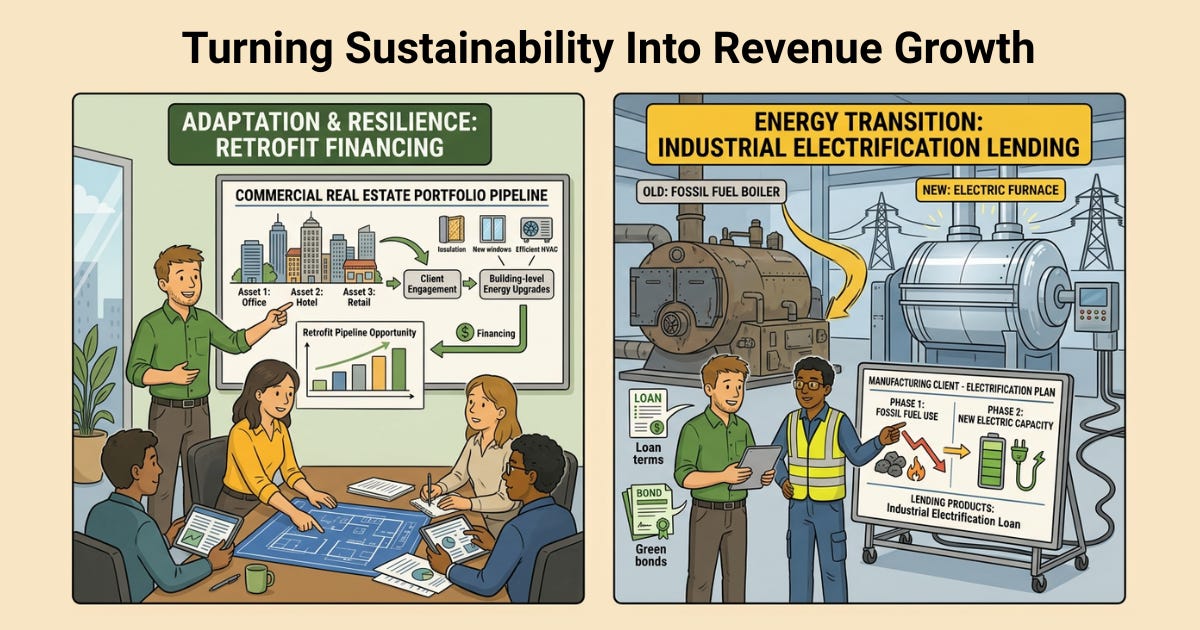
We have worked with several financial institutions to identify these opportunities with clients, both on the energy-transition side and in adaptation and resilience. For example, one European bank we supported identified a pipeline of retrofit financing opportunities across its commercial real estate portfolio by working directly with clients on building-level energy upgrades. Another client in Asia developed new lending products tied to industrial electrification after mapping where its manufacturing clients were planning to shift away from fossil fuels.
The organisations making the most progress are connecting sustainability expertise with sector knowledge, relationship management and financing.
There is already clear evidence of scale. BloombergNEF research showed that global investment in the energy transition reached over $2.3 trillion in 2025.
For financial institutions, the focus is on helping clients turn plans into projects that can be financed. That is where sustainability starts to translate into revenue growth, stronger client relationships and more resilient portfolios.
Comments
Nothing yet. Say the first thing.
Sign in to join the conversation.