
Here’s what we cover this week across the world of sustainability, risk, and finance:
At a glance:
Finance | Only 8% of Private Climate Finance Targets Adaptation
Risk | Wildfires Are Surging Across the US and Europe
Regulation | SEC to Rescind Climate Rule, But Risk Remains
Research | Banque of France Study Finds Nature Loss Could Trigger Stagflation
Policy | EU AI Transparency Rules Live, High-Risk Rules Delayed
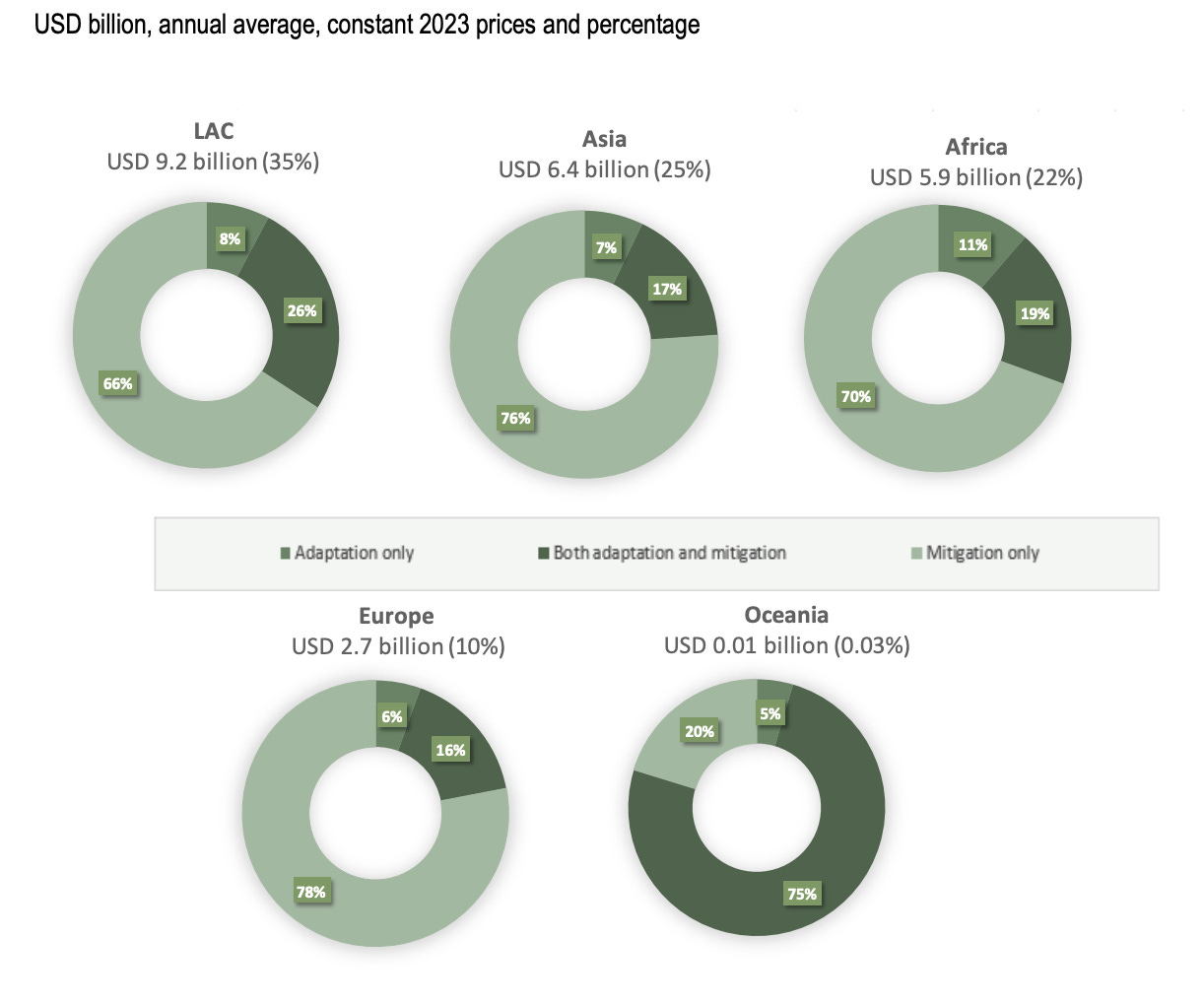
The OECD tracks private finance mobilized through official development finance interventions. Of this pool, an average of $26.2 billion a year supported climate action between 2021 and 2024, around 40% of the total private finance mobilized. Most of it went to mitigation-only activities (70%), followed by combination of mitigation and adaptation (22%), and targeted adaptation (8%).
Adaptation-only projects are particularly difficult to finance because they are often small, geographically dispersed, and lack clear commercial revenue streams. Their benefits may also be public, highly context-specific, or realized over long periods, which increases transaction costs and limits investor appetite.
Finance for industrial decarbonization also remains insufficient. Only $2 billion was mobilized between 2012 and 2023 for steel, cement, and chemicals in emerging and developing economies. Recent growth has yet to produce a structural shift, while major manufacturing centers in Southeast Asia remain largely absent from the leading recipient countries.
So what?
The report shows capital continues to favor mitigation projects with clearer revenue models, while dedicated adaptation finance remains a small share of the total. The OECD’s explanation captures the issue well: many resilience investments generate broad public benefits but lack the predictable cash flows private investors expect.
Public and development finance must play a more active role to close that gap through patient capital, guarantees, and blended-finance facilities.
The industry findings reveal another major gap. Steel, cement, and chemicals account for the bulk of industrial emissions. Finance needs to reach the sectors and manufacturing regions where emissions and transition risks are concentrated, including Southeast Asia.
Read more from the OECD
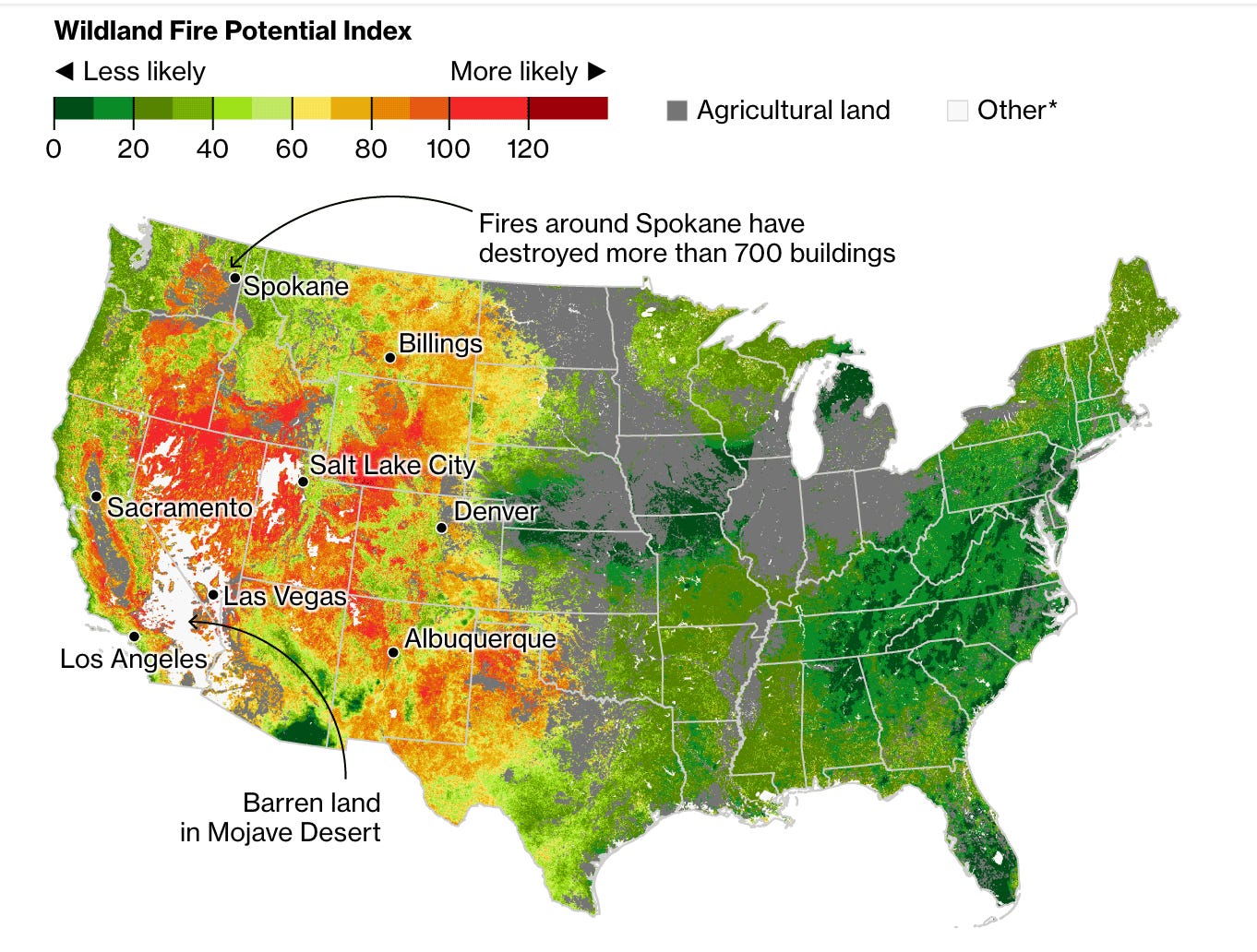
The US is experiencing one of its worst wildfire seasons in years. Through August 3rd, 44,722 fires had burned nearly 5.2 million acres. Around Spokane, Washington, three major fires destroyed hundreds of structures and forced more than 60,000 people, roughly 10% of the local population, to evacuate.
A snow-starved winter left forests across the Western US unusually dry. Prolonged heat causes trees and vegetation to lose moisture, making landscapes increasingly flammable. Global warming is intensifying these periods of extreme heat and dryness, while also allowing severe fire conditions to persist for longer.
The same pattern is visible in Greece, France, and Spain, where recent fires have burned tens of thousands of acres and displaced at least 300,000 residents. These regions have different ecosystems, but each experienced sustained periods of exceptional warmth or dryness. Climate change is worsening fire conditions in established hotspots while expanding the range of landscapes capable of supporting destructive wildfires.
So what?
Climate change is worsening losses in established wildfire hotspots and expanding the number of communities, assets, and supply chains exposed to extreme fire. Due to this, historical fire records will increasingly understate future exposure in places with little experience of severe wildfires.
Moreover, when major fires occur simultaneously across several countries, governments cannot assume that firefighters, aircraft, and emergency equipment will be available from neighboring regions. This raises the risk of longer disruptions, greater property losses, and pressure on insurance markets and public finances.
Read more from Bloomberg
Thousands of investors are opposing the SEC’s proposal to rescind climate disclosure rules that would require listed companies to report climate risks and greenhouse gas emissions. A Risk Journal analysis found that at least 80% of original submissions opposed rescinding the rules. The SEC received more than 18,000 responses opposing the move.
Public pension investors argued that climate-related financial risk remains in their portfolios regardless of whether disclosure is mandatory. Without standardized reporting, investors must rely on inconsistent company data, estimates, and assumptions when comparing exposure.
The SEC says the rules exceed its authority and would impose excessive costs on companies. However, climate reporting is expected to continue through investor demand, existing securities requirements, and state-level rules. California is moving ahead with emissions and climate risk reporting for large companies, while New York is considering similar measures.
So what?
Eliminating disclosures does not eliminate risk. It makes existing exposure easier to identify, compare, and price. Investors will still hold assets affected by floods, wildfires, heat, and transition pressures whether or not the SEC requires standardized reporting.
This also shows policy and market forces moving in opposite directions. Federal regulation is retreating, but investor demand for climate information remains. Many companies have already built the systems and controls needed to report and are likely to continue because shareholders, lenders, customers, and other jurisdictions still expect it.
The SEC’s move will most likely result in greater fragmentation. As states introduce their own requirements, companies could face overlapping rules instead of one federal standard. That adds cost and complexity and reduces comparability.
Read more from Dow Jones
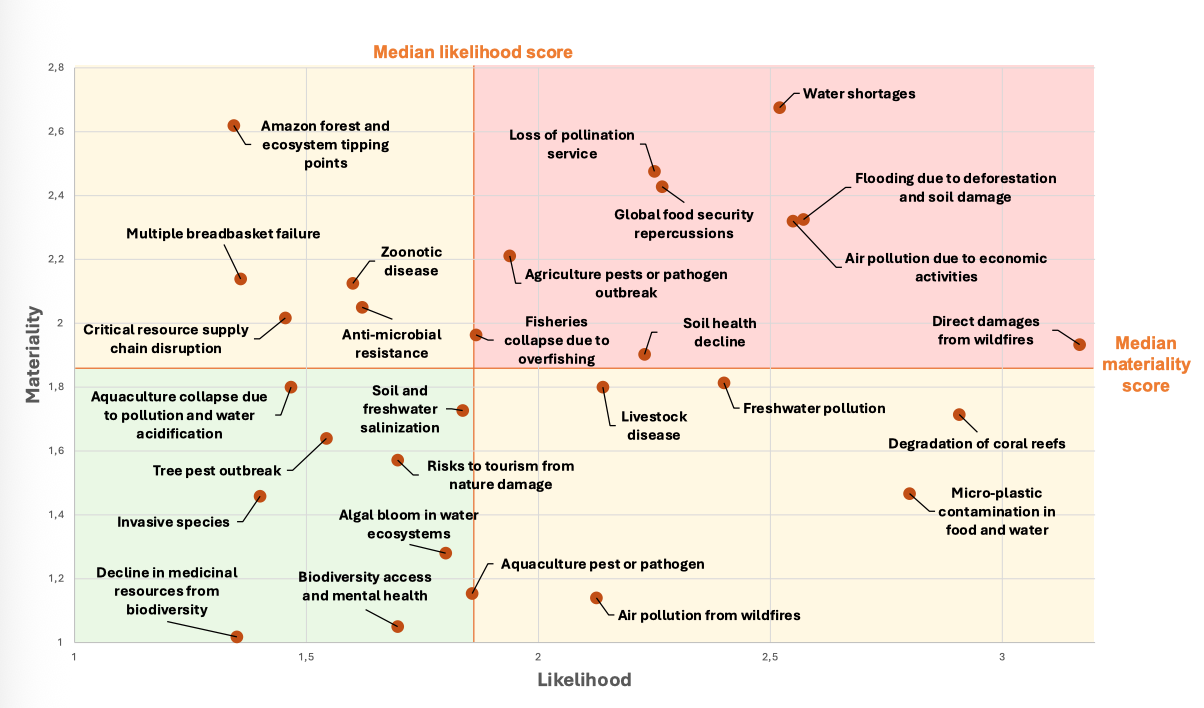
A new study from the Banque of France examines how nature degradation could affect the French economy through two major risk channels: disruption to the water cycle and declining agricultural productivity.
The first scenario combines chronic water scarcity with acute droughts. The resulting constraints on industrial and energy production create a persistent decline in economic activity alongside higher prices, producing a stagflationary shock.
The second scenario models simultaneous crop failures in France and other major agricultural producers. Because France is closely connected to global trade, these losses spread through international supply chains, causing deeper output declines and sharp increases in food prices.
The study warns that more frequent nature-related shocks could threaten price stability and complicate monetary policy. It also finds that standard macroeconomic models struggle to capture the non-linear effects and sectoral connections involved.
So what?
This study shows how water scarcity constrains industrial and energy production, which then reduces output and raises prices. The same pattern was visible during France’s 2022 drought, when low river levels disrupted nuclear power generation and contributed to higher energy costs across Europe.
The water scenario also demonstrates how chronic and acute risks compound. Long-term scarcity weakens the baseline, leaving the economy more exposed when a severe drought occurs. Models based on historical averages may underestimate both the frequency and scale of future losses.
The multiple breadbasket failure scenario shows how local ecological shocks become global financial risks. Simultaneous harvest losses spread through trade and supply chains, increasing food prices, weakening household purchasing power, and putting pressure on corporate margins and monetary policy.
Access the paper here
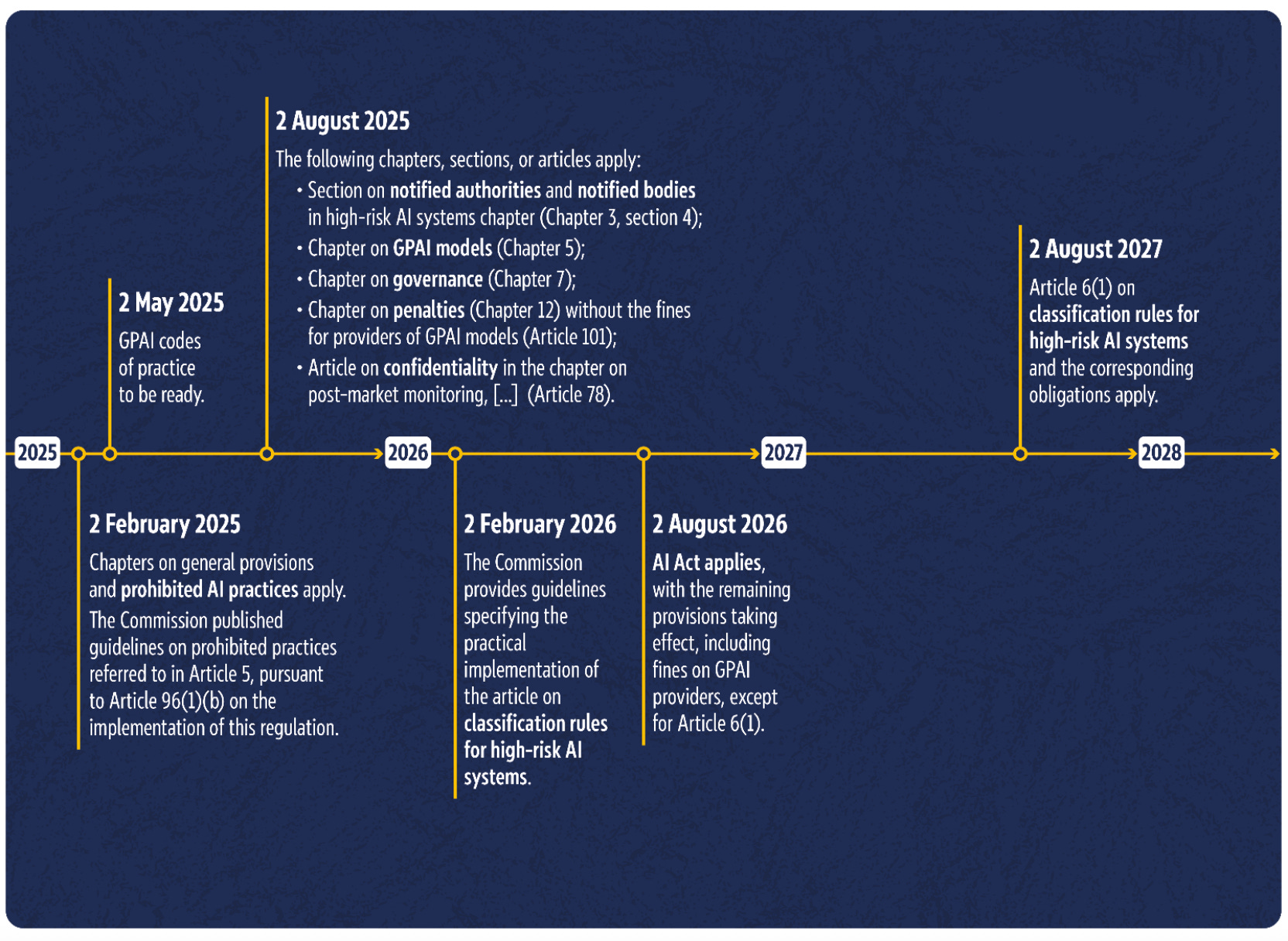
A new phase of the EU AI Act took effect on 2 August. Companies must now tell users when they are interacting with AI and ensure certain AI-generated or manipulated content can be identified. People must also be informed when emotion-recognition or biometric-categorization systems are being used. Breaches can result in fines of up to €15 million or 3% of global annual turnover.
The Act’s more demanding rules for high-risk systems have been delayed until December 2027. These cover AI used in areas including employment, education, essential services, migration, and border management. The European Commission says the delay gives companies and regulators more time to develop technical standards and guidance, while critics warn that it leaves vulnerable groups without the Act’s strongest protections.
So what?
The AI Act may follow the same path as GDPR and EU climate disclosure rules. Companies serving European customers often find it cheaper to build one product to the strictest standard than to maintain separate compliant and non-compliant versions. Requirements to label synthetic content and disclose AI interactions could therefore become global operating norms, even where governments have not introduced equivalent rules.
However, the Brussels effect is strongest where requirements can be standardized across markets. Disclosure and labelling rules travel relatively easily. Enforcement, penalties, and rules tied to specific uses or jurisdictions remain local. The delay to high-risk obligations also shows that regulatory convergence is not guaranteed. Competitiveness concerns can slow implementation, even after legislation has been agreed.
Enjoyed this analysis? D. A. Carlin & Company helps clients navigate these turbulent times through strategic briefings, practical capacity-building workshops, and regulatory support. Book a call with us today (info@dacarlin.com) and find out how we can give you and your team the future-ready skills and strategies you need.
No posts
Comments
Nothing yet. Say the first thing.
Sign in to join the conversation.