
In this final installment of Life Between Skate Tricks I’m going to focus on why the strategic placement of seating and standing zones relative to the obstacles in designated skate spaces is equally important as the skate obstacles themselves.
Let’s start with a photographic example and then some video examples of how skateboarders made use of unwittingly well placed seating and standing zones that existed near the obstacles they skated in two of street skatings most well known spots.
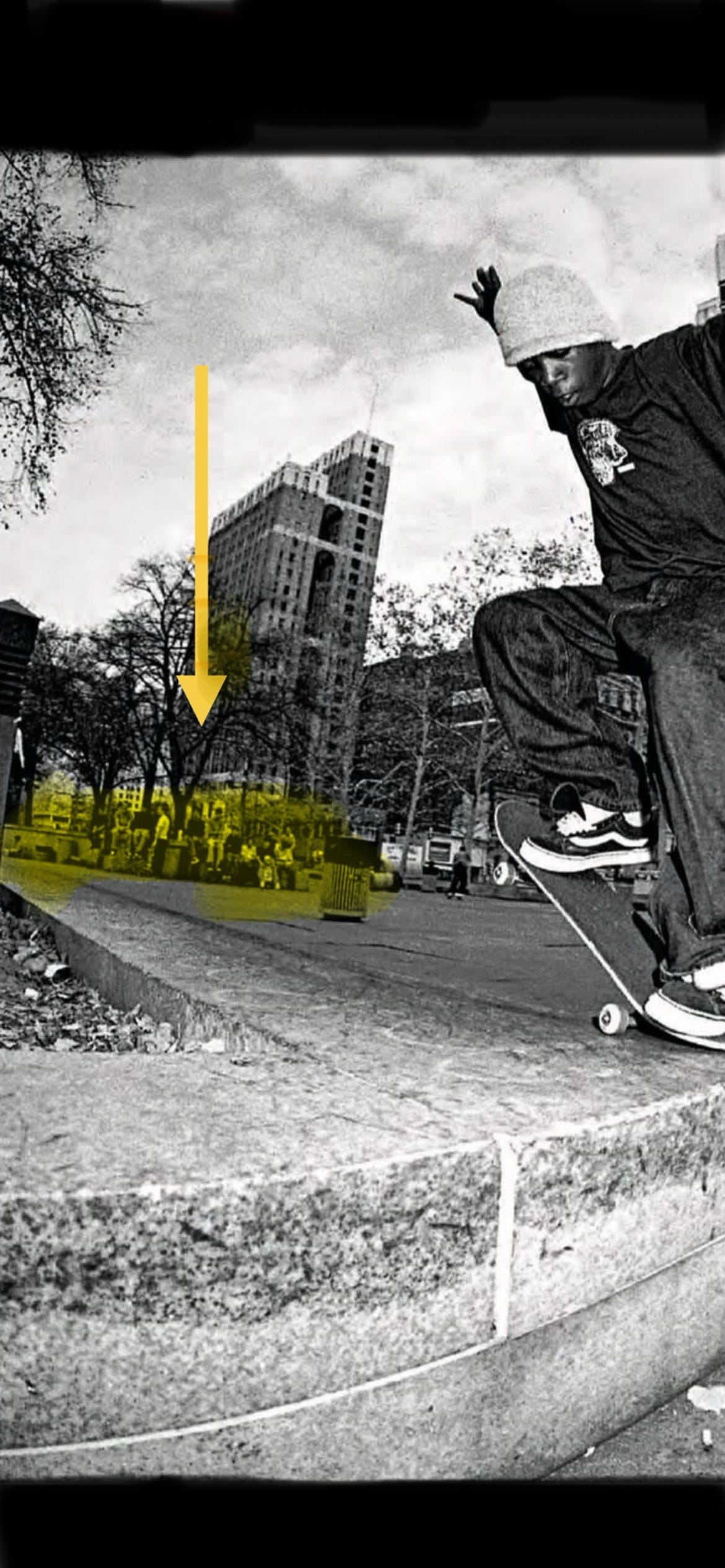
Take notice of where all the skaters watching Stevie Williams skate the main ledge at Love Park are sitting or standing. This tall ledge that ran perpendicular to the main ledge and was an estimated 40 to 60 feet away possessed all of the hallmarks of well placed seating in a skate space. It wasn’t in the way of where people skated. While seated, onlookers were oriented towards the main ledge. The seating was the proper distance away from the skated ledge to be the place where skaters waited in between trick attempts. This meant that the waiting in between trick area was combined with the sitting, hanging out and maybe not skating at all area. This seemingly innocuous seating placement lead to a highly social environment that played a crucial part in the development of Love Park’s vibrant, unique and historically remarkable skate cultures. The spatial relationship between the skated ledge and the ledge for sitting was symbiotic in the evolution of these cultures.
Look at where the skaters watching Kevin Taylor do his line at Love are hanging out. They’re on the other side of the main ledge. So we see that both sides of the main ledge at Love Park had optimal zones in which to linger.
Think of this, at one point City Hall and Love Park were both skateable and across the street from each other. City Hall and Love Park had amazing ledges, stairs and rails that were made out of similar materials. Both were no doubt skated heavily back then, but as Rick Oyola famously (amongst skaters) said in the 411 Philly metrospective, “City Hall’s the new rad spot these days……..now that Love Park is banned”. I can’t help but assume that Love Park was the chosen spot of the two because while both contained great conditions for skateboarding, Love Park contained much better accommodations for sitting/viewing/standing/lingering. When it comes to street skating, if there are two spots near each other with similar obstacles but one has better seating and standing zones, skaters will always favor the place with better conditions for life between skate tricks. I guess it’s mostly a subconscious choice, because when skateboarders make designated skate spaces they never include properly placed seating or standing areas.
Look at all the life between skate tricks happening in this clip of Sal Barbier at Embarcadero. People sitting on the stage, on the ledges, next to the steps, and on the three steps. All out of the way of, but in view of, where people are skating. Again all of these areas to sit and stand played an integral role in the street skating culture that developed at Embarcadero in the early and mid 90s.
A more current example is Tompkins Square Park. There’s a ton of wooden obstacles there these days, but at times there has been next to nothing or actually nothing but flatground to skate at Tompkins. Yet skaters would still meet up there and then get stuck skating/ lingering there all day. The simple placement of the original benches made it New York’s best place to skate and socialize. There are spots everywhere in all five boroughs that are easily accessible by a quick train ride or a free ferry, but a court spot with some benches and flatground became New York’s TF. So turns out you might not even need any skate obstacles to beat modern skateparks in usage comparisons. Perhaps just some well placed benches to post up on and some decent flat-ground are enough. Well maybe you’d need to fire a tombstone in there or something.
Hard to believe that this glaring aspect of the way skaters use public space has never made its way into any of the built environments made for skateboarders by skateboarders. I don’t think the concept has even made its way into the pseudo intellectual world of writing about skateboarding.
Take a hypothetical skater who is given the chance to design a space made to mimic street spots. Let’s say they’re trying to decide what type of street spot to build. For inspiration and because it’s what street skaters do, that person goes out street skating with friends and, for the sake of our example, let’s say they happen upon two new public plazas. Both plazas contain similar skateable objects but one has better sitting/standing options. The situation would play out just like how City Hall vs Love Park did. The plaza with better sitting/standing areas would be the spot our hypothetical skater and their friends would more frequently session. But then that same skater would design their street spot and not include a single properly placed sitting/standing area anywhere in the entire layout. It’s a really unfortunate disconnect. It’s also an extremely consistent one. How it became so persistent is hard to say exactly. But don’t worry, I’m pretty confident I can explain. I’ll save that for later articles. Likely though our skater friend would include some ledges or obstacles that resemble the ones in the new plaza they had recently been skating. But overall the layout would probably just consist of some ledges, curbs and maybe a bank or two all lined up in a row and across from each other. Or maybe a mix of these obstacles would be clumped together into one skateable sculpture floating awkwardly out in the middle of a space and neither option would have any properly placed seating in sight. It’s as if skaters get overwhelmed or too excited by the opportunity to make whatever they can think of in a space and forget all about how much they enjoy hanging out with their friends while skating and talking with other skaters and non skaters as well.
I’m not saying that the spot our hypothetical friend would design wouldn’t be fun to skate. It definitely would be. But that would be the only enjoyable thing to do there. Just like City Hall the space would be phenomenal to skate but not so great for socializing. In the history of skateboarding so far no one has ever designed a space that functions like our culture’s most highly regarded street spots. Even the new skate space that is an exact replica of a section of Love Park functions more like City Hall than Love Park. In that space the lingering zones are in between the skateable ledges, which does give a good view of people skating and they are mostly out of the way of people skating so in those respects it’s better than most skate spaces. Unfortunately though there is no seating placed in the standing zones where people wait in between tricks. The situation is similar at Montreal’s granite plaza, and the two new skate spaces in San Francisco. They have zones for sitting but as far as I can tell from photos and videos none of those areas are optimally placed.
Just to be clear I don’t say all of this in a hateful manner. I would love to skate all of these new spaces. They all look unbelievably fun to skate and I see them as a vast improvement relative to typical modern skatepark designs. I also have nothing but respect and admiration for the people who designed and then managed to get these places built. I just see a design element that is consistently overlooked.
The fact that well placed seating and standing areas can greatly improve the quality of public spaces seems to be an unknown concept in the world of skate park/ skate space design but it’s old news in the regular public space design world. In fact the last chapter of Life Between Buildings is almost solely dedicated to this topic. So if my rants or my video and photographic evidence aren’t enough to convince you of the importance of well placed sitting and standing areas in public spaces (including skate spaces) maybe you’ll take it from an expert who developed and used these principles to redesign much of Copenhagen, Denmark. A city full of skateboarders, that plenty of skaters travel to these days and I’m sure they can all attest to the high functionality of Copenhagen’s public spaces.
The following are a few quoted paragraphs from the beginning of the aforementioned chapter.
The preceding sections discuss ways to assemble people and functions in time and space and ways to integrate, invite, and open up rather than close in activities through city and site planning. Thus, primarily the incidence of activities is influenced: that is, how many people actually come. But the activity level and number of events do not in themselves describe the quality of the public environment.
That people and events are assembled in time and space is a prerequisite for anything at all to occur, but of more importance is which activities are allowed to develop. It is not enough merely to create spaces that enable people to come and go. Favorable conditions for moving about in and lingering in the spaces must also exist, as well as those for participating in a wide range of social and recreational activities.
In this context the quality of the individual segments of the outdoor environment plays a crucial part. Design of individual spaces and of the details, down to the smallest component are determining factors.
As discussed earlier in this book, it is important to note how the various categories of outdoor activities are influenced by the quality of outdoor space, and in particular how it is precisely the optional, largely recreational functions and social activities that are given a chance to develop where such quality is improved.
Conversely it has been noted how these very activities tend to disappear where the quality has been reduced.
In this section, where the subject is not the number of events but the character and content of outdoor life, it is important to note that these activities, which make it particularly attractive and meaningful to be in public spaces, also are the activities that are most sensitive to the quality of the physical environment.
Skate parks and other designated skate spaces do a great job of allowing people to come in and skate and then go. However they are terrible places in which to linger and socialize. This means that the character and content of the time spent in skater made spaces is relatively low grade. (Relative to non skater made street spots like Embarcadero, Love Park, Brooklyn Banks and many other lesser well known street spots.) They simply lack the conditions for any other quality social or recreational activities to develop. Because of street skating we know that a majority of skaters would prefer a spot that is well designed for skating and socializing over one that is just properly designed for skating.
However this doesn’t mean that we can just plop a bench any old place in a skate space. Or put an ambiguous skateable ledge in the place where skaters would sit and/or stand in between skate tricks to approach other obstacles and say it’s multi use. As mentioned in the above quoted paragraphs “it is important to note that these activities, which make it particularly attractive and meaningful to be in public spaces, also are the activities that are most sensitive to the quality of the physical environment.” This means that “Design of individual spaces and of the details, down to the smallest component are determining factors.” In skate spaces the minute details of seating placement and standing zones relative to the skate obstacles have to guide the layout in order to create a skate spot that is particularly attractive and meaningful to be in. Not only for skaters but non skaters as well. All seating has to be for sitting only and placed so that it is oriented towards the skating happening in the space. It also must be situated in the zone where skaters stand in between trick attempts. Any other configuration will degrade the quality of socialization. Too much or too little approach space from the combined sitting/standing zone would be equally as detrimental. The Skate Court, The Quarterpipe Park and the Stair Spot all adhere to these seating/standing zone principles. If any of these three designs were built and placed next to any skatepark in the world I’m confident that their use would dwarf that of any existing skate spaces. Humans are social creatures. Skateboarders included.
If you disagree with me about this bold claim let me point you in the direction of another observation mentioned in the last chapter of Life Between Buildings.
Common activities and experiences as well as unexpected or unusual events serve to initiate and generate conversation. In The Social Life of Small Urban Spaces, William H. Whyte uses the term ‘triangulation’ to describe this phenomenon, as, for example in the interrelationship between street performers and audience. Spectators A and B exchange smiles and begin to talk while enjoying the skills and talents of the street entertainer, C. A triangle is formed, and a tiny but very enjoyable process has begun to develop.
If a space is consciously designed for life between skate tricks, an enhanced version of this triangulation phenomenon has the potential to develop. For instance, Spectators A and B (who are both skateboarders themselves) exchange a shared reaction to the skills and talents of the Person Actively Skating C. If the area to wait in between tricks is also the spot where skaters sit and stand when not actively skating then C will come back to the zone where A and B are talking about what C just did. B compliments C on the trick just performed while A sets off to attempt a trick of their own. Then B and C talk about A’s unexpected slam that just occurred. These small interactions taken all together are this enhanced form of triangulation. It makes both skateboarding and socializing thoroughly enjoyable. It’s probable that those small bits of easy going banter will develop into more lively conversation. It’s triangulation but with a line from C back to the middle point between A and B. On top of that A and B also move back and forth from the tip of the triangle back to their respective zones. All this happens in quick successions. Even a few tricks done in a row by one skater only takes a matter of seconds. Maybe a minute if someone was really on one. Or let’s say A and B aren’t skaters. They’re just sitting in the zone where C stands in between tricks. You would still get an enhanced form of triangulation because C, in short bursts, is performing then returning back to the zone between A and B.
In William H Whyte’s example of triangulation A and B may not even end up conversing with C. C would be too busy performing to socialize with A and B. And even if afterwards they did converse with C there would no longer be an active shared experience to talk about. With skateboarders we are constantly and quickly switching between the role of street performer and audience member the entire time we’re skating. Thus over and over again “A triangle is formed, and a tiny but very enjoyable process begins to develop.”
The lively social environment that my designs would lead to is something that no amount of unique, challenging or artistic skateable objects can compete with. Those objects, once built, will always remain the same until they’re torn down or crumble over time. A vibrant social environment is constantly changing. As humans we can’t help but find other humans more interesting than inanimate objects. Even us skaters who worship inanimate objects.
This is why I’m confident that if a small space like the ledge court that only contains two well placed and thoughtfully dimensioned obstacles plus strategically placed sitting and standing zones was situated next to any elaborately designed skate park, skate plaza, new style of skater made street spot or any other kind of skater made space the ledge court would always be the spot skateboarders favor.
The enhanced form of triangulation coupled with proper seating options would result in longer, higher quality stays for skaters who frequent spaces like the ledge court, stair park or quarterpipe spot. In other skater made spaces once a person is done skating they’re likely to leave soon after. In my proposed spaces once someone was done skating they would probably have a seat for a few before leaving, due to choice seating placement. Presumably (even though they planned on leaving) they would get caught up in the enhanced form of triangulation and end up chatting with some other skaters and or non skaters. While this extra bit of lingering is happening another friend might show up who would spark our friend back into another skate session. Or maybe just someone else shows up that they wanna sit and chat with. Friends of friends become friends and so on and so forth. One person lingering leads to two more people staying put and that leads to five more people hanging out and that process can lead to event-like numbers. Instead of some people who do marketing for a skate company advertising an event in all the various ways they do in order to rally a crowd to a skate space, the event-like crowd in my spaces would develop naturally. No marketing needed. Just a space designed strategically well for skating and socializing. That’s one of the most beautiful things about skateboarding. Give us this type of space and we’ll have more fun and congregate in a more lively manner than almost any group of people in the world. No marketing, no advertising, no hero performer, no set structure needed. Just a few things to skate and a few optimally placed seating and standing options.
Following this line of reasoning it’s easy to see how spaces made for skating with both socialization and skateboarding in mind can be a powerful marketing tool to promote the act of skating. Yet it’s wholly unused. Most kids or even adults who start skating these days learn in skate parks which are only good for skating. Because of this all of the social aspects of skating that would lead them to a deeper interest and love for skateboarding are squandered. The result is that once these skaters lose interest in trying tricks or decide they aren’t good enough to pursue a career in skateboarding they quit. Conversely when someone learns how to skate in an area or areas that provide quality skateable objects and quality zones for socializing and lingering they develop that deeper attachment to skateboarding. Their interest in doing skateboarding tricks might wax and wane but their interest in socializing with other people in those spaces will remain for the duration of their lifetime.
A greater number of people would give skateboarding a try if more spaces were designed for both skating and socializing. In a space like the quarterpipe spot someone walking by might be lured in by an interest in the skating happening. Since the seating zone is placed in view of but also out of the way of the skating happening that person could easily mosey in to linger and watch people skate. It’s likely that they would chat with some of the skaters since they’d be sitting right where they wait in between tricks. They might come away thinking that skating not only looked like an enjoyable thing to do but that it also appears to be a great way to meet people and socialize. Someone walking by a modern skatepark might also be lured in by the skating happening but they will quickly find that there isn’t a good place to sit and watch the skating taking place. They definitely aren’t gonna enter the spot and hang out on top of the quarterpipes where skaters are waiting in between tricks. Even if they did they would be in the way which would lead to them either getting vibed or fully kicked out. Not because skaters are assholes, but because the space is designed only for people skating. So people act accordingly.
In almost every skate interview you read people say they got into skateboarding from seeing someone skate in front of them. The friend up the street, the older sibling, etc. So it stands to reason that if the spaces we build for skateboarding are designed in a way that is more welcoming and inviting, to not just skateboarders but pedestrians as well, then more people will likely get into skateboarding.
Let’s end this series with another little thought experiment. Imagine you meet a skater who tells you they grew up skating their local skate park almost everyday of their life and now they are incredibly good at skating. Now imagine you meet a skater who tells you they grew up skating Embarcadero in the late 80s/early 90s almost everyday of their life and they’re just ok at skating. In this example both skaters are charismatic, affable people with a sharp memory of the time spent in their respective skate spaces. Which person do you think lead a more interesting life while they were skating? Which person do you wanna chat with about their time spent in their respective skate spaces? Sure our skate park friend may be an amazing skateboarder but man that is a pretty drab environment to have spent a large chunk of your life in. Especially when you compare that to the experiences had by our friend who spent the majority of a portion of their life skating and socializing at Embarcadero. Even if our Embarcadero friend never got all that good at skating they still lead a way more interesting skate life than our park buddy.
In my opinion this scenario sums up the current state of skateboarding. More people than ever are amazing skateboarders. However these accomplished skaters developed those skills in socially bland, hoary, mono-functional skate parks and for the most part the only interesting thing that occurred in those spaces was skating. How could we expect cool culture to develop in spaces like that? It’s highly unlikely if not completely impossible. Interesting lives produce interesting culture. It’s no wonder that skating seems to be losing its foothold as something cool. More demos, more marketing, more skate parks are not the cure. Built environments that allow skateboarders to lead interesting lives while they’re skating is the most sure way to breathe life back into “Skateboarding’s” cultural significance. Spaces designed for skateboarding and socializing are the key.
No posts
Comments
Nothing yet. Say the first thing.
Sign in to join the conversation.