
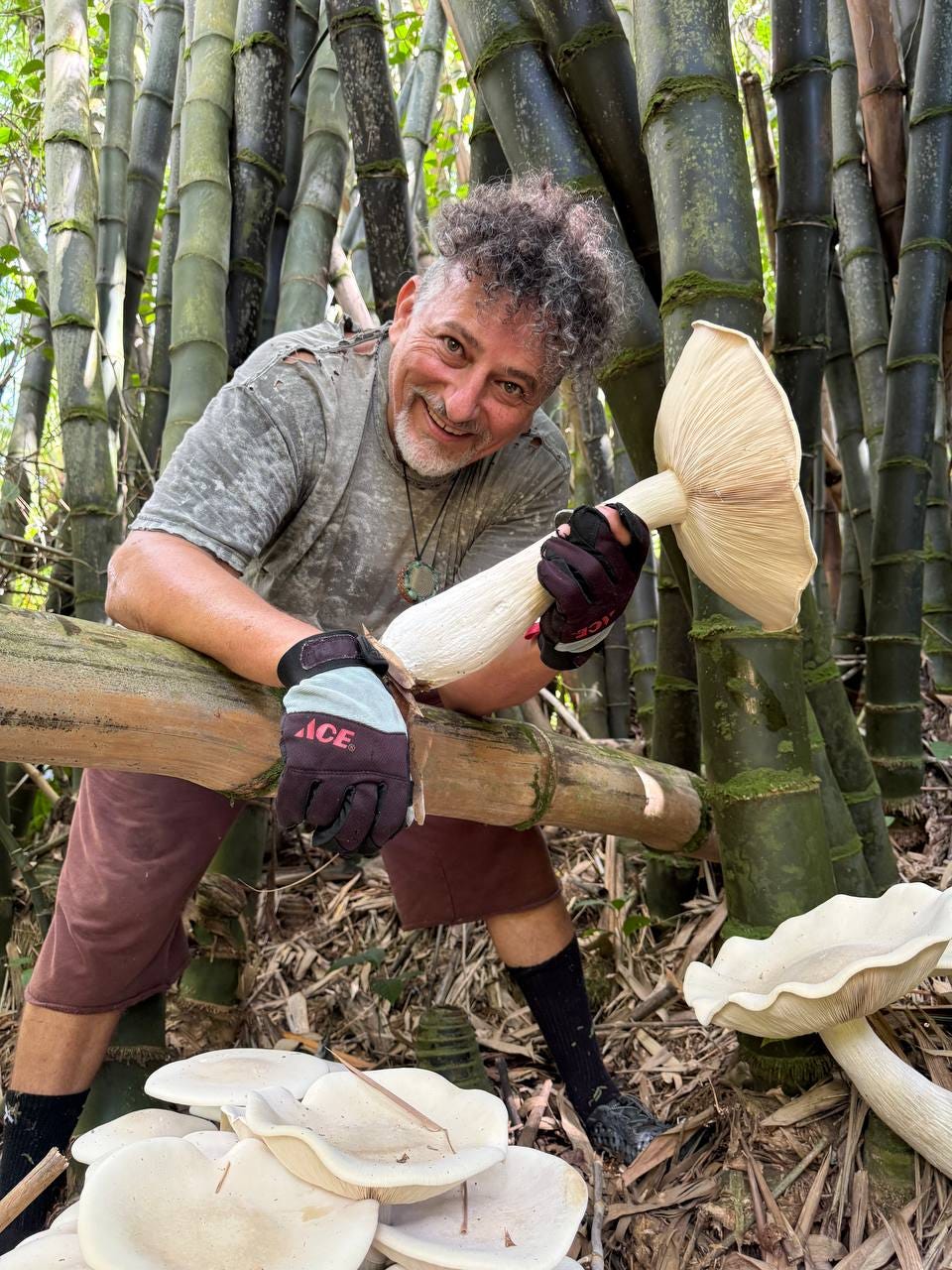
Imagine walking down your street and discovering a mushroom wider than a serving platter. Macrocybe Titans! What a find at NoniLand!! I was walking on the road outside the property with my neighbor when I spotted this in our bamboo!
This is no fairy-tale fungus. It is Macrocybe Titans, one of the largest gilled mushrooms on Earth and the largest known mushroom of its kind in the Western Hemisphere.
Often called the American Titan or Giant Gilled Mushroom, Macrocybe Titans can develop caps measuring up to three feet across. A single specimen may weigh several pounds, while clusters can rise from the ground like an entire mushroom village. Its thick white stem, broad cream-colored cap and extraordinary size make it almost impossible to overlook once it reaches maturity.
The mushroom grows primarily in tropical and subtropical regions of the Americas. Researchers have documented it in Mexico, Central America, the Caribbean and South America, as well as parts of Florida and Georgia. It often appears in lawns, gardens, roadsides, wood-chip beds and other places where decaying plant material lies beneath the soil. University of Florida researchers describe it as the mushroom giant of the Western Hemisphere, with reports of caps exceeding 100 centimeters in diameter — that’s more than 3 feet.
This post is free thanks to the support of our paid subscribers. Please consider becoming a free or paid subscriber to keep this content available to the public.
Beyond its tremendous size, the M. Titans mushroom is attracting attention for another reason. Scientists have begun identifying unusual natural compounds within it, including antioxidants, polysaccharides and a previously unknown triglyceride called macrocybin. Early laboratory research suggests that these compounds may target the framework of cancer tumor cells that enable cancer to metasticize.
Yes, the research remains young, and no clinical trials have established that eating Macrocybe titans can prevent or treat disease. Nevertheless, this giant mushroom is beginning to reveal a fascinating biological profile.
Macrocybe titans has historically been collected and eaten in parts of Mexico, Central America, and South America. Several mushroom guides describe young specimens as edible, although opinions about their flavor and texture vary. Mature mushrooms may become fibrous and tough.
Edible? We are going to go for it!! Smells of amaretto!
Edibility, however, does not mean that wild specimens should be harvested casually. Specifically, young Macrocybe titans mushrooms may be confused with poisonous species, such as the green-spored parasol, Chlorophyllum molybdites. For this reason, researchers advise the public never to consume a wild mushroom unless it has been positively identified as edible.
This warning is especially important because Chlorophyllum molybdites is a poisonous lawn mushroom and the most frequently reported cause of mushroom poisoning in the United States.
Still, there is at least one reported incident to advise caution. A 2025 case report documented adverse health effects after people in Brazil ate wild Macrocybe titans collected from an urban lawn. A single incident cannot determine the safety of an entire species, but it does challenge the idea that every Titan mushroom is unquestionably safe to eat.
The maturity of the specimen, growing conditions, preparation method, individual sensitivity or natural chemical variation may all influence how a wild mushroom affects the body.
I’ve been hunting and consuming wild mushrooms for decades. For this epic find — and since the books say it’s edible — we are going to give it a try!
Yet if you are not a seasoned mushroom hunter, always proceed with caution and make certain — 100% sure — of the mushroom species you choose to harvest and eat. Never eat a wild mushroom based solely on an online description or image. Identification should come from a qualified local mycologist or mushroom expert familiar with the species and its poisonous look-alikes.
One of the most direct studies of Macrocybe titans investigated its activity against Candida albicans. Candida is a yeast that can live naturally on and inside the human body. Under certain conditions, however, it can overgrow and contribute to oral, vaginal, skin or more serious systemic infections.
In a 2023 study, researchers prepared several extracts from Macrocybe titans to test on cultures of Candida albicans. Microscopic examination showed changes in the Candida cells exposed to the extract, including surface damage and abnormal cell elongation. These observations suggest that compounds in the mushroom extract interfered with normal yeast-cell structure or growth.
The researchers also reported that the most active extract did not demonstrate cytotoxicity under the laboratory conditions used in the study. This finding is useful because a promising antimicrobial substance must affect the targeted organism without simply damaging every type of cell around it.
While the scientists worked with prepared extracts and isolated yeast cultures, not people, the findings suggest that M. titans may contain water-soluble substances worth exploring as sources of future antifungal compounds.
The same 2023 study found that the active aqueous extract contained substantial levels of phenolic compounds and flavonoids. It also displayed strong antioxidant activity in laboratory testing.
Phenolic compounds form a large family of natural substances produced by plants, fungi and other living organisms. Many of them can interact with unstable molecules known as free radicals. Flavonoids are another broad group of compounds best known for their presence in colorful fruits, vegetables, herbs and teas, although fungi may produce antioxidant substances with related chemical behavior.
Antioxidants help control oxidation. Oxidation is a normal part of life, energy production and immune activity, but excessive oxidative stress can damage fats, proteins, cell membranes and DNA. The body maintains its own antioxidant defense systems, which work alongside nutrients and protective compounds obtained through the diet.
The antioxidant activity observed in Macrocybe titans is promising. And different varieties of the Macrocybe species of mushroom already offer great benefit to the cultures that consume them. For now, however, the research establishes that M. titans contains antioxidant-associated compounds, though it does not yet establish an antioxidant benefit from eating it.
Perhaps the most intriguing discovery within the Titan mushroom is a natural triglyceride researchers named Macrocybin.
Triglycerides are commonly associated with stored dietary fat, but the term describes a broad chemical structure made from glycerol attached to three fatty acids. Individual triglycerides can differ considerably depending on the fatty acids they contain. Macrocybin appears to have a unique structure and unusual biological activity.
Researchers tested isolated Macrocybin against A549 human lung-cancer cells in the laboratory. The compound inhibited the growth of the tumor cells more strongly than it affected normal lung cells. This selective action drew particular interest because one of the central challenges in cancer research is finding compounds that interfere with abnormal cells while causing less damage to normal tissue.
Next, these researchers tested Macrocybin in mice carrying implanted human lung tumors. Macrocybin reduced tumor growth in this experimental model. The treatment also disrupted the actin cytoskeleton within tumor cells.
The cytoskeleton acts like a structural framework inside a cell. It helps the cell maintain its shape, organize its contents, divide and move. Disrupting that framework can interfere with the ability of a tumor cell to grow and survive.
The study shows that Macrocybe titans contains more than ordinary nutritional components. It may also manufacture highly specialized molecules capable of influencing complex cellular pathways.
Mushrooms contain complex carbohydrates called polysaccharides. Unlike simple sugars, polysaccharides consist of long chains of individual sugar molecules joined together in specific arrangements. Their biological activity can change according to their size, shape, branching and chemical structure.
A 2025 study isolated two polysaccharides called fucogalactans from M. titans. The researchers named them F-1 and F-2. Although the two compounds shared a similar underlying structure, F-2 had a molecular weight more than 20 times greater than F-1. When researchers challenged human breast-cancer cell lines with F-1 and F-2 compounds, both slowed cancer cell-cycle activity; F-2 also increased apoptosis and necrosis in these cells. Importantly, neither compound showed harmful effects against the non-tumor control cells.
Apoptosis is an organized process through which damaged or abnormal cells shut themselves down. The body uses it as part of normal growth, tissue maintenance, and cellular quality control. Cancer cells often develop ways to resist apoptosis, allowing them to survive when normal cells would not.
As with the Macrocybin findings, this was early laboratory research. Nevertheless, the study gives researchers another reason to explore the extraordinary chemistry hidden inside this extraordinary mushroom.
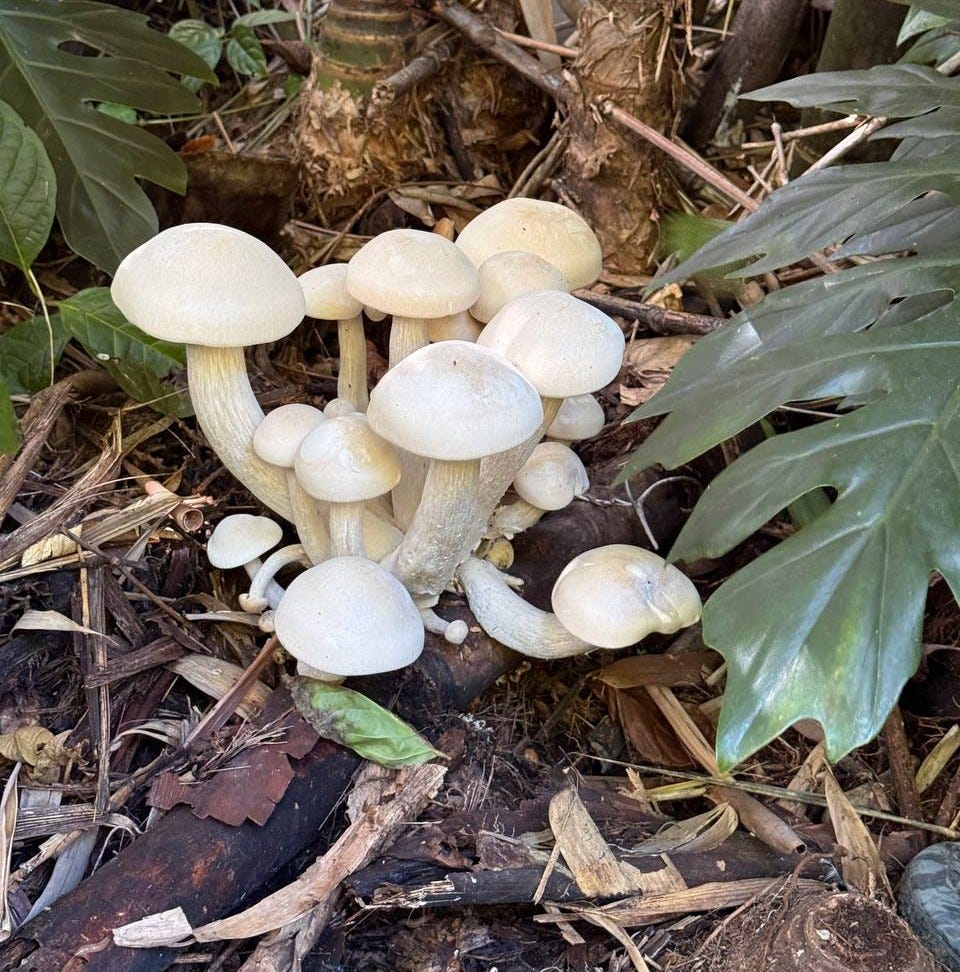
The Titan mushroom does not grow to its enormous size by preying upon living trees or stealing nutrients from healthy plants. Instead, it primarily lives as a saprotrophic fungus, that is, it feeds on dead and decaying organic material.
Beneath each mushroom lies a much larger network of threadlike tissue called mycelium. The visible mushroom is only the reproductive structure. The mycelium spreads through soil, buried wood, dead roots, mulch, and other organic matter, releasing enzymes that break complex materials into smaller components.
This process makes fungi essential recyclers. Without decomposers, fallen branches, dead roots, leaves, and other plant material would accumulate across the landscape. Fungi help release locked-up nutrients and return them to the soil, where other organisms can use them again.
Here’s a video on the lifecycle of a mushroom, including the largest in the Western Hemisphere:
Macrocybe titans frequently appears in disturbed environments such as lawns, abandoned properties, landscaped spaces, and roadsides. Although a mushroom may seem to emerge from bare grass, its mycelium may be feeding on buried wood, old tree roots, or organic debris hidden beneath the surface.
Once the underground fungal network has gathered enough energy and the temperature and moisture become favorable, enormous fruiting bodies can appear with surprising speed. Several mushrooms may grow together in a cluster, creating a display that looks almost prehistoric.
Through decomposition, the Titan mushroom helps transform death into new life. It breaks down yesterday’s plant material and feeds tomorrow’s soil. Its giant fruiting body provides only the most visible evidence of a much greater process happening beneath our feet.
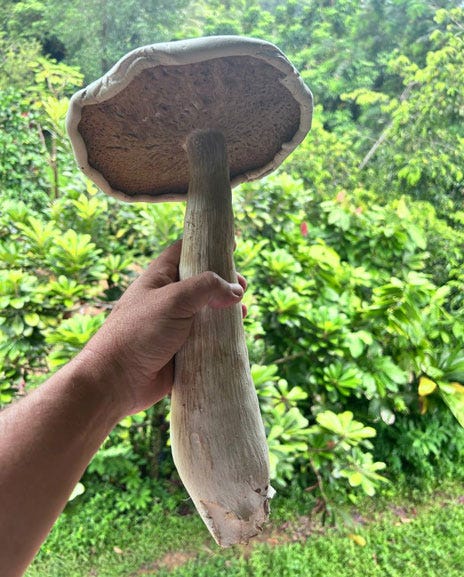
I am attempting to dry this giant Magrocybe titans mushroom. So far, it’s working! It must be pulling the anti-fungal silica in from the bamboo it grows upon.
Macrocybe titans lives up to its legendary name. It can push a mushroom cap more than three feet across the ground, turn an ordinary lawn into a natural spectacle and recycle tremendous amounts of decaying organic material beneath the soil.
Its health profile is equally intriguing, although still in the early stages. However, what the research does reveal is possibility.
The Titan mushroom reminds us how much remains undiscovered within the fungal kingdom. A mushroom may appear above the ground for only a brief time, yet inside that fruiting body lies an intricate chemistry built through millions of years of adaptation.
Sometimes Nature places her most mysterious medicine in the smallest leaf or seed. Other times, she delivers it in a mushroom three feet wide.
These statements have not been evaluated by the Food and Drug Administration. This information is not intended to diagnose, treat, cure, or prevent any disease.

Featuring: David Avocado Wolfe and Special Guests at a beyond beautiful Private Texas Ranch.
Detox & Cleansing: Cleansing, Fasting, & Detox for All Ages; Nicotine, Parasites, & Nanotech Protocols; Charcoal, Activated Charcoal, & C60.
Immunity & Performance: Creating a Host Defense/Mega Immunity (Mushrooms, Superherbs, & Electronic Medicine); Peak Performance & Superfoods; Jing Energy.
Farming & Soil: Foraging & Farming; Soil: The Ecstatic Skin of the Earth.
Self-Governance & Strategy: United Non-Compliance & Selecting Out of Big Brother Systems.
Mindset & Philosophy: Activating Genius (The Power of Intention); Navigational Philosophies (Rudolf Steiner, Charles Fort, Book of Revelation); The Best Day Ever & More!
This is where transformation begins — are you ready to join us?
Ready to go all-in? Experience the new Wolfe University with both free and paid courses, as well as the platform for David Wolfe's Inner Circle.
Are you new here? Opt-in for my weekly newsletters and gain access to your first course — on me! Click Here: https://wolfeuniversity.kit.com/free-course
David Wolfe Website: https://www.davidwolfe.com/
Wolfe University: https://university.davidwolfe.com/
David Wolfe Shops
Australia: https://davidwolfe.com.au/
Canada: https://www.wildavalon.ca/
Chocolate: Our favorite Chocolate Factory is now located in Central Florida! Please visit Butler’s Raw Chocolates! 2400 South Hopkins Avenue, Unit E, Titusville, FL 32780
Butler’s Raw Chocolates: https://butlersrawchocolates.com/
Links on this page may include affiliate links; any commissions earned are at no extra cost to you and support the continuing work of David Avocado Wolfe.
This Substack post may have been created with the aid of AI.
Comments
Nothing yet. Say the first thing.
Sign in to join the conversation.