
I debated starting this essay with a clever line like “systems, not software” to call out how much of the business world is still over-indexing on a technology-first approach to extracting value from AI. But then I turned to human nature, psychology, and some deeper truths I think we’re collectively downplaying as we try to scale AI across the enterprise.
Maslow started with our foundational, if not essential, human needs and worked his way up from there. He started with biology and then moved on to philosophy. Without water to sustain us, we do not live long enough to entertain the luxury of pursuing purpose, love, self-actualization, or any of life’s higher-order functions.
In the business world, the lifewater we need to start with is people.
But not just any people. Leaders.
Everything else in an enterprise flows downhill from them. Budget flows down. Permission flows down. Fear flows fastest of all.
And right now, fear is running too many AI rollouts.
Mandates, Metrics and Make-Believe
Earlier this year, engineers at Meta built an internal dashboard called “Claudeonomics” that ranked employees by how many AI tokens they consumed. Top scorers earned titles like “Token Legend.” Silicon Valley gave the behavior a name: token maxxing. Meta eventually shut the leaderboard down. Similar ones reportedly popped up at Shopify and OpenAI.
Christina Cordova, COO of Linear put it simply:
“Don’t mistake a high burn rate for a high success rate”
People burned tokens in loops. Not to solve anything. To rank. Give humans a way to social engineer something, and we’re going to exceed expectations. Somebody above those developers decided that consumption was proxy for progress. That decision came from the top of the org chart and rolled downhill, and everything that happened after it was people doing exactly what they were incentivized to do.
Incentives are everything. Good leaders know this and lead with the right ones.
Microsoft told employees that using AI is “no longer optional” and moved to factor AI usage into performance reviews. Accenture tied AI adoption to promotion eligibility and started tracking weekly logins to verify it. Block reportedly warned staff that refusing to adopt AI could put their jobs at risk. During the same window, Microsoft cut more than fifteen thousand jobs in a record-revenue year. IBM quietly swapped a couple hundred HR roles for agents.
Now put yourself on the receiving end of that. Adopt the technology that may be coming for your job. Prove your adoption in your review. Do more with less. Smile for the all-hands.
What does a rational person do under that kind of pressure?
They perform. But not the way leaders want them to. Performative is not performance.
Harvard Business Review named the output of all this quiet performance “workslop”—AI-generated work that looks polished, advances nothing, and quietly transfers the cleanup to whoever opens it next. Forty percent of workers report receiving it. Nearly half trust the sender a little less afterward.
Token maxxing.
Hidden usage.
Workslop.
Three faces of the same thing.
When people are frightened and unclear, they will optimize for the appearance of adoption every single time. You cannot purchase your way past that. You definitely cannot mandate your way past it.
The Mountain Under the Machine
KPMG surveyed more than two thousand senior leaders across twenty countries this past quarter. Average AI spend at those organizations was one hundred eighty-eight million dollars. The share that had established a measurable return on it was seven percent.
The reported benefits are going the wrong direction. Productivity gains fell from forty-two percent to thirty-five percent. Decision-making speed slipped from forty-one to thirty-six. Cost reductions dipped as well. Spending climbed. Results thinned.
Almost half of those organizations have delayed or scaled back AI initiatives after the costs ran past the value. Vendors are moving to usage-based pricing built on token consumption, and only about a third of companies can see their AI operating expenses clearly. The leaderboard problem increasingly looks like a leadership one.
Goldman Sachs found no meaningful economy-wide relationship between AI adoption and productivity gains. A global talent survey found regular AI use climbing thirteen percent year over year while worker confidence fell eighteen.
More usage. Less trust.
Then there’s the finding that should end the technology-first argument on the spot. Only twenty-four percent of those organizations said the CEO is ultimately responsible for AI-driven business outcomes. The ones who did put accountability on the CEO were nearly four times as likely to report established ROI.
Not better models. Clearer ownership.
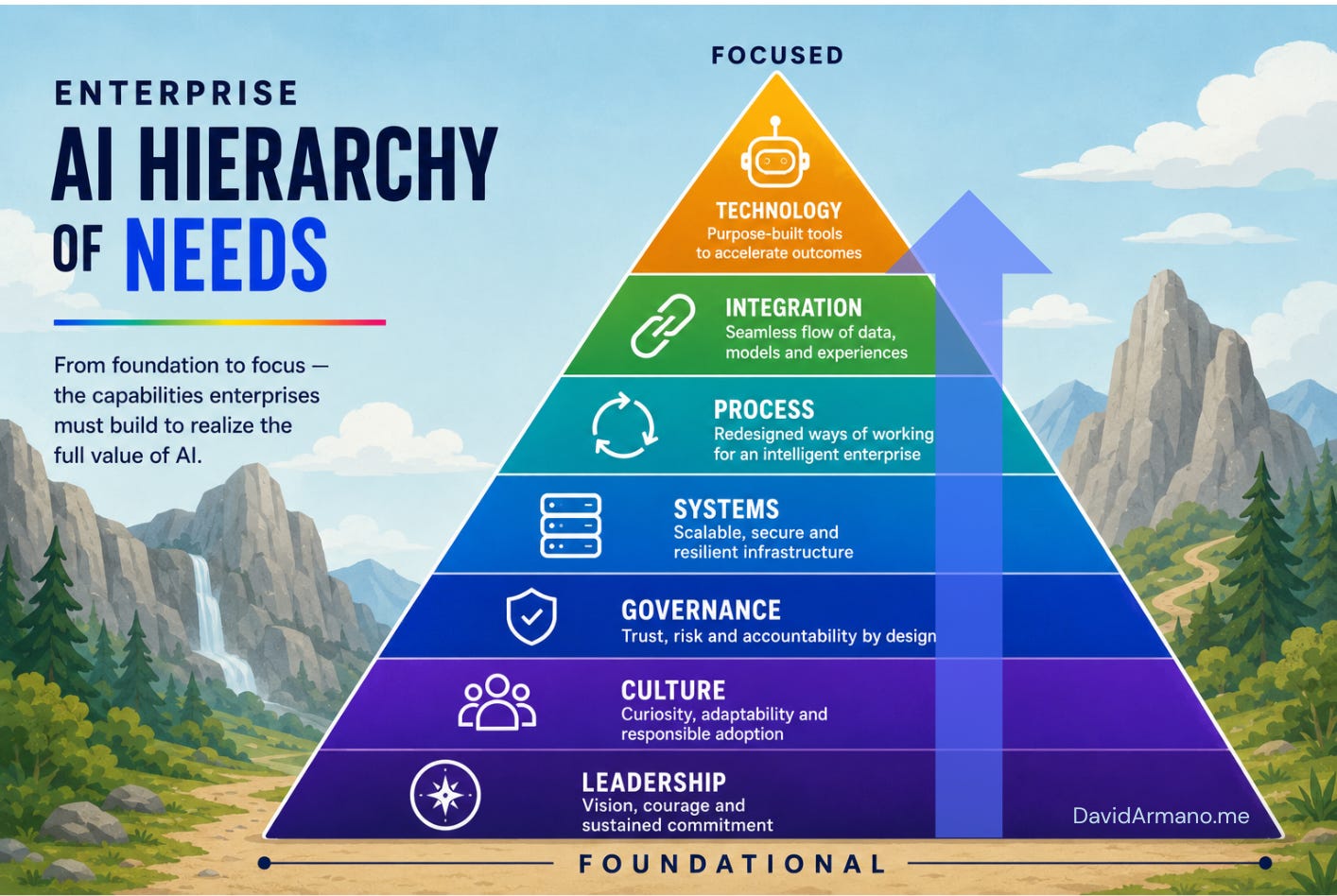
In other words, we are the bottleneck. And by we, I mean leaders. Which brings me to the visual at the top of this piece.
The nod to Maslow is intentional, with one inversion worth considering. In Maslow’s pyramid, you climb toward becoming more fully human. In this one, the entire base is human, and only the peak is pure technology. It’s an inversion because the foundation informs how we focus our technological efforts—or should.
That’s why a focused, purpose-built technology bet only pays off near the top. Not because the tools improved. Because the foundation finally got strong enough to support the weight. Most enterprises run the sequence backward. They shop for the sought-after summit and skip the arduous climb.
Here’s the climb:
Leadership. Vision, courage, sustained commitment. Courage is the hard one. It costs a leader almost nothing to buy a platform and announce a mandate. It costs real nerve to tell the board you’re redesigning how work happens before the return shows up, and then to hold that position through the next earnings call. Pilot theater is a leadership failure before it becomes anything else.
Culture. Curiosity, adaptability, responsible adoption. I’ve argued before that intellectual curiosity is the new IQ, and it applies to organizations as much as individuals. A curious company treats AI as a thought partner and pressure-tests what it produces. A frightened one treats it as a threat to hide from or a box to check. Token maxxing is what a scared culture manufactures when you reward motion instead of moving the needle.
Governance. Trust, risk, accountability. Governance gets sold internally as the department of no. It’s actually the department of trust. When people know who owns an AI decision and what happens when that decision is wrong, they stop concealing their usage and start improving it. Shadow AI and workslop both need somewhere to hide. Accountability takes that away.
Systems. Scalable, secure, resilient infrastructure. The unglamorous plumbing nobody puts in a keynote. Stalled pilots almost always trace back here, to data that was never made ready for what got built on top of it. A brilliant model sitting on broken, disconnected, ungoverned data is an expensive way to generate confident nonsense.
Process. Redesigned ways of working. This is where the gap between spending and return actually lives. The organizations posting real numbers don’t bolt AI onto yesterday’s workflow. They redesign the work around what the technology now makes possible. Strapping a jet engine to a horse cart doesn’t produce a plane. It produces a wrecked cart.
Integration. Seamless flow of data, models, and information. This is where intelligent experiences get built, where the model stops being a chatbot parked in the corner and becomes part of the loop. It works only if everything beneath it connects. You cannot integrate what you never made trustworthy, resilient, or redesigned.
Technology. Purpose-built tools to accelerate outcomes. The peak. The part almost everyone starts with. Notice it’s the smallest slice of the pyramid, and notice where it sits. Generic tools demo beautifully and stall the moment real work demands context. Purpose-built tools deliver, but only on a base that can carry them.
The technology was never the hardest part. Building the mountain under it IS.
Start With The Foundation. Build The Focus.
Look at the visual again. The base is labeled foundational. The peak is labeled focused. That sequence is the whole argument:
Focused technology-enabled solutions is what a strong foundation buys you. It is the last thing you get, not the first thing you procure. So start at the bottom and work up. Start with making it safe for performers to actually… perform.
Make Honesty About AI Safe.
More than half your team may be hiding their AI use from you. KPMG and the University of Melbourne surveyed nearly forty-eight thousand workers across forty-seven countries. Fifty-seven percent admitted to concealing their AI usage and passing the output off as their own.
They’re hiding it because somebody made honesty expensive.
A mandate attached to a performance review teaches employees to perform for managers. Permission attached to support teaches them to learn in front of you. Trade the ultimatum for air cover. Say out loud, on the record, that experimenting is expected, that fumbling is part of the deal, and that nobody loses standing for being honest about what these tools can and can’t do yet.
Fear produces workslop. Safety produces skill.
Measure Outcomes, Not Motion.
If your AI scorecard counts tokens, logins, or “adoption rate,” you are measuring performative theater. Retire those metrics. Replace them with one question asked of every initiative: what output actually changed? Cost per completed task? Cycle time? Defect rate?
Outcome maxxing beats token maxxing.
Narrow The Gap Between Foundation and Focus
Most enterprises have some version of a foundation and some version of a focused bet. What they don’t have is anything connecting the two. That gap is where the value leaks out. Close it by picking one painful human workflow to redesign while applying AI.
One.
Before your next purchase order, name the specific thing that’s broken about how your people work today. If you can’t name it in a sentence, you aren’t ready to buy another technology.
Enterprises keep trying to run it in reverse. They buy the sharp bet first and hope the foundation shows up later.
It doesn’t…
None of this is an argument against the technology—it’s an argument for better technological solutions built on solid ground, not shifting quicksand. These evolving agentic models are the most capable general-purpose tools we’ve ever built, and the upside is real for the organizations that earn it. Focus lives at the top of the pyramid when foundational progress is made, and there is no effortless elevator that removes the sweat and rigor required to get there.
The Enterprise AI Hierarchy of Needs starts with people, and ideally strong leadership. The climb never really ends. But the effort put into building the foundation makes technology investments smarter, more informed, and better focused.
Visually yours,
Did you enjoy what you just read? Please consider forwarding it to a friend or five.
Want more insight? The TBDaily is a human-curated, AI-automated daily briefing that provides fresh takes on what’s shaping the future of AI, Technology, Culture, Work, Health, and more. The TBDaily is trained by me to see around corners and to help future-proofers like you stay curious, inspired, and informed. The future is TBD. Get up to speed daily.
David Armano is a futurist, strategist, and Enterprise AI transformation leader who helps his colleagues, clients, and community solve intricate business challenges and see a clear path forward.

He’s known for his unique approach to visual thinking and for insightful yet grounded takes on intelligent experiences, culture, and leadership. In addition to his day job, he writes David by Design to translate complex shifts into actionable ideas.
Comments
Nothing yet. Say the first thing.
Sign in to join the conversation.