
Few tech companies have absorbed more reputational damage than Meta. The societal mixed bag of its social platforms. The Metaverse pivot that landed with a thud. The recent announcement, then walk-back, of plans to monitor employees to train AI models. The company has given us plenty of reasons to be skeptical.
So when Meta announced “America’s Workforce Academy,” endorsed by people I respect like Mike Rowe, it caught my attention.
Here’s the short version. America’s Workforce Academy (AWA) is a $115 million national training initiative aimed at addressing the severe shortage of skilled trade workers needed to build the physical infrastructure of AI. In partnership with the Associated Builders and Contractors and CBRE, the program offers free, fast-tracked, five-week courses in electrical work, plumbing, welding, fiber optics, and HVAC. Meta covers everything: tuition, airfare, lodging, and a daily stipend. Graduates earn industry-recognized credentials and a guaranteed job placement with a Meta general contractor at an active data center site in pilot states like Texas, Louisiana, Ohio, and Indiana.
Strip away the press release, and you find a genuinely smart move on four fronts:
The economics: AI runs on plumbing
We talk about AI like it’s made of math, but it’s really made of concrete, copper, and cooling systems. Every model needs a data center, and every data center needs electricians, welders, and pipefitters who are in critically short supply. By training workers and guaranteeing them placement, Meta solves its own bottleneck and locks in a loyal labor pipeline before competitors can. And unlike knowledge work, these jobs are tied to physical places.
You can’t offshore a cooling system installation in Ohio.
The politics: jobs are the last bipartisan issue
Launching in Ohio, Indiana, Louisiana, and Texas brings high-paying work to regions that have watched the Silicon Valley boom from a distance. Domestic infrastructure and job creation might be the only things left that both parties applaud. A $115 million workforce investment also buys something harder to price: goodwill that softens the next round of antitrust or privacy scrutiny.
The culture: validating work we spent decades devaluing
For two generations, the cultural script said get a degree, get behind a screen, climb. Partnering with someone like Mike Rowe signals respect for a path we were told to avoid. It connects the most advanced technology on the planet to the people who physically build it. That bridge matters because the gap between Silicon Valley and the rest of the country is as much cultural as economic.
The reputation: from job destroyer to job creator
Public anxiety about AI centers on one question: What happens to my job? Meta flips the script by showing AI creating tangible, well-paying work. After the abstraction of the Metaverse, this is grounded and practical. It also gives the company a positive story to point to when the conversation turns, as it always does, to privacy, moderation, and surveillance. The trick here for Meta, is that data center construction near communities is becoming increasingly unpopular with residents, so the location of them is going to be critical to navigate.
Blue-collar renaissance, white-collar reckoning
Now hold those four points up against what’s happening elsewhere in the same company.
While Meta pours $115 million into protecting manual trades from automation, it, like most of its peers, it is also cutting knowledge workers. Software engineering, content creation, digital marketing, and data analysis... All is being reshaped by AI, whether through direct displacement, infrastructure spending, or plain uncertainty about how this plays out.
Meta is funding the infrastructure that accelerates the automation of white-collar work while elevating and protecting blue-collar work.
For more than two decades, Big Tech invested in the knowledge class with premium salaries and remote flexibility. That bet has now changed. Money is moving away from expensive human knowledge-work teams and toward the bricks, wiring, and cooling required to sustain the AI era.
As always, follow the money…
This upends generations of conventional wisdom. The story we told ourselves said moving away from manual labor and into a corporate, screen-based role was the path to upward mobility. Now vocational skills look like the safer, more recession-proof bet, while a university-educated digital class navigates a precarious job market with no script for what comes next.
Who was racing toward obsolescence?
The irony is this: The most sophisticated digital revolution in human history is being built by people who don’t use a keyboard to do their jobs.
For years, white-collar professionals viewed manual labor as a relic and assumed their degrees and digital savvy made them safe. Now tech giants are spending billions to secure the people who build with their hands while automating the people who type for a living.
So we should ask ourselves the uncomfortable question: Who was actually racing toward obsolescence all along?
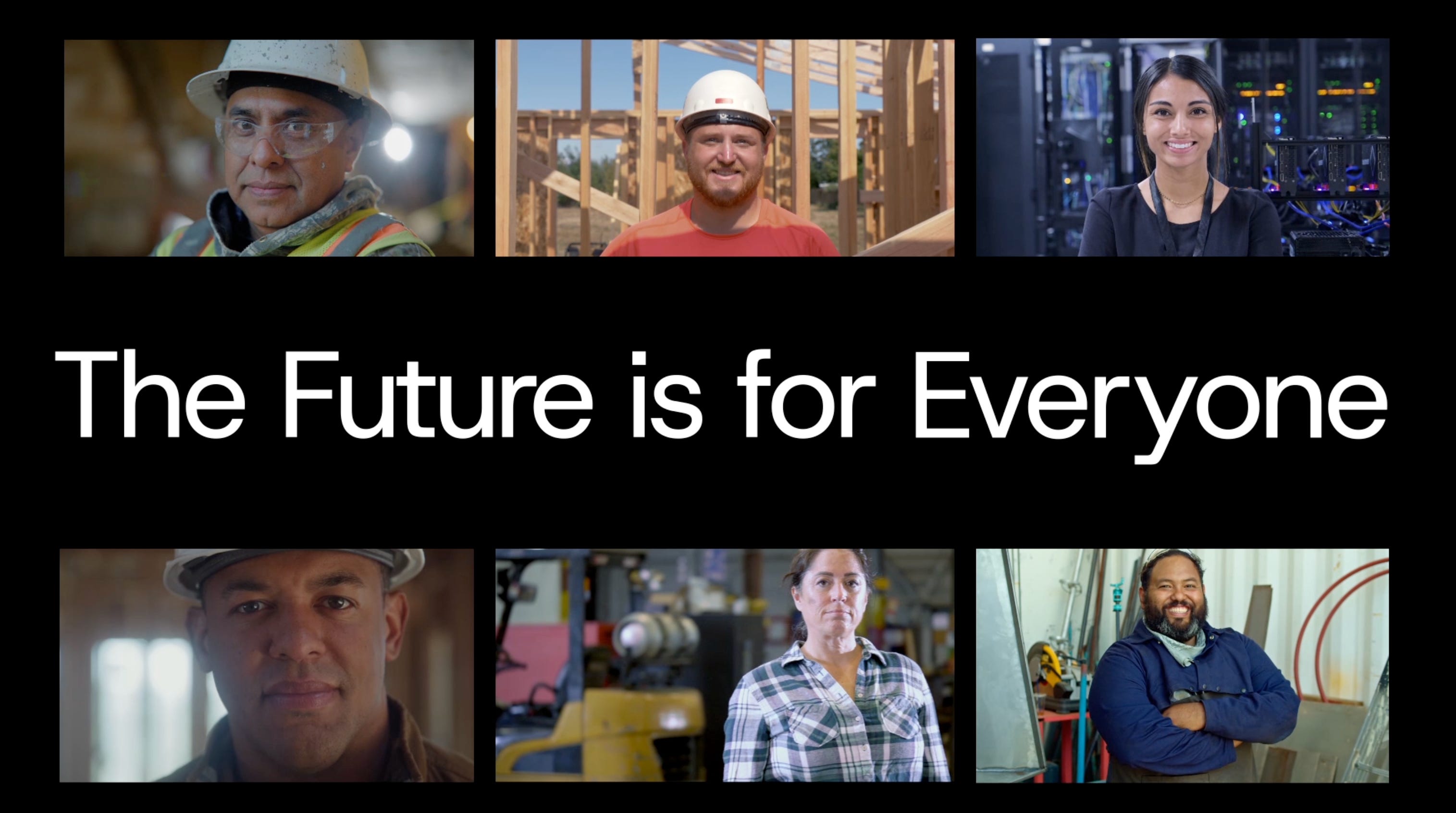
Meta chose the tagline “The Future is For Everyone”—a clear acknowledgment that while knowledge workers have historically flourished, sectors such as manufacturing haven’t fared as well. That’s all changing now as the world moves to build the infrastructure needed to generate the computing power we’ll demand, while AI is poised to disrupt the knowledge work have traditionally understood.
That future is TBD but increasingly physical, and Meta is betting on a blue-collar renaissance to help build it.
Visually yours,
Did you enjoy what you just read? Please consider forwarding it to a friend or five.
Want more insight? The TBDaily is a human-curated, AI-automated daily briefing that provides fresh takes on what’s shaping the future of AI, Technology, Culture, Work, Health, and more. The TBDaily is trained by me to see around corners, and to help future-proofers like you stay curious, inspired, and informed. The future is TBD. Get up to speed daily.
David Armano is a futurist, strategist, and Enterprise AI transformation leader who helps his colleagues, clients, and community solve intricate business challenges and see a clear path forward.

He’s known for his unique approach to visual thinking and for insightful yet grounded takes on intelligent experiences, culture, and leadership. In addition to his day job, he writes David by Design to translate complex shifts into actionable ideas.
Comments
Nothing yet. Say the first thing.
Sign in to join the conversation.