
Nathan Hatch commented in a Substack note on a recent article about having written a book, ‘
And the reviews are rolling in — “It’s nice you’re staying busy” says one unnamed family member.
This reminded me irresistibly of my mother telling me “It’s nice that you have a hobby.” She was talking about music rather than writing (we’ll come back to that), but it came several decades after I abandoned the first phase of my academic career to become a not-very-successful musician, and even my not-so-far-back first recordings. (Admittedly, she died before most of my recent recordings were released.)

West Malvern, playing with Don MacLeod.
So I’ve never been sure that ‘hobby’ quite covered it.
The further back that attempt to be a professional musician fades into history, though, the more I accept that now, as it gets harder to play guitar or even sing to a reasonable standard, it’s not the buzz of a reasonably satisfactory live gig or studio recording that keeps me afloat, though I miss the applause (but not the stage fright). It’s the act of writing, whether it’s lyric or melody, or just words that don’t require a melody. In fact, the first song I remember writing (though it wasn’t a very good one) was written long before I learned to play an instrument, or even passed on to secondary school.
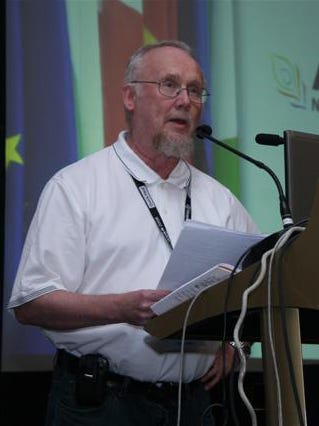
Presenting a paper at some conference or other, probably AVAR
My mother was probably right about one thing, though. She said I’d never retire because I’m a workaholic. I did, in fact, retire several years ago – I might have resumed my musical career, except that Covid made that impractical – but I haven’t stopped writing, having self-published several more books than I ever put out through mainstream publishers. I’m not making appreciable money out of it. Actually, I never did – even with mainstream publishers, security books don’t sell like hot cakes – but writing and editing in other venues kept me comfortably afloat for several decades, the books being more of a loss leader than a living. I just hope that I can manage for the rest of my life without having to take another job (even if I never sell another book).
The sad fact is that for many – maybe most – successful writers, completing the book in a final form that meets the publisher’s expectations is only part of the job. A major part of ensuring that success is meeting the demands of all and sundry in terms of selling the finished product, and those demands often go far beyond the demands of agents and publishers, who seem less engaged with pushing product than in days of yore, unless it’s the product generated by the most commercially successful authors.
Perhaps that has something to do with the economic shifts introduced by print on demand, and the ever-increasing market share of eBooks. I’d like to hope it’s not the belief that AI is making it ever easier to generate content that doesn’t require paying human writers, but I can’t help observing that many publishers will appreciate the ability of LLMs to plagiarize recycle and imitate existing work. It may not come as a surprise to you that publishers are often more interested in publishing what has previously been successful, rather than prioritizing originality. But then, that was probably always the case.
Until fairly recently, I was reluctant to admit that I didn’t really want to work at all, any more. So LinkedIn’s job suggestions continued to amuse me when they seemed to consist mostly of jobs teaching AI to write like me so that in future, no one will have to pay for the real thing. Or of volunteer jobs for which I won’t be paid but will give me experience I can use when someone offers me a paid job, presumably training more AI to write like me when my writing’s been improved by all this unpaid labour*.
Anyway, I don’t think I’m interested in that sort of training. Unfortunately, it’s too late to worry about my content (or some of it, at least) having been scraped, though it seems there might be the barest possibility of my claiming something from Anthropic for its use of Viruses Revealed.
Like Seajade, it’s the act of writing that matters to me, though I admit to getting more satisfaction from writing songs, fiction or verse than I ever did writing about security. Perhaps that’s because after 35 years of writing about security, you have to wonder whether you’ve made any difference at all, when people are still falling for the same sort of social engineering, while the media are still recycling the same snippets of advice I was giving decades ago. Or perhaps that’s because writing for a living, for me, was as much about being a ‘shop assistant’ – or at any rate meeting the requirements of marketing and PR departments – as it was about actual creation.
And while I do the occasional pro bono writing or editing task that requires me to keep to a deadline, the writing that keeps me going is not subject to any deadline but the very last one. (As they say, death is nature’s way of telling you to slow down.) But the world will not worry much if I miss that one, and I won’t be in a position to care about anything at all…
Still, I have a great deal of sympathy for people who have to keep to deadlines because meeting contractual demands is part of the price of success. For instance, one of my friends recently pressed the Pause button on her Substack newsletter so that she could concentrate on finishing her next novel by the deadline. If I have any deadlines at the moment, they’re self-imposed, but I do find myself worrying that I’m not writing enough, and thinking that I should post less and write more.
As a sidenote to that, I must admit that I’m considering abdicating from the Substack chat function. I thought that if any of my (small) audience wanted to chat about what I post, that would be more than fine. However, it’s been a mixed blessing: sometimes, I’m not sure if I’m talking to a person or a bot; sometimes, the chat seems to be all about selling me a service; sometimes the point seems to be to get me to continue the chat on an unsafe platform; and sometimes, I’m the target of a fusillade of requests for information I wouldn’t necessarily offer in a face-to-face conversation. Information that I certainly have no intention of giving to someone whose bona fides I’m in no position to check.
Perhaps some of it goes back to my notorious workaholic tendencies, though: even now, I sometimes feel guilty about not giving something I’m writing my full attention. I certainly feel uncomfortable with the time it’s taken me to write this. (Don’t ask!) Still, it seems a shame to forgo some of the pleasant chats that sometimes happen!
* There is, I suppose, some relief in realizing that some organizations still see some point in using people to train AI rather than leaving algorithms to be trained by other algorithms. But there are plenty of organizations - Facebook springs to mind - where saving on the cost of human labour is more important than accuracy and verisimilitude, let alone creativity and good writing. But let’s not revisit the difficulties of getting past Meta’s AI in order to persuade a human being to Do The Right Thing, whether it’s taking action against a scammer, or taking action to restore the reputation of someone unfairly penalized.
Comments
Nothing yet. Say the first thing.
Sign in to join the conversation.