
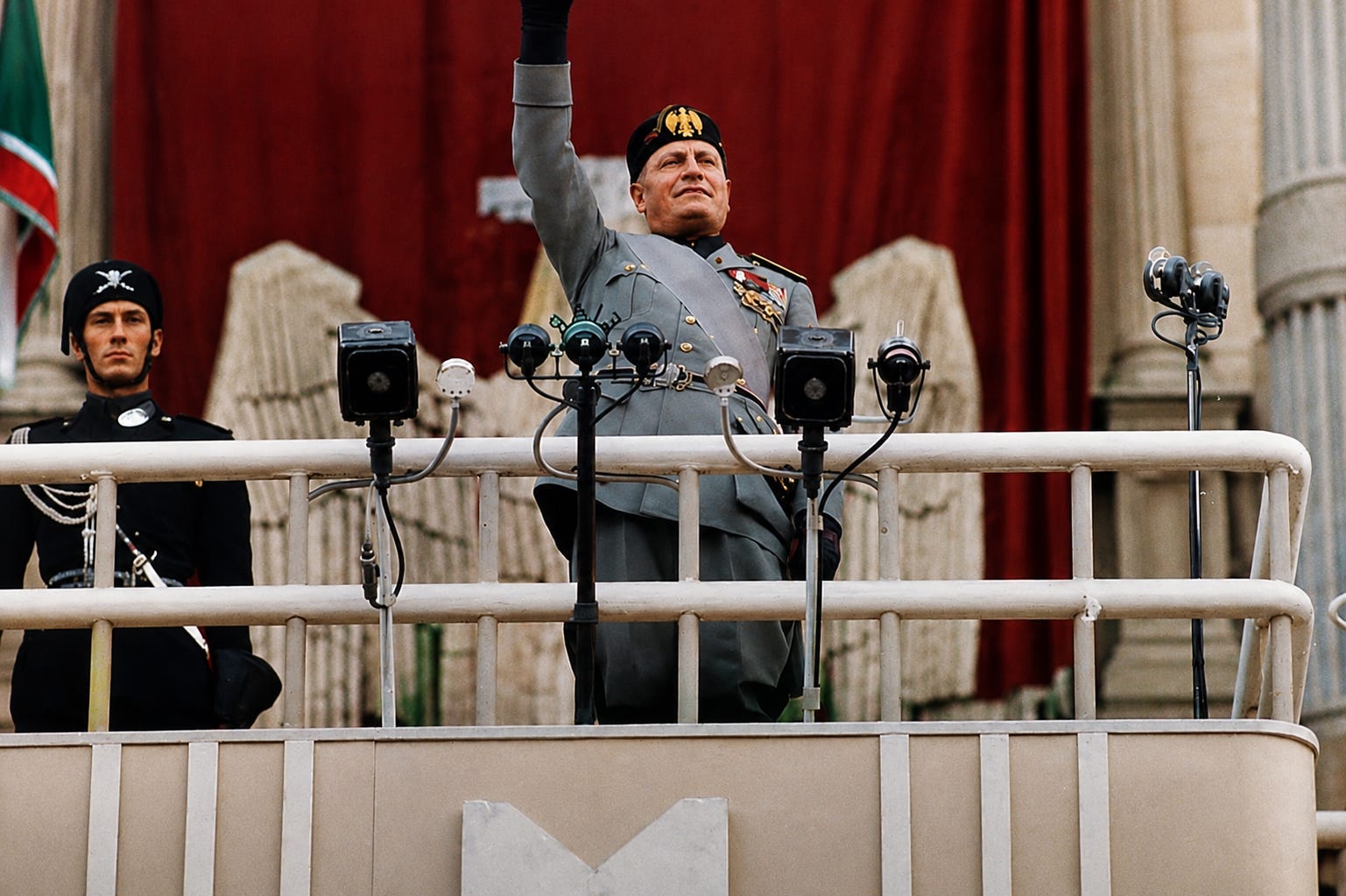
In the early 20th century the Jewish population of Italy was small, highly assimilated and safe. By the time the war ended in 1945 between 15 and 20% of Italian Jews were dead in the Holocaust. The story of how that happened isn’t well known outside Italy, but it aches with lessons for us in our rancorous early 21st century.
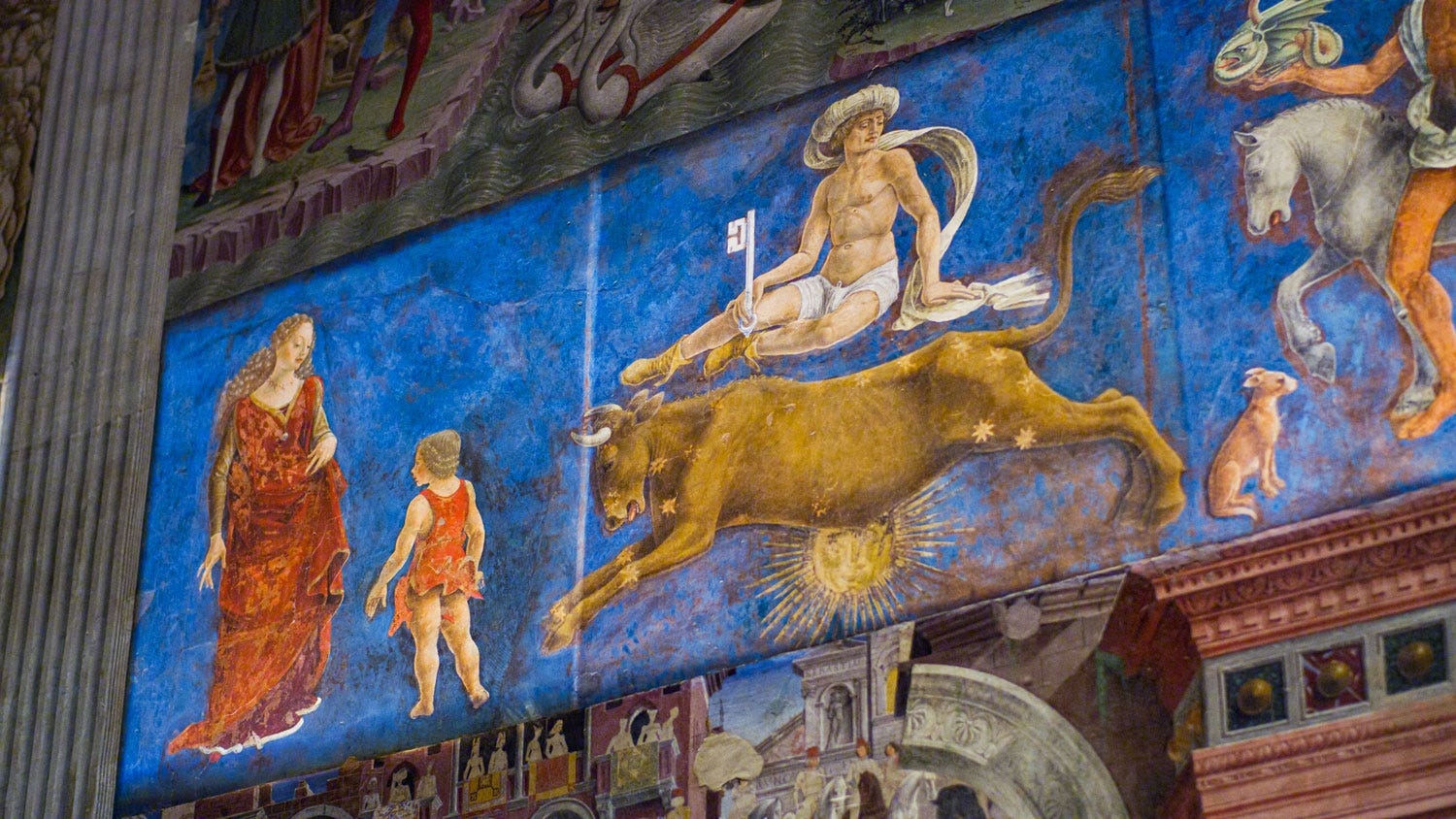
Last autumn I went to Ferrara in search of Renaissance frescoes and found them in abundance. The portable art had been stolen by various dukes and Bonapartes, but they couldn’t take the buildings, and the city has spent a lot of money and effort on restoring what had been painted on their walls. The picture above is from the Hall of the Months – the Salone dei Mesi – in the Palazzo Schifanoia and was executed in 1469. In the garden behind the Palazzo is a café/restaurant which is pasta-perfect. My idea of heaven.
But to walk there from the hotel where we stayed, took us past the great brick castle of the D’Este family, down the old Via Mazzini and past a building with a white plaque on either side of a large door. I am a plaque addict. I can’t bear the thought of not knowing what they say.
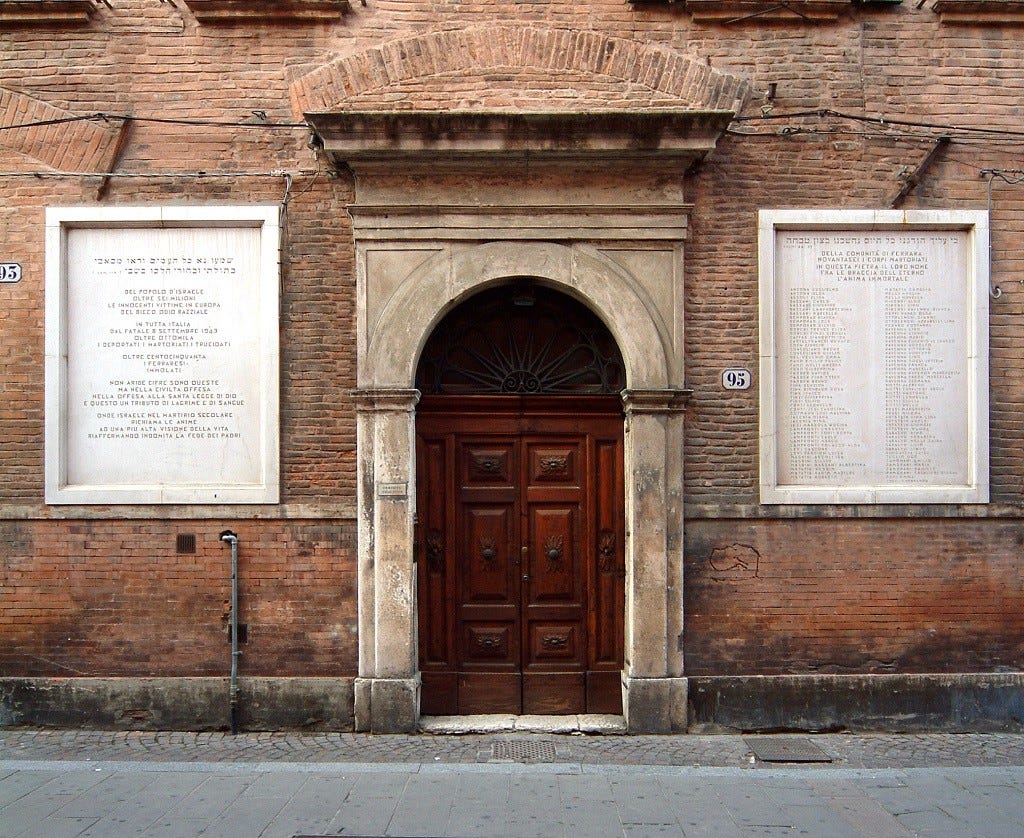
On the left the plaque carried an inscription in Hebrew and one in Italian. The one on the right, a long inscription and a list of 96 names. You can’t have lived as long as I now have in the shadow of the Holocaust not to realise what a list like that is likely to mean.
I don’t read Hebrew and only some words in Italian were recognisable. I looked it up. The Hebrew is from the Psalms and reads “Nay, but for Thy sake are we killed all the day; we are accounted as sheep for the slaughter.” The Italian next to it, “From the Ferrara community / ninety-six martyred bodies / their name is in this stone / in the arms of the eternal / the immortal soul.” The building is a synagogue.
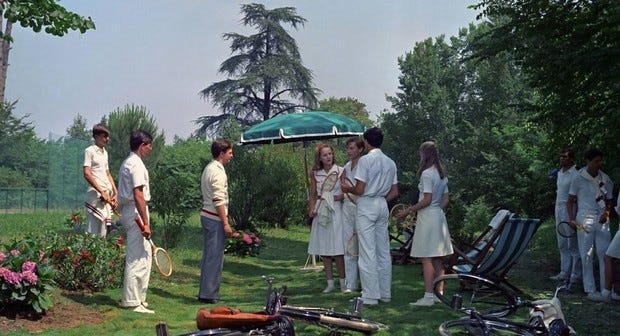
This wasn’t exactly a surprise. A few years ago I got round to reading Giorgio Bassani’s novel The Garden of the Finzi Continis - some readers will have seen De Sica’s film of the book.
Bassani was brought up in a prosperous Jewish family in Ferrara between the wars and his novel is partly based on his own experience. In the book the principal character is befriended by a very wealthy Jewish family who own a large house set in a huge secluded garden. Their wealth and position seems to guarantee them a gilded future that only illness or accident can threaten.
But the regime takes a turn towards racial politics and new laws begin to deny the Finzi Continis and other Jews membership of Ferraran society, most notably of the upmarket tennis club - so their own tennis court becomes a refuge of a kind. The young narrator is most concerned with his love for the daughter of the family and the incremental closing in of the walls on the Jews of Italy is just a backdrop.
The Jews of Italy
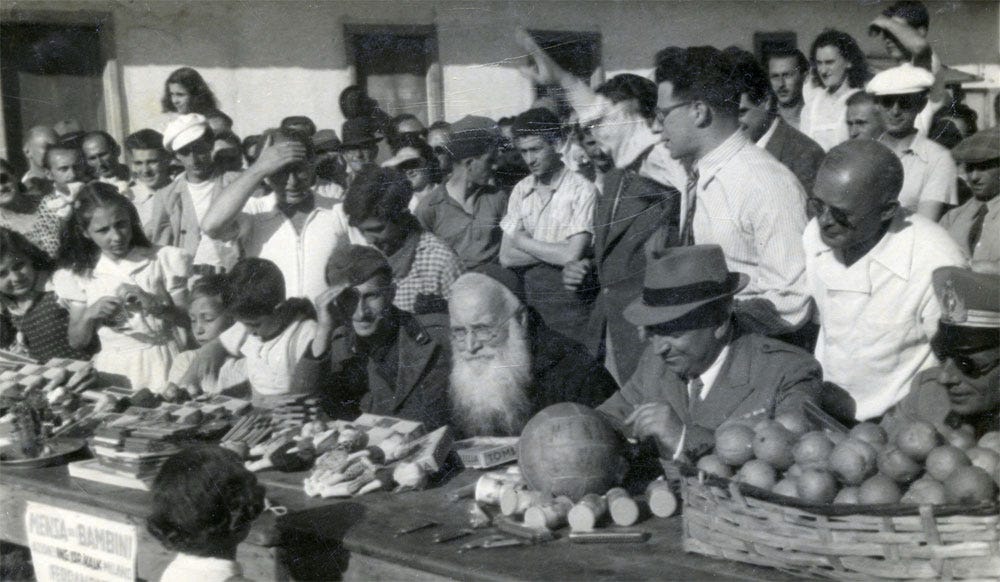
In 1938 there were (according to a special census) around 45,000 Jews in Italy out of a population of nearly 45 million. That’s 0.1%. In his book The Jews in Mussolini’s Italy, the historian Michele Sarfatti reminds us that in the same year the Jewish population of Warsaw was 350,000.
Jews were primarily urban, enjoyed far higher rates of literacy than the non-Jewish population, and in the early part of the 20th century supplied some of the young country’s leading statesmen, including a minister of War and a minister for Justice and Religion. Giuseppe Modigliani, brother of the painter, Amedeo, was a prominent member of the Italian Socialist Party. Sarfatti notes that while Italian Jews observed Judaic customs such as circumcision, there was “very scant observance of Jewish alimentary regulations”. In the land of Parma ham and pappardelle al cinghiale, this is not surprising.
Jews fought for Italy in the Great War and were decorated. And any hostility that the highly assimilated community encountered was a result of the Holy See’s contention that Jews were associated with modernising and anti-traditional tendencies.
The question occurs: did ordinary Italians actually feel threatened by Jews? It’s entirely possible that most never even met a Jew.
How did it happen?
So how did it come about that the Jews of Italy were repaid for their loyalty to Italy and assimilation into its culture (which was also their culture) by persecution and finally, for many of them, by transportation and death? I write this as anti-migrant rhetoric, laced with a constant infusion of racism - now often overt - seems to have taken hold in parts of the UK, not least in parts of the British media. In 1940 an Italian Jewish woman wrote to a friend that, “The press which belongs entirely to the state and wants to assume an anti-Jewish spirit, furnishes a pitiful spectacle vomiting up incongruities, contradictions, historical distortions… But from all this... the sense of suspicion and hate will stick and perhaps will spread (to our shame). Already there is no lack of parrots and villains.”
And so there aren’t.

The myth
After the Allied invasion of Sicily in July 1943 Mussolini was toppled and replaced by the head of state, Victor Emmanuel III with the veteran soldier, Pietro Badoglio. Six weeks later an armistice was signed with the Allies and a month after that Italy declared war on Germany. Mussolini, rescued by German commandos from a soft imprisonment on an Italian mountain, was set up in a new fascist republic, whose territory included the city of Ferrara. It was under this government that the 96 Jews on the Via Mazzini plaque were imprisoned and then sent to Auschwitz.
Possibly because Italians died fighting the Germans or were massacred by them (as on Kefalonia in September 1943) there was a considerable effort on the part of post-war Italian historians to absolve their country of the worst sins of the Nazis. An idea became widespread that Mussolini’s antisemitism was somehow extrinsic, almost forced upon him by a desire to appease or imitate Hitler. Similar arguments were made by some French historians about the treatment of the Jews by the Vichy French. More of that (if you can bear it) in a forthcoming post on the writer Gertrude Stein.
There is an unremarked symmetry here. In both Vichy and fascist Italy the man who assumed responsibility for identifying Jews and organising their persecution, had been deeply involved with the publication and dissemination in the early 20s of translations of the antisemitic forgery The Protocols of the Elders of Zion.
The truth is less digestible for patriotic Italians. As early as 1919, two years before his “March on Rome” brought him to power, Mussolini had written in his house journal, Il Popolo D’Italia about “the great Jewish bankers of London and New York, linked by race with Jews in Moscow as in Budapest, who seek revenge against the Aryan race”.
Two years later his rhetoric concerned his idea of Jewish dual loyalty…
A Jewish question does not exist in our country and let us hope that there never shall be one, at least not until Zionism poses Italian Jews with the dilemma of choosing between the Italian homeland and another homeland.
Note that this was a quarter of a century before the establishment of Israel. In 1928, after sporadic local antisemitic attacks carried out by blackshirts Mussolini placed all responsibility on the victims, writing…
Let us hope that Italian Jews will continue to be smart enough not to provoke anti-Semitism in the only country where it has never existed.
Later that same year he congratulated himself in having both raised “a debate” about Jewish loyalties and, by raising it, having solved it. He could now turn his full attention to making trains run on time, bare-chested horse riding and planning to invade various other countries in order to create a new Roman empire.
But it was precisely this imperial ambition that would turbocharge fascist Italy’s racial antisemitism. Until the 30s Mussolini’s main gripe had been that the Jewish community might not give its full backing to the slogan, Credere, Obbedire, Combattere (Believe, Obey, Fight). In that sense Judaism was probably more of a problem than race.
It started with the Africans
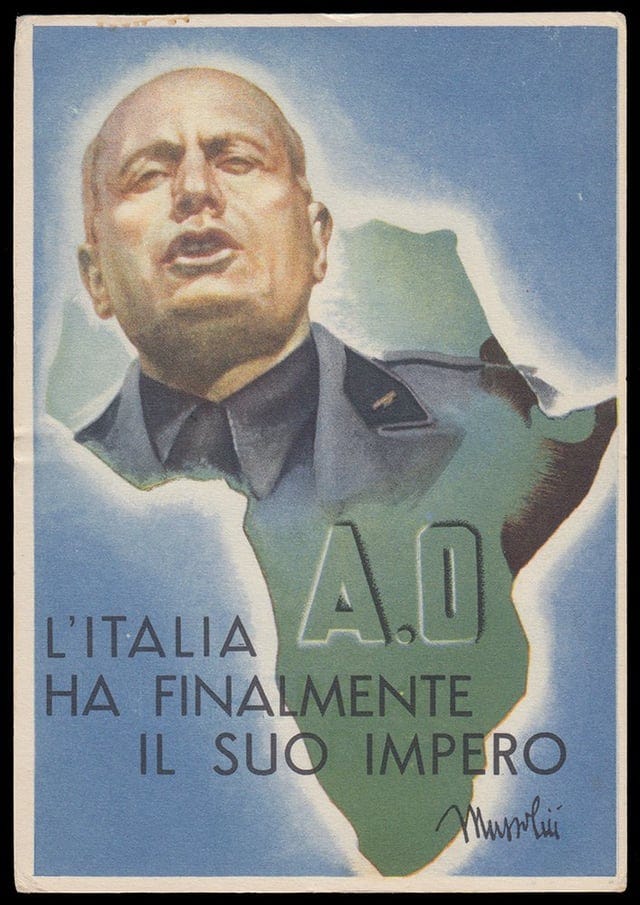
Mussolini inherited an African empire, which consisted of Libya, Italian Somaliland and Eritrea. By the early 30s he was considering further African conquest. What this meant was white Italians ruling over millions of black or brown Africans. In 1932 a young Italian anthropologist, Lido Cipriani, published an influential book called In Africa from Cape to Cairo. The book warned of the dangers of colonial race mixing:
“The superior races should... be careful as of now to refrain from crossbreeding with inferior races, and the law should intervene to prevent it…. And is that still today indifferently welcome inferior races to their bosom and proclaim their members as ‘citizens’, with the same rights as men of the white race, are condemned, inevitably in my opinion to early decadence.”
Comments
Nothing yet. Say the first thing.
Sign in to join the conversation.