
Canada is the second largest country in the world by land area and by any comparative measure is sparsely populated. Canada has roughly nine times more land per person than the United States. Yet most of the population growth (and much of the economic growth) is concentrated in a tiny share of the country’s land.
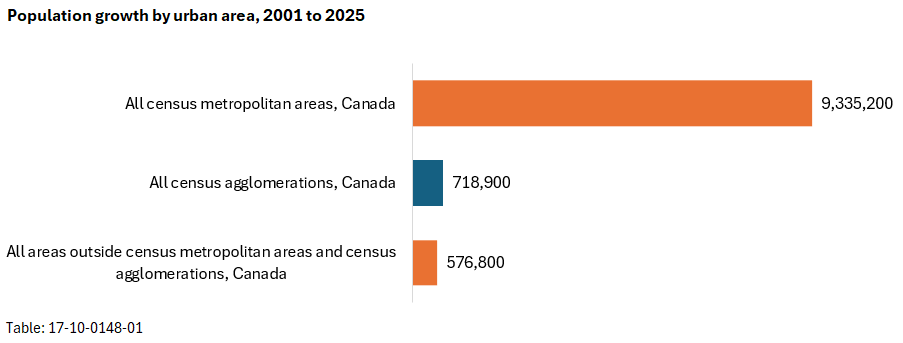
Between 2001 and 2025, the Census Metropolitan Areas added 9.3 million to the country’s population while the Census Agglomerations and areas outside CMAs and CAs added a tiny fraction of the number in CMAs. Now, some of that is deceptive because a number of CAs graduated to CMAs over the period but the fact remains that the country’s 40 or so largest urban centres accounted for a massive share of population growth.
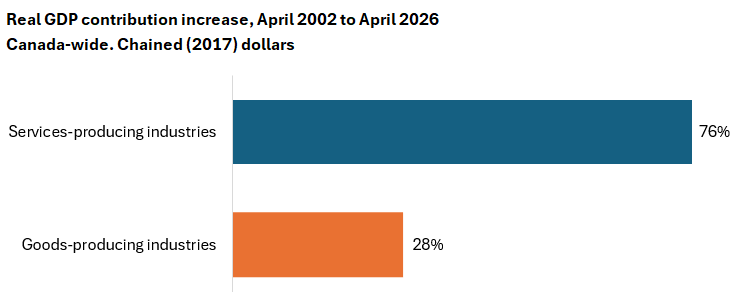
Because of the economic linkages between urban and rural (e.g. Calgary’s GDP is highly influenced by oil wells in rural areas), it is hard to make a clear delineation in GDP growth but if you look at services-producing industries, the real GDP contribution has increased 2.7X faster than goods producing industries between 2002 and 2026. Manufacturing GDP is down 12%, forestry and logging down 45%, mining (excluding oil and gas) up only 17%. Meanwhile health care GDP is up 75% in real terms), professional services (+108%), universities (+97%), public administration (+65%), finance and insurance (+140%).
I have written about this before. I’m not sure this was part of a deliberate strategy although the greatest thinkers from Glaeser to Florida were pumping the notion of an urban focused approach in the 1990s and early 2000s (until now).
The federal government put a lot of hope in its superclusters strategy which were mostly urban focused. Even the oceans supercluster seemed to be primarily a technology play as the federal government actively worked to undermine the development of aquaculture in western Canada and was at best lukewarm about offshore oil and gas in Atlantic Canada.
I haven’t seen any kind of independent assessment of the growth of the superclusters - maybe it is out there - but I haven’t seen it -but the bottom line is that average annual real GDP growth in Canada dropped 34% between the 1982-2007 period and the 2008-2024 period. And without the population surge in recent years, the gap would have been much wider.
Note: If you add up the national real GDP contribution from aquaculture, fishing, seafood product preparation and packaging, ship and boat building and water transportation, the real GDP contribution in 2026 is lower than it was in 2018. If you add in offshore oil and gas, it is down $2.4 billion in real GDP terms. This is not necessarily an indictment of the oceans supercluster as it was focused more on things like ocean tech than stimulating more offshore oil and gas development or aquaculture.
So maybe it is time to think about Canada as more than just a cluster of dense urban areas and vast hinterlands. Maybe we should think about population growth the way we did 100 years ago when immigrants were locked in rail cars (literally? Metaphorically?) and only let out when they reached their tract of land in the Prairies.
There are significant natural resources opportunities from coast to coast. The forest products industry has waned (except in New Brunswick), there has been limited mining investment. The oil and gas folks say there is much more potential. Beyond that I think we could see much more growth in agriculture and aquaculture.
Further, I think the tourism industry across much of the country has been constrained because of a lack of workers.
For me when I think about the vast area in Canada outside the large urban centres, I seen the need for two big focus areas - population and workforce growth and electricity development. You can’t develop industries without people and you can develop natural resource industries (e.g. mining) without a lot of electricity.
The CMAs will continue to drive growth in this country - particularly in services industries. Much of the innovation will be spurred in our big cities and universities. We should continue to focus on tech startups and the intersection of tech with our core industries.
But we need to get back to the idea of building a strong economy from coast-to-coast - urban and rural. That is what will get us back to a solid level of GDP growth and expand the tax base to sustainably fund the public services, social safety net and public infrastructure that we take for granted.
No posts
Comments
Nothing yet. Say the first thing.
Sign in to join the conversation.