
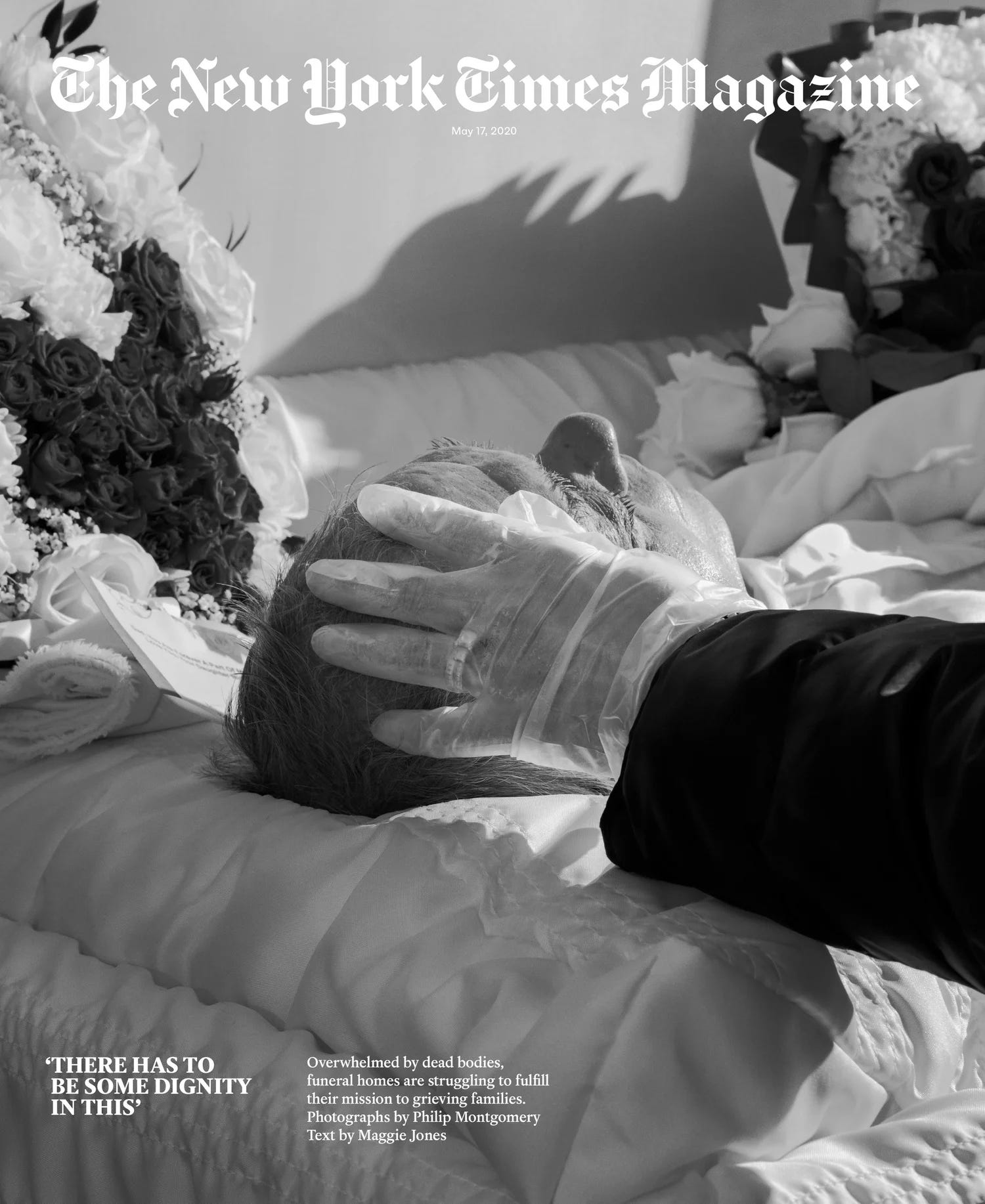
NEW YORK TIMES Magazine. Photograph by Philip Montgomery.
In the terrifyingly early days of the pandemic I was cold calling funeral homes for The New York Times Magazine, requesting unfettered photographic access for the photojournalist Philip Montgomery to uncover what was unfolding behind their walls. In normal times, a taboo.
Suddenly: refrigeration trucks parked outside hospitals, laden with bodies waiting to be identified and, if lucky, transferred to a funeral home for care. Coffins piled up on chairs and tables inside funeral homes, embalming and cremation being performed at great risk to the mortician: families denied services for their loved ones. A heartbreaking drama behind closed doors.
No one answered the phones. They were overwhelmed. And when they called back they couldn’t conceive of taking on the extra burden of a photographer adding to the chaos and intruding on those who were grieving. No less a photographer who shot with a strobe to achieve immediacy and, counter-intuitively, intimacy.
After a week of calls, something miraculous happened. Sal Farenga returned my several calls. He and his brother Nick ran the 100-year-old family business, Farenga Brothers Funeral Home, in the Bronx. I thought they were the perfect embodiment of the story and Sal needed the world to witness the stark realities that they were confronting. Evidence in black and white and in real time.
In those haunted days of death and fear, Philip and I earned the trust of not only the Farenga brothers who ran their family business with the utmost dignity, but that of a courageous family who allowed us to tell their story of traumatic loss.
As I shepherded the story with Philip, the writer, Maggie Jones was introduced into this world. Then, Kathy Ryan and I started the brutal process of editing. Struggling with Solomonic ethical and legal decisions as to which of the many graphic images would best inform the catastrophic days while protecting identity and respecting the dead and their families.
After culling through Philip’s powerful images and with input from the magazine staff, we ultimately chose a picture of the wife of the grieving family we were following. She is gently reaching out to touch her husband’s face in the casket with her gloved hand, her wedding ring visible through the transparent glove. The photograph told the story in a single frame.
There was no question that we had the legal right to publish the photograph but we were sensitive to the family’s feelings about seeing their loved one dead on the cover of The New York Times Magazine. I had developed a strong relationship with the deceased’s daughter, and we decided to send the family a cropped version beforehand to help soften the blow. After a painful silence they responded that their immigrant father would have been honored to be on the cover of The New York Times Magazine.
Debbie Samuelson was a contributing producer at The NYTimes Magazine during the pandemic, and before that visual editor for various publications and a creative executive at Geffen Records and Epoch Films. She is presently a creative coach and visual consultant at Synthesis-Coach.
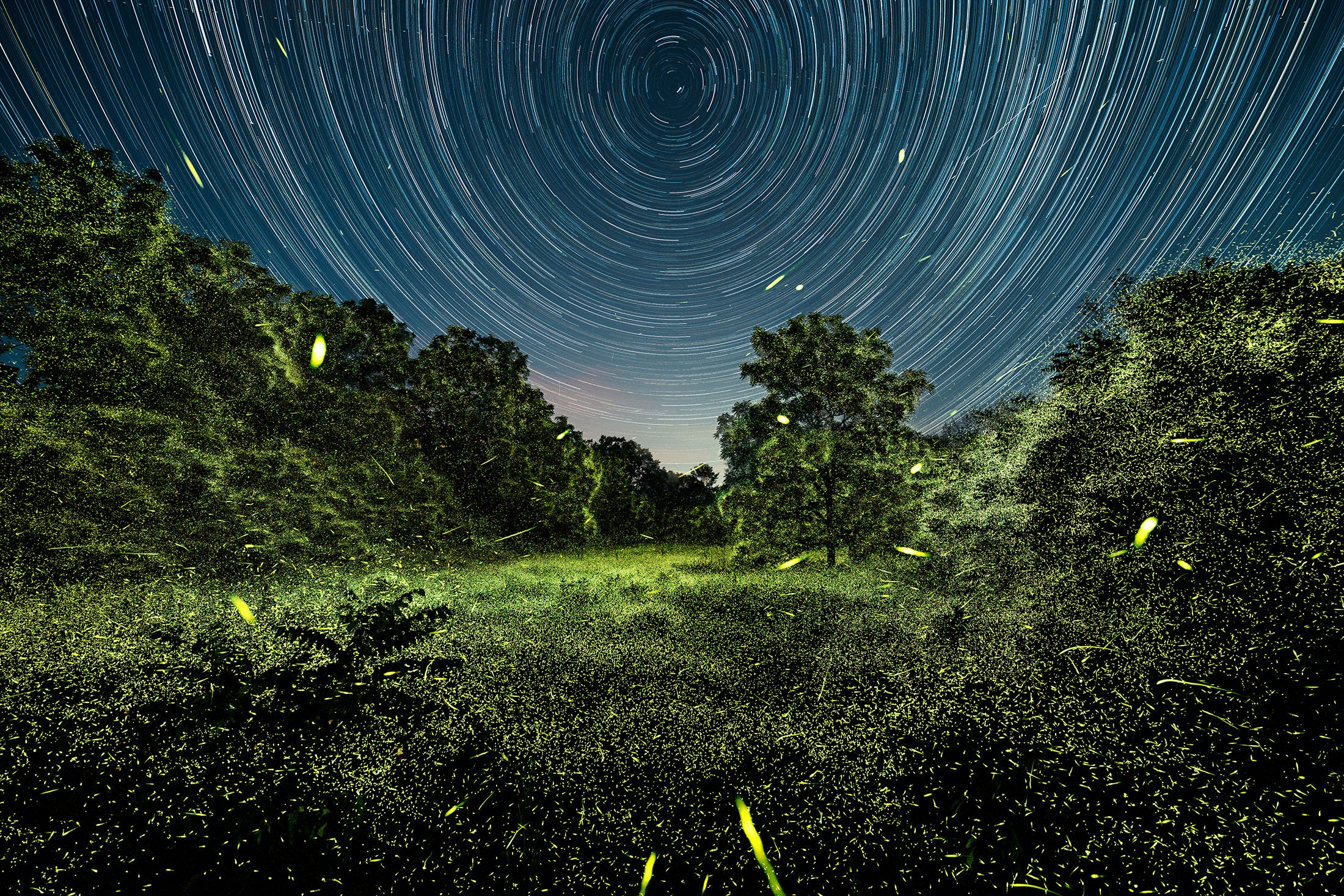
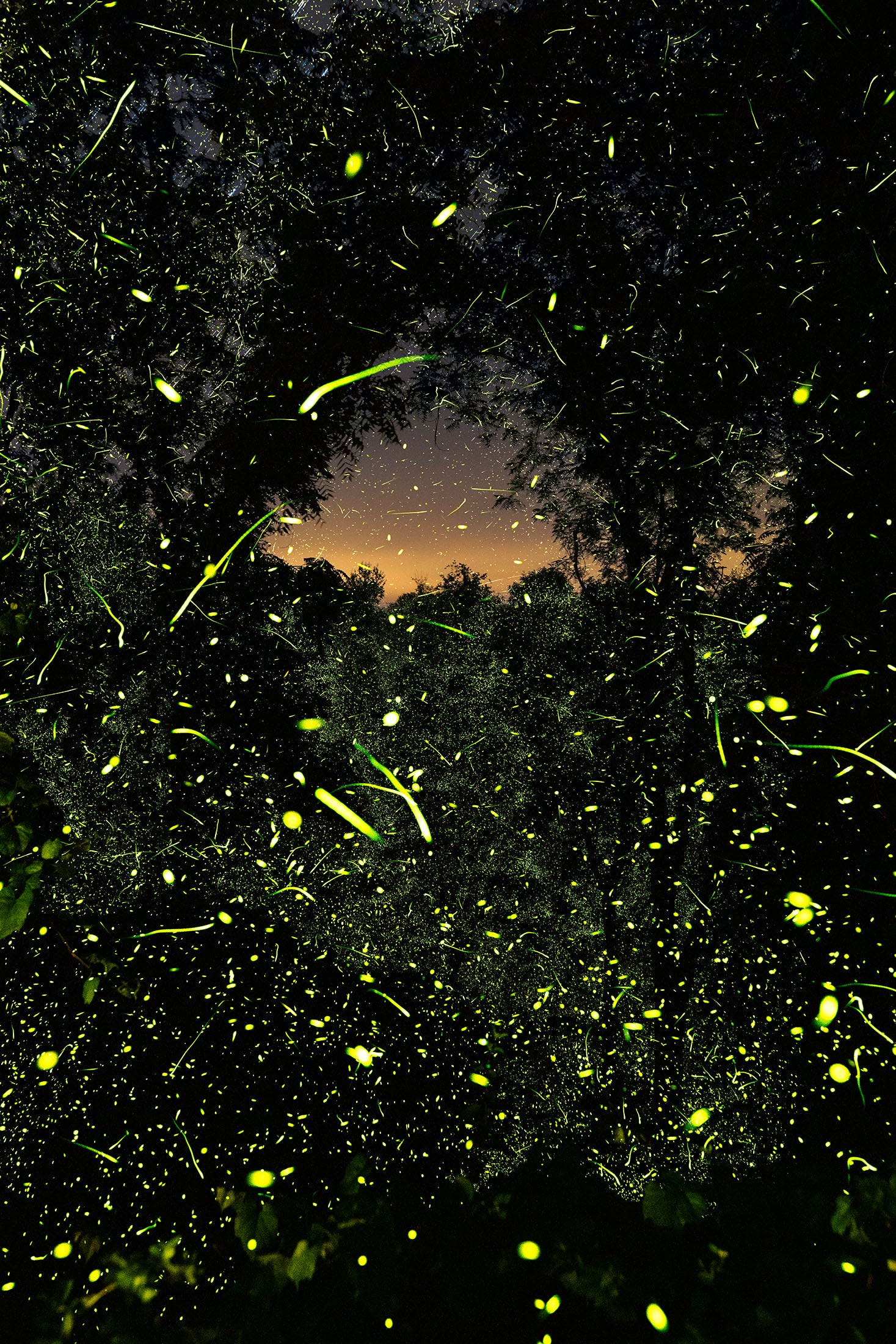
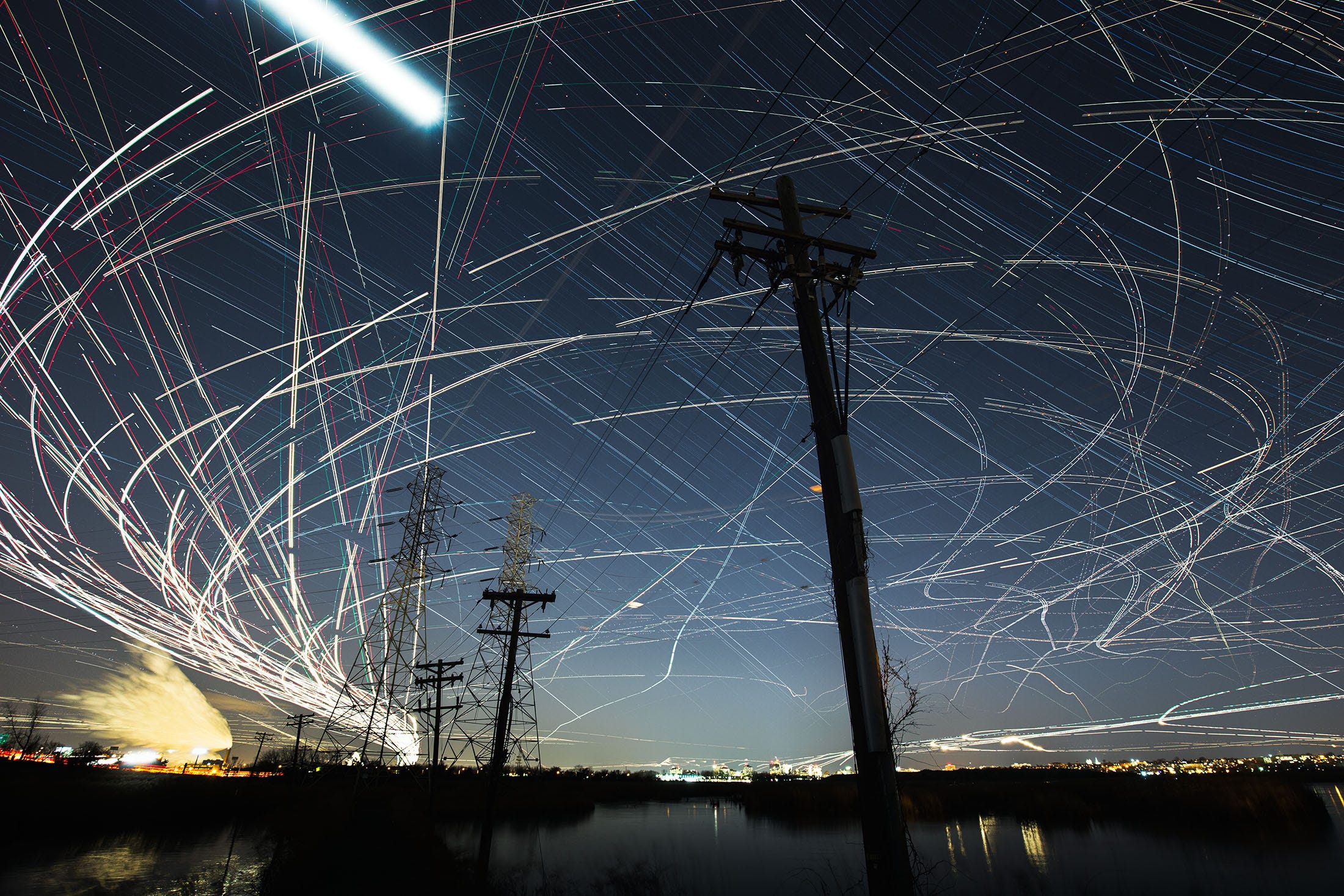
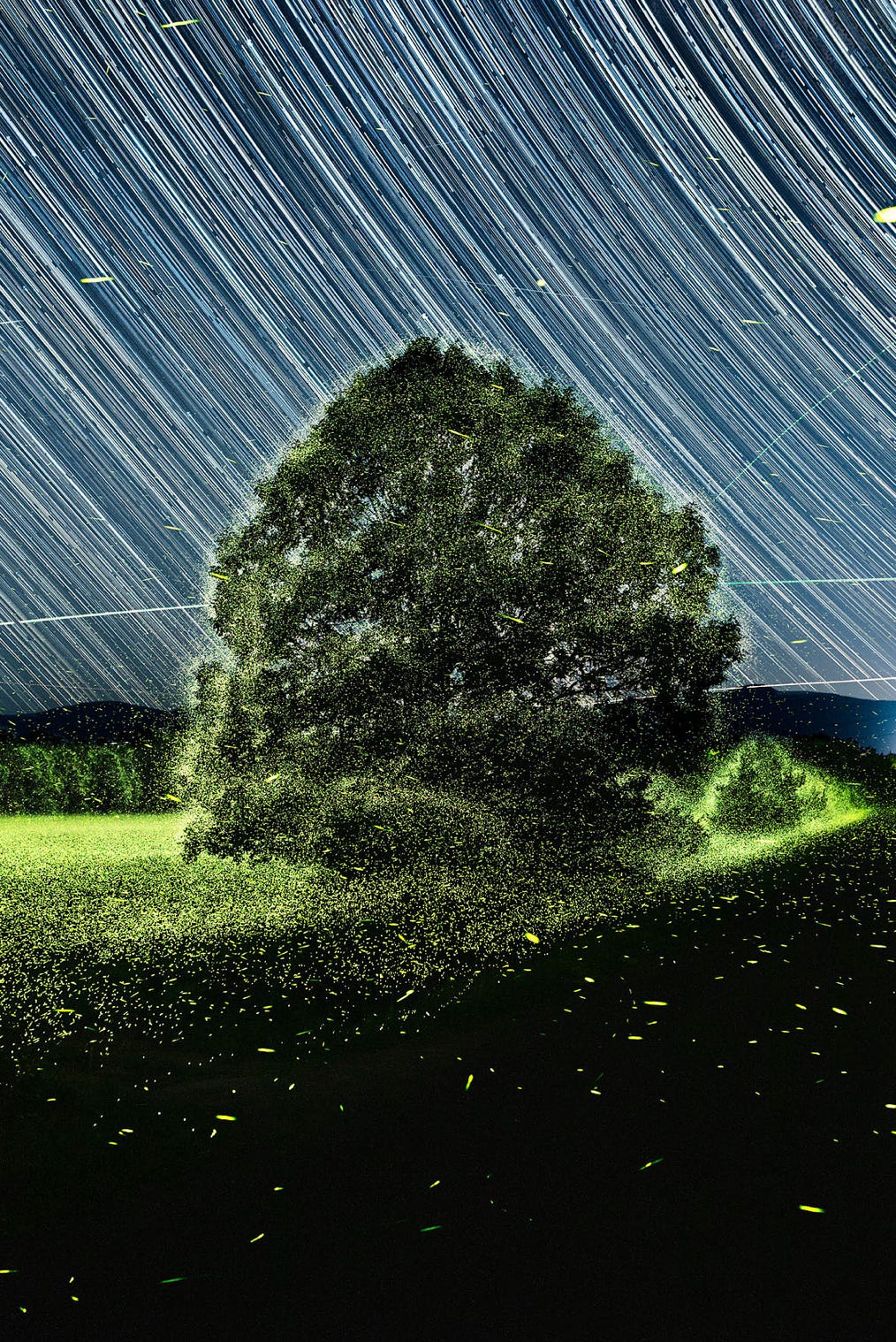
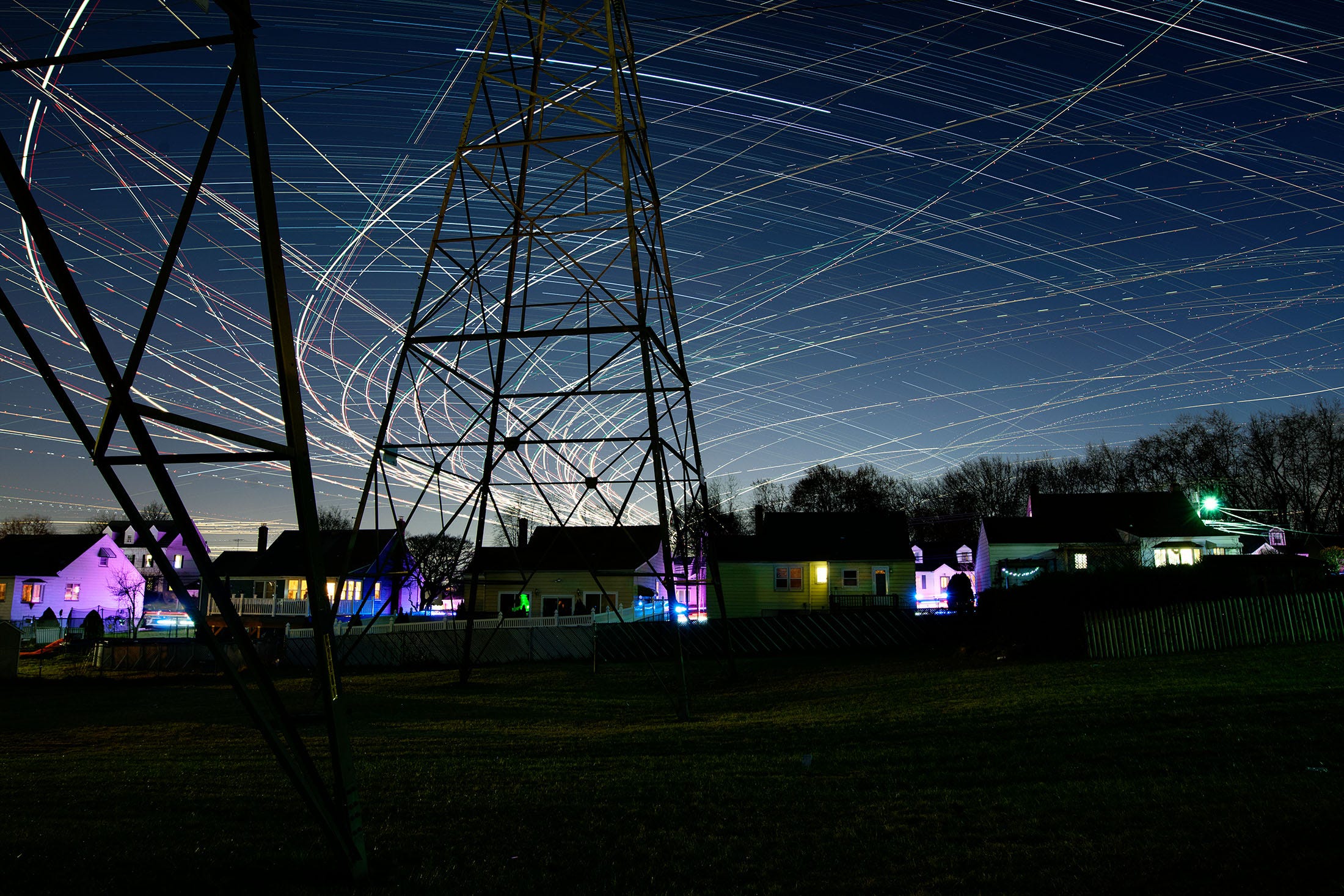
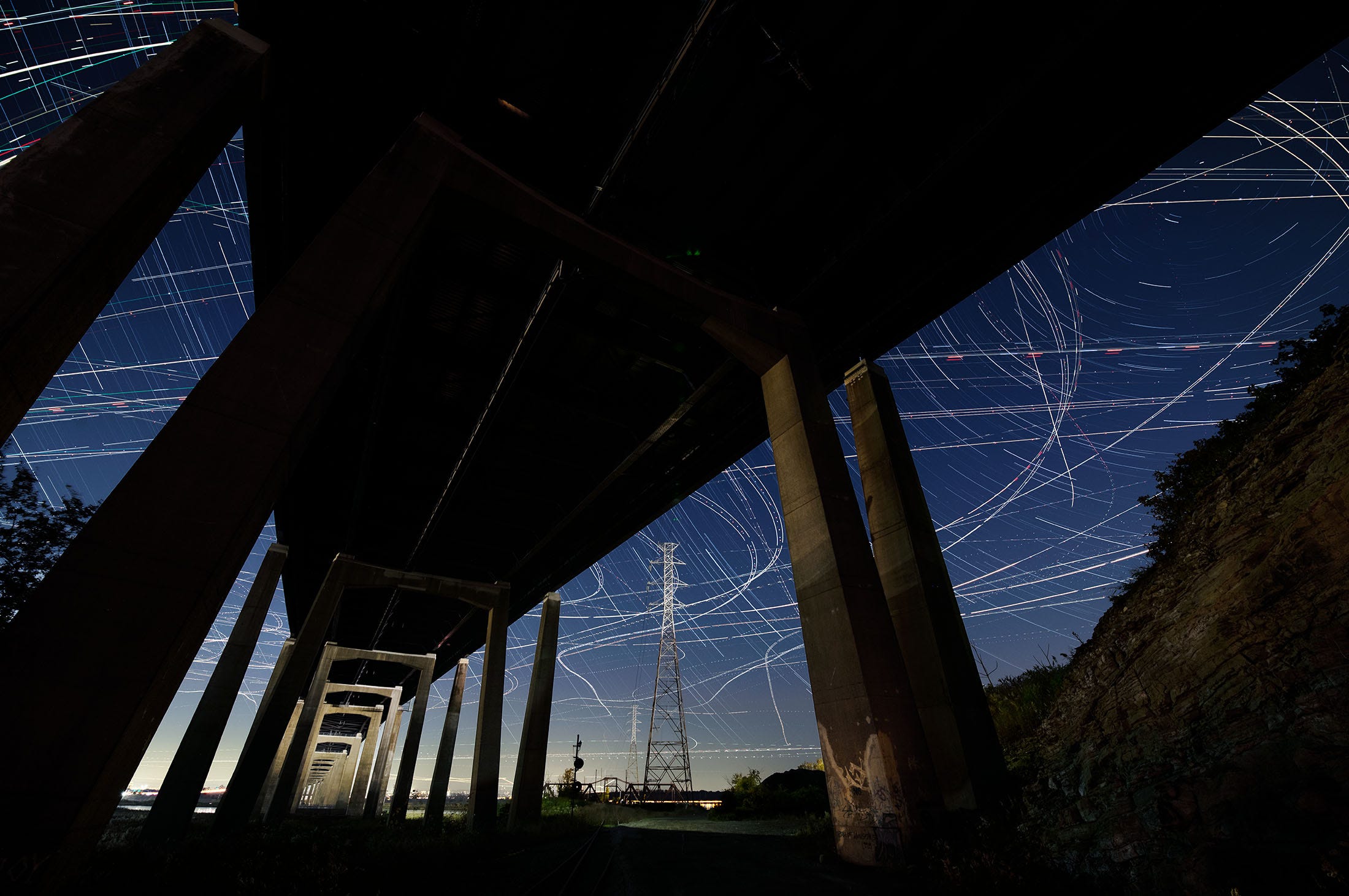
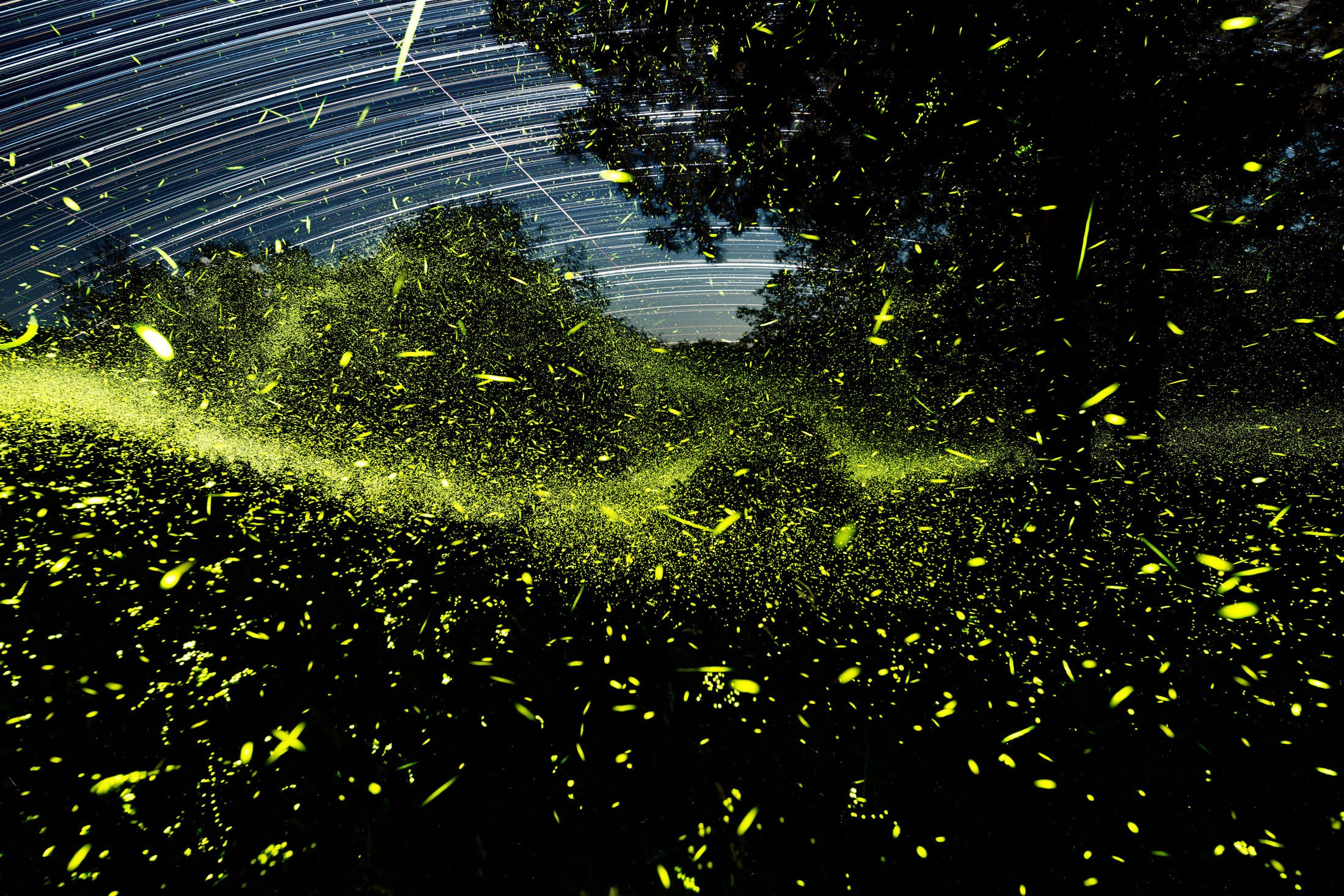
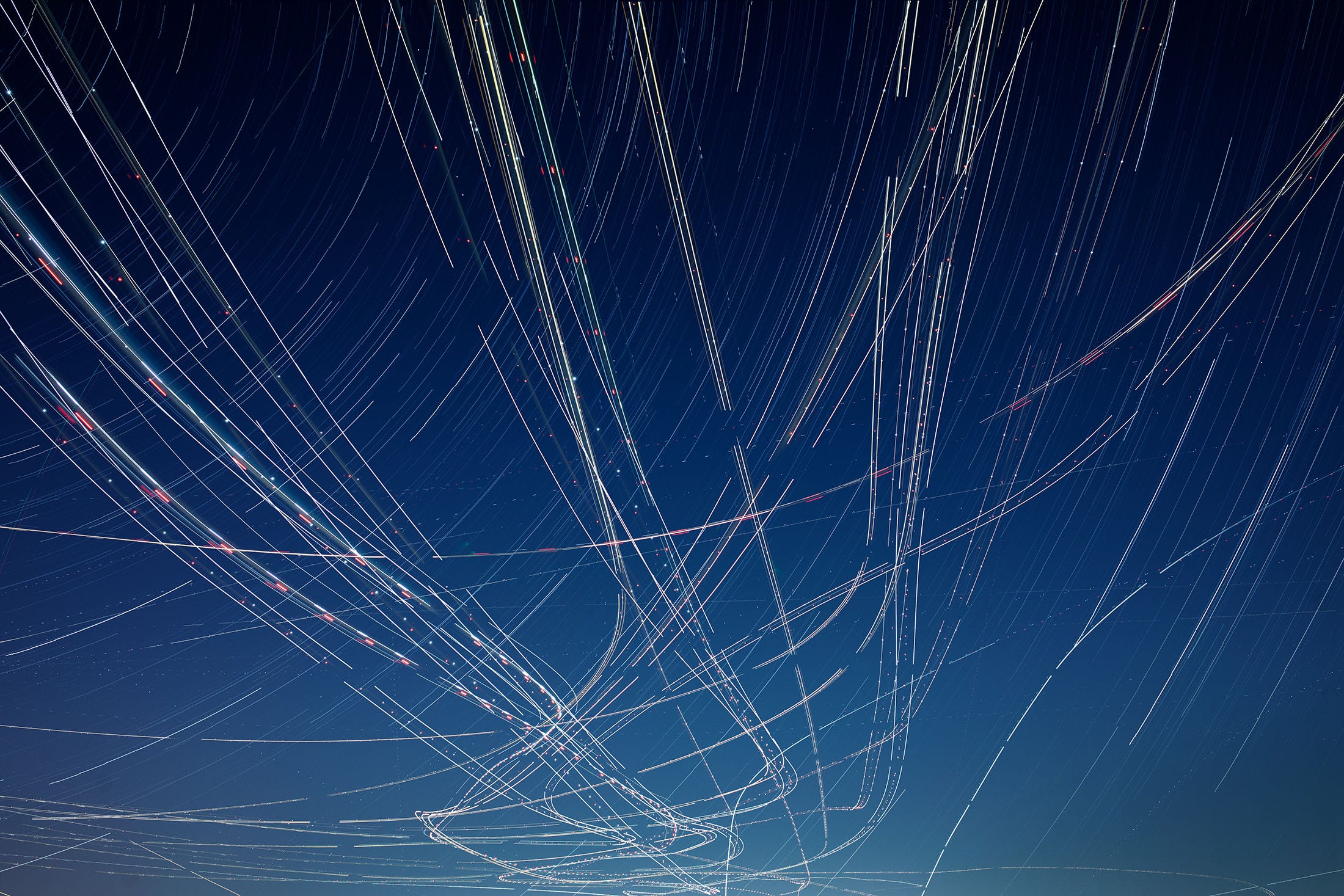
“There has never been a time for me when time itself wasn’t of primary interest. It comes as no surprise to me that it is this intangible that has become my dominant muse.
Once it might have been my 35mm trying to record every scrap of anything I could focus on to in every direction all at once because I knew I could never contain it all in my internal, overloaded memory banks equipped with their flawed processors. And yet I was still always scraping up against time, in and out of friction with it, losing it all together or just losing control. Like when you get caught in that wave at the beach that was a bit bigger than you thought and get tossed around powerless, clueless and maybe even ground into the sand and you’re not always 100% sure you will make it out unscathed.
So. In my searches, with my cameras, I started to explore parameters well outside the traditional fractions of a second it “takes” to get “the shot”. To consider in what new ways a decisive moment might appear. To reconsider what it meant, for me, to see and to feel time.
Eventually, I came to learn how to wander through it. With and without cameras. To hold still and to move fast at the same time. To draw out the human experience of one second as long as I could in real time before inevitably wondering, WTF, really, what even is “one second” except a really, really long time on a microwave when waiting for coffee? To release from sequential time, radioactive decay time, transitional human time, and to experience it as omnidirectional, graphic, dimensional was what I wanted.
I engaged proxies in the darkness, unpaid actors, to be my guides and collaborators, although they were out of my control, unresponsive to direction and uninterested in my priorities. Fireflies, aircraft, interstate truck traffic, broken street lights flickering endlessly. Whatever I could get my eager hands on. Systems, structures and patterns emerged from what was chaos and shadow. Some play out in a linear manner we can almost relate to, others coax out a cumulative reality that is not anything whose enormity we can humanly experience without a flattened intermediate document.
Detachment from our relentlessly sequential human experience followed. Somewhere in between the unmeasurably brief flashes of subatomic particles colliding, decaying, spiralling and creating their fantastical bubble chamber drawings and the more opaque processes of geologic time came the deep knowledge, the primal meat-level knowledge, that, in the big picture, there really is not much of a difference between five hours and 1/8000th of a second. Or 10,000 years. Or a lifetime”.
Pete Mauney received an MFA from Bard College. A book of his work “While We Slept” was published by GOFF Books in 2024. His work is in the collection of The Morgan Library in New York.
THIS WEEK’S RECKONING OF THOSE WHO ARE ON OUR MIND: A GLOBAL GATHERING OF THE INFLUENTIAL, THE CLEVER, THE SILENT, THE TRULY ORIGINAL, THE TENACIOUS.
THE SWASHBUCKLING POET MAX BLAGG PROVIDES VERSE AND NARRATIVE INSPIRED BY A PICTURE.
“let the gods lay chains on us/so no day unbind them”
the garden dark behind me, no moon,
fireflies signaling from the four quarters
hovering over the damp grass
and my glasses catching a flash
of light sent from the blue yonder
who calls my name in this darkness? what creatures out there
see me in their dreams?
All the right handles
and a glove compartment lined with fur like Meret Oppenheim’s teacup.
Books on shelves tea in cup
heart in mouth cock in repose,
what it’s like to be alone.
You can eat as much as you want
piss in the sink wear a filthy t-shirt to bed.
and there is no voice in the room
other than your own. Silence on the radio.
Staunch the emptiness with music
‘let the airwaves flow’.
A Language of Appearances It feels appropriate to consider the consequences of the capacity of AI tools to achieve fluency in the kind of speech that photography traditionally claimed as its own. The camera is and will remain central to the future of photography, and indispensable wherever pictures are asked or required to provide testimony. Yet photography’s visual language no longer secures the medium’s representational authority that, historically, was its defining identity. The photograph’s privilege of such authority is now shared by generative images that collapse the barriers between fiction and photographic credibility.
If an image can look photographic without actually being a photograph, it must still be understood as participating in photography’s language of appearances, the visual codes and cultural signals through which images become recognizable as photographs. In its earliest days, the camera originated a native language that grew, adapted, and evolved throughout each of photography’s technological descendants. While this language has matured, propagated, and hardened throughout global culture, it is now becoming untethered from the apparatus that made it possible in the first place.
The jurisdiction of photography is shifting. The camera’s authority becomes more focused and deliberate, concentrated around those uses where evidence and contact remain essential. Beyond this scope, many tasks once assigned to the camera can now be delegated to generative engines that are both fluent and abundant in photography’s language of appearances.
Photography’s Native Tongue The language of appearances we associate with photography is an accumulation of visual signifiers that have built up for nearly two centuries. It’s these signifiers that allow identification of the photograph as opposed to, say, a painting, illustration, or our own natural vision, and are so fundamental to the medium’s appearance that we often take them for granted.
This language is derived from the parameters and visual residues of the tools of photographic creation; Film grain, motion blur, harsh flash, color grades, depth-of-field, and so on. Photography’s visual codes have evolved through the consequences of its chemistries, tools, and outputs, alongside the continual refreshing of how cultural fashion is expressed through the medium’s capabilities.
Other aspects of the photography’s language are in the structures of visual syntax formed through compositional patterns, optical quirks, perspectival tropes. These are visual properties that aren’t native to the eye but which photography has repeatedly taught viewers to recognize as natural to camera seeing. The recognition of these sorts of patterns, even as faint traces of camera tools, often trigger the ingrained credibility and belief we offer to photographs. It follows that the medium’s authority is found by these identifying traits that separate it from other media.
Photography’s language of appearances also influences the social behavior of images. Across different aesthetic, perspectival, compositional patterns, we see exceedingly common traits shared within different categories of photographs: war reportage, family photographs, surveillance pictures, selfies, advertising pictures, yearbook portraits, aerial photographs, and so on.
In your mind, imagine a product photograph of a can of soup made from the perspective of a surveillance camera, or a light-leaked holga portrait of an athlete on a baseball card. What about a police mugshot made with a park in the background? These are pictures we never see because they deviate from the expected social behaviors of photographs and the language of appearances we expect for a soup ad, a sports card, or public evidence.
All told, we sit upon an immense and bottomless visual catalog accumulated from nearly two centuries of camera pictures through which photography’s language of appearances became immediately legible to just about the entire global population. By the time we witnessed the arrival of the AI era and its visual products, we had already established a long-standing set of hardened codes that determined how we speak through photographs, how we expect photographs to speak to us, and how photographs themselves become legible through their visual, social, and cultural conventions.
AI’s Photographic Inheritance The arrival of generative AI is preconditioned on the ocean of global cultural and scientific information that has been digitized, categorized, and fed into machine learning systems at tremendous scale. A quick inquiry to ChatGPT yields estimates of around 17 trillion photographs made since the medium’s invention. Even with wild overestimation, a fraction of that number would seem perfectly adequate for advanced AI infrastructures to learn how photographs look and what makes them look the way they do.
AI also arrives in a visual culture that is thoroughly saturated by, and literate in, photography’s conventions, cliches, and assumptions — its language of appearances. Over two centuries the immense repetitions and iterations of camera pictures gradually established a native tongue, and it is a language that supersedes spoken and written languages as the most accessible and globally transactional means of communication we share.
These are the conditions that the camera has created, and they are what comprise the inheritance that is passing on to generative systems, now capable of proficient adoption of many of the camera’s use cases. As far as we can imagine, generative AI tools cannot replicate the photograph’s relationship to the physical world, but it builds significantly on the accumulated residue of how the world has already been pictured. AI accesses the world through the memory photography established.
Generative images are built upon vast layers of sediment that photographic culture has left behind. They are fossil records of documentary conventions, portrait styles, advertising tropes, and the vernaculars of family and social media pictures, among so many others. Years and decades and centuries of image language are compressed into a ground that now fertilizes the knowledge of AI systems and the future of picture-making.
From Babble to Fluency Early-stage AI images often appeared photographically strange. Systems like DALL-E and Midjourney could approximate photography’s language, but not yet speak it fluently. As the father of a one-year-old who babbles the shape of certain words like “doggy” and “hello,” I take liberty to note a clear throughline in the development of articulation between human and machine thinking; an emergent capability to grow the capacity for communication from pure abstraction to coherence, and eventual mastery.
In those early attempts of photographic language, faces fractured, hands sprouted extra fingers, illusions of physics collapsed into muddled form. What we saw were images that looked like mutated photographs, failed cameras, aesthetics of collapse. That period now feels historically brief, but significant in the evidence of the learning progress that AI tools have demonstrated in the span of a few short years.
The systems improved quickly because photography’s language was already immense, repetitive, and globally standardized. Through its lifecycle, photography has trained billions of people on how photographs should look while simultaneously producing the enormous archive from which generative systems learn. AI’s inheritance was photography’s aesthetics, but also the rhetorical minutiae that photography’s language of appearances employed in emotional registers of atmosphere, aspiration, intimacy, persuasion, sincerity, and spectacle.
At the same time, what is left out of such an inheritance is photography’s obligation to physical encounter. In a photograph, appearance and contact with the world are intertwined and co-dependent in their achievement of narrative, catalog, or assertion. Generative images pull these conditions apart to the extent that an image can now fully participate in photography’s language of appearances without participating in the previously requisite relationship to the physical world.
Credibility After the Camera These new and rather quizzical conditions do not mean that photographs and generative images are equivalent. Further, we cannot fall into the convenient fallacy of calling AI made images photographs. But the capacity of AI to demonstrate total fluency in photography’s language of appearances points to a growing worry about the diminished position of the photograph as, to use Fred Ritchin’s term, “the credible witness.”
In one particular corner of the internet, we can already see this credibility crisis in action. The Reddit group called r/isthisAI, is devoted to asking whether photographic images are AI or not. This community, as of this writing, receives over 4.6 million weekly visitors to witness and participate in analysis, speculation, and reasoning on the credibility of mostly vernacular and social images presented to the group. Many actual photographs are met with skepticism, many images presented there don’t achieve consensus. In this community, the assessment of personal and social pictures produced for limited audiences carry with them low stakes. Yet the speculative nature of the conversations could easily be extrapolated to the kinds of journalistic or politically purposed images that carry potential for enormous consequences in shared belief.
It should be underlined that the medium’s credibility was never secured exclusively through visual appearance alone. Photography’s plea for credibility relies just as much if not more on caption, context, and the trust of the authors and institutional actors that background an image.
We might consider a thought experiment: Imagine a single issue of the New York Times published in two separate formats. One in which there are photographs without captions, and the other in which there are captions without photographs. The photographs of course would offer narrative suggestion and a surface of evidence, but it is the captions that would provide the specific claims to facts that perform the historical record. The image lends force to the claim, yet there requires a chain of command between institution, author, and photographer in which credibility is distributed.
This compact of credibility has always been vulnerable, but the existence of generative images exposes new and widespread threats toward photographic believability. Not least of which is the rhetorical fluidity at the disposal of AI picture makers that allows achievements in the efficiencies, specificities, and persuasions in which ideological ideas can be formulated through photography’s language of appearances.
Gregory Eddi Jones is an artist, writer, and publisher. His photographic work has been published in the British Journal of Photography, Dear Dave, magazine and Foam Magazine, and he has contributed writing to Afterimage, Paper Journal, and Unseen Magazine.
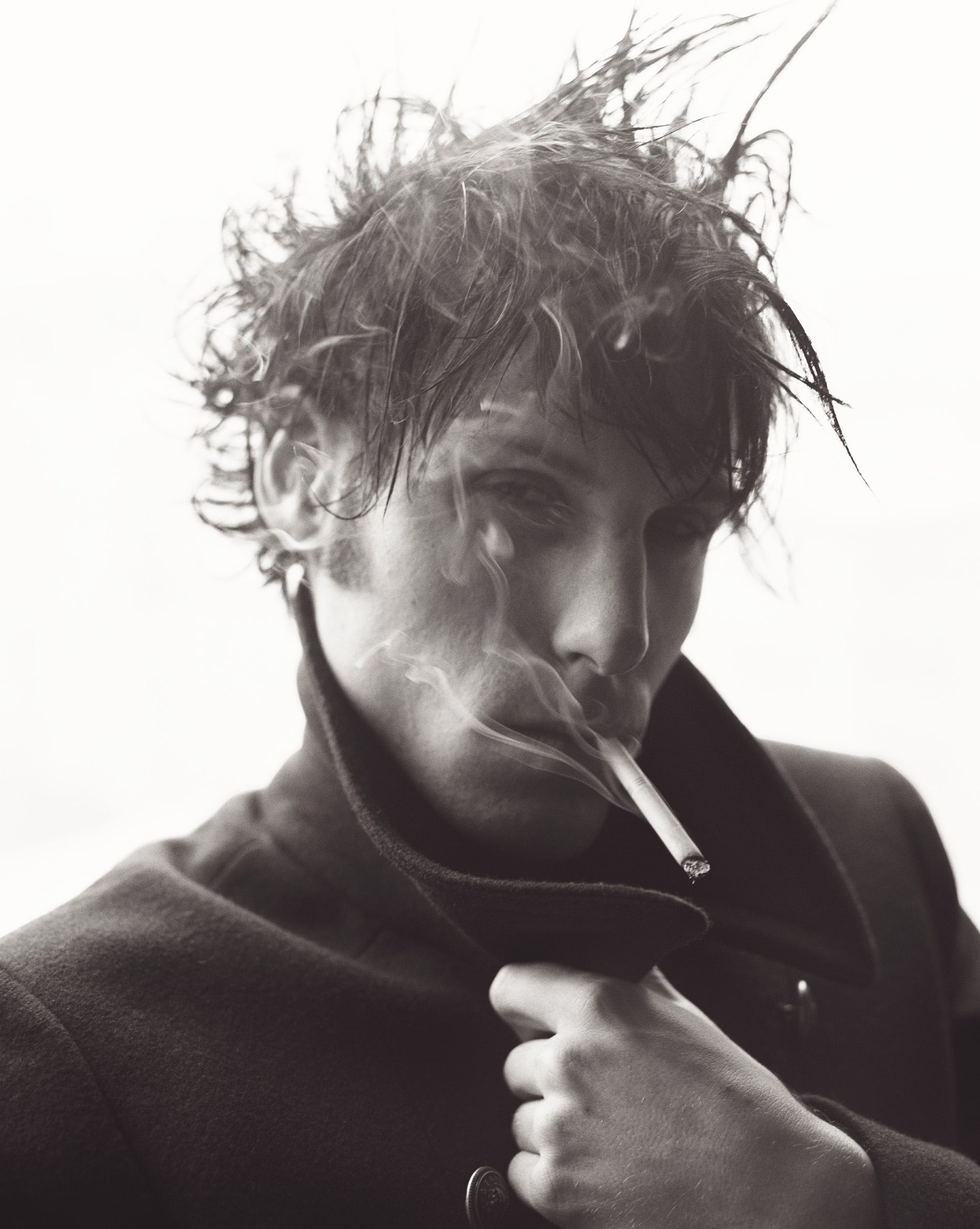
Steven Meisel has been named Photo London’s Master of Photography 2026, an accolade accompanied by an exhibition of his work at the fair. He is the second recipient of the award, with last year’s inaugural prize going to Sebastião Salgado. Meisel’s fashion photography is a stark contrast to Salgado’s social documentary work, highlighting the breadth of photographers Photo London seeks to platform and give recognition to.
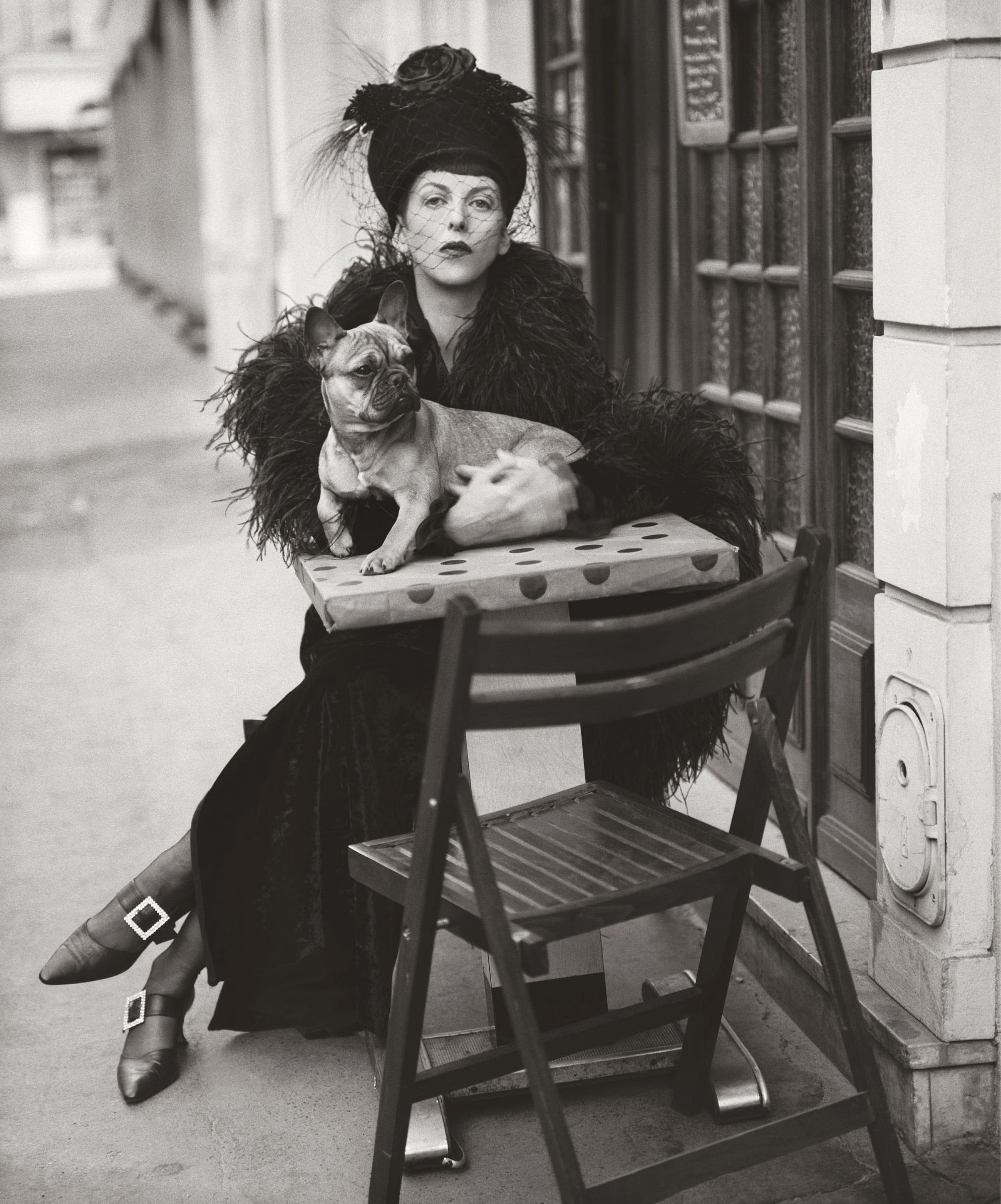
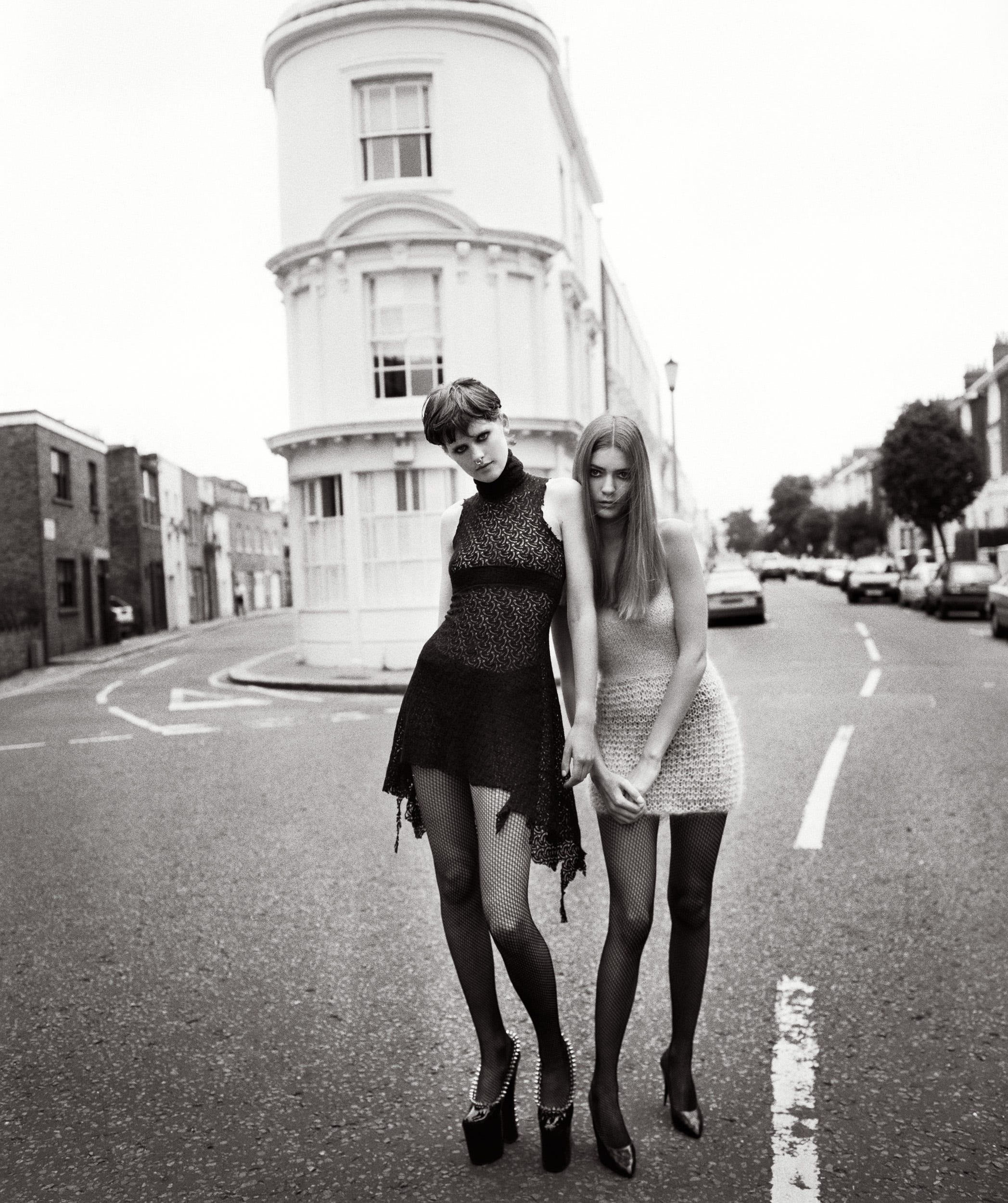
A prolific photographer, in 1993 alone Meisel shot twenty-eight covers and one hundred editorials for Vogue internationally. The works displayed at Photo London were drawn from this early year in his career, with a focus on photographs taken in London, primarily from the series ‘Anglo-Saxon Attitude’ for British Vogue (December 1993) styled by Isabella Blow. Meisel’s portraits were printed large and dominated the upper gallery of Kensington Olympia, their magnitude varying dramatically in scale from the magazine pages we are used to seeing his work in, seeming to announce his ‘legend’ status from across the vast venue.
In the work displayed, Meisel chose to take his models out of the studio and utilise the varied London settings. His preference for London’s canals, alleyways and pubs contrasted high fashion with the actual realities of the city and leant into the nineties desire to present high-end fashion against gritty backdrops, subverting expectations of glossy fashion magazines and taking inspiration from the anarchic nature of London’s fashion scene then.
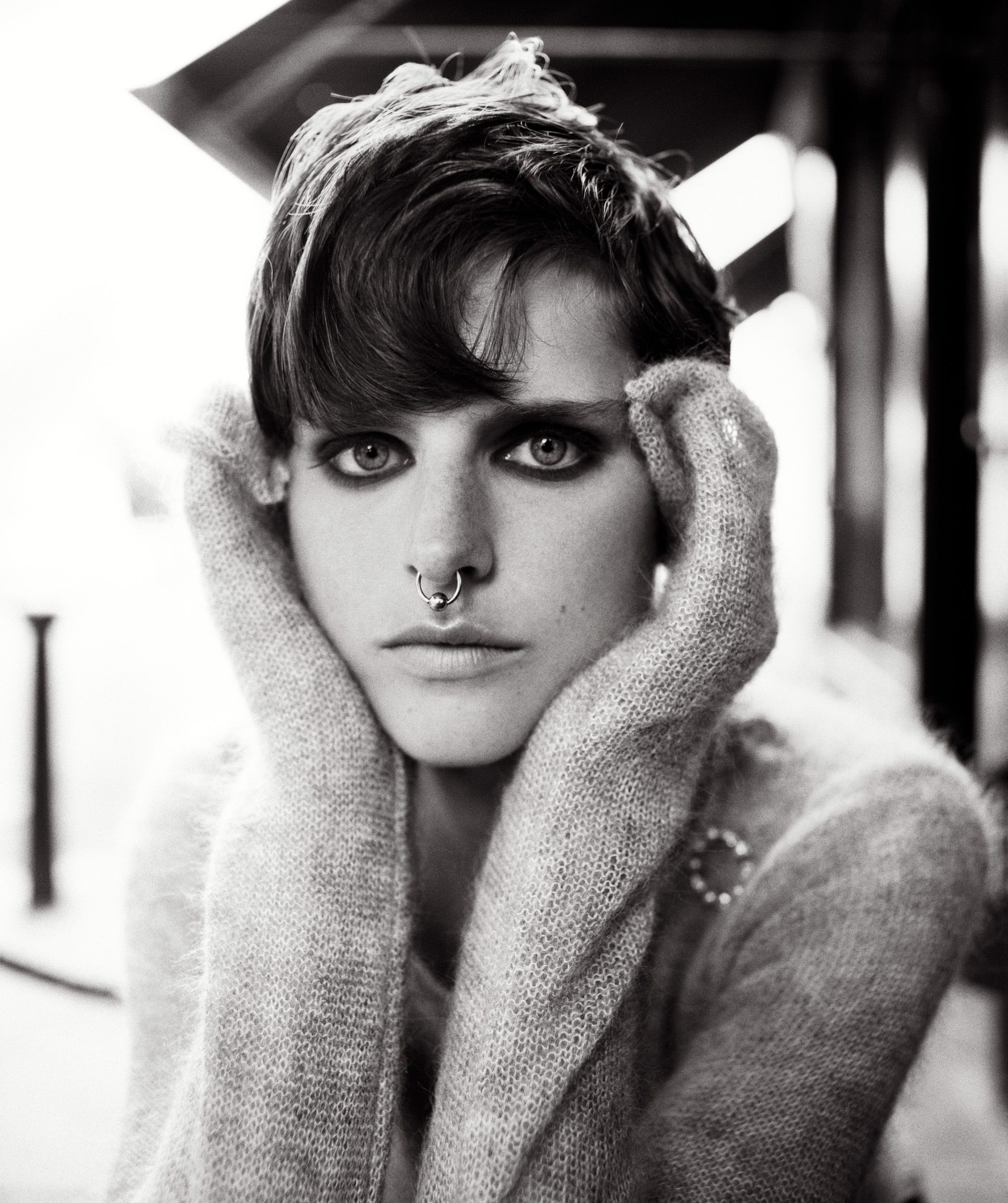
Highlights of the show include portraits of Stella Tennant, an art student he discovered and convinced to model despite her lack of interest. Heavy eyeliner, nose ring and cropped hair, Tennant appears like a nineties version of Twiggy, and similarly, became a key model of her era. Her grunge, androgynous vibe mixed with her upper class background combined current trends with the tradition of British aristocracy being models in London’s style magazines for the past century. She was the face for a new generation of ‘old money’, and would shortly after this shoot become the muse of Karl Lagerfeld at Chanel.
Photographs of Isabella Blow show the stylist as eccentric and self-assured. In some photographs she holds a French bulldog, never allowing her canine accessory to touch the floor. Seated at an outdoor table or at the bar of a pub, she seems the kind of local everyone knows, who has lived in the neighbourhood forever and never has to order a drink: of course the bartender got her usual as soon as she walked in.
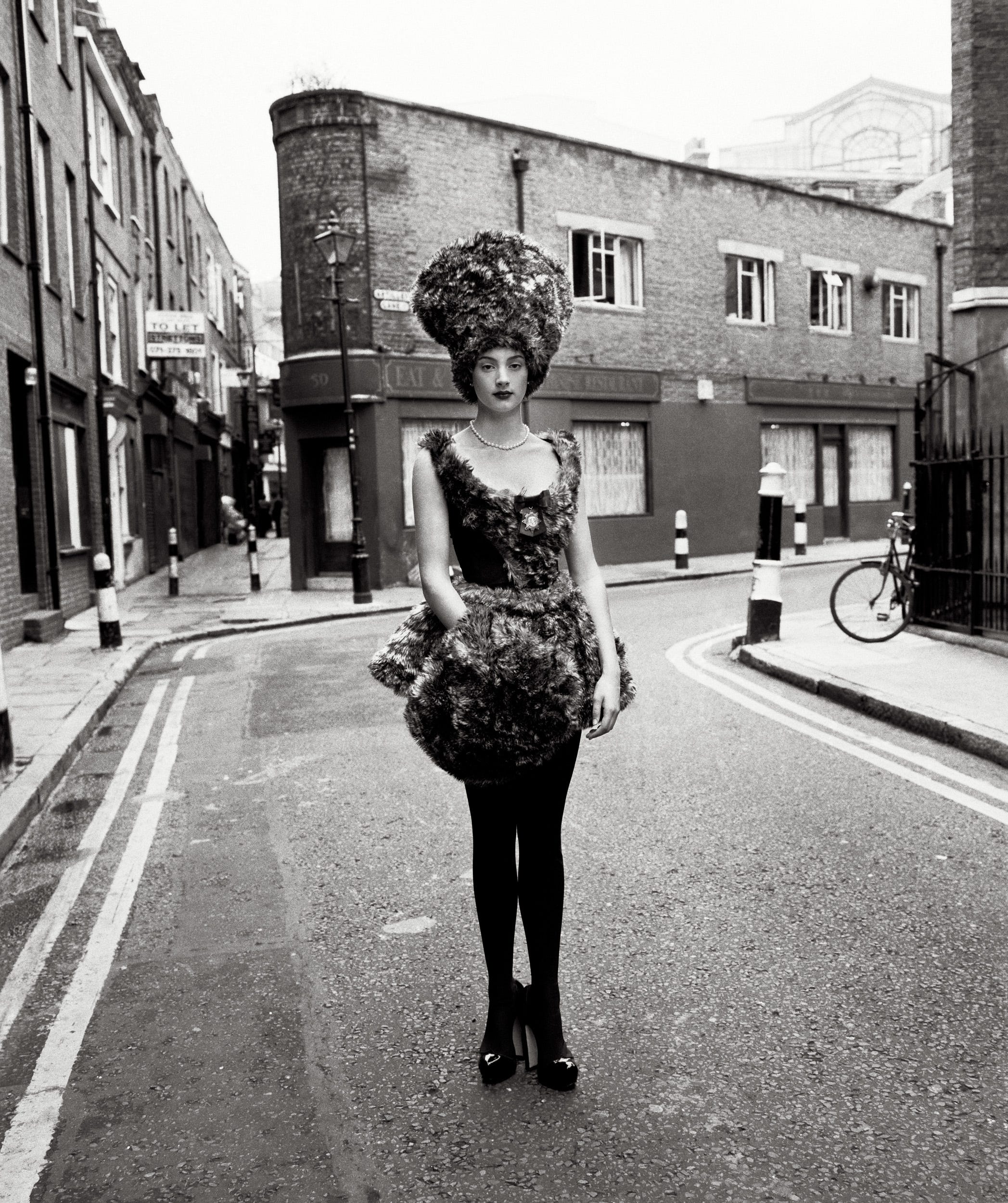
Honor Fraser stands almost en pointe in her dramatic heels, perfect posture and a tall fur hat make her appear like a pin stuck into the Spitalfields’ back road, completely incongruous with her surroundings. Despite Fraser’s impassive expression, this photograph is a wonderful example of Meiser’s playfulness, and the sense of close rapport between photographer and model as they create these heightened, sometimes absurd scenes together.
A trio of portraits of Hamish Bowles announce the British fashion journalist, who had been hired by American Vogue the previous year, as a fashion force on his own. In each photograph he seems to emerge as an aesthete from a bygone era, posed in close interiors, channelling the likes of Cecil Beaton or Radclyffe Hall. Meisel works against the grain of masculinity at the time, with slender statuesque figures reminiscent of Apollo. The addition of a corset to Bowles further feminizes the image and shows an alternative view of androgyny to that presented by Meisel’s images of Stella Tennant.
Here all in black and white, Meisel’s 1993 portraits seem to exist in their own time. Taken over thirty years ago, the images are simultaneously exciting, contemporary, and capsules into the past. Their high contrast rendering of model and setting feels nostalgic yet unsentimental. Meisel creates tactile images; only a thin line seems to stop us stepping into his photographs and feeling the same brisk London air, hearing the camera shutter, smelling the same streets as the models. It is more than just fashion photography, it’s world-building, and requires the keen instincts of a photographer with an eye for all aspects of his image. The results are images that stand as portraits as much as fashion photographs, with the models’ shining through as much for their own identities as for the clothes they wear.
At the turn of the millennium Meisel’s work shifted. His ability to instantly build upon a trend was extended to include much broader topics of the zeitgeist, and his style became glossier and more theatrical, his models becoming the protagonists of grand narrative editorials. Turning moments of cultural and political conversation into supermodel-filled fashion images means he is now well-acquainted with controversy. His editorials for Vogue Italia have included ‘Makeover Madness’ (July 2005) which staged models undergoing plastic surgery, ‘Make Love Not War’ (September 2007) inspired by the Iraq War and showing models in bunkers with soldier, and ‘Water & Oil’ (August 2010) inspired by the Deepwater Horizon oil disaster in the Gulf of Mexico. These cinematic pieces have been met with admiration and uproar. In a rare interview given to 032c in 2008, Meisel said his favorite editorials to create were “the ones that I have a minute to think about; all the ones that are the most controversial in fact. But it’s not because they are controversial that I like them, but because they say a little more than just a beautiful woman in a beautiful dress. I love that too, but to try and say something is also my goal.”
Meisel has received the Master of Photography award in recognition of his entire career, but it is notable that the focus of Photo London’s exhibit was his 1993 works, showcasing the type of photography he rose to prominence with. A personal favourite shoot of mine is Grunge & Glory for Vogue US (December 1992), where the rawness of Nirvana’s grunge aesthetic was repurposed for the pages of Vogue, a brilliant example of fashion coming up from counter-culture, rather than a top-down diffusion of style, which Meisel handled with tenderness, soft colour and fine-grain film. By honing in on his 1993 London photos, Photo London reminds us of the roots of this now globally recognised fashion photographer and shines a spotlight on his models from the time, many of whom went on to be successful models or fashion journalists.
Megan Stevenson is an independent researcher, writer and curator based in London. She has an MA in the History of Art from the Courtauld Institute.
Comments
Nothing yet. Say the first thing.
Sign in to join the conversation.