
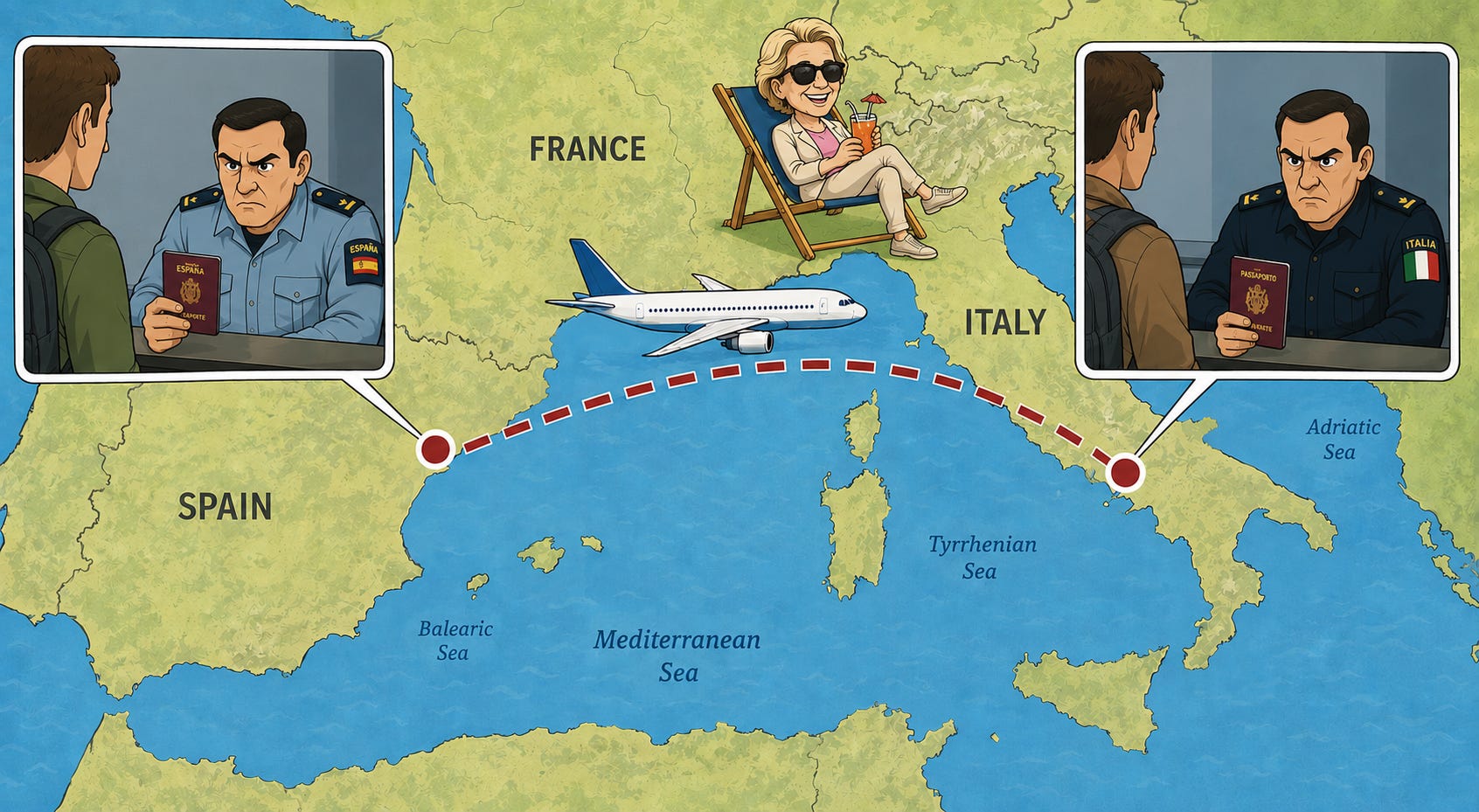
I’m in Rome today – last night I flew here from Barcelona. Just before boarding the flight, we received news that the Spanish government was demanding Italy end its passport controls on people coming from Spain within three days or they would take “proportionate measures”. By the time we landed, we learned that Italy had already rejected the “ultimatum”, and Spain had responded by announcing passport checks on people flying from Italy for the next three weeks unless Italy ends its checks which are "unjust, contrary to the interests of the European Union and discriminatory towards the Spanish population."
But when we landed in Rome, nobody on the plane faced any ID checks. The aircraft arrived like any other plane from within the Schengen area. It highlighted the absurdity of the situation. Italy is only doing a handful of spot checks, because this is all political theatre. They know that there is no actual threat of the Ceuta invaders crossing the Mediterranean and entering mainland Spain and the Schengen area. But they can’t back down now because they pretended this was so important. The bigger problem, however, is that the European Commission went along with this pretence.
Countries in the EU’s passport-free Schengen Area (all EU countries except Ireland and Cyprus, with the addition of Norway Iceland and Switzerland) are permitted to introduce temporary six-month passport controls at interstate internal EU borders in the event of an emergency, but these need to be notified to the Commission and sufficiently justified. For years, the Commission has been accepting these notifications with the flimsiest of excuses, and letting countries renew them every six months making them effectively permanent. It’s made a mockery of the system. This was true when Commission President Ursula von der Leyen accepted the reasoning of her co-national and party colleague Friedrich Merz for establishing spot checks at all of Germany’s nine internal Schengen borders because of “the impact of the global security situation”.
And so naturally, last week von der Leyen accepted the flimsy excuse of her new ally Meloni (currently the most politically powerful leader in the EU) that Schengen had to be suspended with Spain “due to recent events in Ceuta” that have caused “a risk of secondary movements within the Schengen area.” The Commission accepted this despite there being no actual risk of secondary movements since Ceuta isn’t in Schengen, and despite the fact that it is unprecedented for a temporary exemption to be made solely and specifically against a member state that the notifying country doesn’t border.
The Commission has for years – predating von der Leyen – let national capitals play political games with Schengen exemptions that were blatantly not justifiable (and not even actually being implemented). But this has kicked into high gear since President von der Leyen took office in 2019, with the reasoning for the exemptions becoming ever more vague and absurd. The national governments are not even pretending these are justified by facts any more – because they don’t need to with this servile Commission president. There are now 22 effectively permanent spot passport checks at the approximately 50 internal borders of Schengen. But as someone who crosses these borders frequently, I can tell you at most of them you’ll encounter a check only extremely rarely. At most, the Commission has just politely asked the countries to end their checks (as they recently did with Germany), but then immediately rolled over and accepted their refusal.
Spanish Prime Minister Pedro Sanchez has today effectively said: you want to play political games with Schengen? Hold my beer. As Italian academic Alberto Alemanno noted yesterday: “Tit-for-tat border controls between two Schengen states are childish and self-defeating. The real cost lands on ordinary European citizens and businesses who now face friction crossing a border that was never supposed to exist.” As one of those ordinary citizens who needs to fly back to Spain, I agree. But I also support what Sanchez is doing. Because he’s exposing the absurdity of the situation. If President von der Leyen isn’t willing to do her job and act as the guarantor of the Schengen treaty, then Sanchez will.
He is daring von der Leyen’s Commission to oppose Spain’s exemption while still supporting Italy’s, even though the facts make Spain’s checks more credible. “Ironically enough, Spain may have the stronger case,” says Alemanno. “Italy faces a far higher volume of irregular arrivals than Spain does…What's most troubling is the absence of the Commission. This is exactly the kind of intra-EU dispute it exists to prevent and mediate. Instead its silence, and partly complicity with the 22 member letter, has let two member states spiral into a retaliatory standoff instead.”
Today’s Spanish passport controls on Italians is absurd and Sanchez’s government knows that. The point is precisely that it’s absurd – to expose the absurdity of this whole situation where the Commission is allowing national capitals to play politics with pointless and arbitrary Schengen exemptions.
The Italian government’s statement rejecting Spain’s “ultimatum” was particularly ironic, and the Spanish government is keen to highlight this. “Italy does not accept ultimatums or impositions from abroad regarding national security and border control,” the statement said. But that is exactly what Italy has been doing to Spain, trying to use the EU to dictate how Spain should run its domestic immigration system and how it should police its external borders. And don’t get me wrong, I think external borders and immigration should be run at confederal EU level. But Meloni can’t have it both ways here. Does she want immigration to be a national competence or not?
On 30 July, there was an invasion of mostly Moroccan nationals across the border into Ceuta, a Spanish enclave across the Straight of Gibraltar from mainland Spain.
Ceuta is effectively not part of the Schengen area and there was no way for the migrants to travel onward into mainland Spain. For this reason, almost all of the people who crossed subsequently returned to Morocco within a day.
Nevertheless, Italy’s far-right prime minister Giorgia Meloni announced Italy will conduct passport checks on flights from Spain in order to intercept the Ceuta migrants. She also convinced 21 other EU governments to jointly send a letter to the EU institutions blaming Spain for being invaded and telling Madrid how to run its domestic immigration policy.
I keep seeing people on social media (like this guy) saying “all Schengen countries are entitled to impose passport checks as they see fit.” That is not true. Countries can implement temporary passport checks at internal Schengen borders in an emergency as long as they are justifiable. They can’t just do whatever they want. And it is self-evident that citing “a risk of secondary movements within the Schengen area” because of a group of people who have not entered the Schengen area, 98% of whom have now left Spanish territory anyway, is not justifiable.
Ceuta is not a migration crisis, it is a political crisis. Though the situation is still murky, there is strong evidence pointing to the involvement of the Moroccan government in this invasion. But both the Spanish government and the EU Council are refusing to examine this line of evidence for fear of upsetting Rabat, a key partner in migration management which is now backed by Donald Trump. Conservatives in Israel and America have been calling for Morocco to annex Ceuta as punishment for Sanchez criticising the two countries and refusing to join the Iran War. This was spelled out in a leaked Pentagon memo in April and by a Republican-written report in the US Congress two weeks before the invasion.
Now, you might be tempted to say, ‘well if the countries aren’t actually conducting the checks, then who cares? You got to Italy with no check.’ But the point is you never know when one of these checks is going to be carried out. We had a friend picking us up from the airport in Rome last night. But we didn’t know if we would have to add an extra hour to the pick-up time for ID processing until we walked out of the gate. So instead of being able to tell the friend when to meet us beforehand, we had to wait until we disembarked to see whether we would be stuck for processing.
In an actual emergency, you could justify this inconvenience. You could actually justify the symbolic damage it does to European unity and connectivity, as I outline in the Gorizia piece below. But the idea of having to be processed for an hour because Giorgia Meloni needed to score some domestic political points, and Ursula von der Leyen refuses to enforce EU rules because she’s so in pocket to Meloni, is infuriating. It will be equally infuriating when we face such uncertainty when flying back to Spain. But I won’t blame Sanchez for that, because he didn’t start this. The fault lies with Meloni and von der Leyen. And I’ll be fine waiting for processing for an hour in Barcelona if it means Pedro Sanchez’s stunt can finally end this absurd situation that the Commission president has allowed to fester.
No posts
Comments
Nothing yet. Say the first thing.
Sign in to join the conversation.