
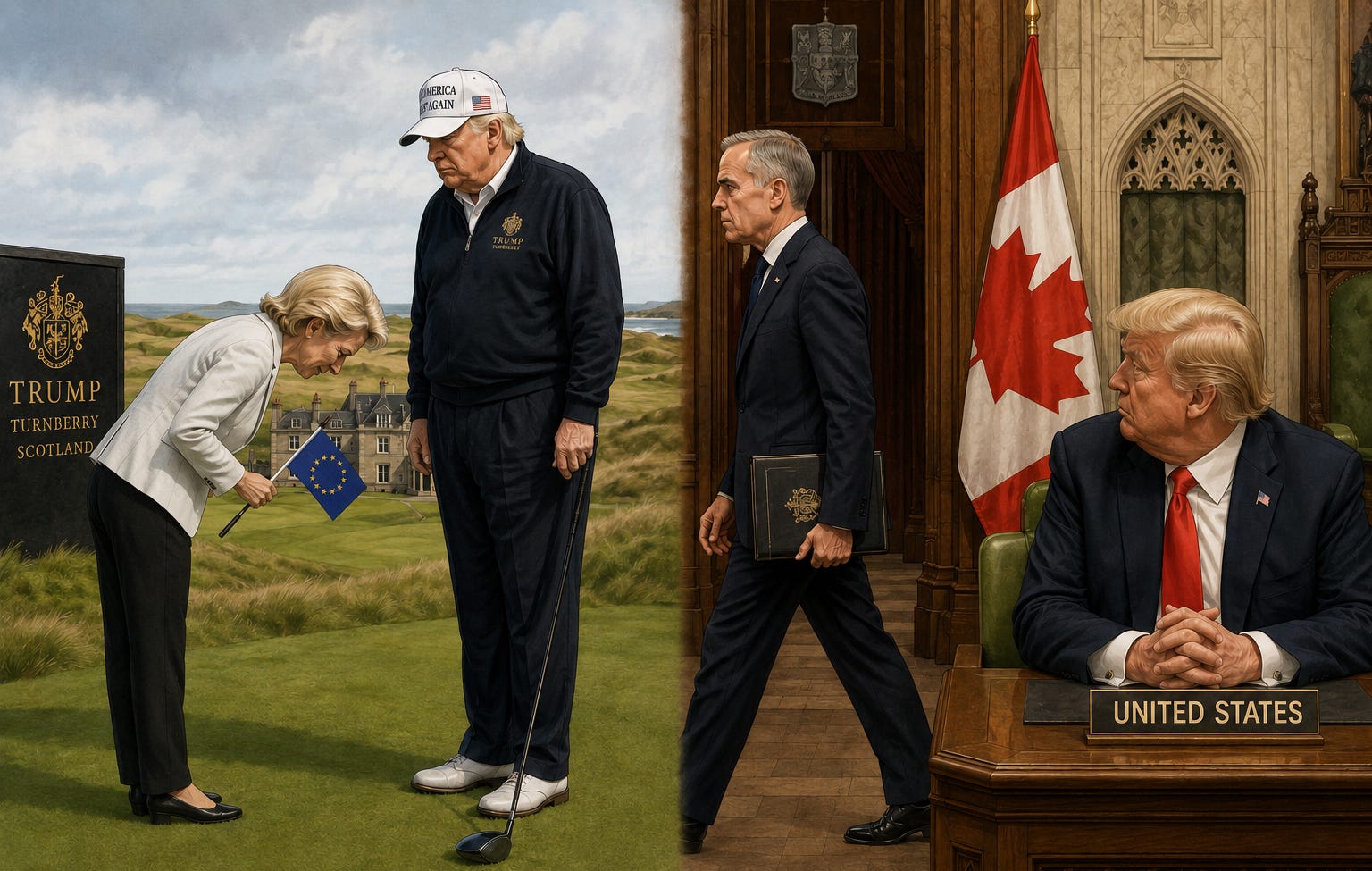
Canadian Prime Minister Mark Carney told his citizens yesterday that they are now at “war” with the United States over trade. “You’re at war when you’re attacked, and we got attacked,” he said. The language might seem dramatic, but it accurately describes the seismic event that occurred yesterday. Carney was preparing his country for the considerable medium-term economic pain that this trade war will bring. But he stressed that the alternative is dishonour - and subjugation that would be even worse for Canada in the long term. I will be travelling through Canada the first half of September, and I am eager to talk to Canadians about their hopes and fears as their prime minister takes them down a resistance road our European leaders have refused to go down.
After Canada walked out of trade talks following outrageous US last-minute demands on Friday, the US government yesterday slapped a 50% tariff on €200 billion worth of goods imported from Canada, and Canada slapped back with equal retaliatory tariffs. The trade war has begun, and nobody knows when it will end – or whether it will escalate as Trump continues his threats to forcibly annex America’s neighbour to the North. “Last spring, I warned that America is trying to break us so they can own us,” Carney said in his speech to the nation. “Canada is becoming stronger and less dependent on America. We are already giving ourselves more than they can take away. And we are just getting started."
The contrast with European leaders, who spent 2025 continually surrendering to Donald Trump’s extortion, is stark. The humiliating “trade deal” concessions signed by the UK and EU in the summer of 2025 have proven to be disastrous in hindsight. Countries that did not surrender to the extortion, like China, India and Brazil, saw Trump back off. Countries that did surrender, like the UK, EU, Japan and South Korea, saw Trump almost immediately violate the terms of their surrenders and come back demanding more. Canada has observed all this, and learned the lessons. But Europe has not. "Our government understood before many that America would transform all of its commercial relationships, that it would put a series of tariffs on its closest allies and use economic integration as a weapon,” Carney said in his speech. “We recognised that sometimes its signature was written in pencil."
“With Canada, China and Brazil showing that you can stand up to the US in trade and related talks, I guess there will be a discreet discussion in the EU and Japan on whether they did the right thing,” observed former Swedish prime minister Carl Bildt today. “Canada should show the way to the EU: with Trump, only firmness pays off,” observed former French ambassador Gerard Araud. “Here is a speech I would like to hear from Europe,” said former Italian prime minister Paolo Gentiloni of Mark Carney’s address. But from our current European leaders, we have heard no such introspection.
Bernd Lange, the chair of the European Parliament’s trade committee, publicly declared his solidarity with Canada yesterday: “Trade agreements must be negotiated on an equal footing between partners, and not imposed unilaterally through pressure or blackmail by a stronger partner. Yet that is precisely what the US Government is now attempting to do once again with Canada.” But we’ve heard no statement of solidarity from Canada’s supposed allies at the European Commission. Nothing from President von der Leyen, nor from her trade negotiator Maros Sefcovic. And in the end, Lange doesn’t negotiate trade negotiations with the US, that’s the Commission’s job. He can only try to convince his committee to approve or reject what the Commission has decided (based on its mandate from EU national governments). I imagine he wishes that the European leaders he has to work with had as much nerve as Carney. But they don’t. As far as I’m aware, not a single European national leader has expressed solidarity with Canada over the past two days. That’s how terrified they are of Trump.
While Canada takes decisions showing dignity and courage, Europe takes decisions showing insecurity and fear. While Canada’s citizens demand their leaders show self-respect, Europe’s citizens accept their leaders humiliating this continent with their grovelling to Trump.
The most frustrating part is that it should be the exact opposite. Europe has far more cards to play than Canada, which is much more exposed to the US than Europe. A confederation of 41 million people, which only achieved full independence in 1982, which has the most US-integrated economy in the world, which relies on the US for its defence, is showing more courage in standing up to Trump than a union of 452 million people, the largest single market in the world, with an independent nuclear deterrent and with only 20% of exports going to the US compared to 72% for Canada. Why the difference? Because Canadians understand their own power. Carney “finally called Trump’s bluff,” noted former Obama official Brett Bruen yesterday. “Trump needs a deal more than Carney. Americans are tired of paying for his trade wars – and the Iran war. The only way to sustainably solve this stupidity is showing him Canadians aren’t gonna cave.”
It’s the opposite of what Europeans did last year. On 2 April, Trump declared “liberation day” with a bizarre chart of seemingly arbitrary tariffs on various countries (including some territories with only penguins as inhabitants). Trump proposed a 20% blanket tariff on imports of EU goods, and 10% for the UK (a clear attempt to reward Britain for voting for Brexit).
As I relay in my book The Owned Continent, at first French President Emmanuel Macron was trying to push for the EU to use the retaliatory tools at his disposal to push back against the extortion. He wanted the EU to draw up a list of retaliatory tariffs and threaten to use the EU Anti-Coercion Instrument against Washington. But Macron has very little political capital left in Brussels ever since he lost firm control of the French parliament after his disastrous decision to call a snap election in 2024. And German Chancellor Friedrich Merz, who had just taken office, had the wind at his back in June 2025 (he’s since plummeted in polls and may be replaced in the next months).
“Do not retaliate and you will be rewarded,” the White House posted on X. Merz and von der Leyen believed them.

Merz wanted to surrender, and the rest of the 26 national leaders went along with this Council group-think. Macron gave up. Commission President von der Leyen, who under the EU treaties is in charge of trade, could have shown leadership and corralled the national leaders into a more courageous response. But von der Leyen is not known for her courage, nor is she known for challenging national governments (especially her own, with a chancellor from her own party). So she dutifully travelled to Trump’s golf course in Scotland, waited patiently for him to finish his putting, and signed the most humiliating surrender in the European Union’s history.
“It’s the biggest trade deal ever” she posted on X afterwards, promising an economic boom as a result. It was clumsy gaslighting. Because what she had agreed to wasn’t a trade deal at all. It was a one-sided capitulation, with the EU making a series of tributes to Washington in order to lower the blanket tariffs from 20% to 15% (Trump had, during the negotiations, threatened to raise them to 30% or even 50%). She even parroted Trump’s words saying the purpose of the deal is to ‘correct a trade imbalance’ – accepting the false premise that the tariffs are reciprocal. It was a ‘peace for our time’ moment for the EU president, even if she had no actual piece of paper to wave on the tarmac.
Others had more accurate descriptions. “It's nothing more than one of the most expensive imperial tributes in history,” said French pundit Arnaud Bertrand. “This does not even remotely resemble the type of agreements made by two equal sovereign powers. It rather looks like the type of unequal treaties that colonial powers used to impose in the 19th century – except this time, Europe is on the receiving end.” French prime minister at the time François Bayrou said, “It is a dark day when an alliance of free peoples, united to affirm their values and defend their interests, resolves to submission.” The Financial Times concluded, “the EU has validated Trump’s bullying trade agenda.” John Clarke, the EU’s former top trade negotiator, called it, “the end of time for the EU’s common commercial policy.”
But citizens shrugged. There were no protests, no calls for leaders’ resignation. A continent that has grown accustomed to humiliation over 80 years of American dominance simply sat back and accepted being extorted, just as they had after their leaders agreed at NATO a month earlier to an absurd and arbitrary commitment to spend 5% of GDP buying mostly American weapons.
Even worse - the EU even accepted last-minute demands that Europe invest $1.2 trillion in the US economy over the following three years – including €750 billion in fossil fuel purchases – as well as implicit commitments to alter EU legislation to meet US wishes (some of which has since been implemented with the so-called “omnibus” packages). Quietly, EU and national officials said these commitments didn’t matter because they were undeliverable. They would give lip service to the outrageous demands made at the last minute, and then just simply let them be forgotten.
Carney also received outrageous last-minute US demands, which he detailed in his speech yesterday in explaining why he walked away. The US was effectively demanding that Canada become a vassal state of the US, with Washington able to dictate Ottawa’s trading relationships and even its language policy. The US demanded that Canada could sign no trade deals the US didn’t approve of, and that Canada end its policies supporting the French language. "President Trump demands Canada change its French language, Quebec culture and Canadian identity as a condition for reversing tariffs,” carney said. “This is no longer about a trade deal-it is about a takeover of Canada's sovereignty and identity."

Rasmus Jarlov@RasmusJarlov
This is ridiculous. These are terms you ask for from an enemy after defeating them in a world war. That is how the USA now treats its 'allies'. And that is why every country in its right mind wants out of the relationship.

9:50 PM · Aug 23, 2026 · 39.4K Views
81 Replies · 360 Reposts · 1.13K Likes
Carney could have quietly signed off on these demands, like the EU did, by saying afterwards that Canada simply wouldn’t deliver them. But unlike our European leaders, Carney has dignity. And he understands that these types of demands are meant to erode the adversary’s sovereignty. The whole point is humiliation, to show that the negotiating partner isn’t actually independent. Accepting them is the geopolitical equivalent of an animals show its hind quarters, signalling to Washington that you are an easy mark and therefor they can keep pushing you further and further. Carney understood that. Starmer (who also signed up to a whole load of sovereignty-reducing ‘symbolic’ concessions) and von der Leyen did not.
“Canada and the EU face the same challenge under Trump: a bold assault against sovereignty disguised as trade talks,” observes Euronews’ Jorge Liboreiro. “For Canada, it’s the French language. For the EU, it’s green and digital regulations. Canada put an end and walked away. The EU still plays along as it pushes back.”
European leaders might think Carney is going out on a limb here and exposing himself to criticism from a jittery public and an opportunistic opposition. But they would be wrong. Polls show only 19% of Canadians are opposed to Carney pulling out of negotiations. The opposition Conservatives support the move. Their leader Pierre Poilievre, who learned the hard way that siding with Trump will lose you Canadian elections, said: “Conservatives support action to protect Canadians and our industries targeted by these unfair U.S. tariffs…Canadians must stand united to defend our country.” against these unfair attacks.” The European public also want strong leaders. Bu the only one they’ve got, the only one willing to stand up to Pedro Sanchez, is Pedro Sanchez – who has been vilified and ostracised by the other EU leaders for daring to do so.

Philippe J. Fournier@338Canada
🍁New poll from the Angus Reid Institute shows majority of Canadians in all regions and age groups siding with Mark Carney's decision to pull out of negotiations.

7:38 PM · Aug 23, 2026 · 159K Views
604 Replies · 495 Reposts · 2.32K Likes
“Do not retaliate and you will be rewarded,” Europe’s leaders were told by the White House. They believed it. Fast forward a year and we can see that the exact opposite is true. Countries that retaliated were rewarded. China was rewarded with new access to American chips. India and Brazil were rewarded by being left alone. The EU, UK, Japan and South Korea did not retaliate, but they were not rewarded. Instead they were punished. Punished with new attacks. Punished with new tariff threats that violated the previous surrender deals. Punished with continued humiliation.
It’s not too late. Europe can change course and our leaders could start defending their citizens from American aggression. But I fear that the personalities of our current crop of leaders render them unable to do so. The UK has dumped their Trump-appeasing prime minister. The jury is still out on whether the new one, Andy Burnham, will stand up to Trump. Germans may dump their Trump-appeasing chancellor in the next months. The European Parliament could choose to dump their Trump-appeasing Commission president in a third impeachment vote (the first two, launched by the far-right and far-left, failed).
Europe is running out of time. If our current leaders don’t have the courage, aptitude or talent to protect Europeans from American aggression, then they should step aside and make way for people who can. We need a European Carney.
No posts
Comments
Nothing yet. Say the first thing.
Sign in to join the conversation.