
Thursday was a dark day for the European Union, and not for the reasons that Europe’s far right and their backers in Washington would have you believe. 60,000 migrants invaded the Spanish enclave of Ceuta, located on the African coast and surrounded by Morocco, in the largest single-surge border violation in EU history. That was followed by the largest single mass return in EU history - as the migrants found they couldn’t go on to the EU’s Schengen passport-free-travel area without boarding planes or boats that would require documents proving their right to be there. 96% of the 60,000 migrants have already been returned to Morocco.
As the days have gone by, a murky picture has emerged that appears to implicate the Moroccan government in coordinating the attack. The New York Times has heard from the migrants that government officials told them that they would not be stopped by Moroccan officials from entering the sea at the enclave’s border as they normally are. One told them that the officials were only allowing Moroccans through and blocking sub-Saharan black Africans. Videos have been widely circulated on social media showing Moroccan gendarmes overseeing truckloads of migrants being dumped toward the sea.
The reason why the Moroccan government would do this is clear: they are angry with Spanish Prime Minister Pedro Sanchez’s recent visit to their arch-enemy Algeria, amid worries that softening relations will mean Spain will back Algeria’s call for the former Spanish colony of Western Sahara to be independent as Algeria has called for (the disputed territory is now under de-facto control of Morocco). Something similar happened in 2021, when Moroccan border forces relaxed border controls at Ceuta in retaliation for Spain admitting the head of the Saharan government-in-exile into a Spanish hospital. But that time, only 8,000 migrants crossed. Over the past days, the Spanish government has avoided directly accusing Rabat of orchestrating the surge, because they needed their cooperation in those initial days in taking the migrants back. I suspect this will change in the coming days now that most have been returned. The intent by Rabat here may have been to demonstrate that they can take these Spanish territories by force if they want to, and to show that the EU won’t come to Spain’s defence in such an attack. Spain will be keen to counter that impression.
Spanish politicians outside the government have called a spade a spade. “Let’s call things by their name: Morocco is using human beings to attack our sovereignty,” said Eduardo Rubiño, a Sanchez-allied left-wing lawmaker. lawmaker with the Sánchez-allied, left-wing Más Madrid party. Ceuta Mayor Juan Jesús Vivas from the conservative People’s Party on Monday defied his own European political family by saying the situation is not “a migration crisis” because “people have the perception that this, if not orchestrated, was encouraged or permitted” by Moroccan authorities.
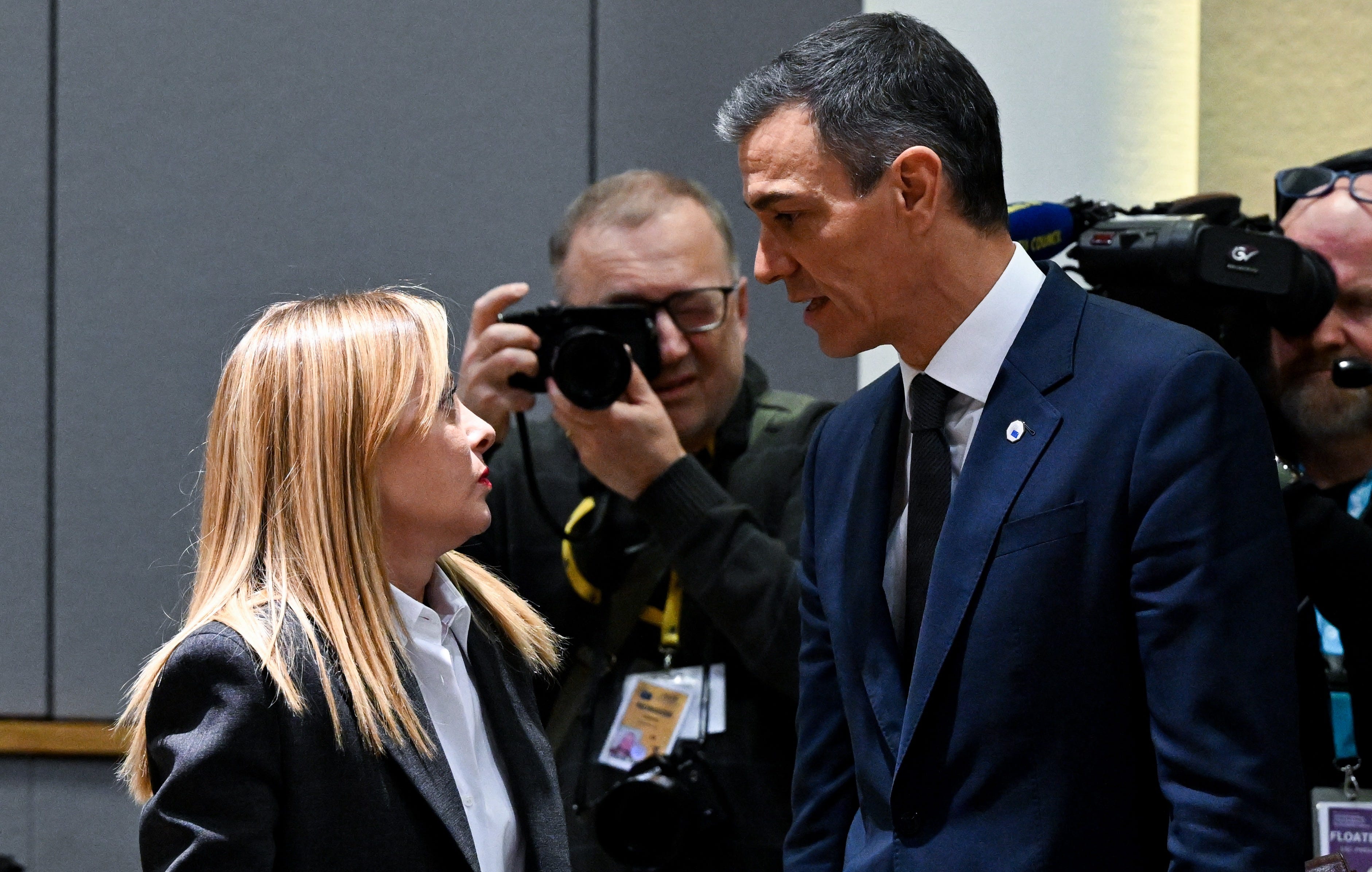
Despite it looking likely from the start that the Moroccan government was involved, that didn’t stop Italian Prime Minister Giorgia Meloni from immediately coming out and blaming Spain for the crisis. She was quickly joined in the Spain-bashing by the Danish and Finnish governments – as well as Manfred Weber, the leader of President von der Leyen’s centre-right European Peoples Party (EPP). Immediately on 30 July, before any of the details were clear, he posted: "The devastating images are the direct consequence of the pull factor of mass regularisation.”
They blamed Spain’s recent amnesty policy – giving illegal migrants who have been living and working in Spain for several years a one-year residence permit – as well as a recent Spanish supreme court judgement saying migrants apprehended while crossing into Ceuta and the other Spanish African enclave Melilla by sea cannot be deported immediately without due process.
Meloni called for Spain to be suspended from the Schengen passport-free travel area, something that is not legally possible. She said Italy is introducing passport checks for people flying from Spain to Italy in response to the crisis (I’ll be doing so later this week, so let’s see if it’s true). That’s despite the fact that not a single one of these migrants has travelled on from Ceuta to Europe. Spain’s foreign minister said Meloni’s comments were “improper” for "a partner and friendly country from which we expect European solidarity and not partisan demagoguery".
Then the US government joined in on the criticism, with statements put out by the US State Department and the US vice president blaming Spain for the crisis. “This unacceptable incident is the direct result of the Spanish Government's deliberate efforts to enable and facilitate mass illegal migration into Europe,” said the State Department statement.
22 EU leaders co-signed a letter initiated by Italy and Denmark specifically blaming the Spanish Supreme Court decision for the crisis. Spain’s Sanchez, France’s Macron, Portugal’s Montenegro and Luxembourg’s Frieden were the only leaders not to sign the letter, addressed to Ireland which currently holds the EU Council’s rotating presidency. It was a striking contrast to the way the EU rallied behind Poland when Russia and Belarus were using migrants as human weapons at the border in 2021. The key difference? Poland has a conservative government.
Prime Minister Sanchez responded by sending an angry letter to the EU institutions criticising the pile-on. “In the current international context, the European Union cannot afford this kind of selfish, polarising and unlawful reaction,” he said. Ireland will chair an emergency meeting on Ceuta tomorrow.
But Europe’s far-and-centre-right leaders were hovering like vultures over Ceuta from the moment this crisis started, eager to exploit it for domestic political gain and to injure Sanchez, the only leftist leader left in the EU. And rather than acting as a leader for all Europeans, and as a defender of Schengen, President von der Leyen chose to echo her political party EPP rather than defend Spain or criticise Morocco. As Morning Post Europe notes this morning: “The Commission President ignored the reality on the ground and the treaties, taking part in a political campaign orchestrated by the European right and far right, and fuelled by actors hostile to the EU such as Russia, the MAGA movement and part of the Israeli government. Only once the crisis was over did von der Leyen finally use the word ‘solidarity.’” The Commission’s response didn’t remind Italy of the Schengen rules that they would be violating by immediately setting up border controls for flights from Spain. There was no praise for Spain, but there was praise for Morocco – with whom their “close partnership” will help to resolve the crisis. Painting Spain is the problem and Morocco as the solution.
It’s a far cry from how President von der Leyen rushed to Meloni’s side in 2023 when the Italian island of Lampedusa was overwhelmed by tens of thousands of arriving migrants – visiting the island with her to express solidarity. This despite the fact that the Commission’s own reports show Spain has managed irregular migration much better than Italy, returning a third more migrants to their country of origin than Italy does and receiving half Italy’s number of illegal arrivals as a result (despite being closer to Africa than Italy).
Von der Leyen’s behaviour was in stark contrast to that of Council President Antonio Costa, himself a Socialist from Sanchez’s S&D group and former prime minister of Portugal. Though he normally only speaks when there is consensus among all 27 national leaders, Costa on this occasion found himself defending one member state against 22, by reminding people of EU law and the facts on the ground which von der Leyen was ignoring. “Third-country nationals in Ceuta do not enjoy free movement to mainland Spain or the rest of the Schengen area,” he posted. “Spain’s firm response, which includes ongoing accelerated returns, demonstrates our determination to protect our external borders.” But he was the only European leader defending Spain and calling for solidarity in those initial days.
“Instead of solidarity with Spain and the people affected, the choice was to blame Spain, a cheap way to score points at home at the expense of a fellow member state managing a hard moment at its border,” noted Italian academic Alberto Alemanno this weekend. “That stance didn’t protect Europe. It handed ammunition to Europe’s worst enemies: the ones who want the Union to look divided, unprincipled, and for sale to whoever shouts loudest.”
Sanchez has been Europe’s most vocal critic of both Donald Trump and Benjamin Netanyahu, so there has naturally been speculation online over the past days that there was American and Israeli involvement here as well – designed to punish Spain. The Moroccan government is now a close ally of both the US and Israeli regimes following the Abraham Accords. Conservative commentators in both Israel and America have openly called for Ceuta and Melilla to be forcibly taken by Morocco in retaliation for Sanchez speaking out against the US and Israeli governments. However, there has been no hard evidence of any US or Israeli involvement in creating this crisis.
But neither country had to be involved in this incident to profit from it. It is probably no accident that just one day after the Ceuta attack, when Europe’s lack of solidarity and unity was on full display, President Trump reignited his threats to take Greenland. It is a quite something that Denmark’s Mette Frederiksen, who has been asking for European solidarity in the face of American threats to Denmark’s territorial sovereignty, was not willing to extend the same solidarity to Spain when its territorial sovereignty was threatened. In her pursuit of a cheap short-term domestic political bounce, she has put the territorial sovereignty of Greenland at risk by showcasing to the world that EU member states do not have each others backs.
It is yet another example of our terrible leaders here in Europe reacting first and foremost with their worst short-term instincts. They allow this union to be continually picked apart by the external forces that want to divide and conquer it. Sanchez is right to be angry.
No posts
Comments
Nothing yet. Say the first thing.
Sign in to join the conversation.