
It intrigues me how much we change but in many ways also stay the same. After diving into my 1983 diary, I’ve reacquainted myself with the twenty-one year-old me. I’ve discovered a young fella with a Summer job, an interesting community of friends, living in Hulme, going to arty films, pubs, cafes, and galleries; and gigs galore (at the Haçienda and elsewhere). He’s definitely a version of me, and I like his energy.
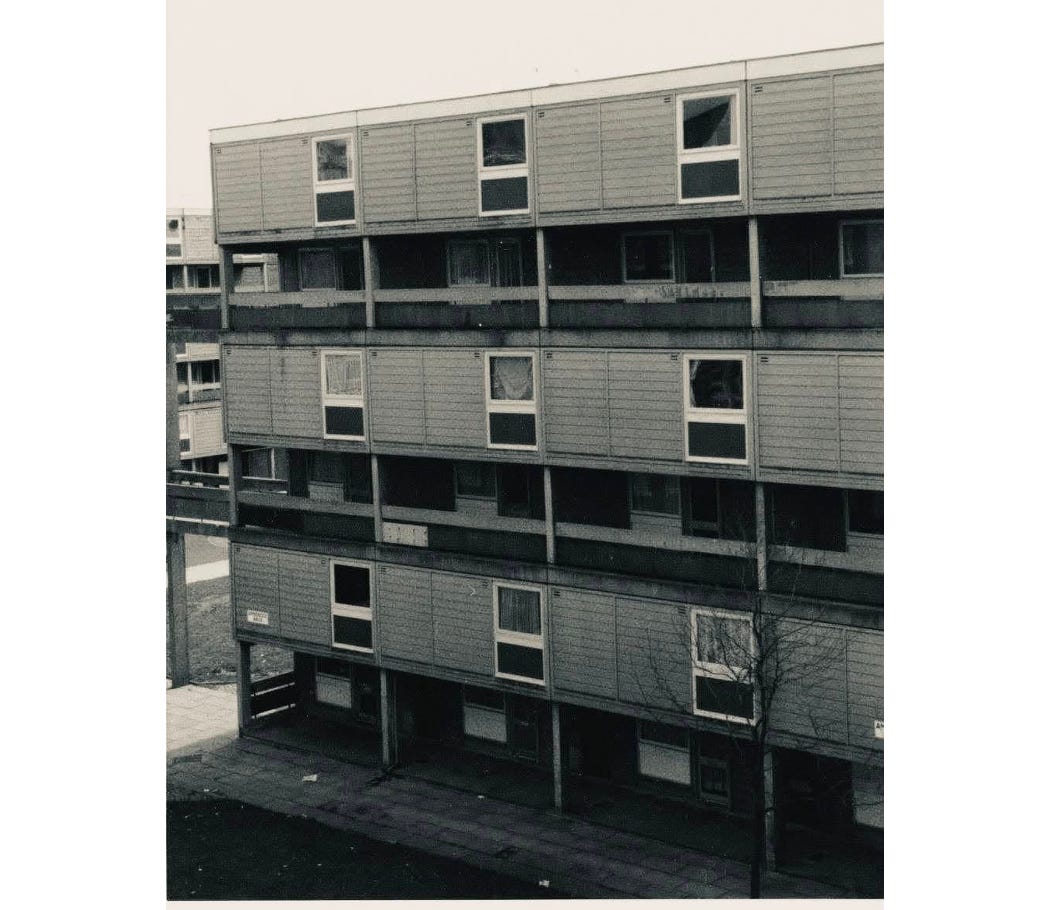
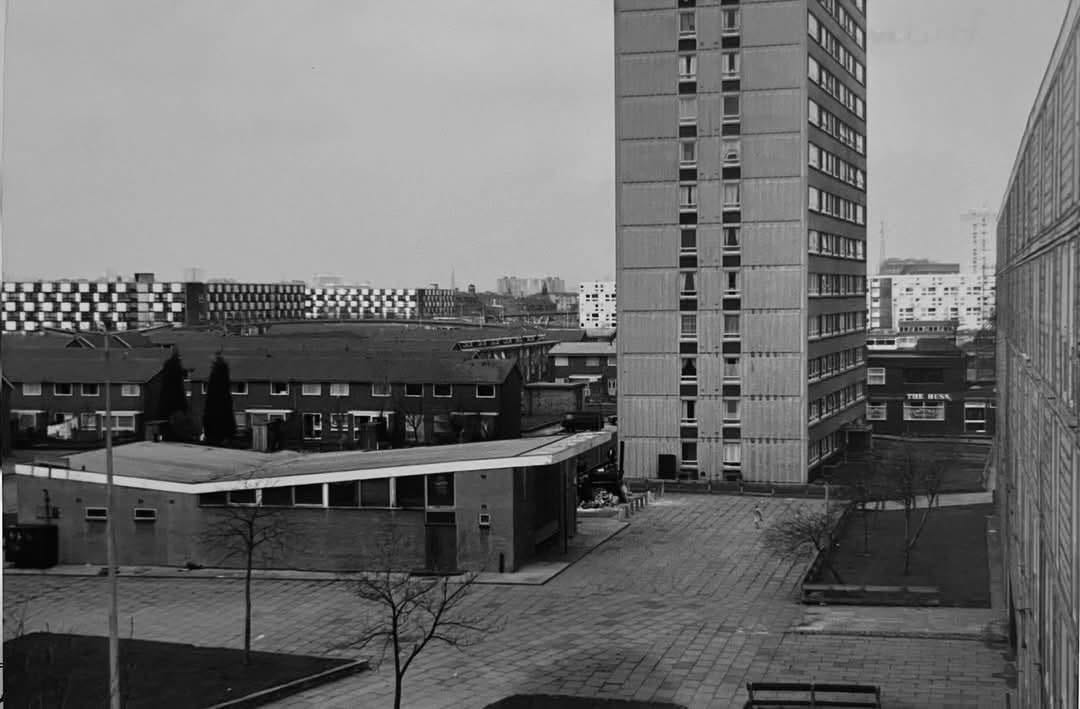
I was living here (see photo); the top floor of a deck access block called Amberidge Walk. Hulme was a two hundred and fifty acre site featuring dozens of modern, brutalist, deck access, and high tower block buildings including the notorious Crescents, and bisected by a dual carriageway, Princess Parkway.
The Hulme estate had been built in the first years of the 1970s after a large scale demolition of terraced housing. During those so-called ‘slum clearances’ residents were rehoused elsewhere. This was happening throughout Manchester and in other cities too; for many households, the break-up of their community was a generational trauma.
Within just two years, the Council had started moving families out of the Crescents and the higher tower blocks. In 1983,just ten years after they’d been built, throughout Hulme many flats were unoccupied, and some burnt out.
My end of Hulme was on the opposite side to the Crescents, close to Salmon Cabs, and well on the way to Moss Side Shopping Centre. Amberidge Walk was situated off the Boundary Lane end of Greenheys Lane, and was accessible by walkway from Duxbury Square and Epping Walk. It also wasn’t far from the Contact Theatre and the University of Manchester.
The nearest pubs to where I lived were the Hussar and the Chequered Flag, although I was most likely to go to the Grant’s Arms or the White Horse. I wasn’t much of a pub goer then but still a lot more than now.
Across the other side of Hulme, on York St, there was a cinema called the Aaben. To get there I had to cross a bridge. I had two or three options including one carrying traffic along Bonsall Street, and a pedestrian one; a bridge now known as “the Joy Division bridge”, the site of photos of the band taken by Kevin Cummins in January 1979.
The Aaben was what was dubbed an “art house” cinema. On July 8th 1983 I went to the Aaben to see the Fassbinder film Veronika Voss. In my mid-teens I developed a taste for non-mainstream films, which I would often catch on late night BBC2; seeing Truffaut’s Les Quatre Cents Coups changed my life. I managed two more trips to the Aaben in July 1983; to see Fanny and Alexander (which I raved about), and The Ploughman’s Lunch (underwhelming).
July 1983 wasn’t an out-of-the-ordinary month in my life. It’s featuring here partly because while I’ve lots of diaries and notebooks, 1983 and 1984 are two years when I wrote stuff down almost every day.
I also think 1983 is worth a dig into as I happened to be wandering around places that have since become mythologised; spending evenings in the Haçienda, for example, years before it became the talk of the town. I very rarely took a taxi in 1983, I’d walk or take a bus everywhere, but I remember if I did take a taxi, the response to my request to go to the Haçienda would be along the lines of “the Hassywhere?” Now, of course, taxi drivers passing along Whitworth St West will proudly point out the site of the club to tourists.
Just a couple of weeks ago, a Paris-based historian and curator contacted me about her current project; researching what went on in Hulme in the 1980s.1980s Hulme itself is remembered - and, again, to an extent mythologised - as both an architectural and social disaster, and a centre of bohemian creativity.
Hulme was deteriorating, a dehumanising concrete landscape I navigated my way around, with a carrier bag of cassettes and always a Penguin Modern Classic book on the go. I’d be going over the Joy Division bridge, seeing friends in the Crescents, pulling together a fanzine with friends.
By 1983, getting a place in Hulme didn’t require a rent book or a reference; it just required a key. If you moved out, you just passed the key on to someone else; they’d be Ok moving straight in as long as they were happy to put up with cockroach infestation, broken lifts, grim stairwells, noise and criminality.
Hulme in 1983 wasn’t only home to a scattered community of boho creatives – we were a small part of a failed, bleak environment. The violence, muggings, break-ins, and vandalism threatened to destroy hope for the older people still there after ten years of moving in, although there were some very hardy old folk doing their best to get through the days. It was a very hard struggle for the families with kids who couldn’t find or buy a way out.
There was one shop at the foot of the block next door, which was expensive; it sold newspapers, canned food, toiletries. In Hulme generally, it was easier to buy smack, speed, and weed, than fresh fruit and vegetables.
The environment on sunny dry days was tolerable, definitely. But rain ate into the concrete and the soul. The snow and cold created a forbidding off-white and grimy grey urban landscape which felt like featuring in a 1982 German black-and-white film about morphine-addiction; which actually was the premise of Veronika Voss.
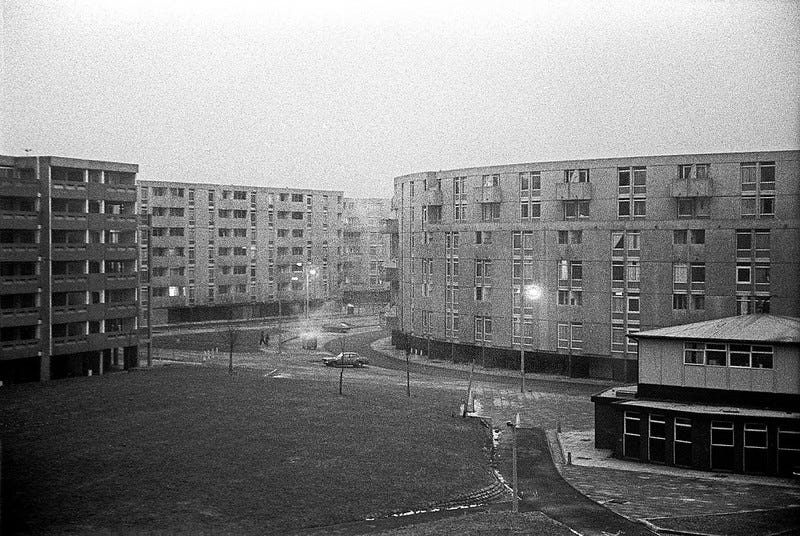
The inhabitants of Hulme were wary of each other and their surroundings. Whatever your background, walking about and through Hulme required being on high alert. One woman I spoke to the other day, who lived on her own in a flat in one of the Crescents, remembers Hulme with little enthusiasm; for her, it was a bleak, intimidating, dangerous place.
The people I hung out with in Hulme were mostly eccentrically dressed people with a taste for underground music. There were small but devoted clusters of jazz music fans; Miles Davis was back in a big way. There was always the sound of reggae. Everywhere broken glass, graffiti, and flamboyant hairstyles.
I guess, though, that the majority of people I hung out with wore black, grey, and army surplus clothes, overcoats and raincoats. Little badges. Factory Records fans. Art school types. Fuckin’ weirdos. Bloody students.
Certain pubs, or certain rooms in certain pubs were off-limits for alternative-types. One of Trump’s advisers, Stephen Miller ranted recently about Antifa demonstrators, claiming “not one of the people that is demonstrating looks like a normal person”, and pouring scorn on their “dress and mannerisms”, saying “their outer appearance becomes a manifestation of their inner hatred”. If he’d have walked into the White Horse in Hulme anytime in the 1980s he’d have died of fright and fascism.
A key element in the conditions for creativity among the young especially, is room to live cheaply. It just isn’t like that now; people similarly minded to us have it tougher in 2026. In the 1980s, Manchester was cheap. In Hulme, we never paid rent, and when we were discovered not to be paying rent, we were asked to pay £2 a week as a contribution towards clearing the debt.
I often think that given the conditions we were living in - cheap or no rent; a relatively lax social security system; a Mai 1968 style disdain for the world of corporate work; and a post-punk belief in DIY cultural activity; Thatcher generating unemployment, and talk of nuclear war, both making us think about the world, if not hit the streets with placards; and with the benefits of a free education (in subjects including, of course, design, literature, art, fashion) - that given this, if we hadn’t have been creative we’d have serious questions to answer.
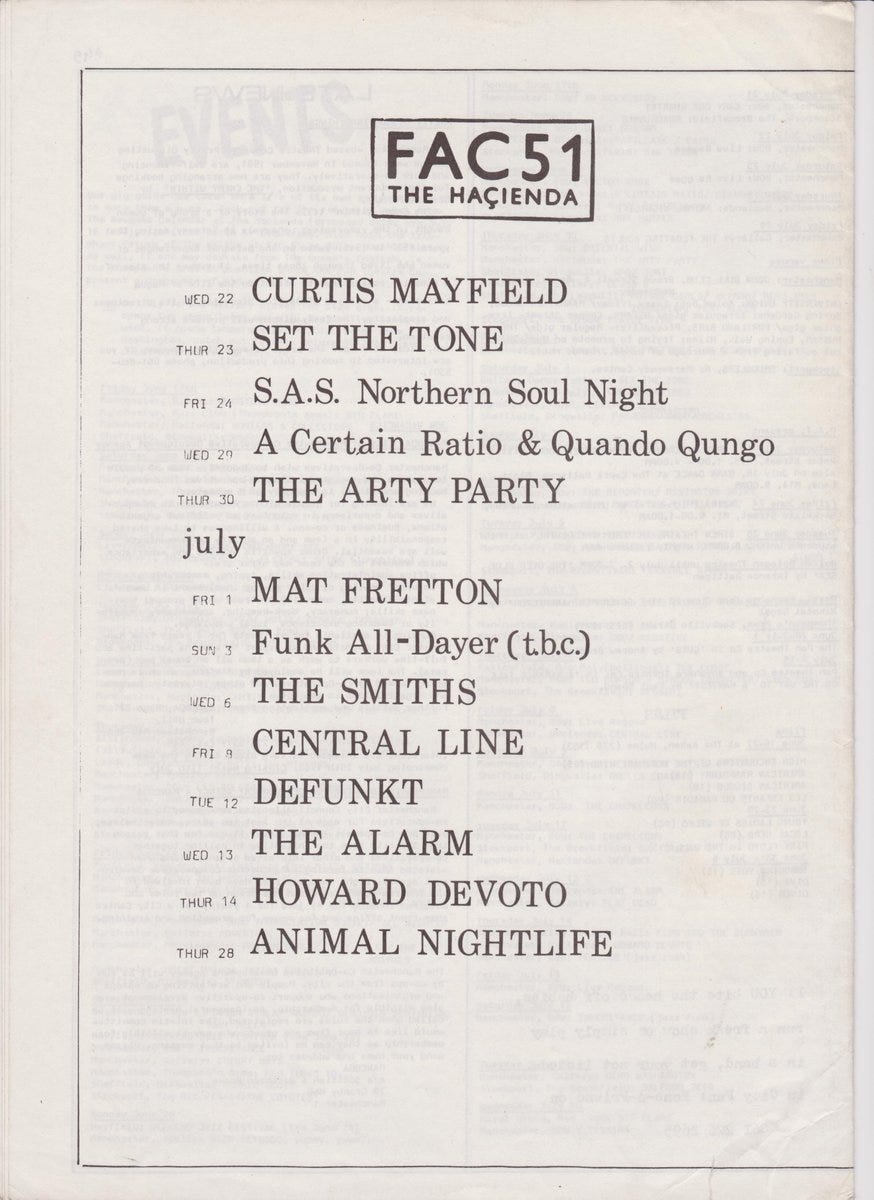
The idea of the Haçienda becoming world famous never occurred to me in 1983. It was on the edge of town, geographically and culturally, some unique amalgamation of music venue, art project, and magnificent folly. And a social club we couldn’t have lived without.
There were other clubs I’d visit, including the Cyprus Tavern, but if you intended on visiting anywhere that didn’t demand male patrons wear a tie and black shoes or where anyone with a touch of the alternative about them could end up with a bottle smashed over their head, choices were limited. Often the best events were midweek nights including Legend (on a Wednesday, presided over by DJ Greg Wilson), or Berlin on a Tuesday (with DJ Colin Curtis).
So, I’d gravitate towards the Haçienda. At weekends there would be DJs, although I recall that it wasn’t until later in 1983, on a newly instituted regular Tuesday night that DJs got much of a crowd. I’ve written more about the early days in a previous post (see link at the end of this piece).
You’d pick up flyers as you left the club to check upcoming attractions or maybe turn up on half a whim; “Oh let’s give it a go”. In one of many Hacienda-related diary entries from around the time I describe what happened to my flatmate Jeff and his friend Janet (August 3rd); “Janet brought her sister Fluff and her boyfriend Roland round and they went to the Haçienda as they’d never been before. Jeff took them, but Roman Holiday were on so they came back”.
I don’t actually remember Roman Holiday. Were they that bad?
I didn’t really adhere to any of the tribalism of the time. I’d go and see the Birthday Party. but I’d also I adored ‘The Message’. In 1983 there was a Hulme band called the Floating Adults. They issued a press release; THE FLOATING ADULTS AIM TO MAKE MUSIC RATHER THAN TO NECESSARILY COMPOSE POP SONGS, THUS SOMETIMES TENDING TOWARDS THE ABSTRACT. Imagine being someone who read that and thought “That sounds good”! That someone was me.
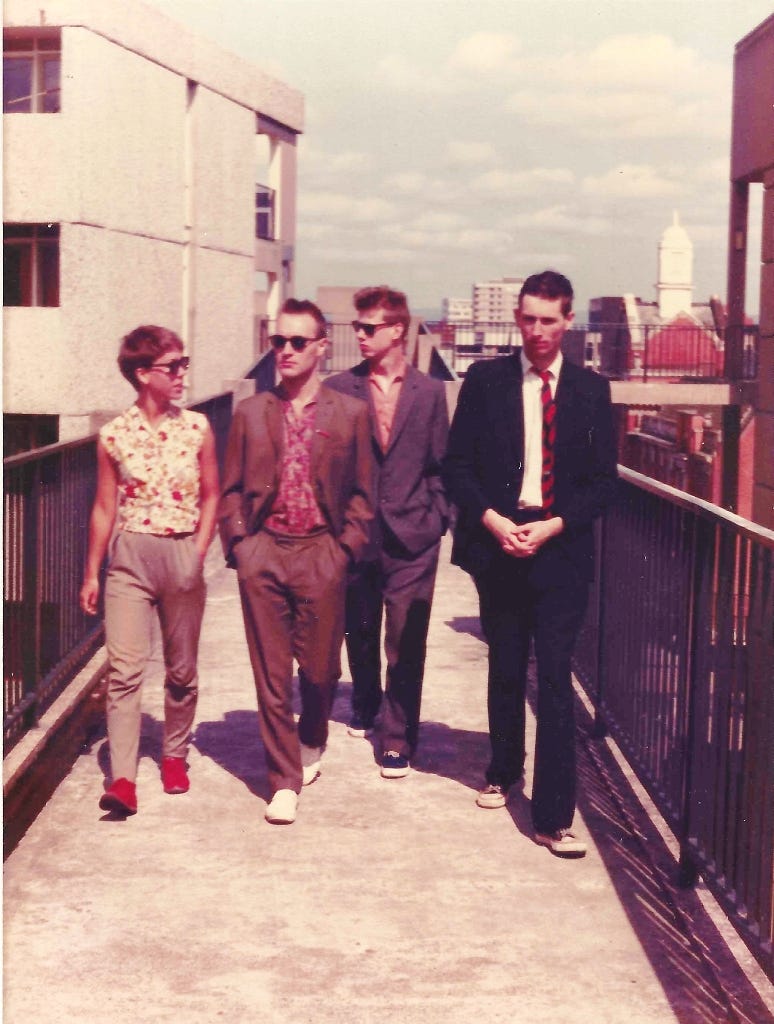
On 29th June I’d found out I’d secured a First Class degree in English (my diary says “First! Yes! Hoped for, but not expected”). Truth is, I was a studious young man. I liked the library, almost as much as I liked music venues and arthouse cinemas.
In July 1983 I was enjoying my first Summer after University. I had a temporary (three week) job set up, working for the Joint Matriculation Board (JMB). I didn’t start until the 11th July. The JMB set and marked O and A Level exam papers. The job entailed checking that the marks on each paper had been correctly added-up.
Some flats had telephone landlines but many didn’t. My flat did. Of course, no-one had mobile phones. According to my diary, I’d often get two or three letters a day from friends all over the country, and I’d spend quite a few hours writing and posting letters too. My Mum used to write from Birmingham at least once a week.
I’d say I was living a relatively adventurous life in July 1983, but I’m pleased my diary reported the mundanities too. At least half my days in July 1983 were spent in and around the flat, walking to Moss Side Shopping Centre for vegetables, watching TV.
Thursday 5th July I walked into Rusholme. I used to drop into a musty, dusty, bric-a-brac, shop called Blood’s, run by an old fella who considered me a prime candidate to regale with stories and opinions. My diary reports that during that visit, “he told me about how young people think watching TV is living”. No idea what he’d make of the screen time we now rack up some days.
My July 1983 diary reveals just how much time I spent knocking of peoples’ doors, walking around bumping into people; “In the afternoon I went to see Owen who wasn’t in”; “Went to see Mark and Paul in the evening but Mark was out”; “Sharon came over from Liverpool to see if she could find Helen but she couldn’t”.
I remember a couple of Owens, I don’t know which one wasn’t in, and similarly Marks and Pauls; I’m trying to think who those guys were exactly. In my diary, if I went out anywhere I had a habit of naming people I knew who were there. There are lots of names in the diary, but I can’t put faces to many of them.
I’m still in touch with Sharon and Helen, who, along with Susan, I knew back at school. Susan was working at the Haçienda, behind the bar, but doing the JMB in the daytime too. Other names popping up in the diary around this time; Rachel N (who took the third bedroom in the flat with me and Jeff), Fran, Murph, Zillah, Steve J, Kim T, Sarah J, Sarah H, Harry S, Andi C, Ernest, Kirsten, Dil.
One young women living in Hulme was my sexual partner but I won’t identity her to save her the embarrassment. Actually, we were very sporadic in our entanglements and I don’t think I was her boyfriend exactly.
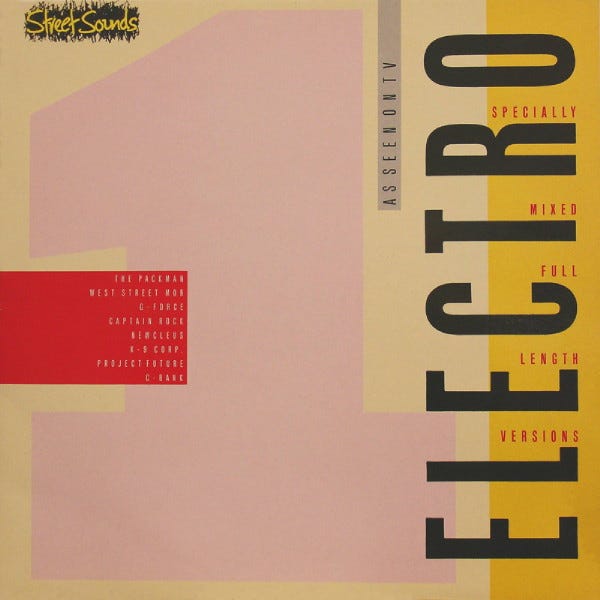
In Hulme, the Summer of 1983 was the Summer of Herbie Hancock’s ‘Rock it’. I was obsessed with it from day one. And walking through Hulme, someone somewhere would have their windows open and the song would be blasting out – all the blocks, all across the estate.
The Street Sounds compilations had been bringing together soul and rap; and then there was a spin-off series dedicated to electro; the first Electro album included ‘I’m the Packman’, ‘Jam on Revenge (The Wikki-Wikki Song)’ by Newcleus, and ‘Break Dancin’ Electric Boogie’ by West Street Mob. Honestly, it bliss to be alive and to be treated to such brilliant new music!
The Factory crowd were on top of all this electro activity in New York. New Order played in New York on 7th July at Paradise Garage with Quando Quango and also visited the Fun House where Jellybean Benitez was a resident DJ. On that trip Arthur Baker produced ‘Confusion’ which was then rush released; John Peel was playing a copy by the end of July 1983. My diary confirms a habit I’d picked up five or six years earlier; “Listened to Peel” ends many of the day’s entries.
To mark the hoped-for-but-not-expected First, I went with Jeff to the Haçienda to see A Certain Ratio. I didn’t know who Quando Quango were at the time, but they were the support act. Diary says A Certain Ratio played “a new set”; that’s the extent of my report. I’m thinking maybe they were getting deep into their jazz phase. It was also the first time I’d seen them without Simon Topping, the frontman in earlier incarnations.
Wednesday 6th July it was my flat mate Jeff’s birthday. I gifted him a Charles and Di mug (how very droll of me). That night a band called the Smiths played at the Haçienda but I wasn’t there. My interest (and then passion) had already started though; I loved ‘Hand in Glove’ which had been released in June.
I missed the Smiths because I’d already had an event I’d promised a friend I’d attend – Sophie was presenting The Good Person of Szechwan by Brecht, and I guess featuring in it too. She was among the friends I had who were studying Drama, or had studied Drama; later in life she became one of Dr Who’s assistants. Simon Hickson played the part of Wong in the play. I was getting used to seeing Simon out and about; I remember first meeting him down the front of an Altered Images gig, which was probably 1980. Simon turned up as one half of Simon & Trev, regulars on BBC Saturday morning children’s television shows.
The day New Order played at Paradise Garage, I signed-on (at the dole office on Aytoun St); our worlds were not colliding, to put it mildly. Simon Hickson was signing-on there at the same time. Or as my diary put it, somewhat sardonically, “Wong was there”.
One evening, another Drama student, Tim Booth, ended-up at the flat with a few other people. It wasn’t unusual to see Tim about – I always chatted to him. The band he sang in, James, were up and running just about that Summer. In the next years, it was fabulous to be around in their time as a Factory act. Songs like ‘Hymn From a Village’ were just the best. Meanwhile, another future star, Ian Brown, had just moved into William Kent Crescent, although I didn’t meet him until two years later.
After the Brecht play, a late drink at the Gallery - a small but well programmed live venue on Peter St. After the Gallery I ate a kebab. I remember the kebab place was just up the road from the Gallery (approximately where the club/bar Impossible is now). I’ve not eaten meat since 1985. The Gallery and the kebab shop have been demolished, and my kebab eating days are long gone.
But some things stay the same. That afternoon Sharon came to find Helen but couldn’t we went to the Whitworth Art Gallery and then the Gemini café on Oxford Rd opposite MRI. I’ve done the Whitworth and then the Gemini many times since; including at least once in the last six months. The Gemini is a Manchester institution; is there a longer standing “greasy spoon” café in the city (having outlasted the Alesia and the John Dalton)?
Saturday 9th July starts “Guardian as usual”. That day I walked into town and headed to the library to borrow Ronald Hayman’s biography of Franz Kafka. A day of very hot weather apparently.
At the JMB the target was to check two hundred and fifty scripts a day. Some entries in my diary noted how many I managed, which seems to average out at about three hundred. To help liven up the boring hours of work, over the next three weeks, I also wrote down some of the stuff people had written on their exam papers; “In the industrial towns the population was high, and there were no proper suez”.
After my second day, I had no plans for the evening, but soon after Brookside, I got a knock on the door, as my diary explains; “Fran came to take me to see Defunkt at the Haçienda. I wasn’t going to go as it was hot and I was tired but she’d made the effort so I thought I would. Went over to Bark Walk – Murph, Tracey W, John Breslin, Ian Long also there. Ian came with Fran and me to the Haçienda. Susan was working and it wasn’t very busy so I talked to her a lot. They played some great dance music before the band came on. Defunkt were loud. I went home to bed at 1, outside the bed without clothes, with the window fully open”.
Apologies for the lack of any kind of review of Defunkt. I must have enjoyed them, though, as I went out a few days later and belatedly bought their 1980 debut album.
My one trip to the Hussar was Thursday July 21st 1983 to see the Floating Adults; then featuring Cathy Brooks, Chris Fenner, Jonathan Bedford, Steve Maguire. I recall seeing them again, at least once, at the Thompson’s Arms, with the The Gay Animals - Cath Carroll and Liz Naylor’s band.
Chris and Steve from the Floating Adults then joined Miaow with Cath Carroll. I later interviewed Miaow for NME, and when Cath went solo, I interviewed her for The Face. In July 1983, Cath Carroll was living at 30 Loxford Court.
Cathy Brooks later joined Dub Sex, fronted by Mark Hoyle. I’m not sure what happened to Jonathan Bedford (he was the singer), but he turns up later in my diaries out at the Ritz on a Monday night. At some point – I think after the Hussar show - Nigel Chatfield joined the band on melodica. As for the gig at the Hussar, my diary doesn’t pick up how the Floating Adults tended to the abstract but does report “Jonathan’s maracas broke”. I also mentioned a few of the attendees; including Kim, Chrissie, Kirsten, Dil.
Dil was one third of Big Flame, a fantastically inventive Hulme-based band. We had a mutual admiration society up and running – I became their resident DJ when they created the Wilde Club at the Man Alive in February 1985.
The Grant’s Arms on Royce Rd was close to the Crescents and PSV club (where the Factory nights took place in the late 1970s). There’s a photo of Mick Hucknall playing pool in there. The building still exists, but it now houses the Bright Eyes Day Nursery – although the Boddington’s Brewery logo is still visible, carved above the door. Mick Hucknall, in his Hulme years, kept an axe next to his bed.
Wednesday 27th July, my diary tells me I went for a couple of drinks at the White Horse and then on to the Haçienda to see the Fall. I got in for a pound thanks to Susan. A succinct report “The Fall were good and I ran home at 1”.
I managed one more visit to the Haçienda that month – they were experimenting with Saturday lunchtime opening. Diary quote; “The place looks better in the daylight – you can appreciate the colour and the space. I was the only customer though”.
I left my flat in Hulme in March 1984 and moved to Great Western St in Moss Side, then Whalley Range, then Withington, and then moved back into 20 Amberidge Walk in 1987. I was busy promoting shows at the Boardwalk by then, and there was enough space to offer some overnight accommodation to bands in town, including Sonic Youth, the Butthole Surfers, Nikki Sudden & the Jacobites, the Pastels, and the Vaselines. A.R Kane dropped in and sat on my bed while they were being interviewed by BBC Radio Lancashire.
The second half of the 1980s, the dereliction in Hulme was almost total, especially around the Crescents. It was inevitable that the modernised Hulme estate was headed towards demolition. In 1991 Amberidge Walk was pulled down. There’s another version of Hulme now, but a rebellious spirit lives on, particularly around Niamos.
Back to 1983. Friday 5th August was my last day at the JMB. I checked a Religious Studies exam paper; “John was strung up in the dessert and left for dead but Jesus saved him”.
Throughout July, out of University, and my life ahead unplanned, I reckon I’d been pondering what was next for me. I’d decided to start a fanzine; the first issue of ‘Debris’ was published in December 1983. Later in 1983, just after Christmas, I was back at the Grant’s Arms, this time with Morrissey, who’d come round to the flat to be interviewed for issue 2. We met up with Liz and Cath from the Gay Animals in the pub and we all pored over printing proofs of the sleeve for the imminent Smiths single ‘What Difference Does It Make?’.
I was hungry for music and culture generally, just as I am now. In 1983 I reckon the intellectual side of my life was well looked after but I’m not sure that I knew myself or the world with any degree of emotional maturity. Is that just me, or is that often the case with a twenty-one year-old fella?
I was floundering a little. I don’t have much evidence for this theory directly in the diary. I wanted to keep it pretty factual rather than emotional. I was aware of the perils of a diary entry “Oh my heart is broken” only a few months later realising actually it really wasn’t.
But maybe also I lacked emotional insight. I think that’s one thing that’s changed about me, thankfully. Men have been encouraged to read their emotions in more recent years and I’m not on top of everything now I’m in my 60s, but at least I can now inquire within myself, and analyse and define my feelings and those of people around me.
I still feel joy at finding like-minded souls to hang out with, but I think I was more gregarious then - is that the usual way things pan out? Or is it more usual to become more gregarious with age?
So how did July 1983 end for me? The day after the JMB job finished, I walked into town to visit the Manchester Free Press, a printing company based on Whitworth St – I think in India House or Lancaster House, two magnificent old buildings, warrens of rooms formerly owned by textile companies. In the early 1980s similar buildings round town would feature empty rooms or ad hoc offices for small businesses, activities such as printing presses, or fashion designers or photography studios, perhaps with barber shops in the basement. By the end of the decade they’d been repurposed into flats.
I seem to remember the Manchester Free Press were based on the third floor. Anyway, I had some conversations with them about whether they might print my fanzine and they gave me some tips about layout and so on. In my diary, after the visit, I report;“It looks promising”.
Is there anything better than going to bed with a diary entry saying “It looks promising”? So there you go – that was me, looking forward. With interesting, creative, and constructive stuff to do, or, at least to plan. Just as it should be and just as it is now.
Further reading
Comments
Nothing yet. Say the first thing.
Sign in to join the conversation.