
Matthew 16: The Turning Point
In Matthew 16:13-17, Jesus asks his disciples, “Who do people say the Son of Man is?” Their responses reflect the popular messianic expectations of the time: John the Baptist, Elijah, Jeremiah, or one of the prophets. When Jesus turns the question directly to them—“But what about you? Who do you say I am?”—Peter answers, “You are the Messiah, the Son of the living God.”
“When Jesus came to the region of Caesarea Philippi, he asked his disciples, ‘Who do people say that the Son of Man is?’ They replied, ‘Some say John the Baptist; others, Elijah; still others, Jeremiah or one of the prophets.’ ‘But you,’ he asked them, ‘who do you say that I am?’ Simon Peter answered, ‘You are the Messiah, the Son of the living God.’ Jesus responded, ‘Blessed are you, Simon son of Jonah, because flesh and blood did not reveal this to you, but my Father in heaven.’” (Matthew 16:13-17 CSB)
Jesus changed the question when he directed it to the disciples. Or did he? “Who do people say the Son of Man is?” becomes “Who do you say I am?”
Who is the Son of Man? Jesus is setting up the greatest turning point in human history, from waiting in hope to claiming in faith. He is here. The Son of God, Son of Man, Saviour and Lord.
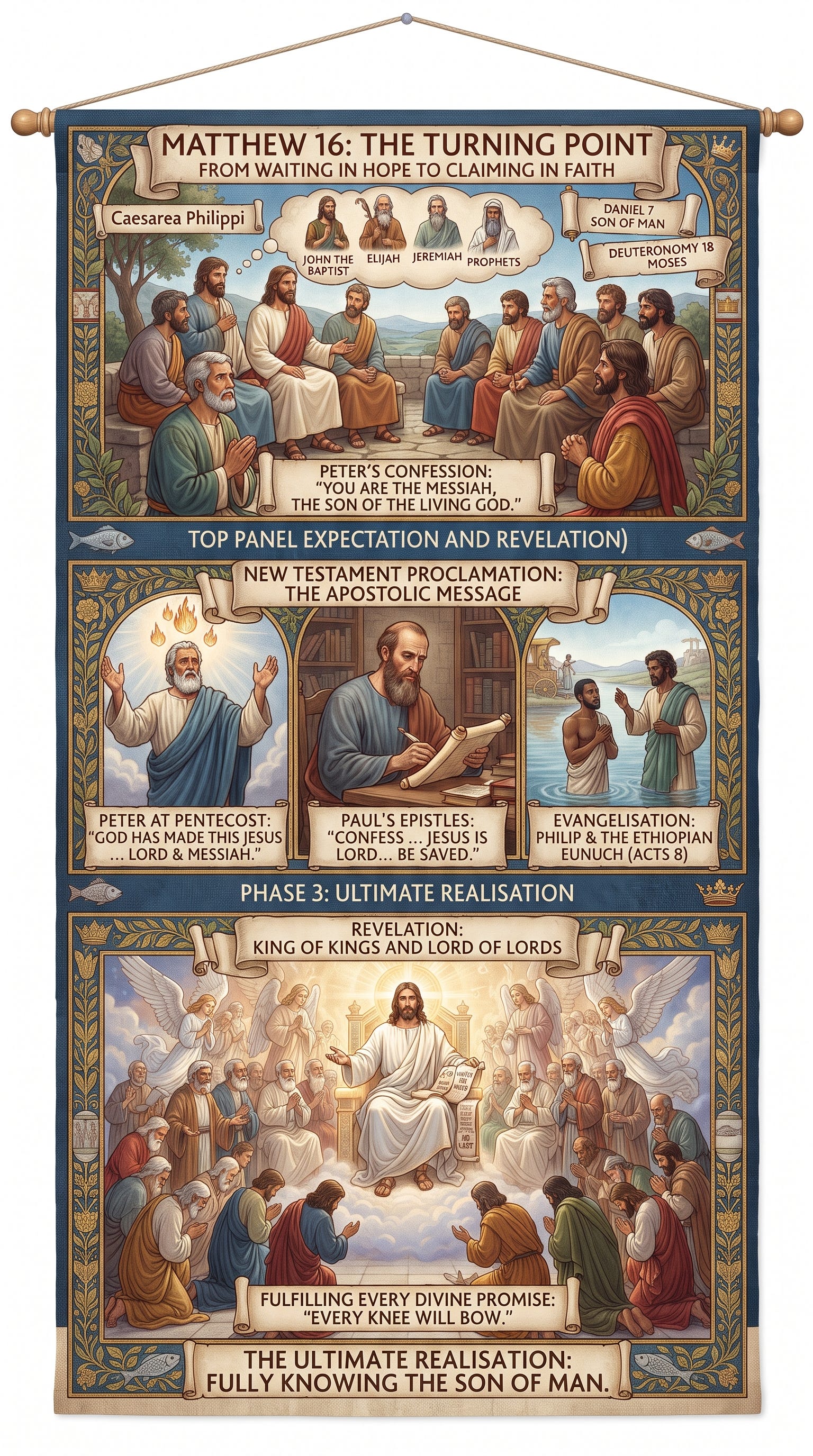
The titles and figures mentioned in Matthew 16 directly connect back to Hebrew Scripture:
The Son of Man: Draws directly from Daniel 7:13-14, where “one like a son of man” approaches the Ancient of Days and is given everlasting dominion and authority over all nations.
“I continued watching in the night visions, and suddenly one like a son of man was coming with the clouds of heaven. He approached the Ancient of Days and was escorted before him. He was given dominion and glory and a kingdom, so that those of every people, nation, and language should serve him. His dominion is an everlasting dominion that will not pass away, and his kingdom is one that will not be destroyed.” (Daniel 7:13-14)
Elijah: Malachi 4:5 prophesied that Elijah the prophet would return before the coming of the great and dreadful day of the Lord. Jesus later clarifies that John the Baptist fulfilled this role as the herald.
“Look, I am going to send you the prophet Elijah before the great and terrible day of the Lord comes.” (Malachi 4:5)
“Truly I tell you, among those born of women no one greater than John the Baptist has appeared, but the least in the kingdom of heaven is greater than he. From the days of John the Baptist until now, the kingdom of heaven has been suffering violence, and the violent have been seizing it by force. For all the prophets and the law prophesied until John. And if you’re willing to accept it, he is the Elijah who is to come. Let anyone who has ears listen.” (Matthew 11:11-15 CSB)
The Prophet Like Moses: Deuteronomy 18:15 promised that God would raise up a prophet like Moses from among the people, to whom they must listen.
“The Lord your God will raise up for you a prophet like me from among your own brothers. You must listen to him.” (Deuteronomy 18:15 CSB)
This Mosaic passage from Deuteronomy was used by both Peter and Stephen to refer to Jesus in the book of Acts.
Following the resurrection and ascension of Jesus, the central focus of the early church became declaring the true identity of Jesus to Israel and the Gentile world:
Peter at Pentecost: In Acts 2:36, Peter proclaims, “God has made this Jesus, whom you crucified, both Lord and Messiah.”
“Therefore let all the house of Israel know with certainty that God has made this Jesus, whom you crucified, both Lord and Messiah.” (Acts 2:36 CSB)
Paul’s Epistles: Paul emphasises that salvation hinges on acknowledging Jesus’ true identity. In Romans 10:9, he writes that confessing with your mouth “Jesus is Lord” and believing in your heart brings salvation.> “If you confess with your mouth, ‘Jesus is Lord,’ and believe in your heart that God raised him from the dead, you will be saved.”
“If you confess with your mouth, ‘Jesus is Lord,’ and believe in your heart that God raised him from the dead, you will be saved.” (Romans 10:9)
Evangelisation: In Acts 8, Philip explains the Isaianic prophecies to the Ethiopian eunuch, leading him to confess faith in Jesus as the Son of God.
The Conversion of the Ethiopian Official (Acts 8:26-39 CSB)
An angel of the Lord spoke to Philip: “Get up and go south to the road that goes down from Jerusalem to Gaza.” So he got up and went. There was an Ethiopian man, a eunuch and high official of Candace, queen of the Ethiopians, who was in charge of her entire treasury. He had come to worship in Jerusalem and was sitting in his chariot on his way home, reading the prophet Isaiah aloud.
The Spirit told Philip, “Go and join that chariot.”
When Philip ran up to it, he heard him reading the prophet Isaiah, and said, “Do you understand what you’re reading?”
“How can I,” he said, “unless someone guides me?” So he invited Philip to come up and sit with him. Now the Scripture passage he was reading was this:
He was led like a sheep to the slaughter,
and as a lamb is silent before its shearer,
so he does not open his mouth.
In his humiliation justice was denied him.
Who will describe his generation?
For his life is taken from the earth. [Isaiah 53:7–8]The eunuch said to Philip, “I ask you, who is the prophet saying this about—himself or someone else?” Philip proceeded to tell him the good news about Jesus, beginning with that Scripture.
As they were travelling down the road, they came to some water. The eunuch said, “Look, there’s water. What would keep me from being baptised?” So he ordered the chariot to stop, and both Philip and the eunuch went down into the water, and he baptised him. When they came up out of the water, the Spirit of the Lord carried Philip away, and the eunuch did not see him any longer but went on his way rejoicing.
The Book of Revelation brings the question of Jesus’ identity to its final, majestic fulfilment:
Jesus is revealed not merely as a suffering servant or an earthly teacher, but as the King of kings and Lord of lords (Revelation 19:16).
“And he has a name written on his robe and on his thigh: King of Kings and Lord of Lords.” (Revelation 19:16 CSB)
He is the Alpha and the Omega, the First and the Last (Revelation 22:13), fulfilling every divine promise and establishing an eternal kingdom where every knee will bow and every tongue confess his true identity.
“Look, I am coming soon, and my reward is with me to repay each person according to his work. I am the Alpha and the Omega, the first and the last, the beginning and the end.” (Revelation 22:13 CSB)
And on that day, when we fully know the Son of Man for who He truly is, we will fully embrace Him, as if for the first time, as He has always embraced us.
No posts
Comments
Nothing yet. Say the first thing.
Sign in to join the conversation.