
You know, I’ve shared a lot with you over these past few weeks. The cost of stress. The cause of stress. The doubt underneath it all. The skills that help. And every time I hit send on one of these newsletters, I get messages back from people who are right there in it, feeling it, living it.
But I realized I might have skipped over something important.
What is stress resiliency? And why does it matter?
Because that’s what’s inviting you here, right? To build it. To figure out how to handle everything on your plate without constantly feeling like you’re one bad day away or a series of mini yet avoidable mistakes from falling apart. Because it’s not like I can ask you to build something without first helping you understand what it is you’re building.
As I get older and wiser, or maybe just wiser because I’ll forever have a youthful exuberance, here’s what I realize:
The ones who struggle the most with stress aren’t the ones with the biggest workloads or the most difficult lives. They’re the ones who are fighting it. The ones who keep asking “why is life so hard and relentless?”
And I get it. Because I was that person for a long time especially after my car accident in 2019 and then reporting to the worst manager I’ve had in my life. Believing that if I could just get through this project, this quarter, this phase of life, then things would calm down and I’d finally be able to breathe. And it did here and there, but those blissful moments never lasted, like NEVER EVER. Because being a human is this beautiful but messy world means living with surprise after surprise around the corner, both the good AND the stress inducing bad.
That’s the trap. Waiting for life to get easier instead of taking the effortful route of building the capacity to handle it when it doesn’t.
Quick pause. I want to acknowledge that I missed last week’s post. I was heads down preparing for a talk I gave yesterday to the Families at Microsoft ERG. And oh my gosh was it a huge success 🥳! 348 people showed up. The chat was on fire the entire time, over 100 messages, 300+ reactions, people sharing their stories and breakthroughs in real time. It was one of those moments where you realize this work is connecting with people in a way that actually matters.
Stay tuned for learnings from it in the coming weeks. But let’s get back to it.
So let me walk you through what I think are the four stages of understanding stress resiliency. Because it’s through understanding and sitting with them is how we move this from a concept into something that can make a meaningful impact on your life.
This is hard because we are creatures of comfort. And this requires you to accept something most of us have been fighting to avoid for too much of our life.
Life will have its incredibly hard and relentless moments. Life will require you to step out of your comfort zone. Life will bring you an incredible amount of discomfort. And rather than fight it, you have to accept that it will happen no matter what. That you can’t numb it indefinitely. That the more you try to avoid stress, the less likely you are to achieve the life you want most.
Because here’s the thing nobody wants to hear. That dream life you’re reaching for, the ambitions you’re working so achieve, it comes with stress.
The promotion you want, the one that would finally validate all the years of work you’ve put in, that comes with more responsibility, more pressure, more moments where you’re going to question if you’re capable of this.
The relationship you’re trying to create or repair, the one where you actually show up fully and vulnerably, that’s going to bring up every insecurity you’ve been avoiding.
The parent you’re working to become, the one who’s present and patient and shows up for the big moments and the small ones, that requires you to navigate discomfort with unicorn sprinkles of tantrum throwing moments on more days than you’d like.
You can’t have the dream without the discomfort that is required to build it. It’s not like you can suddenly become a super hero with no bad guys to face. And I think that’s where most people get stuck.
They’re waiting for a version of their dream life that doesn’t come with stress.
And it just doesn’t exist.
The first stage is genuinely accepting that life will come with stress in many flavors. So let’s not be afraid to taste the rainbow.
Once you accept that you can’t live a stress-free life, you can finally start to realize something powerful.
Although you can’t control what life throws at you, you do have control over how you respond to those moments. You have agency over whether stress becomes the thing that stops you or the thing that makes you more extraordinary. So let’s define it.
STRESS RESILIENCY
The ability to thrive even during the hard, the unexpected, the uncomfortable moments in life without letting stress hold you back from your dreams and ambitions.
And you gain this ability by understanding how your mind, your body, your nervous system works, the difference between doubt and belief, fragility vs. resiliency, and following people who understand you and know what they’re talking about (like me!).
After that talk yesterday, one attendee posted something on LinkedIn afterward that captured the shift perfectly and makes me proud to do this work.
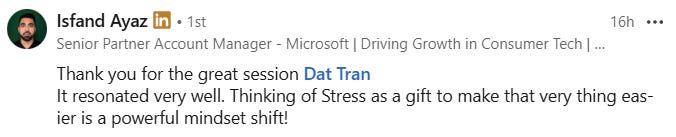
A gift. Not a problem. Not something to eliminate, numb, or manage your way through. A gift that makes the hard things easier when you know how to use it.
And when you understand that stress can be a gift, everything changes which leads us to how to convert stress into a gift.
But understanding isn’t enough. You can know intellectually that stress is useful, that it’s part of growth, that you can handle more than you think. But if your mind and body doesn’t believe it, if you don’t have proof, you’re still going to shutdown when the hard moments come.
So stage three is about building that proof. Building evidence that you can trust.
You do that by teaching yourself how to do hard things until life doesn’t feel as hard anymore. By regularly stepping out of your comfort zone so fewer and fewer things stretch you. By practicing being present in the moments that matter, the big ones and the small ones, so you’re not just surviving life but actually living it.
And every time you do that, every time you choose the hard conversation, every time you show up for the uncomfortable moment, every time you don’t let stress make the decision for you, you’re building evidence. Evidence after evidence after evidence.
Evidence that you can handle more than you think. Evidence that discomfort doesn’t break you. Evidence that the hard moments are where you grow, not where you shrink. Evidence that when life asks more of you, you have the capacity to meet it.
This isn’t about learning techniques. It’s about proof. Proof that your brain can trust. Proof that when life gets hard, and it will, you’ve done hard things before and you can do them again.
And then, once you do the work not in passing but intentionally, if you really commit to building that evidence over time, something shifts.
Stress resiliency stops being something you’re working toward but something that shifts in your presence and your entire sense of being. Until you’re not just “managing” stress anymore. You’re using it. The hard moments become opportunities that get’s others to trust you more. The uncomfortable becomes where growth lives. Stress stops being the thing holding you back and becomes the thing building you up.
You meet the promotion, the relationship challenge, the parenting moment, the unexpected crisis, and instead of wondering “Can I handle this?” you already know the answer. Not because you’re overconfident. Not because you’re pretending it’s easy. But because you’ve built the evidence. You’ve done the work. You’ve integrated it into who you are.
And that’s when stress resiliency becomes your competitive advantage. Not something you’re striving for, but something you carry with you into every hard moment for the rest of your life.
That’s what this work is about. And I’m really glad you’re here for it.
Dat
P.S. Which stage are you stuck at? Which one do you relate with the most? Let me know in the comments or hit reply. I read every response, and I’d love to hear more about your journey.
Thanks for reading! Pass this along to someone that needs to hear it.
No posts
Comments
Nothing yet. Say the first thing.
Sign in to join the conversation.