
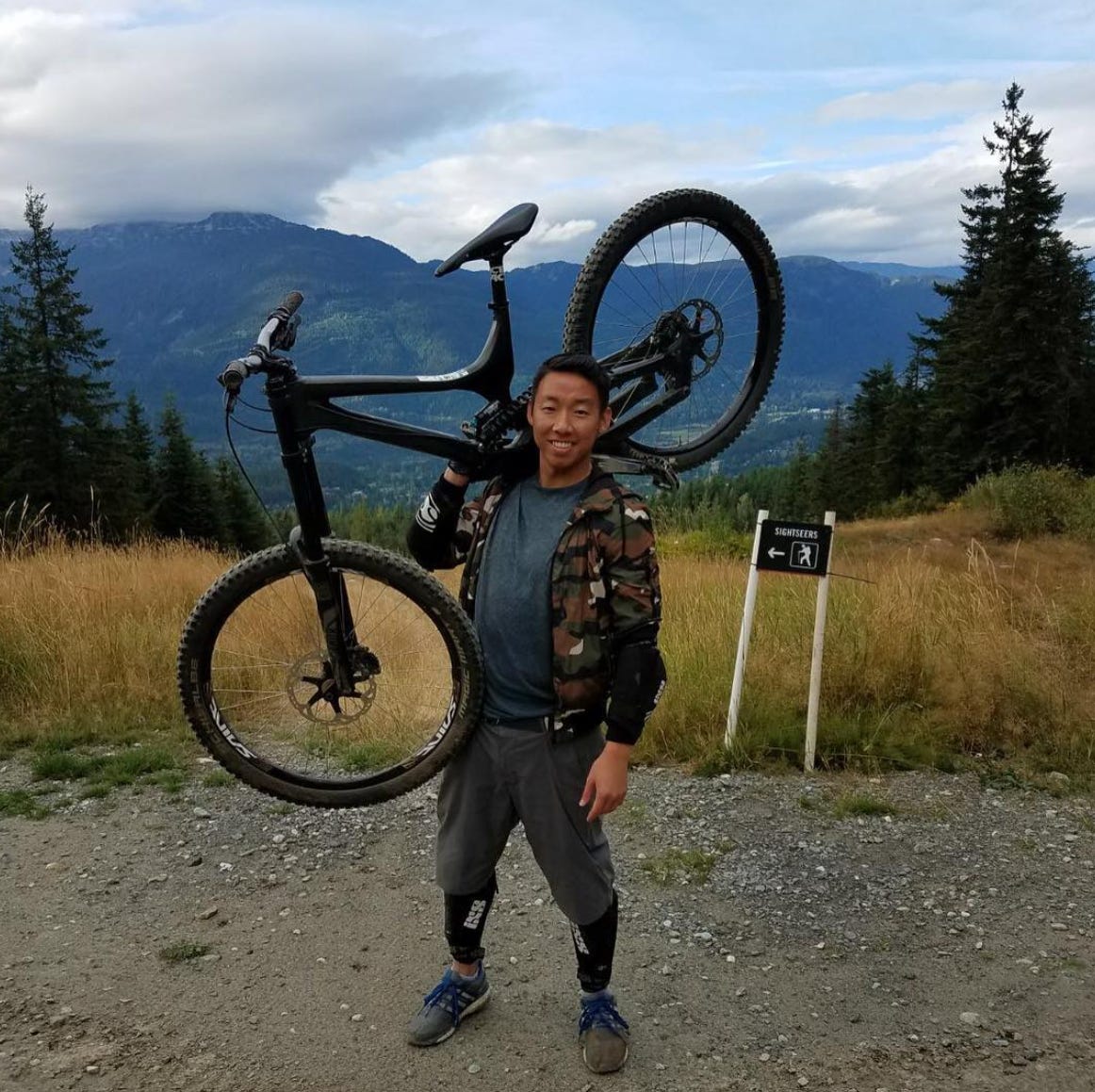
I was standing at the top of a mountain in Whistler, straddling a bike I’d never ridden before, staring down a trail that looked more like a rock garden than a path.
I don’t even own a bike. And here I was, about to ride down a mountain.
My mind was screaming at me. You’re going to hit a rock and fly over the handlebars. You’re going to break something. This bike isn’t built for someone like you. You don’t know what you’re doing.
Every doubt I’d ever had about myself came rushing up in that moment, and my body responded the only way it knew how: with stress. My shoulders tensed. My breathing got shallow. I gripped the handlebars like my life depended on it.
I was terrified. Not of the mountain. Of my own inability to handle it.
And that’s when a stranger rolled up next to me.
Before I tell you what he said, I want to say thank you for joining me on this journey.
Two weeks ago, I launched this newsletter, not entirely sure if anyone would show up. Since then, 175 of you have. A subscriber and new client sent me a message that stopped me in my tracks: “The first video lesson was amazing. It’s like you know me.” Another subscriber booked me to come speak to Microsoft’s Families employee group on April 29th about sustainable resilience across generations.
You’ve opened these emails, you’ve replied with your own challenges, and you’ve reminded me why I’m doing this work in the first place.
All of this happened because we showed up together. So thank you.
The stranger looked at me, saw I was frozen after falling a few times, and said something I’ll never forget.
“Hey man, can I give you some advice? Just trust the bike and lean into the corners. You are way more capable than you think.”
I nodded. I didn’t believe him, but I nodded anyway.
I got back on the bike. Shakily at first, praying for survival while tensing up every time I saw a rock. Replaying his advice my over and over in my mind. Then, somehow, against all my doubts, I made it to the bottom.
I spent the next hour at the Airbnb, emotionally recovering from the ride. And then I told myself I’d get back up that mountain one more time. Just once more to prove to myself that I am capable.
What I didn’t realize in that moment was that his advice didn’t just get me down the mountain. It taught me something about stress that shaped my life without me even knowing it.
Here’s what I realized since helping so many amazing humans achieve more and stress less.
Doubt triggers stress. Not what’s happening in your career, relationships, or life. It’s doubt.
In your brain is a part I like to refer to as the emotional brain. The scientific term is the limbic system and amygdala. Its one function is to protect you and the people you love most. And when you doubt your ability to do that, it uses stress to overcompensate for the doubt.
Think about what happens in your own life. When you doubt your ability to handle your workload, your brain floods you with stress hormones to keep you activated. When you doubt your child’s ability to do their own laundry, stress kicks in to trick you into doing it for them. When you scroll the news and absorb every reason to doubt the safety of the world, your brain manufactures stress to prepare you for threats that aren’t even in the room.
It’s the same mechanism that was happening to me on that mountain. But here’s the thing. Although it “protected” me, it was also preventing me from making it to the end.
The stress my brain created to protect me was actually making me less capable of achieving the results I truly desired.
Here’s what I’ve been noticing. We live in a world that’s constantly teaching us to doubt.
You’re taught to doubt yourself. Imposter syndrome has become almost a badge of honor in high-functioning circles, like if you’re not questioning whether you belong, you’re not ambitious enough.
You’re taught to doubt others too. Stranger danger, don’t trust anyone you don’t know, keep your guard up because the world is full of people waiting to take advantage of you and your family.
And then you’re taught to doubt the world itself. Open the news and you’ll find a hundred reasons to believe everything is falling apart. Scroll social media and see everyone’s curated highlight reel and it’s easy to conclude you’re falling behind.
Every single one of those doubts sends a signal to your emotional brain: “We’re fragile. We’re not capable. We need to stay on high alert.”
So your brain does exactly what it’s been trained to do. It floods you with stress hormones to give you strength to face those doubts, even when you’re sitting safely in your living room, even when the threat is imagined, even when the danger is months or years away or not coming at all.
So what do you do when your brain is wired to protect you from doubt? What do you do when you want to stress less?
You give it evidence to believe in yourself and the world again by having a practice of gratitude and affirmations.
Every time you practice gratitude, you’re giving your brain a reason to hope. Hope that things can get better. Hope that the world isn’t as dangerous as it seems. Hope that you have something worth protecting and worth building toward. And when your brain has hope, it stops treating everything like a threat that needs to be met with stress. It starts to relax. It starts to believe the future might actually be okay.
Every time you give yourself an affirmation, you’re building your brain’s confidence in you. Not fake confidence. Real confidence based on what you’ve already proven. The hard things you’ve handled. The challenges you’ve overcome. The moments you showed up when it mattered. When your brain has confidence in your ability to handle what’s ahead, it doesn’t need to manufacture stress to compensate for doubt. It trusts you.
This isn’t about positive thinking. It’s about evidence-building.
Your brain believes what you show it. If you show it doubt, it responds with stress. If you show it evidence of your capability, your safety, your resilience, it starts to relax. It starts to trust. It stops treating every challenge like a life-or-death situation.
I went back up that mountain later that day. Not just once, but five more times.
Each time, I made a choice. Instead of doubting my fragility, I chose to believe in my resiliency. Instead of doubting the bike, I chose to trust it was designed for exactly this terrain. And each run got smoother, not because I became a better rider, but because I had more evidence that I could handle it.
My emotional brain stopped flooding me with stress because it started to believe what the stranger told me: I was way more capable than I thought.
The stranger’s advice wasn’t just about biking. It was about stress. When you trust yourself and lean into the discomfort, you realize you can handle way more than you think.
And when you realize that, your brain stops needing to protect you, unlocking the path to achieving more while stressing less.
Then ask yourself these two questions.
Where are you doubting yourself most right now? How would your life change once you give your brain the evidence it needs to believe again?
Let me know what you come up with. I read every response, even if I may be slower to respond.
Dat
P.S. There are 2 seats remaining for a transformative women’s cohort that starts this Friday, April 10th. If you’re ready to overcome your doubt, create evidence in your resiliency, and open the pathway to achieve more while stressing less, click here to learn more.
No posts
Comments
Nothing yet. Say the first thing.
Sign in to join the conversation.