
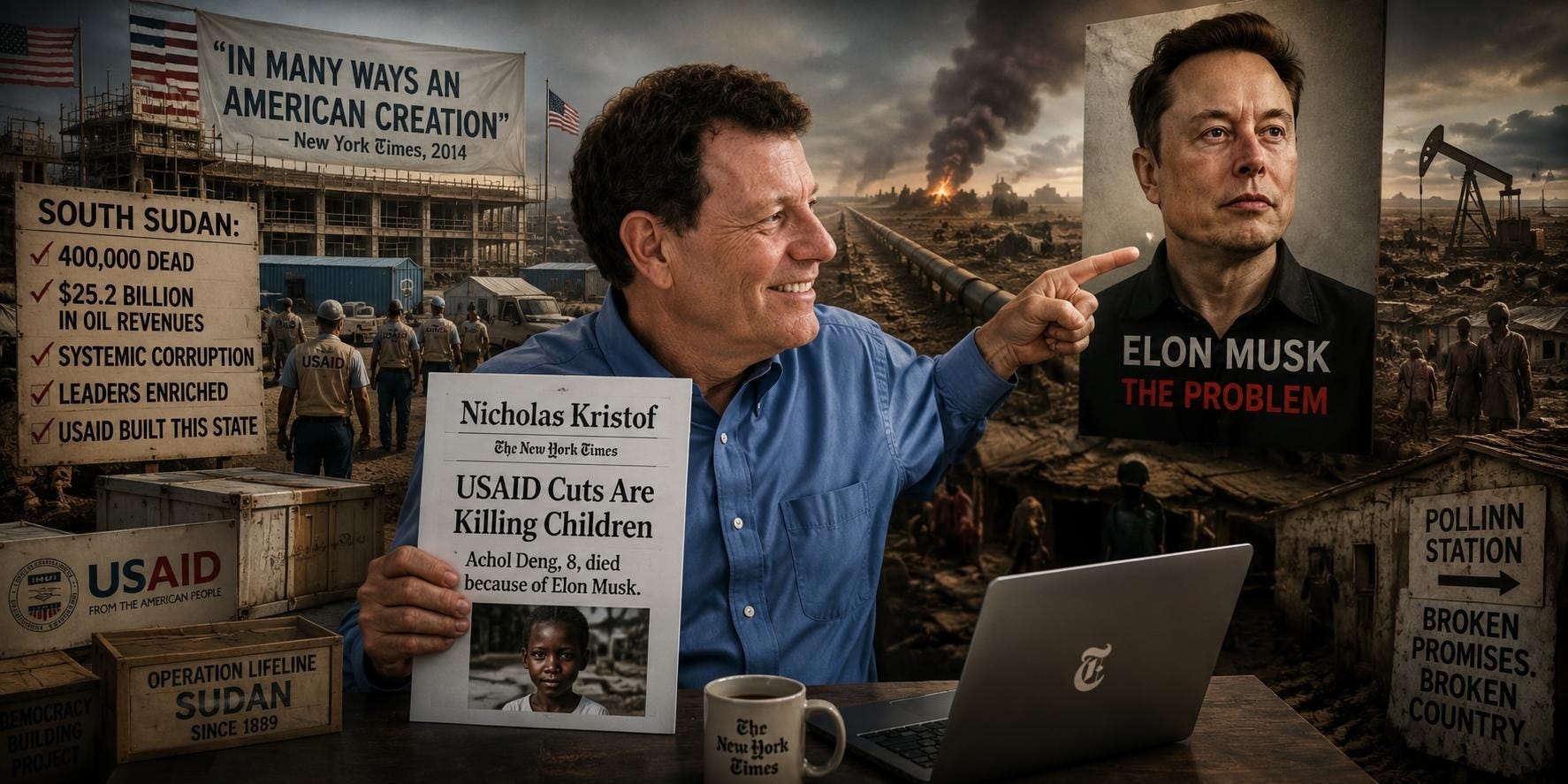
Nicholas Kristof, the New York Times columnist feuding with Elon Musk over USAID cuts, wants you to know that an eight-year-old girl named Achol Deng died in South Sudan because she lost access to HIV medicines when DOGE disrupted USAID programs. He invites Musk to come hold starving children and look into their eyes — without mentioning the 400,000 who died while the aid was flowing, the $25.2 billion in oil revenues that the UN says hardly reached essential services, or that the president’s twelve-year-old son held a 25 percent stake in a holding company.
Today, all that is blamed on “corruption.” But the story untold is that South Sudan, in and of itself, is a creation of “democracy-building” efforts - perhaps more so than any other country in the world.
If Kristof does not believe me - then perhaps he will believe his own publication home. New York Times, back in 2014, called South Sudan “in many ways an American creation, carved out of war-torn Sudan in a referendum largely orchestrated by the United States, its fragile institutions nurtured with billions of dollars in American aid.”
This is the story of how USAID built, and destroyed, an entire country.
On July 9, 2011, Susan Rice brought her thirteen-year-old son to Juba.
She wanted him to see history. The world’s newest country was being born, and the United States had delivered it. And she was far from alone:
President Obama declared “a moment of promise.”
Secretary Clinton pledged to help build “a free, democratic and inclusive society.”
George Clooney monitored the referendum in person.
Jimmy Carter and Kofi Annan had led the referendum observation six months earlier.
The referendum had produced a 98.83 percent vote for independence. But two and a half years later, South Sudan collapsed into civil war. Approximately 400,000 people died.
South Sudan’s independence was the product of a twenty-year American political project that united four constituencies who agreed on nothing else. Evangelicals found Christians enslaved by an Islamist government; Francis Bok, captured at age seven, became the first formerly enslaved person to testify before the Senate Foreign Relations Committee. The Congressional Black Caucus found Arab militias enslaving Black Africans; the apartheid divestment playbook was redeployed against Talisman Energy, the last major Western oil company in Sudan. Neoconservatives found a state sponsor of terrorism that had hosted bin Laden. Liberal interventionists found a genocide in Darfur; the Save Darfur rally on the National Mall in 2006 drew tens of thousands of people.
The Darfur Peace and Accountability Act passed the House 416 to 3. All four constituencies arrived at the same policy: pressure Khartoum, support the south, self-determination. The Save Darfur Coalition merged in 2011 — referendum year — into “United to End Genocide”. The momentum from one crisis was redirected to engineer the independence of a different part of the country.
Meanwhile, Operation Lifeline Sudan had been running since 1989 — sixteen years of airstrips, supply chains, and NGO networks that USAID inherited. OLS was the first time the UN negotiated directly with a non-state armed group, implicitly legitimizing the SPLA (Sudan People’s Liberation Army) as a governing authority before it governed anything.
The entire project was built around John Garang de Mabior — BA from Grinnell College, PhD in economics from Iowa State, Infantry Officers Advanced Course at Fort Benning. His formation was substantially American. His vision was not independence but “Sudanism”: a united, secular, multiethnic Sudan. The Comprehensive Peace Agreement, brokered and financed by the US-UK-Norway “Troika” in January 2005, was built around this vision. Six years of autonomy, then a referendum. Unity was the goal. Independence was the fallback.
Just weeks after being sworn in as First Vice President of Sudan, Garang died in a helicopter crash. No formal investigation produced findings.
Salva Kiir inherited leadership. Garang had a political philosophy and cross-ethnic standing. Kiir had loyalty from the Dinka military core and a Stetson hat from George W. Bush. He was a separatist, not a unifier. I could not find a single US official who raised concerns about Salva Kiir on the public record.
Kiir would go on to rob his own people and engage in a civil war. But first, the United States had to build the institutions that Kiir would operate on.
The United States proceeded to build South Sudan’s government.
The referendum itself was an international operation: UNDP provided the technical backbone, USAID funded ballot logistics through NDI, IRI, and IFES, and the International Organization for Migration ran diaspora voting in eight countries.
Then USAID contracted Deloitte for $92.7 million to construct a functioning government from scratch. Deloitte consultants didn’t advise; they governed. They built the central bank’s payment system, executed $3.3 billion in first oil sales, and managed the fiscal crisis when Kiir shut down oil production in 2012. A midterm evaluation found “ten people were doing 80 percent of the work while the rest were just ‘drinking tea.’”
DynCorp built the SPLA’s military headquarters at Bilpam with State Department money — the base for the army that would turn its weapons on the population within just a few years.
USAID funded continuous election preparation across over a decade of independence. Elections were postponed from 2015 to 2018 to 2021 to 2023 to 2024 to December 2026. Over a decade of election infrastructure produced zero elections.
Five months before the civil war, USAID’s Inspector General audited the Deloitte contract. Deloitte’s monitoring system “did not capture the kind of information on which to base any conclusions.” The flagship nation-building program had no functioning way to measure whether it worked. Deloitte was gaming metrics — when the target for legislation was 90, they changed the target to 60. There were $601,990 in ineligible costs, and $300,000 in fuel with no controls to track whether it was stolen.
USAID concurred with all seven recommendations from the report. Five months later, President Kiir accused Vice President Machar of a coup. The same Dinka-Nuer fault line that had produced the Bor Massacre twenty-two years earlier — when Machar’s forces killed thousands of Dinka civilians — replayed at industrial scale. Approximately 400,000 died. Famine was declared in 2017, the first anywhere since Somalia 2011, during peak USAID spending. UNMISS had 12,500 authorized peacekeepers; they were present during atrocities at Bentiu, Malakal, and the Terrain Hotel.
Today, South Sudan’s oil is extracted by Chinese and Malaysian state-owned enterprises. China’s CNPC holds 40 to 41 percent of both major consortiums. Malaysia’s Petronas holds 30 to 40 percent. No Western company operates there — US sanctions and the divestment campaigns that helped create South Sudan drove them all out. The companies that filled the vacuum faced no comparable pressure on human rights.
Every barrel flows north through pipelines to Port Sudan — through Sudan, the country South Sudan voted to escape. Sudan collects transit fees on every barrel. The former oppressor takes a cut of every shipment.
Of roughly $4.1 billion in gross annual production, consortium partners take their profit shares, Sudan takes its transit fees, oil-backed loans consume hundreds of millions more, and elites divert the bulk of what remains. The UN documented $25.2 billion in total oil revenues since independence and found hardly any reached essential services. Much of it was stolen by the Kiir family; Kiir’s twelve-year-old son held a 25 percent stake in a holding company. The “Oil for Roads” scheme diverted billions — the vast majority of promised roads were never built.
In other words, the financial system and oil sector bootstrapped by Deloitte, financed by USAID, ended up going into the pockets of BRICS countries and stolen by the US-backed Kiir family.
Although South Sudan produces approximately 157,000 barrels per day, it has zero refining capacity. Every drop of diesel is imported.
An oil-producing nation can’t afford diesel — not because Musk cut USAID, but because $25.2 billion in oil revenues were diverted while USAID was supposed to be bootstrapping the government, while 12,500 peacekeepers patrolled, and while a $92.7 million governance program couldn’t track its own spending.
Kristof’s latest column names Achol Deng, eight, HIV-positive in South Sudan. Jibia, ten, who died of malaria in Uganda. Yamah Freeman, who bled to death while villagers carried her through the jungle in Liberia because the ambulance had no fuel.
But in the extensive Kristof corpus I reviewed, he does not name anyone who benefited from the democracy and governance programs — the Deloitte contracts, the election prep for elections that never happened, the civil society programs in a country rated less free than North Korea.
South Sudan’s dependence on foreign-aided diesel is downstream of a nation-building project that created a state, outsourced its governance, watched its leaders divert $25.2 billion in oil revenues, armed the military that waged the civil war, backed the President that ended up looting its country, and never built institutional capacity for self-sufficiency.
When someone turned off the money, the New York Times sent a columnist to find the dead children and blame the people who cut the funding.
The New York Times did not send a columnist to find the names of the 400,000 who died in war and many more who died in a resulting famine.
No posts
Comments
Nothing yet. Say the first thing.
Sign in to join the conversation.