
Most Nigerians appear more concerned about cheaper borrowing costs than lower inflation, despite acknowledging the economic strain rising prices create.
According to the Central Bank of Nigeria’s (CBN) April 2026 Household Expectations Survey, 60.9 per cent of Nigerians want interest rates reduced. When asked to choose between lower interest rates and higher inflation, 50.8 per cent said they would prefer lower borrowing costs even if inflation rises further. In contrast, 41.1 per cent preferred lower inflation despite higher interest rates, while 8.1 per cent were undecided.
Interest rates, measured through the Monetary Policy Rate (MPR), are the benchmark rates set by the CBN to guide how commercial banks lend and borrow. These rates ultimately influence how much Nigerians pay to access credit. Inflation, on the other hand, refers to the sustained rise in the general price level of goods and services, reducing purchasing power and causing the same amount of money to buy less over time.
The relationship between the two is central to monetary policy. When the CBN raises interest rates, it does so primarily to slow inflation. Higher borrowing costs typically discourage spending and credit demand, reducing pressure on prices as businesses face weaker demand and have fewer reasons to raise prices.
However, public sentiment reflects a difficult economic reality. While many Nigerians favour lower interest rates, 66.7 per cent also admitted in the survey that further increases in the prices of goods and services would weaken the economy.
This points out that while many Nigerians want cheaper borrowing, they also recognise that rising prices erode living standards.
But in an economy where households are already constrained by rising costs, higher interest rates can feel counterintuitive, especially when borrowing becomes a coping mechanism rather than a choice. This creates a policy impasse: demand for cheaper credit on one side, and the need to restrain inflation on the other.
In 2024, Nigeria revised how inflation is measured by rebasing the Consumer Price Index (CPI), replacing the 2009 base year with a more up-to-date consumption structure. The change was meant to better reflect current spending patterns and improve the accuracy of economic decisions.
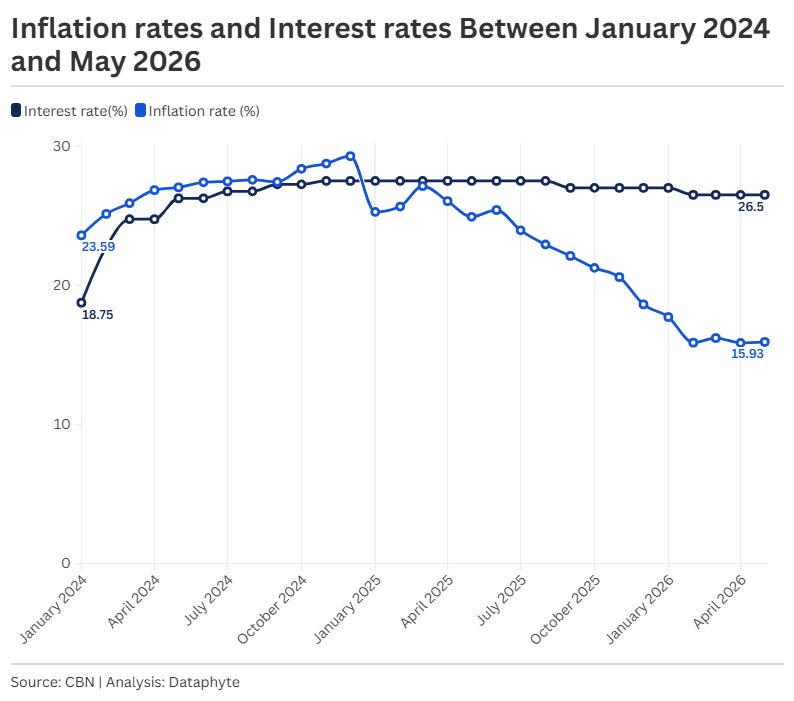
Following this adjustment, interest rates were raised through 2024 and into 2025 to curb inflation. By September 2025, inflation appeared to be easing, though this did not translate into lower prices. Instead, it meant prices were still rising, just more slowly, leaving the cost of living elevated for most households.
In September 2025, the Central Bank of Nigeria cut the interest rate from 27.5 per cent to 27 per cent, its first reduction after a prolonged tightening cycle. The move signalled the beginning of a cautious shift, even as inflation remained above comfort levels and household pressures persisted.
Also, in October 2025, while the interest rate stayed at 27 per cent, inflation rates gradually went down moving from 22 per cent in September 2025 to 21 per cent in October 2025 and now at 15.9 per cent as of the recent May 2026 figures published by the Central Bank of Nigeria.

We release in-depth research publications and publish compelling data-driven reports on a wide range of topics.
Comments
Nothing yet. Say the first thing.
Sign in to join the conversation.