
See Part 1 here.
Acknowledging assistant professor of machine learning Ana Lucic for her review of this post.
Why did the AI cross the road?
To get to the other... buffering... recalculating... optimal route determined... side! It just needed to optimise its journey with 17,000,000 data points first.
Recently my father asked me: “Oliver, the media keeps talking about AI, but what does it actually mean? And could you give me some examples”. I paused for a while not knowing how to best answer the question. How would I explain what AI is to someone with essentially no background in the field, in an intuitive way?
Interestingly, not only do I think my father could profit from a simple explanation, but ask 10 ambitious business leaders — that frequently use the term — what AI is, and I recon you’d get 11 different answers back. Hopefully this blog post will help with some foundational understanding to align us all.
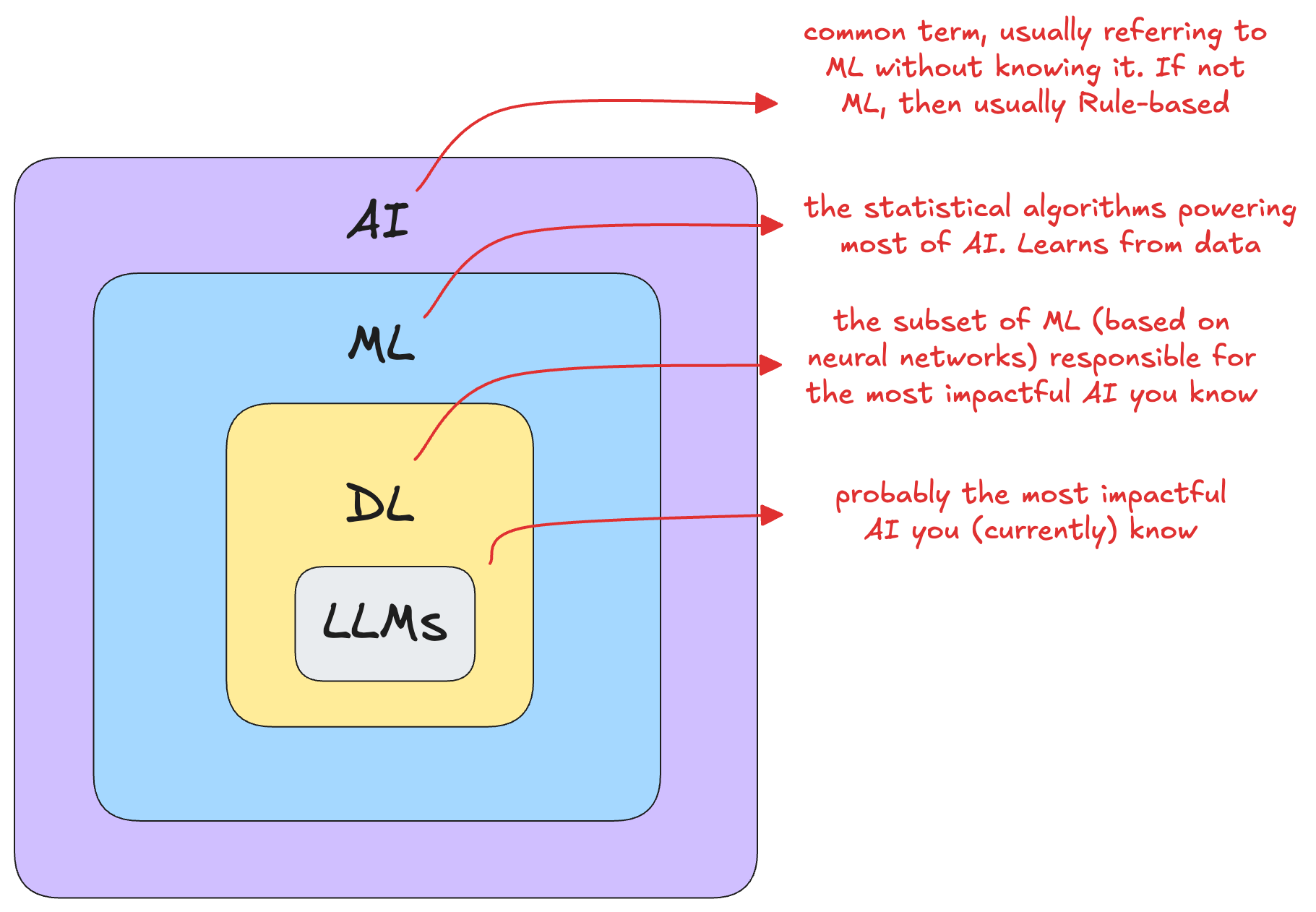
At its core, AI is about creating machines that can perform tasks mimicking human cognitive abilities. However when the term “AI” is used in everyday language, what someone is usually referring to without knowing it, is a system based on machine learning (ML). Then there is deep learning (DL), a subset of ML that took root decades ago in academia, but really started to gain traction about 10 years ago for real world applications when computational power could match the greedy demands of DL models. And finally, Large Language Models (LLMs) are a subset of DL trained on vast amounts on text data, and the engines behind well known applications like OpenAI’s ChatGPT.
The relationship between AI, ML, DL, and LLMs looks like:
It is easy to associate AI solely with ML, but there exists AI that is not ML. These are typically referred to as “Rule-based systems”. Imagine you are a coffee stand owner and want to predict iced coffee sales. Here, a rule-based system would use pre-programmed “IF-THEN” rules:
Rule 1: IF air temperature is greater than or equal to 30C, THEN predicted iced coffee sales are “High” (75+ coffees).
Rule 2: IF air temperature is between 21C and 30C ), THEN predicted iced coffee sales are “Medium” (40-74 coffees).
Rule 3: IF air temperature is less than 21C, THEN predicted iced coffee sales are “Low” (below 40 coffees).
Rule 4: IF it is raining, THEN reduce the prediction by 20 coffees.
Rule 5 IF it is a weekend, THEN increase the prediction by 15 coffees.
These rules are explicitly defined by human experts, and the system follows them without deviation.

The outcome for each case can be visualised as a step-plot, with the dashed lines showing the outcomes for the rain & weekend scenarios:
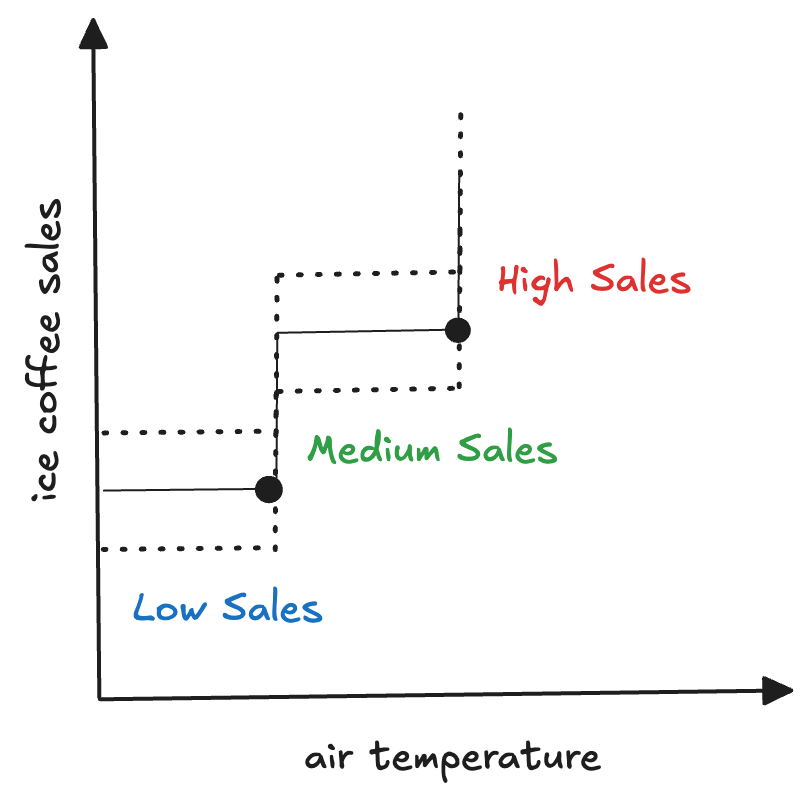
Here we have a discrete set of categories (“High”, “Medium”, “Low”). For any additional scenarios to be included, a human expert would explicitly add them as rules.
The fundamental difference is that ML systems learn directly from data, rather than being explicitly programmed with rules. One of the most basic machine learning models is linear regression. Linear regression helps you draw the "best-fitting line" through your data points.
Imagine we collect air temperature and ice coffee sales Monday-Friday:
Monday. air temperature: 15C; coffees sold: 20
Tuesday: air temperature: 22C; coffees sold: 45
Wednesday: air temperature: 32C; coffees sold: 85
Thursday: air temperature: 25C; coffees sold: 60
Friday: air temperature: 28C; coffees sold: 61
We can visualise the collected data on the same axis, and fit a straight line through, satisfying the equation y = mx + b, where:
y is the predicted coffee sales
x is the air temperature
m is the slope of the line
b is the y-intercept
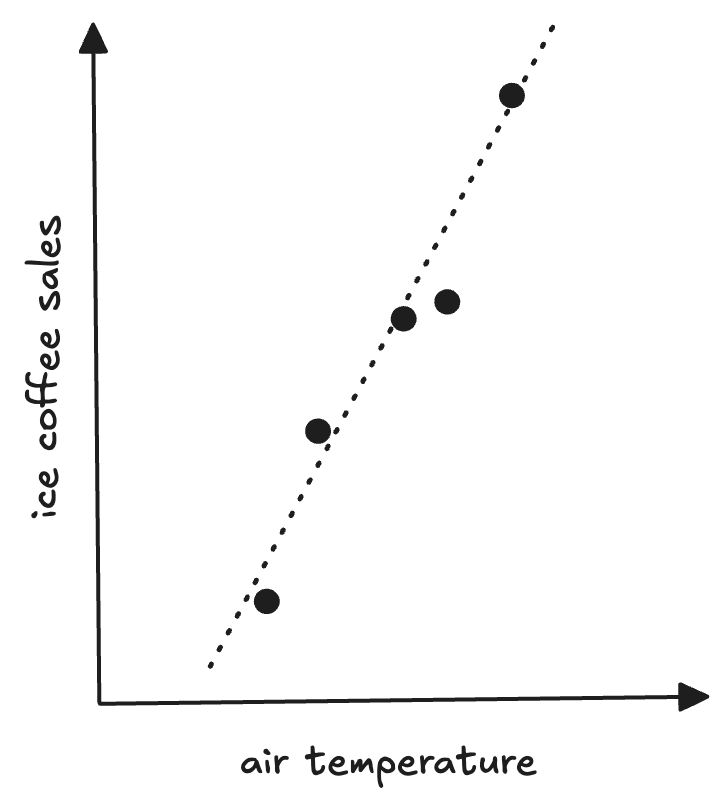
After fitting a straight line through the data via an iterative optimisation process, the equation that describes the line is found to be y = 4x - 35. This means that for every increase in 1C, you expect to sell 4 more ice coffees. With this model, we can predict coffee sales for any new temperature that wasn’t in the original dataset.
There are some key advantages of the ML approach:
Discrete vs. Continuous: Gives you a continuous numerical prediction, instead of discrete categories. Linear regression can handle air temperatures between your rule boundaries smoothly. The rule-based system has sharp cutoffs.
Explicit Rules vs. Learned Relationship: Automatically learns the relationship from the data.
Complexity: Linear regression, with only one independent variable, is quite simple. If there are more variables (rain, day of the week, marketing promotions, etc), the equation would become:
\( y = m_1x_1 + m_2x_2 + m_3x_3 + ... + b. \)
The regression learns the weights. A rule-based system can quickly become complex as you need to add more rules to account for combinations. How do rules 4 and 5 interact? What if it is 20C, raining, and a weekend? You'd need more rules, or a system for prioritising the rules.
“Best Fit”: Linear regression has a clear mathematical definition of “best fit” (minimising squared errors). The “best” set of rules in a rule-based system is more subjective and relies on expert knowledge or iterative refinement.
Why did the two neural networks become friends? Because they had a lot of neurons in common!
In the above example there were two unknown parameters that were found via an optimisation process: m (slope) and b (y-intercept). With these two parameters, the statistical model is defined. Neural Networks are similar: there are parameters whose values need to be determined by learning from data (also known as the “training” process).
Let’s use an example from the bible of machine learning, that uses the “hitters” dataset (take a quick look at the data here). Our goal is to predict the salary of a baseball player in 1987 using his performance statistics from 1986. The dataset consists of 263 players and 19 variables (or “features” in ML terminology). A basic Neural Network architecture to solve this problem could look like:
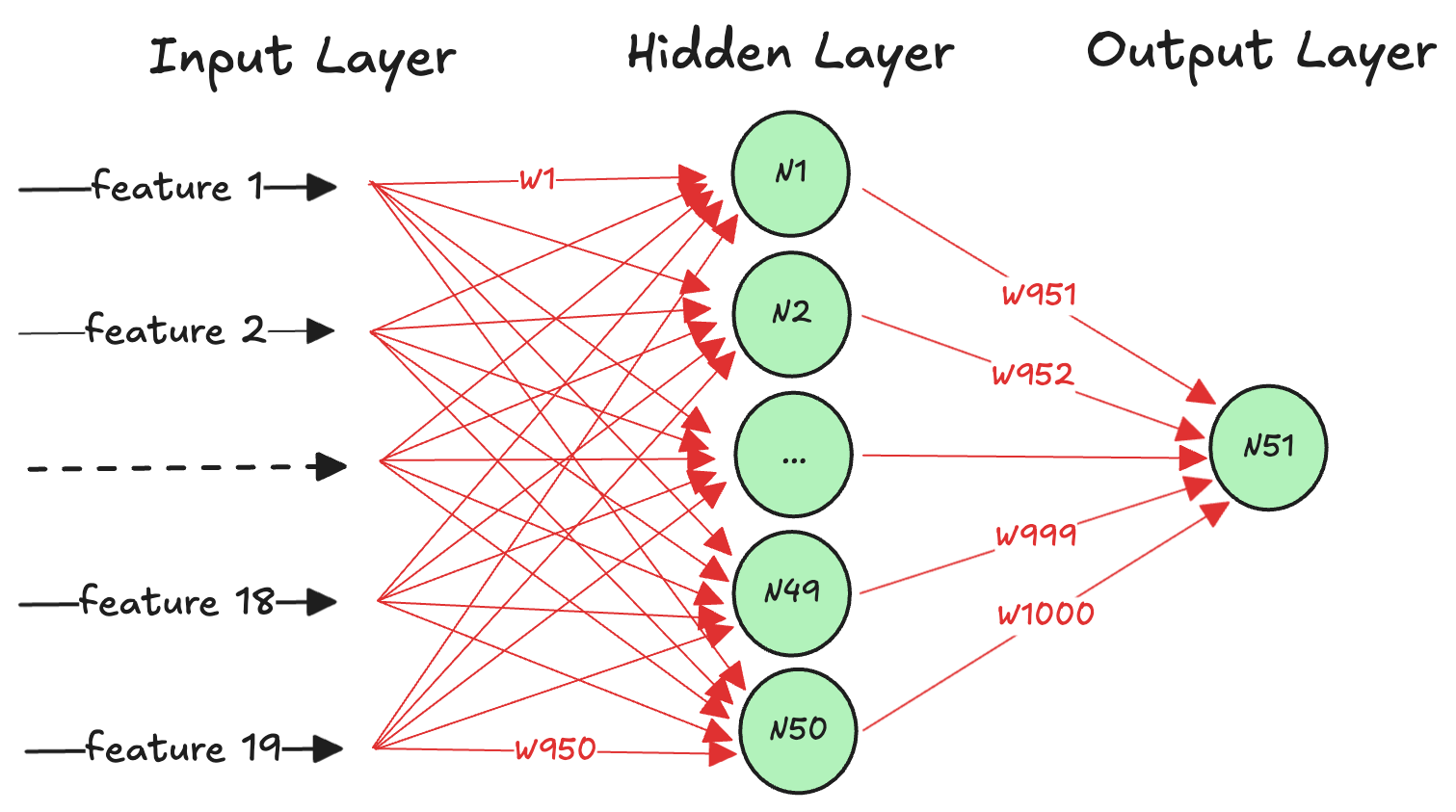
The building blocks of neural networks are weights (“W”) and neurons (“N”). In total there are 1000 weights (19 x 50 + 50 x 1); and 51 neurons (50 + 1). Each neuron and Weight is an unknown number that needs to be determined by learning from the data, exactly like the m parameter in linear regression. The y-intercept in linear regression given by b, is equivalent to an additional 51 bias-terms for each of the 51 neurons.
So in linear regression we had 2 unknown parameters to find, through the learning from the data process; in this example we have 1051 unknown parameters in total:
19 x 50 + 50 x 1 = 1000 weights
50 + 1 = 51 neurons
50 + 1 = 51 bias-terms
Next, the system learns the parameters by churning through data (the 19 features), as well as the known salary for 1986. Once the model parameters are known we can use them to predict 1987 salaries from the 19 features from that year.
Wizard: “Deep learning can approximate any function!”
Civilian: “No, What!?”
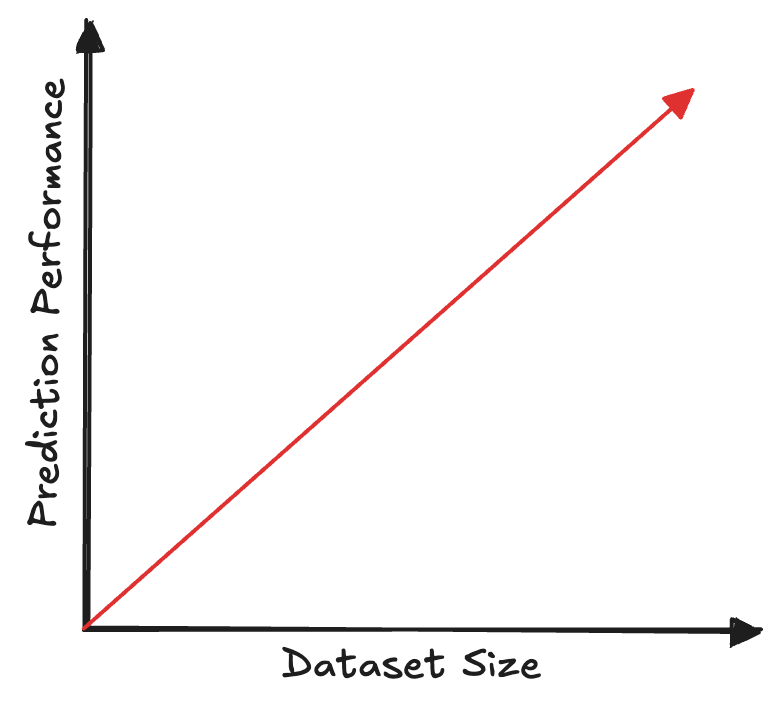
DL is an expansion of the basic neural network architecture shown above. The key difference is that there are multiple hidden layers, not one. An important characteristic of DL that is not seen in traditional ML (e.g. linear regression) is that the performance of such models tends to keep growing as a function of the dataset size:
The best performing Large Language Models (LLMs) have been trained with DL, and have a total number of parameters that are truly astonishing:
GPT-1 (2018): 0.2 billion parameters
GPT-2 (2019): 1.5 billion parameters
GPT-3 (2020): 175 billion parameters
Llama 3.1 (2024): 405 billion parameters
DeepSeek V3 (2024): 671 billions parameters
They’re called large language models for a reason. The cost of training such models (on essentially the whole internet of text data) is over $100’000’000 for a few weeks.
Understanding the spectrum of AI, from simple rule-based systems to DL, is crucial, but it’s only the first step. The real challenge for businesses lies in translating this theoretical knowledge into tangible value. To truly assess a company’s potential to leverage AI and separate genuine innovation from mere hype, we need a practical framework. This framework moves beyond simply having AI capabilities and instead focuses on the critical factors that determine whether those capabilities can actually deliver a competitive advantage and drive meaningful business outcomes.
What are the building blocks of AI that can give companies a competitive advantage?
The ML process always look like this:

That’s the technical AI lifecycle.
Data is an asset. Without it you have no AI — and the performance of your AI is dependent on the quality of your data. What data does your company own to train AI? Is it proprietary or publicly available? Is it well managed and clean, or scattered around?
The model is the code describing the algorithm to use in the training process. Is it linear regression; a multi-layer deep learning architecture; or another of the myriad of known ML algorithms? The model is usually cheap unless you’re at the frontier of big tech using sophisticated customised algorithms with countless optimisations to be at the forefront of performance and cost-effectiveness.
Training can be extremely expensive for large models with billions of parameters — $100’000’000 and upwards to train a single frontier LLM. However for most companies not competing in big tech, this is not something to be concerned about.
Predictions (often used interchangeably with “inference”) utilise computing power so can rack up enormous costs if your trained models are being used to make predictions frequently. This is a concern for companies like OpenAI with hundreds of millions of weekly users (especially when the “reasoning” capabilities are turned on), but probably not for most companies.
Then there are other important non-tech dimensions that need to be considered to really asses a company’s future potential AI value:
Strategy & Vision is the clarity, ambition, and strategic alignment of the company's AI strategy and roadmap. This assesses whether AI is seen as a strategic priority, if there is a clear vision for AI adoption, and if the AI strategy is well-integrated with the overall business strategy.
Talent is the quality, depth, and breadth of AI-related human capital within the company. AI is fundamentally driven by talent. A company's ability to build, deploy, and maintain effective AI systems heavily relies on having skilled personnel.
AI Products & Business Outcomes are the positive outcomes generated by AI initiatives. This is measured by metrics like ROI, efficiency gains, new revenue streams, improved customer satisfaction, and competitive advantage directly attributable to AI.
Pervasiveness is the breadth and depth of AI integration across different business functions and processes within the company. This assesses how widely AI is deployed beyond isolated projects and how deeply it is embedded into core workflows.
Ultimately, the more advanced AI technology becomes, the more tasks it can automate — computer-based work currently seems to be the low hanging fruit for disruption.
Using the dimensions above that are relevant to you, how would you score your company?
No posts
Comments
Nothing yet. Say the first thing.
Sign in to join the conversation.