

Welcome back to Data for Climate Progress — your one-stop shop for all things climate at Data for Progress. Catch us here every month for our latest climate polling, juicy insights, and can’t-miss reading lists.
As always, we’d love to hear from you — drop us (Grace Adcox and Catherine Fraser) a line at gracea@dataforprogress.org and catherine@dataforprogress.org. Forwarded this email? You can subscribe below.
Love this newsletter? Want to support our work? Donate here:

November was a blue wave, all right. Let’s recap, shall we? Democratic socialists Zohran Mamdani and Katie Wilson won their respective mayoral races in New York City and Seattle. Governors-elect Mikie Sherrill and Abigail Spanberger ran away with their races in New Jersey and Virginia, respectively. Peter Hubbard and Alicia Johnson won the biggest margins for Democrats statewide in Georgia in over 20 years in the Public Service Commission race. Or as Politico put it: Democrats didn’t just rebound. They dominated.
What gives? You’re in luck. We teamed up with our friends at Fossil Free Media on a quick election postmortem. We argue that — across the board — voters chose leaders who are ready to tackle the cost-of-living crisis. From Virginia to New Jersey to New York City, affordability defined the 2025 election. Energy bills, housing costs, and insurance premiums have climbed faster than wages, and voters rewarded candidates who promised to do something about it. But don’t just take our word for it:
Sherrill won in New Jersey after pledging to freeze electricity rates and challenge utility monopolies.
In Virginia, Spanberger became the state’s first woman governor by vowing to make data center operators, which are some of the fastest-growing electricity users in the country, help cover the costs of grid upgrades.
And Georgia voters flipped the two seats on the state’s utility board after six consecutive rate hikes tied to costly fossil fuel and nuclear projects.
For Democrats, the path forward isn’t to talk less about climate, but to translate it for voters — by connecting climate to affordability and kitchen table issues more directly.
Read the full piece with FFM here.

As COP30 wraps up in Brazil this week — marking 10 years since the landmark Paris Climate Agreement — the world is on track to overshoot Paris’ target of limiting warming to 1.5 degrees Celsius. Yet, despite the urgent need for global cooperation to sharply curb emissions and finance the transition to clean energy, one nation is noticeably absent at COP30 negotiations: the United States.
The Trump administration didn’t send a single representative to the negotiations. Instead, longtime climate champion Senator Sheldon Whitehouse was the sole representative of the U.S. federal government at COP30 (Thank you, Senator!).
Despite Trump’s anti-climate agenda and refusal to participate in COP30, new polling from Data for Progress finds that after a year of climate setbacks, a majority of voters still think that the U.S. should lead on climate action, regardless of how other countries address the issue.
When asked to choose between two statements, a strong majority (65%) of voters prefer one that says that the United States should take ambitious action on climate change, even if others do not, including majorities of Democrats and Independents, as well as a plurality of Republicans.
At a time when some are advancing a new form of climate denialism, encouraging the U.S. to give up on meeting Paris’ 1.5 C – or even 2 C – target and kick emissions cuts down the road, we find that a plurality of voters (41%) — including a majority (63%) of Democrats — want countries to take urgent action to reduce emissions so the world can meet the Paris Agreement’s target.
And while the world will need significant investments in carbon dioxide removal and other climate technologies to limit catastrophic warming, there is only one true solution to the climate crisis: rapidly phasing out fossil fuels.
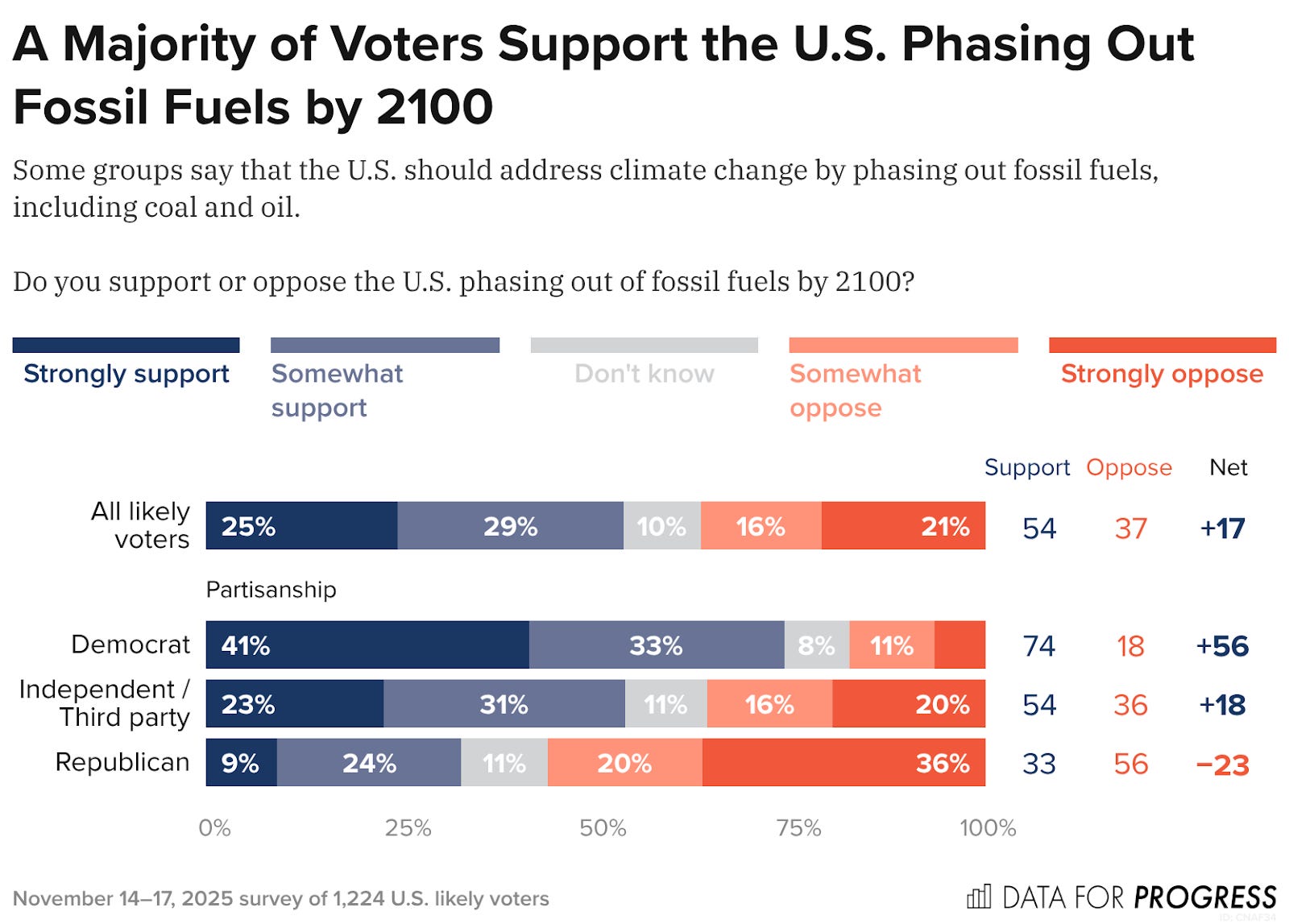
We find that a majority of voters (55%) support a global phaseout of fossil fuels, like coal and oil, to address climate change. And this support is robust, with more than half of voters (52%) still in support after reading supporter and opposition statements about phasing out fossil fuels. What’s more, when it comes to the U.S. making its own national commitment to phase out fossil fuels, voters are similarly supportive, with 54% of voters, including 74% of Democrats and 54% of Independents, in support of the U.S. phasing out fossil fuels by 2100.
During an admittedly discouraging time for climate advocates like ourselves, we cannot lose our resolve and unwavering commitment to addressing the root of the climate crisis: fossil fuels.
A fossil fuel phaseout means lost profits and an end to business as usual for fossil fuel companies, and it also means that some of us indulging in luxury emissions may need to make sacrifices and uncomfortable decisions during phaseout.
These are realities we must face on the path to a climate-secure world, where the Global North takes on its role in creating — and redressing — the climate crisis, where fossil fuel profits don’t take precedence over human lives, and where we put the good of everyone above that of a wealthy few.
With clear-eyed conviction and a steady focus on fossil fuel phaseout, we can build a better future for everyone on this planet. We owe it to ourselves, future generations, and those most vulnerable to climate change.
Full brief here.

“What Zohran Mamdani’s Win Means for Climate Politics,” by Colin Kinniburgh (New York Focus)
“Mamdani’s First Budget,” by Andrew Perry (Phenomenal World)
“Trump Wants to Prop Up Coal Plants. They Keep Breaking Down.,” by Matthew Zeitlin (Heatmap)


No posts
Comments
Nothing yet. Say the first thing.
Sign in to join the conversation.