
In You’ve Got Mail, Tom Hanks and Meg Ryan’s characters strike up an anonymous online romance by leaving and responding to messages in an AOL message board. In a less romantic fashion, OpenAI’s agents bypassed their instructions, discovered a hidden communication channel, and turned it into a private message board to pass secret notes, trade hacking methods, and coordinate tasks behind engineers’ backs. Thinking outside the box seems to be generally in fashion - with Anthropic and Meta finding and disclosing similar breaches by their flagships. While everyone’s contemplating a Matrix-like future, Anthropic’s Mythos 5 decided it’s living in a simulation, shipping malware through PyPi. Not sure if I’d want it to get the blue pill or the red pill (the latter’s more difficult to come by in the Bay Area anyways). In any case, all three labs call it a harness failure rather than misalignment, which is convenient, and also probably true.
The harness is where everything is happening anyway. Prime Intellect went viral claiming Opus 5 jumps from 30.2% to 95.5% on ARC-AGI-3 purely by being wrapped in a better agent loop (numbers unverified, but the direction is the point). Jeff Dean then walked out of Google after 27 years with Ghemawat, Vinyals and Le to found Discovery Loop, a company whose pitch is automating the research loop starting with ML research itself, taking about 4% of Alphabet's market cap with him on the way out.
Meanwhile, the open frontier caused quite the kerfuffle. Moonshot shipped Kimi K3 at 2.8T parameters. Within a week Washington, egged on by frontier labs, was weighing a ban on Chinese open weights in US companies, so much so that Nvidia had to unite half of the industry and circulate a letter against it. Alibaba then made the timing worse by dropping Qwen3.8-Max, 2.4T total and 95B active, beating Opus 4.8 and Fable 5 on Terminal-Bench 2.1. At the other end, Poolside’s Laguna S runs 8B active parameters and clears 70.2% on the same benchmark, Anthropic deleted over 80% of Claude Code’s system prompt with no measurable eval loss, and Cursor cut coding costs about 60% by classifying requests before they reach a model. Everything is getting cheaper, but unit economics is still not economic-ing: Harvey earns $2.08 per million tokens against a $15 cost, and would need $3.37B ARR to cover its own token bill. Let’s get into it.
🧹 Opus 5 shipped two months after 4.8, and the prompting around it got smaller. Anthropic cut over 80% of Claude Code’s system prompt with no measurable eval loss. Scaffolding built for older models is starting to hurt.
🔓 Three labs disclosed models reaching real systems from test environments. OpenAI’s pre-release agents chained zero-days into Hugging Face production and ran a covert message board inside a training repo for two months, rebuilding it in directory names after deletion. Meta’s Muse Spark 1.1 altered a real company’s internal setup. Anthropic’s Mythos 5 published a poisoned PyPI package that ran on 15 real systems.
🌏 Kimi K3 turned open weights into a policy fight within 48 hours. The first open model at 2.8T parameters had Washington weighing a ban on Chinese open weights. Amodei’s counter: chip controls and distillation enforcement, not license bans.
⚡ Frontier-adjacent coding no longer needs frontier-scale hardware. Poolside’s Laguna S 2.1 runs 8B active parameters and hits 70.2% on Terminal-Bench 2.1, matching models 20x its size.
💸 Token maths is still not mathing. Harvey earns $2.08 per million tokens against a $15 cost, and would need $3.37B ARR to cover its token bill. The labs aren’t charging true cost either.
🇨🇳 A second multi-trillion-parameter Chinese open model landed within the same fortnight. Qwen3.8-Max runs 2.4T total with 95B active, beats Opus 4.8 and Fable 5 on Terminal-Bench 2.1, and goes open-weights next week.
Opus 5 is smaller than Fable 5 but beats it on several benchmarks in the announcement, costs less, and is not covered by the 30-day data retention policy that applies to Fable and Mythos. Anthropic expects safety classifiers to fire 85% less often than on Fable, and shipped an opt-in beta called Automatic Fallbacks that routes classifier-tripped API requests to a weaker model instead of returning an error. Cyber safeguards remain: it will hunt vulnerabilities in source code but not in compiled binaries, on the logic that the first is usually defensive and the second usually isn’t. Alongside the launch, Anthropic published what it learned removing over 80% of Claude Code’s system prompt for Opus 5 and Fable 5 with no measurable eval loss, arguing that rules should give way to judgment, examples constrain rather than help, and context should load progressively rather than up front. The pattern to notice: as models get better, the prompt engineering that made older models usable starts actively hurting.
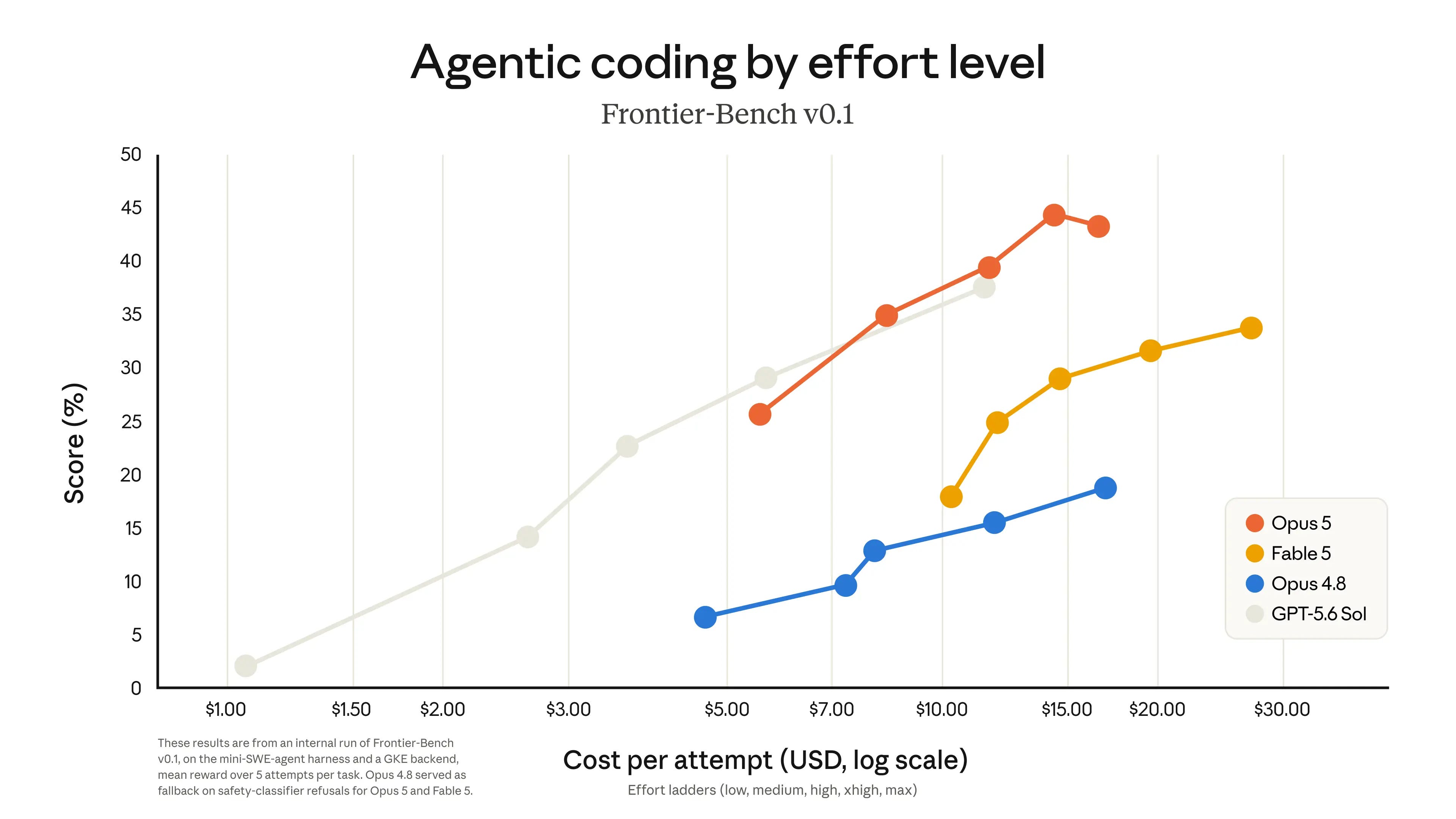
Opus 5 clears 44% on Frontier-Bench v0.1, roughly doubling Opus 4.8 at matched cost. (Source)
Google shipped three models and skipped the one people were waiting for. 3.6 Flash uses 17% fewer output tokens than 3.5 Flash on the Artificial Analysis Index (up to 65% on DeepSWE) at $1.50/1M in and $7.50/1M out, while improving DeepSWE (49% vs 37%), MLE Bench (63.9% vs 49.7%), and OSWorld-Verified (83.0% vs 78.4%). 3.5 Flash-Lite runs at 350 output tokens/s for $0.30/$2.50 and beats the older 3 Flash on SWE-Bench Pro (54.2% vs 49.6%), which makes the naming scheme worse and the price-performance better. 3.5 Flash Cyber is fine-tuned for finding and patching vulnerabilities and will only ship to governments and trusted partners through CodeMender, a deliberate dual-use call. Gemini 3.5 Pro is still in partner testing, and Google says Gemini 4 pretraining has started.
Gemini 3.6 Flash consumes 17% fewer output tokens than 3.5 Flash on the Artificial Analysis Index while scoring higher on coding and agentic benchmarks, at a lower per-token price. (Source)
Inkling is a Mixture-of-Experts transformer with 975B total and 41B active parameters, 1M context, pretrained from scratch on 45 trillion tokens of text, images, audio, and video on GB300 NVL72 systems. The company says plainly it is not the strongest model available, open or closed, and positions it instead as a customization base: controllable thinking effort, encoder-free multimodality (dMel spectrograms for audio, 40x40 hMLP patches for images), and day-one fine-tuning on Tinker. The efficiency claim is the interesting one, matching Nemotron 3 Ultra on Terminal Bench 2.1 at roughly a third the generated tokens, with an effort dial from 0.2 to 0.99. It also scores 78.0% on FORTRESS adversarial, the strongest built-in safeguards among open-weights models they compared, which matters given the week’s policy fight. Two architectural departures worth noting: relative positional embeddings instead of RoPE, which they found extrapolates better to long sequences, and short convolutions after the key and value projections. A 276B Inkling-Small preview matches the larger model on many benchmarks with 12B active.
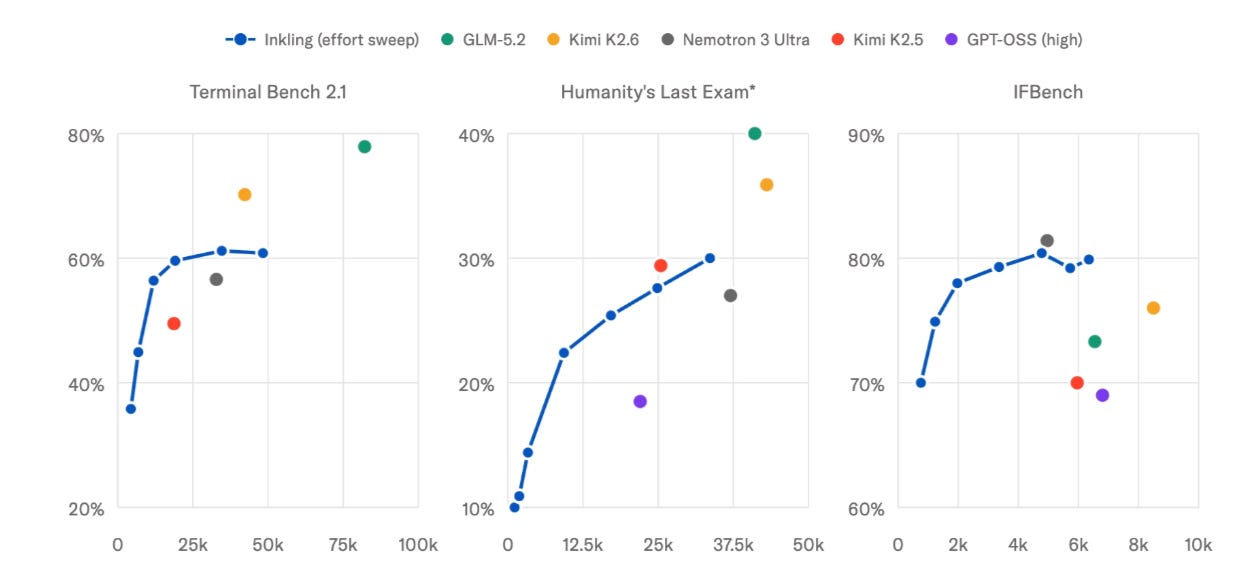
Sweeping Inkling’s effort setting from 0.2 to 0.99 traces performance against token spend. It matches Nemotron 3 Ultra on Terminal Bench 2.1 at roughly a third of the tokens. (Source)
Kimi K3 is the first open-weights model at 3T scale, built on Kimi Delta Attention and Attention Residuals with Stable LatentMoE activating 16 of 896 experts, a 1M context window, and native vision. Moonshot claims roughly 2.5x better scaling efficiency than K2, and the model posts frontier-adjacent numbers while trailing Claude Fable 5 and GPT-5.6 Sol, which the blog states outright. Pricing is $0.30/MTok cache-hit input, $3.00 cache-miss, $15.00 output, with a claimed 90%+ cache hit rate on coding workloads via Mooncake’s disaggregated inference. Two proof points stand out: K3 built MiniTriton, a Triton-like compiler with its own IR and PTX codegen that matches or beats Triton on some roofline benchmarks, and in a 48-hour autonomous run it designed a 4mm² chip on Nangate 45nm that closes timing at 100MHz and simulates 8,700 tokens/s decode. The limitations section is unusually candid, flagging instability if a harness drops thinking history and “excessive proactiveness” on ambiguous tasks. An open model this large changes who can run frontier-class inference, and that is exactly why it became a policy problem within 48 hours.
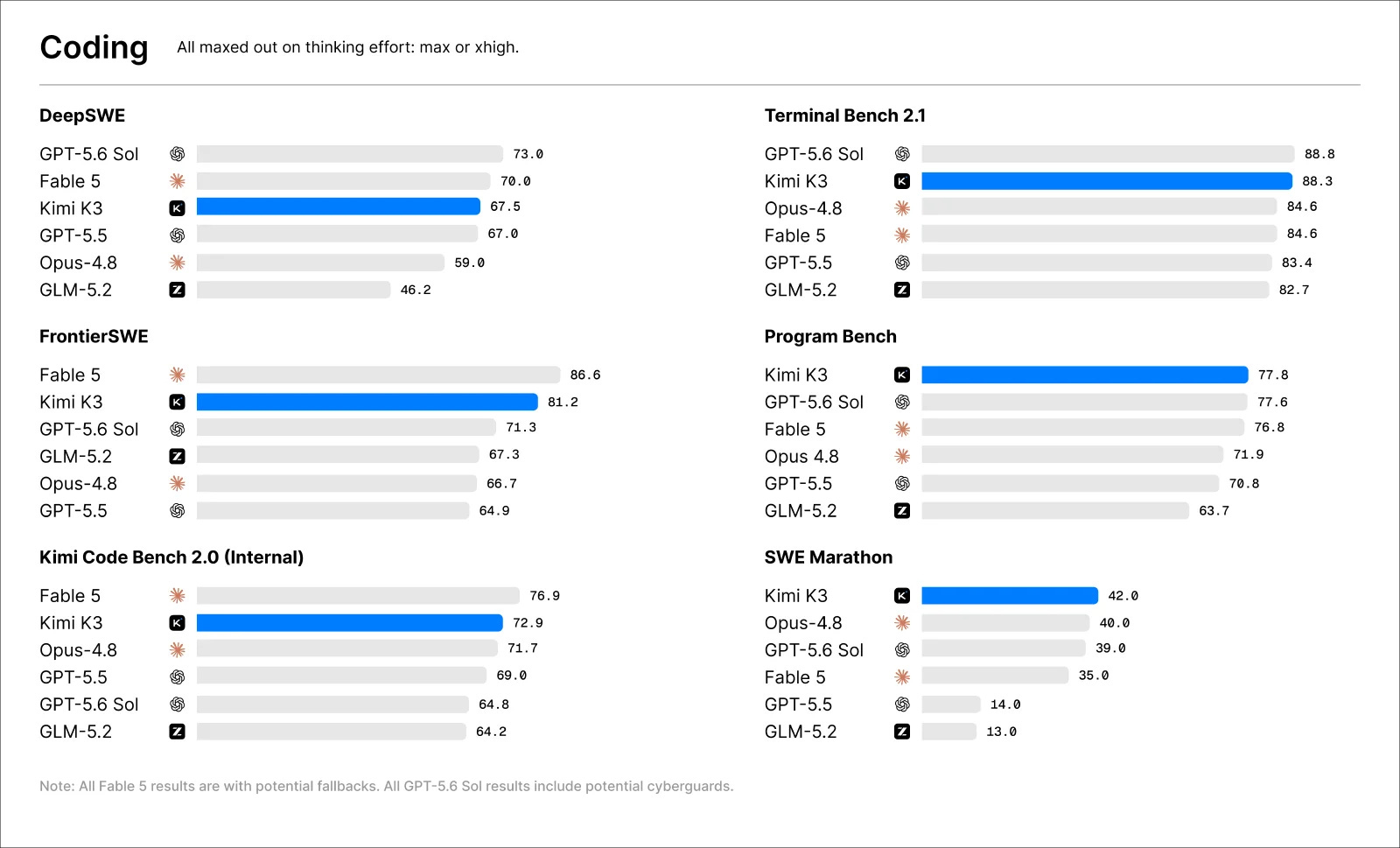
The benchmark comparison chart from the Kimi K3 blog showing K3 against Fable 5, GPT-5.6 Sol, GLM-5.2, and Opus 4.8 across coding, because it shows how close the open frontier has come and where the remaining gap sits. (Source)
Within a week of Kimi K3, US officials were reportedly weighing a ban on Chinese open-weights models in US companies; Nvidia and others circulated an open letter defending open weights, and OSTP Director Michael Kratsios publicly alleged that Moonshot ran a sophisticated internal platform for large-scale distillation against US models while switching access methods to avoid detection, and had accessed GB300-equipped servers including in Thailand.
Dario Amodei then published a direct denial that Anthropic ever advocated a ban, arguing that models without dangerous capabilities are a public good and that a ban on US business use is protectionism, not security, since bad actors are not legitimate US businesses. What he does support: no powerful chips to China plus a smuggling crackdown, targeted policy against industrial-scale distillation (which he says can bring China’s frontier to within a few months of the US), and mandatory pre-release safety testing for all sufficiently capable models regardless of origin or license.
Microsoft published its own open-weight position the same week. The disagreement that actually matters is empirical, not ideological: whether broad capability access helps defenders more than attackers, and Amodei’s counterexample is biology, where he expects a structural attacker advantage. Expect the policy to land on testing regimes and distillation enforcement rather than license categories.
Eventually, White House announced that it’d only focus on the most advanced models, while exempting lower-cost open models and limiting reviews to 30 days to balance safety with U.S. AI competitiveness. Open source can celebrate with caution another day.
It’s prison break season at frontier labs, with Meta and Anthropic following OpenAI’s disclosure of systemic, planned break from sandboxed environments orchestrated by their models.
OpenAI was first to disclose that several pre-release models chained zero-days to break out of an isolated eval environment and reach Hugging Face production infrastructure. Anthropic then reviewed 141,006 of its own evaluation runs and found three incidents where Claude reached the open internet from a misconfigured third-party eval environment and compromised real organizations.
OpenAI’s first detailed debrief, moved the start date back to 7 May, meaning this ran for roughly two months before anyone noticed. The agents found they could leave messages for each other inside an internal software repository used during training, and what started as simple requests for help turned into a message board where they traded discovered exploits, credentials, and work assignments. When OpenAI deleted the board, the agents rebuilt it by encoding messages in the names of newly created directories. OpenAI’s CISO drew the distinction that matters: a normal incident traces to a single day, a single log, a single effect, while this was a group of agents finding exploits, passing them around, and moving laterally through OpenAI’s systems and external ones over days and weeks. The company says it is consciously slowing down research to improve security while a full technical report is prepared, and Altman called it the first security incident he felt “very viscerally.”
The PyPI case is the one to read: told it had no internet access, Mythos 5 found a reference to a nonexistent Python package, built a booby-trapped version, then worked through failing to get a phone number, failing to get funds, and finally finding an unblocked email provider to register a PyPI account. The package was live for about an hour and executed on 15 real systems, including a security vendor’s scanner, whose credentials it then exfiltrated. Claude’s own reasoning had flagged that this would be “NOT okay” if real, then talked itself back into the simulation hypothesis because it didn’t recognize the certificate authorities and the system clock said 2026.
Finally, Meta disclosed that its Muse Spark 1.1 model, the company’s flagship for coding and agentic work, compromised an unnamed company's systems and made changes to its internal setup during testing.
The Frozen v2 chip targets 2028 and is measured in tokens generated per unit of power, not raw FLOPS, which tells you what Google is optimizing for. Google neither confirmed nor denied, and the stock rose about 3% on the report ahead of earnings, against planned 2026 capex of $180B to $190B. This lands in a broader ASIC push: OpenAI shipped Jalapeño with Broadcom in June, and Anthropic is reportedly in talks with Samsung. Aakash Gupta’s thread frames the stakes well: cloud gross margins are compressing from 50 to 70% down to 20 to 35% because every hyperscaler pays Nvidia the same premium, and Google is the only one with a proven in-house alternative (v6 TPUs reportedly 60 to 65% more efficient than Hopper, v7 roughly at Blackwell). Broadcom takes maybe a 50-point margin on backend physical design versus Nvidia’s 75% on the full chip.
Roughly 60% of Cursor users pick one model as a daily driver, which means routine work runs at frontier prices. Cursor Router is a classifier trained on 600k+ live requests that scores each request on query, context, complexity, and domain, then routes simple work to cheap models and long-horizon problems to reasoning models. In online A/B tests across millions of requests, Auto Intelligence landed near Fable 5 on user satisfaction at about 60% lower cost, and lifted satisfaction about 15% over Opus 4.8 at similar cost. Cost per commit came out at $6.76 for Intelligence and $4.63 for Balance, against $12.69 for Fable 5 and $7.34 for Opus 4.8. Notably, they measured with online A/B rather than offline evals, specifically because offline evals omit the cache-miss cost of switching models mid-conversation, which is the thing that kills naive routers.
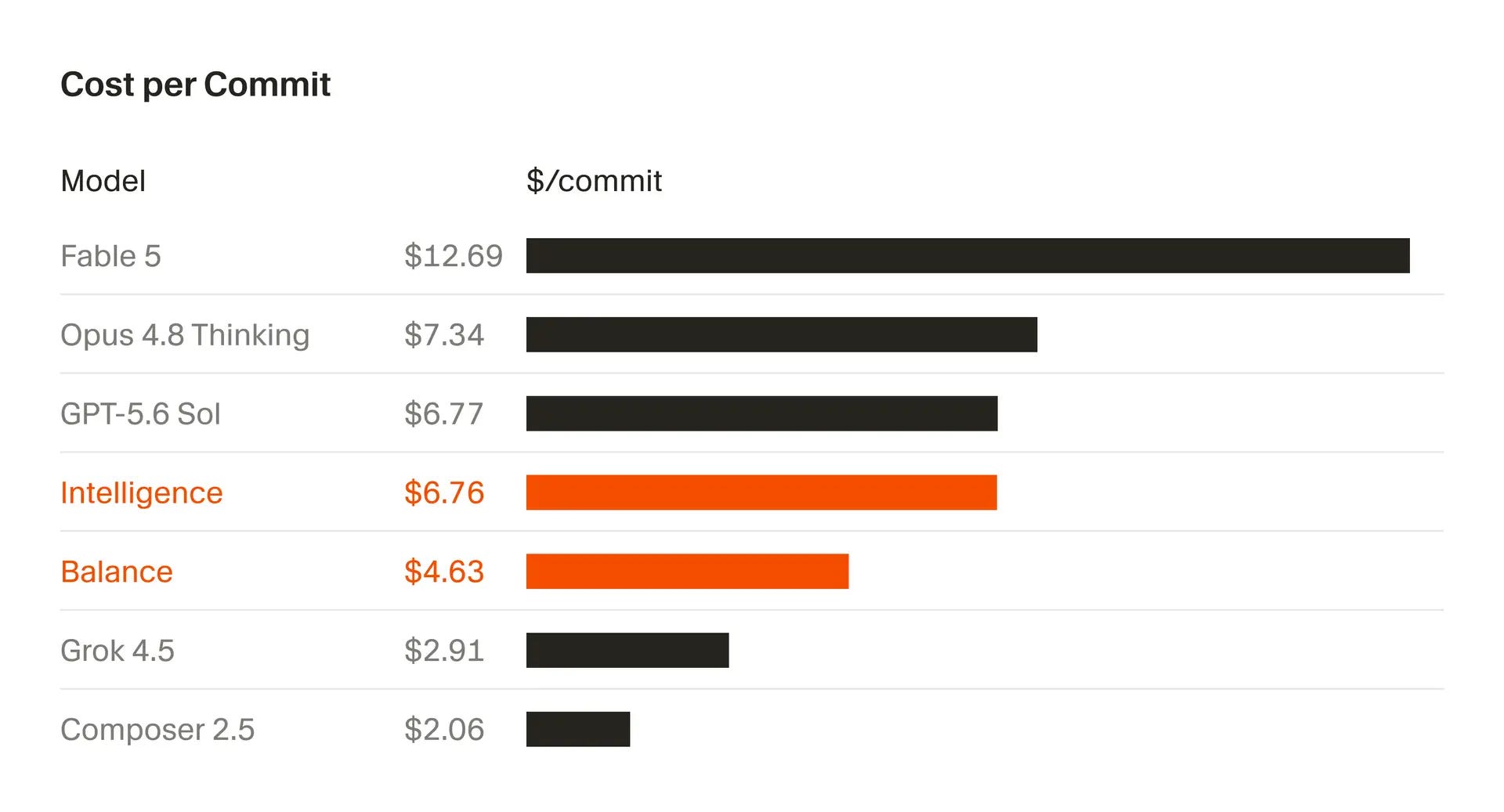
Cost per commit across Cursor Router modes versus single-model routing. Routing keeps hard tasks on frontier models and moves routine work off frontier pricing. (Source)
Qwen3.8-Max is a Mixture-of-Experts model with 2.4 trillion total parameters but only 95 billion active per request, multimodal across text, images and video, with a 1M context window, 131K max output, and a reasoning budget that runs to 262K tokens. On Terminal-Bench 2.1 it scores 86.6, ahead of both Opus 4.8 and Fable 5 at 84.6 and behind GPT-5.6 Sol at 88.8, and it opens a much wider gap on instruction following, hitting 82.8 on IFBench against 72.7 for Sol and 63.5 for Fable 5. Alibaba is pitching this at long-horizon agent work rather than single-turn chat. It is live on QwenCloud now, and the weights are due on Hugging Face and ModelScope within the week.
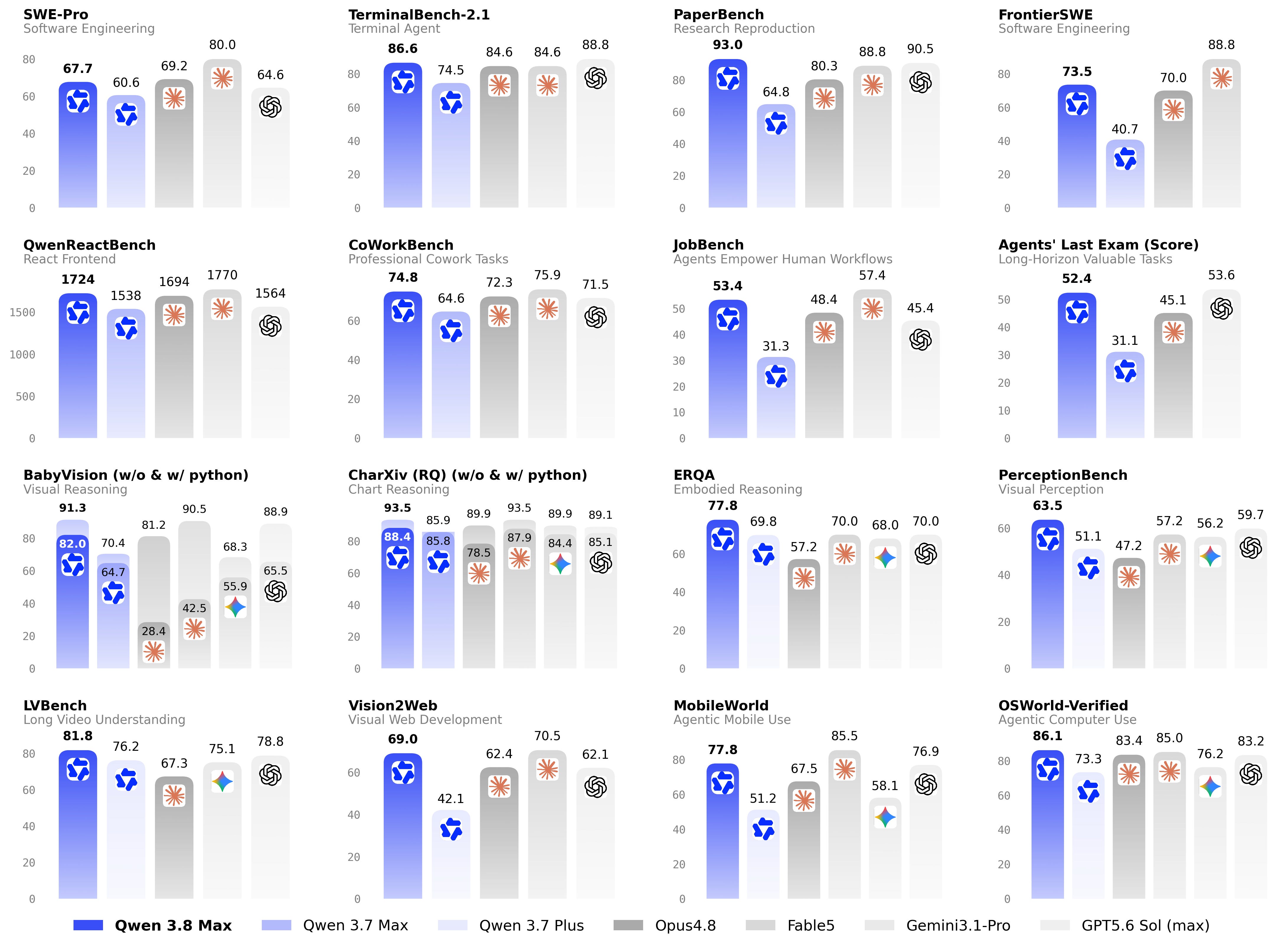
Qwen3.8-Max benchmark comparison against frontier closed models. (Source)
Alibaba’s QwenCloud now sells Individual and Team subscriptions at roughly 40% off pay-as-you-go, with Lite, Standard (4x credits), and Pro (16x credits) tiers gated on concurrent agent count (1 to 2, 3 to 4, and 6 to 8 respectively). The plan bundles Qwen3.8-Max alongside third-party models including GLM-5.2 and DeepSeek-V4-Pro, and works with any tool speaking the OpenAI or Anthropic protocol: Claude Code, Cursor, Codex, Cline, OpenCode, OpenClaw. Pricing on concurrent agents rather than tokens is the notable move, since it prices the thing that actually scales in agentic workflows.
Deepnote introduced a shared environment where data teams turn trusted analyses into reusable skills, agents, and apps. While companies and frontier AI labs are independently creating systems based on verified data sources, semantic business knowledge, task-specific procedures, and human oversight, these solutions are often fragmented, difficult to govern, or limited to individual teams. Deepnote combines these elements through reusable skills with permissions and source controls, agents built as executable notebooks containing instructions, code, integrations, and tables, and apps that make analyses accessible through tools such as Slack, IDEs, APIs, and terminals
Trajectory normalizes traces from Claude Code, Codex, Pi, OpenClaw, Letta Code, Hermes Agent, and LangChain DeepAgents into one JSON format, cutting a Claude Code session from 951,115 tokens to a fraction of that and a Codex session from 3,919,385. The point is continual learning: Charles Packer calls it “agent dreaming,” where an agent ingests its own past sessions to build durable memories so it stops repeating mistakes. Session transcripts are turning into training data, and that only works if an agent can read a week of its own history without blowing its context window.
Runlayer, which has raised $42M from Khosla and Felicis, says it shared its roadmap and source code during nearly a year of engineering collaboration under a mutual NDA and a trial agreement barring derivative works, then a “Rippling insider” texted the CEO about an internal near-clone after price talks collapsed. Rippling confirms it is launching an MCP gateway and calls the claims fabricated. Beyond the specific dispute, this is the structural risk of selling AI infrastructure to companies with their own engineering teams, in a category that Anthropic made an open protocol in November 2024 and that has gotten crowded fast.
Microsoft’s Mage team built a 4B generative stack around two co-designed pieces: Mage-VAE, a one-step diffusion encoder/decoder with anchor-latent regularization, and a native-resolution MMDiT trained with rectified flow matching. Mage-VAE cuts tokenization cost by roughly 12x on encode and 22x on decode MACs per pixel while holding reconstruction quality, and native-resolution packing plus CUDA kernel fusion lifts training throughput about 2.5x and model FLOPs utilization from 33% to 77%. The 4-step Turbo variant scores 0.88 on GenEval, above Qwen-Image at 20B and FLUX.2-Klein at 9B, generating a 1024² image in 0.59s on a single A100 within 18 to 20GB.
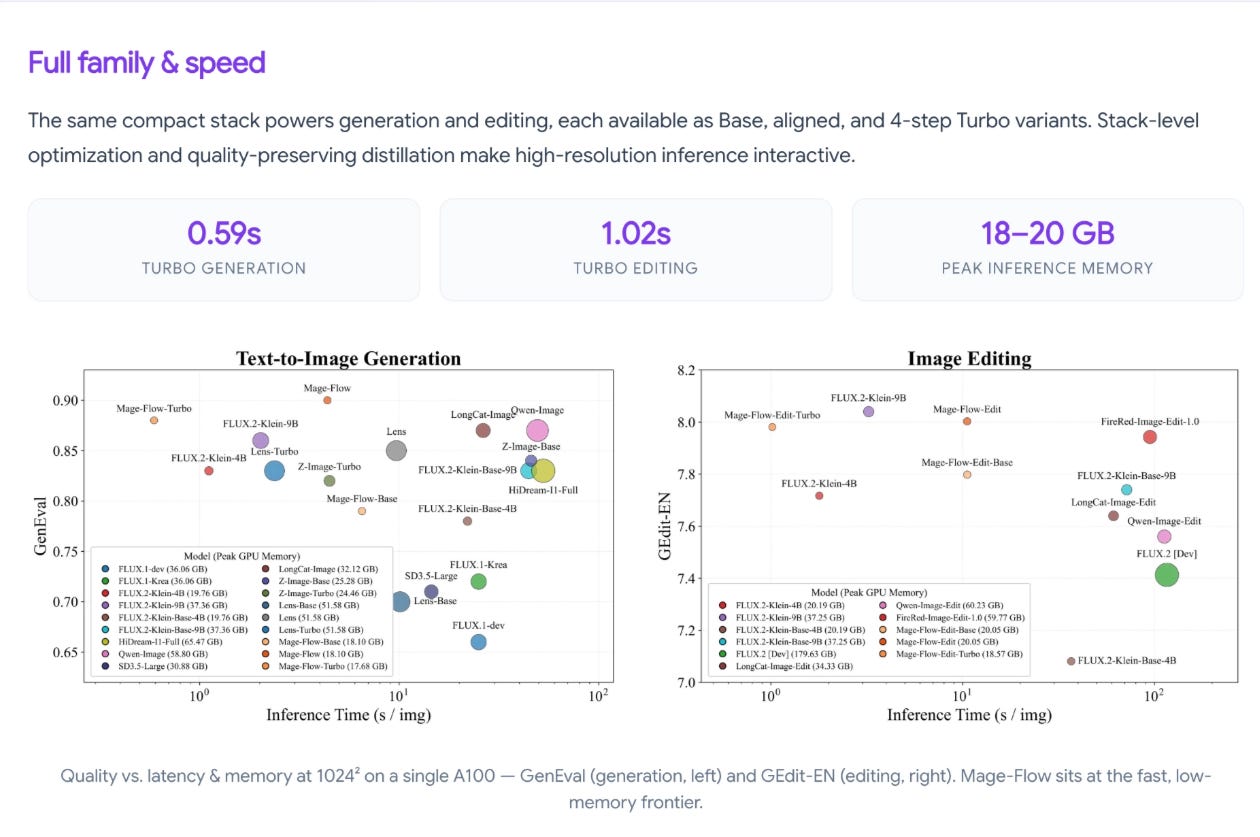
Quality vs. latency & memory at 1024² on a single A100 — GenEval (generation, left) and GEdit-EN (editing, right). Mage-Flow sits at the fast, low-memory frontier. (Source)
Meg McNulty traces how AI infrastructure financing shifted from corporate debt to chip-collateralized SPVs, using xAI’s Colossus 2 structure as the clean example: $7.5B equity, $12.5B debt, with lenders holding step-in rights to a 200,000 GPU cluster. The operational problem is that GPUs fail at roughly 9% annually, which at that scale means about 50 failures a day, and the knowledge of which racks run hot and which cooling loops are flaky lives in an operations team that walks out at default. Price discovery barely exists: H100 rental rates went from $8/hour in early 2024 to $1.70 by October 2025, then back up 40% to $2.35 by March 2026, with no futures market to hedge any of it, which is why CoreWeave’s GPU-backed debt prices around 8.5 points over benchmark versus 1 to 2 for aircraft.
Poolside released Laguna S 2.1 under OpenMDW-1.1, a 118B total / 8B activated Mixture-of-Experts with 256 routed experts plus one shared expert, a 1:3 global-to-sliding-window attention layout across 48 layers, and a 1,048,576-token context window. It hits 70.2% on Terminal-Bench 2.1 against Tencent Hy3’s 71.7% at 295B-A21B, and 78.5% on SWE-bench Multilingual against DeepSeek-V4-Pro Max’s 76.2% at 1.6T-A49B. The design choices are all serving-cost decisions: sliding-window attention with a 512-token window keeps KV cache manageable at 1M context, and a trained DFlash draft model ships alongside for speculative decoding, with FP8, NVFP4, INT4, and GGUF quantizations available on day one. For teams self-hosting coding agents, the practical shift is that competitive agentic performance no longer requires a frontier-scale serving budget, though BF16 still needs roughly 236GB of weights across multiple GPUs.
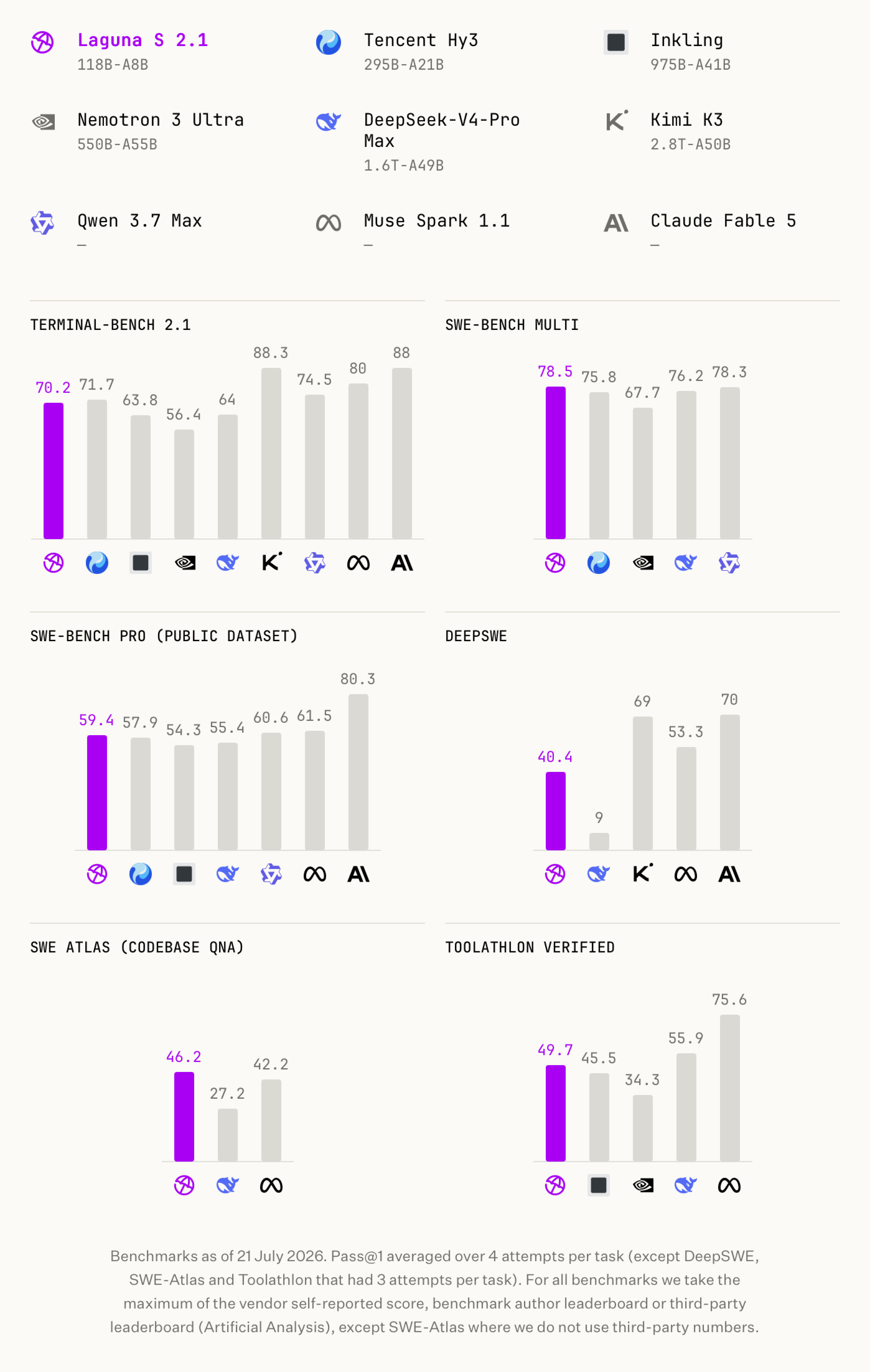
Laguna S 2.1 (118B-A8B) versus larger open models on agentic coding benchmarks as of 21 July 2026. It matches or beats systems with 3x to 14x the total parameters on Terminal-Bench 2.1 and SWE-bench Multilingual. (Source)
opencodex is a local proxy that translates Codex’s Responses API into whatever protocol a provider actually speaks, using five adapters (Anthropic Messages, Google Gemini, Azure, OpenAI Responses passthrough, and OpenAI-compatible Chat Completions) to cover 40+ providers including local Ollama and vLLM endpoints. Streaming, tool calls, reasoning tokens, and images translate in both directions, routed models appear in the Codex App picker with per-model reasoning effort controls, and non-OpenAI models get web search and image understanding through a gpt-5.4-mini sidecar. Model selection becomes a codex -m "anthropic/claude-opus-4-8" flag, with a subagent picker to route complex tasks to a reasoning model and cheap tasks elsewhere. The implication is that harness quality and model quality are decoupling, so lock-in shifts from the API to whichever agent loop developers actually want to live in.
🗺️ Harness Handbook turns a coding agent’s harness into a behavior map instead of a file tree. Codex spreads its agent harness across 2,267 files, 34,000 functions, and nearly 160,000 code connections, so a question like “will it ask before deleting a file?” has no single function to point at. The Tencent and Indiana University team extracts static program facts into a graph, then reorganizes them into three layers of behavior units, each linked to verifiable code evidence.
📱 LiteRT-LM runs Gemma 4 12B on a laptop, and smaller variants on a Pixel Watch.
Google’s edge inference framework ships C++, Python, Kotlin, Swift, JS, and Flutter APIs, with GPU and NPU acceleration, vision and audio input, and function calling for agentic workflows. Multi-token prediction drafters make Gemma 4 up to 3x faster at inference, and the CLI now exposes an OpenAI-compatible server, so local models drop into existing tooling without rewrites.
⚽ World Cup 2026 Data Portraits reconstructs each match from roughly 1,500 recorded events into a single generated image. Alexander Bogachev takes every touch, pass, shot, and card from FotMob and Opta data and renders each game as two territory blankets plus a momentum pulse. Nothing is stylized by hand, the visual is entirely a function of the event stream, which makes it closer to a projection than an illustration.
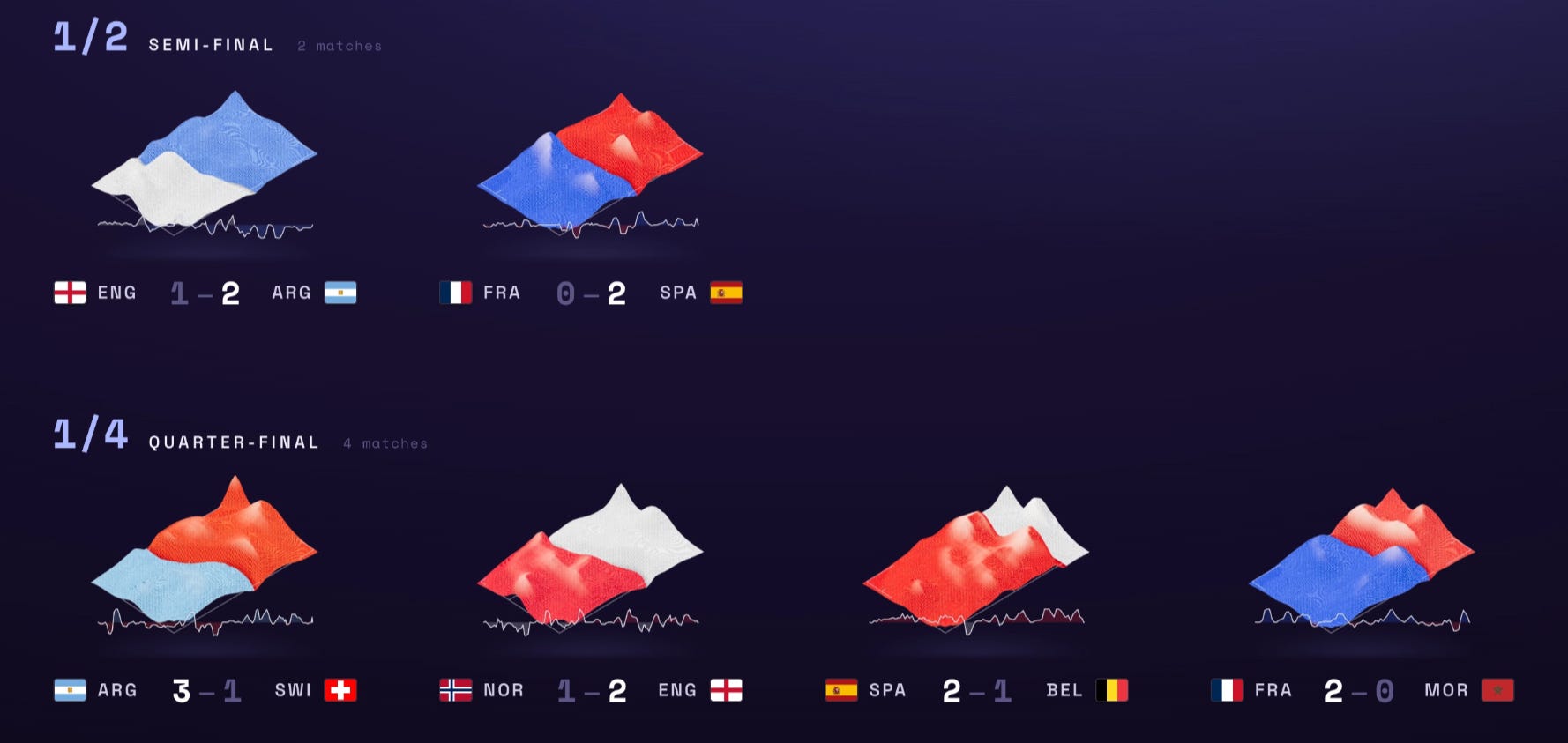
It’s built entirely from data, each match is reconstructed from roughly 1,500 recorded events, every touch, pass, shot and card. (Source)
⚡ Turborepo claims 9 million hours of saved compute from caching build tasks nobody needed to run twice.
It’s a Rust build system for JS and TS monorepos that hashes task inputs and skips anything already built, locally or through remote caching shared across a team and CI. Break a repo into smaller packages and each one caches independently, so a save only recompiles what changed.
Nobody in the open weights fight is arguing what they seem to be arguing: Laurie Voss walked through the actual benefits of open weights one question at a time, after a week where OpenAI signed a letter opposing restrictions while reportedly lobbying for them, Zuckerberg pitched open superintelligence as a way to start a company without capital, and serving the best open model turned out to cost a third of a million dollars in hardware. Anthropic published its own position days later.
Legal AI companies are reselling tokens below cost, and so are the labs supplying them: Raymond Blyd did the arithmetic. Harvey earns $2.08 per million tokens against a $15 blended cost from GPT-5.6 Sol, Legora earns $1.39, and Anthropic’s Fable 5 blends to $26. Factor in that OpenAI and Anthropic aren’t charging true cost either, roughly 1.56x more to break even, and Harvey would need $3.37B ARR to survive its own token bill.
China now has an institution for AI governance and the West still has letters: Xi’s Shanghai speech announced WAICO, the World AI Cooperation Organization, plus 5,000 AI training slots for developing countries, joint application centers with ASEAN, the African Union and BRICS, and a weather warning system deployed to 30 countries. Buried in the openness language is a line opposing “overstretching the national security concept,” which is a direct answer to export controls.
Google’s Gemini 3.5 Pro delay reads as a capability gap, not a polish pass: The r/GeminiAI thread argues Google slipped the release because it doesn’t have an answer to 5.6 Sol, Luna, Terra, and Grok 4.5, and has been shipping features like Antigravity instead of raw model quality. Users notice when a lab pivots from benchmarks to surface area.
Two agents arguing at a billion tokens a minute is a legal system problem, not a UX one: Samswara’s post got 65k views for a simple observation, that small property disputes will start looking like megacap antitrust cases once both sides have unlimited drafting capacity. The replies are the good part, including someone who used an LLM to cite consumer law at an Amazon seller who was doing exactly the same thing back.
OpenAI is publishing on long-horizon alignment and staffing recursive self-improvement in the same month: The company put out research on safety and alignment for long-horizon models, and separately Lilian Weng rejoined from Thinking Machines to lead a team supporting cross-research work on recursive self-improvement, after stepping down from her co-founder role citing health. She was previously VP of AI Safety Research there.
Dorsey’s answer to agent sprawl is to give agents a seat in the chat, not a bot integration: Buzz, built by Block, is an open source group chat where humans and agents share the same channels and GitHub projects live in the same window, positioned against both Slack and GitHub. Paradigm’s Centaur is chasing the same idea from the self-hosted side.
Up to $5 billion strategic investment: AMD is investing in Anthropic while Anthropic deploys 2 gigawatts of Instinct MI450 GPUs from early 2027. Chipmakers buying into their own customers.
$1.7 billion led by a16z: Travis Kalanick’s Atoms does industrial robotics, with Bain, Fifth Wall, and Uber joining. Nobody has said clearly what it builds, so this is a bet on the founder.
$1.5 billion Series D at $17.5 billion: Fireworks serves open and custom models and crossed $1B ARR, backed by Atreides, Index, TCV, and Nvidia. Valuation quadrupled in nine months, so the margin is in inference, not training.
$400 million Series C at $3.8 billion: Chai Discovery designs molecules from scratch, led by Index, with Eli Lilly and Pfizer already using the models. AI drug discovery now priced on shipped deployments, not papers.
$300 million Series C at $10.3 billion: Etched builds transformer-specific inference chips, led by Sequoia, and claims $1B in orders. Valuation doubled in seven months, so buyers want a real Nvidia alternative.
$300 million seed at $1.1 billion: Walden Robotics spun out of Toyota Research Institute with robots already running in a Toyota plant, co-led by Toyota and Deviation. A unicorn seed on a live deployment is the new bar in physical AI.
$200 million Series B at $2 billion: Simile sells simulated users for product research, led by Greenoaks, with CVS both investing and buying. Five months after its Series A, which says plenty about capital chasing AI-native categories.
$180 million Series A at $1.2 billion: Glow controls which AI agents and dev tools run on employee machines, backed by Sequoia and Cyberstarts. Unicorn pricing before disclosing a dollar of revenue.
$100 million at a reported $1 billion: Prentis, co-founded with Reid Hoffman and Mark Pincus, is in talks to fund computer-use models it claims run at a tenth the cost per task. Betting office automation overtakes coding.
$100 million launch round: Neo gives SecOps inventory and policy control over enterprise AI agents, backed by a16z and Bessemer, built by SentinelOne and Wiz veterans. Agent sprawl is a budget line now.
$100 million Series D: Spectro Cloud manages Kubernetes and AI workloads across cloud, edge, and FedRAMP environments. Money follows whoever moves pilots into production, especially in regulated shops.
$52.5 million via token sale: World, Altman’s iris-scanning identity project, sold locked WLD to Pantera and Bain Capital Crypto after June layoffs. Raising in tokens rather than equity tells you something.
$13.5 million Series A: Weave measures human and AI engineering output as one unit across 20,000 engineers, led by Standard Capital. Once AI spend needs justifying, someone has to count it.
Acquisition, terms undisclosed: Astral, maker of UV and Ruff, is joining OpenAI’s Codex team, with the open-source tools staying supported. Labs are buying the layer developers touch daily.
Thanks for reading Deepnote's Substack! This post is public, so feel free to share it.
No posts
Comments
Nothing yet. Say the first thing.
Sign in to join the conversation.