
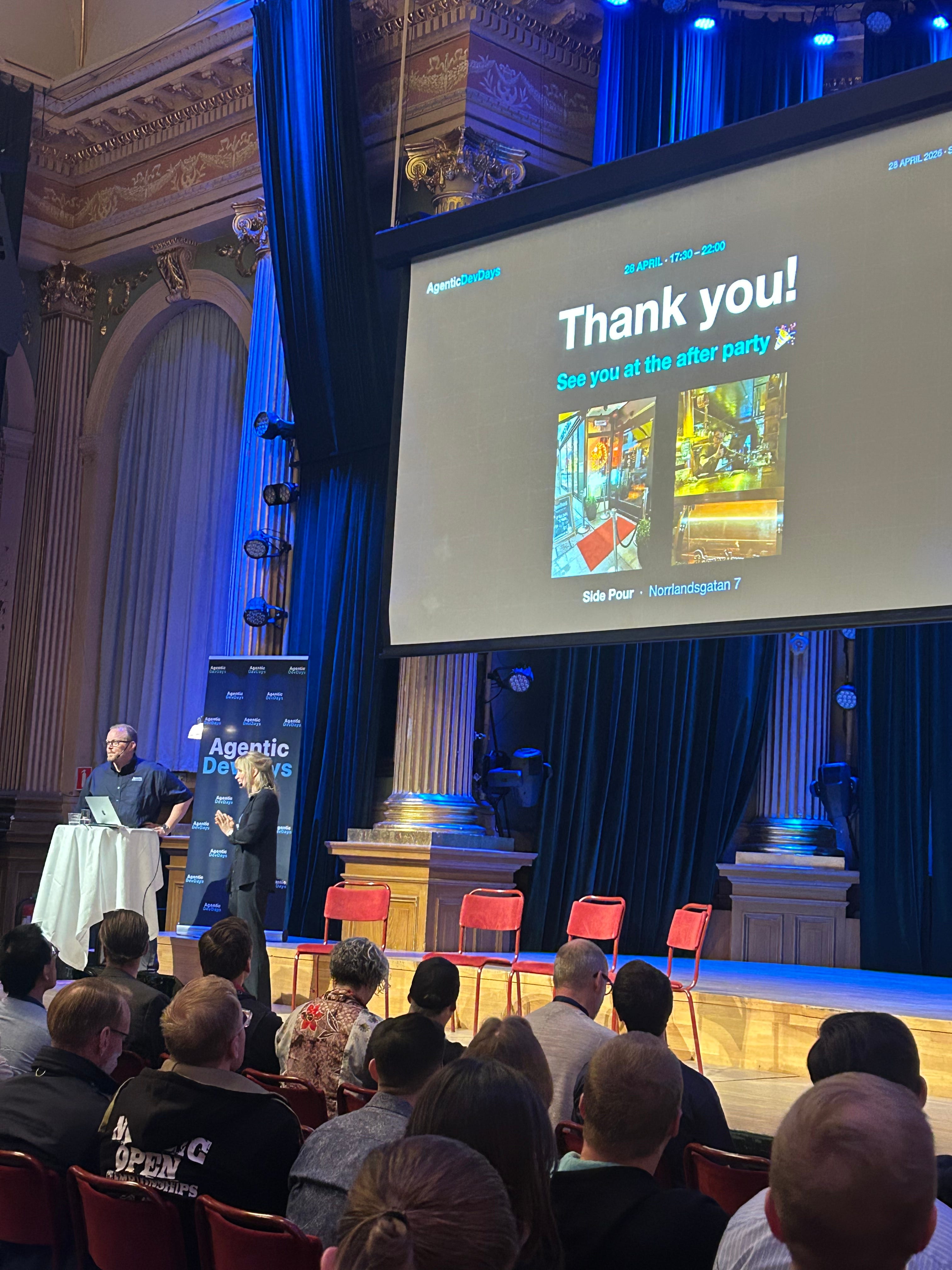
Yesterday, I attended Agentic Dev Days in Stockholm, and it has been so interesting to get to hear all the different talks.
Biggest intake?
👉 Something fundamental is changing in how we build software.
And I don’t think we’ve fully understood it yet.
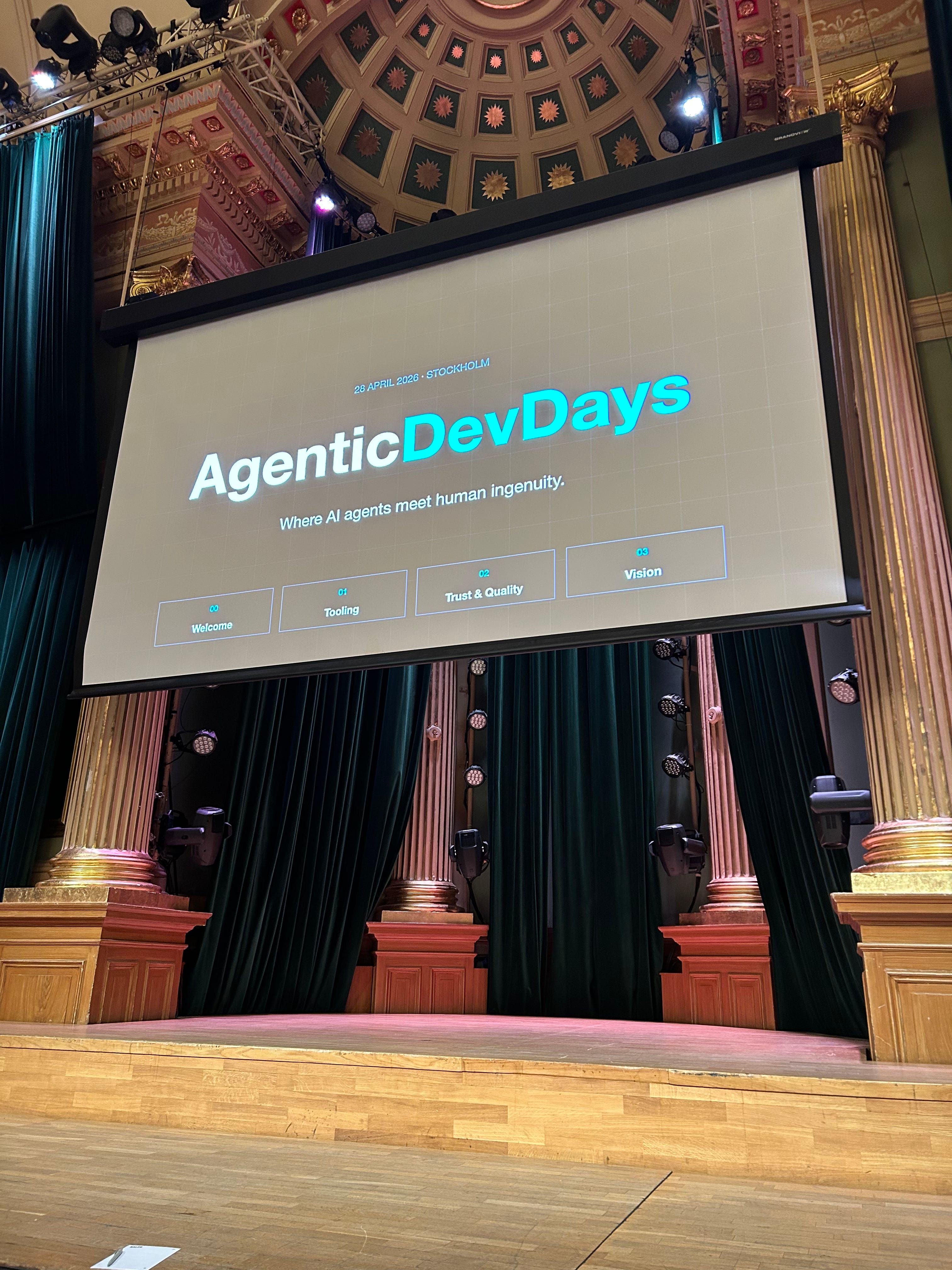
At some point during the conference, a sentence stuck with me:
“The bottleneck has moved from typing to deciding.”
And the more I thought about it, the more it made sense.
For years, being a developer meant being fast, precise, and efficient at writing code. That was the craft. That was the value.
But now?
Code is no longer the scarce resource.
AI can generate it in seconds.
What’s becoming scarce instead is:
clarity
direction
judgment
We are no longer just building things line by line.
We are deciding what should exist in the first place.
And that shift is much bigger than it sounds.
Before attending the conference, I expected discussions around models, which one is best, how to optimize prompts, what’s next.
Instead, one insight completely reframed everything:
The model explains a small part of the outcome.
The system around it explains far more.
That was a turning point.
Because it challenges how most people are currently approaching AI.
We tend to focus on:
choosing the right model
improving prompts
tweaking outputs
But what really matters is everything around it:
how the system is structured
how components interact
how failures are handled
how results are validated
In other words:
👉 You don’t win by having the best AI
👉 You win by building the best system around it
As the day went on, it became clear that we’re not just building “features” anymore.
We are building systems of agents.
Systems that:
make decisions
call tools
interact with data
operate across boundaries
And suddenly, the complexity increases.
Not because AI is hard to us, but because it’s powerful enough to do a lot, and that “a lot” needs to be controlled.
So the role of the developer shifts.
You are no longer just implementing logic.
You are:
designing how systems behave
orchestrating workflows
defining boundaries
ensuring reliability
And most importantly:
👉 You are responsible for what the system does
Even if you didn’t write every line of code.
There was also a lot of talk about “vibe coding,” or, better, “Vibe engineering,” building quickly with AI, experimenting, exploring.
And yes, it’s exciting.
But it also became clear that this only gets you so far.
Because when things move from prototype to production, everything changes.
Suddenly you need:
structure
clarity
maintainability
predictability
And that’s where engineering fundamentals come back, stronger than ever.
Understanding:
how systems are designed
how components interact
how to handle edge cases
These are not “nice to have” anymore.
👉 They are the difference between something that works once
👉 And something that works reliably
AI doesn’t remove the need for good engineering.
It amplifies the consequences of not having it.
If there was one word that kept coming up again and again, it was:
Testing.
Not at the end.
Not as a checkbox.
But as a continuous process.
Because when AI is generating outputs, you can’t just assume correctness.
You need to:
define scenarios
validate behavior
test edge cases
build feedback loops
And that changes how we think about development.
We’re no longer just testing code.
👉 We are testing behavior.
And that requires a different mindset.
Another area that stood out, and honestly felt a bit underestimated, was security.
Because these systems:
access data
call tools
trigger actions
They don’t just compute.
They act.
And that introduces new risks.
It’s no longer just about securing endpoints or APIs.
It’s about:
controlling what agents can do
isolating environments
managing permissions
preventing unintended behavior
Security is no longer something you add later.
👉 It’s something you design from the start
Beyond all the technical insights, there was also a more personal reflection.
Looking around the room, I realized:
I was one of the very few women there.
And that stayed with me.
Because I know, through Data & AI Stockholm, that there are so many talented, curious, and capable women in this space.
So why weren’t they there?
Maybe it’s:
hesitation
lack of confidence
feeling “not ready yet”
But the truth is:
👉 They would absolutely belong in that room.
They would understand the discussions.
They would contribute to them.
They would enjoy them.
And I really hope to see that change.
Because the future we’re building should not be shaped by a narrow group of people.
If I strip everything down to the core, this is what I’m left with:
We are not moving towards a world where developers disappear.
We are moving towards a world where developers evolve.
Where:
writing code is less central
understanding systems is more important
thinking becomes the main skill
But here’s the important part:
👉 You still need to understand code
Not to write everything manually,
but to:
evaluate what’s generated
design better systems
make better decisions
understand trade-offs
We are at a point where things are changing fast. Faster than most of us are fully comfortable with. And yet, it’s also incredibly exciting. Because we’re not just witnessing a shift. We’re part of it!
We are redefining how software is built. How systems behave. How humans and machines collaborate. And honestly?
These are some of the most interesting times to be in tech. (^_^)
> This is written by Vanessa Andersson, for Data AI Stockholm. More about DAIS. If you would like to contribute or write to us, please reach out to us here or on DAIS’s Linkedin
No posts
Comments
Nothing yet. Say the first thing.
Sign in to join the conversation.