
There is an image of ultra trail running that most people know before they have ever been part of it.
They know it from YouTube. From the helicopter shots over Chamonix, slow-motion start lines, elite athletes running through the night with dead eyes, yet perfect form, crowds hammering on barriers as if they were at the Tour de France. Music, drones, tears, finish-line collapses and all the other cinematic drama.
It is powerful and beautiful. But it is also misleading.
Because most trail races, even the big ones with the UTMB label, do not feel like that. They are smaller, more ordinary, less pompous in real life than they appear from the outside. The start lines are small-scale and the finish lines are often deserted for hours. Except for a few elite athletes trying to secure direct entries to the Finals, most people standing there are exactly that: people. Regular runners. Nervous, underprepared, overprepared, excited, scared, slightly injured, talking too much, manically checking their gear, forgetting where they put their gloves.
People like my friends Benni and Maria.
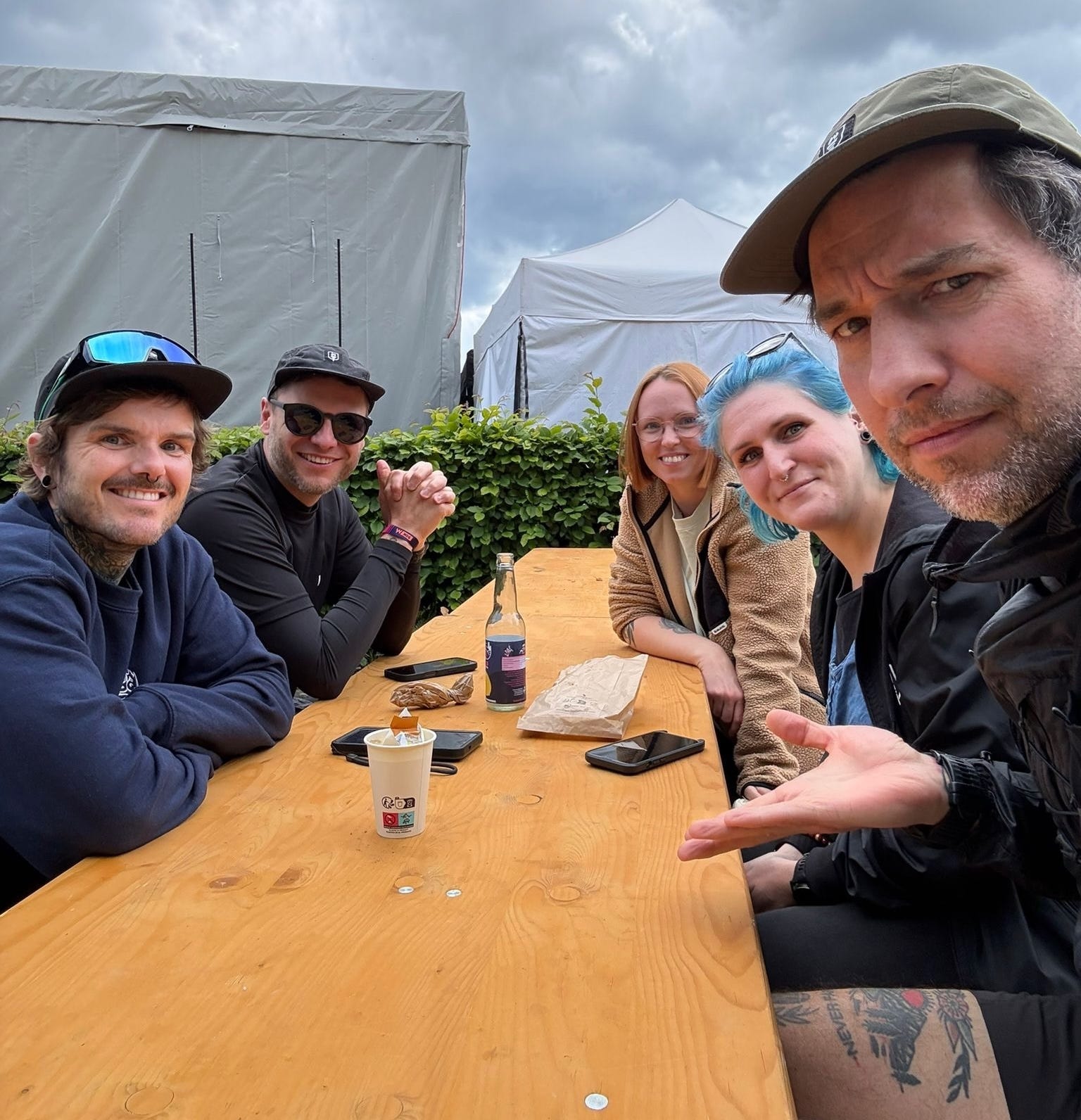
Benni has been at Trail Alsace by UTMB since its first edition. Every year he comes back. That alone says something. Runners like to pretend they are always looking for the next new thing, the next more remote race, the next bigger challenge, but the races that really fit often do something different: they become places you return to because they just feel right.
For Benni, part of that feeling starts with the obvious practical thing: short travel. From southern Germany, Alsace is close enough to avoid the heavy logistics that often come with mountain races. But that is not what makes him return every year.
“I liked that they made their region part of the whole thing, with all the knights and castles,” he says. “That gives it a certain flair.”
He said ‘flair’. That is something different than hype, myth or once-in-a-lifetime vibe that surrounds Chamonix each August. Flair is smaller. It is local and somehow fragile. It lives in details: old walls, narrow streets, half-timbered houses, villages that don’t care that thousands of tired people in running vests run through them.
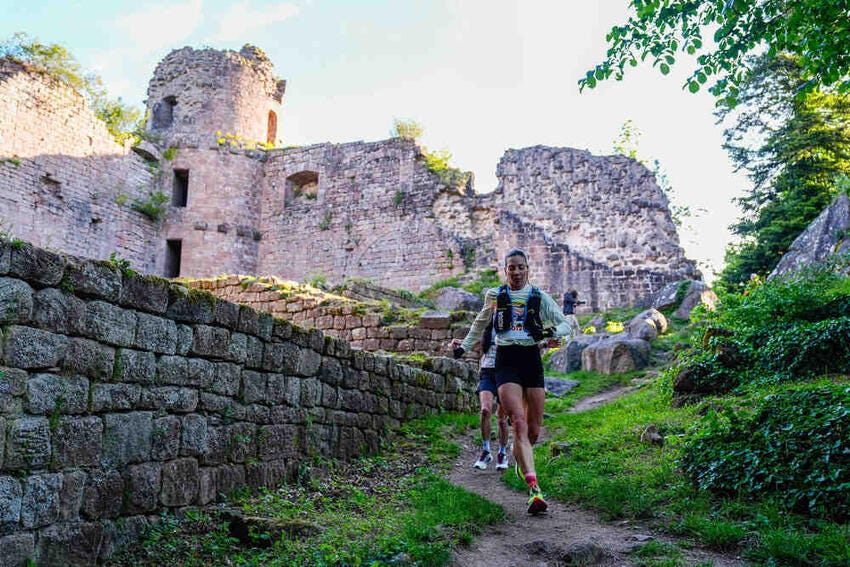
In Obernai, where the event is centered, the finish area sits right next to the old town. Benni loves the finish on the old city wall, the direct access to the beautiful historic center, and the fact that the place itself adds something to the race that cannot be copied.
However, Trail Alsace is not an old local race that later received a global logo. That distinction is important. The event was created as part of the newly launched UTMB World Series and first took place in 2023. In that sense, it is young. Very young. But it was placed in a region with a strong running culture.
The Vosges and Alsace have a long relationship with trail and mountain running. Races such as the Crêtes Vosgiennes, first held in 1976, or the Trophée des Vosges, organized since 1979, show that people were already racing across this landscape long before “trail running” became an industry. The popular Trail du Petit-Ballon, another reference point in the region, has grown into one of those early-season fixtures that pull thousands of runners into the Vosges.
That is the real tension of Trail Alsace. The race itself is new. The ground underneath it is not.
It would be too easy to write the predictable piece here: UTMB comes in, a global brand lands in a region, local running culture gets absorbed by big sponsors, and runners only come to collect stones.
Some of this is even true. The UTMB label is never neutral. It brings visibility, fixed structures, ranking systems, professional logistics and access to the infamous UTMB ecosystem. It also brings the questions that now follow almost every “by UTMB” race:
Who owns the story of a place? Who benefits from the event? What happens to smaller races around it? Can a region be celebrated without being packaged as a product?
This is the most discussed question since UTMB and the Ironman Group turned the volume of trail running up to eleven.
But standing in Obernai, watching the race unfold (which I did), it simply didn’t feel off. Trail Alsace is not a giant machine crushing the local character and burying it beneath. At least not from the outside. Not in the way many people imagine when they hear “by UTMB”.
Benni describes it simply:
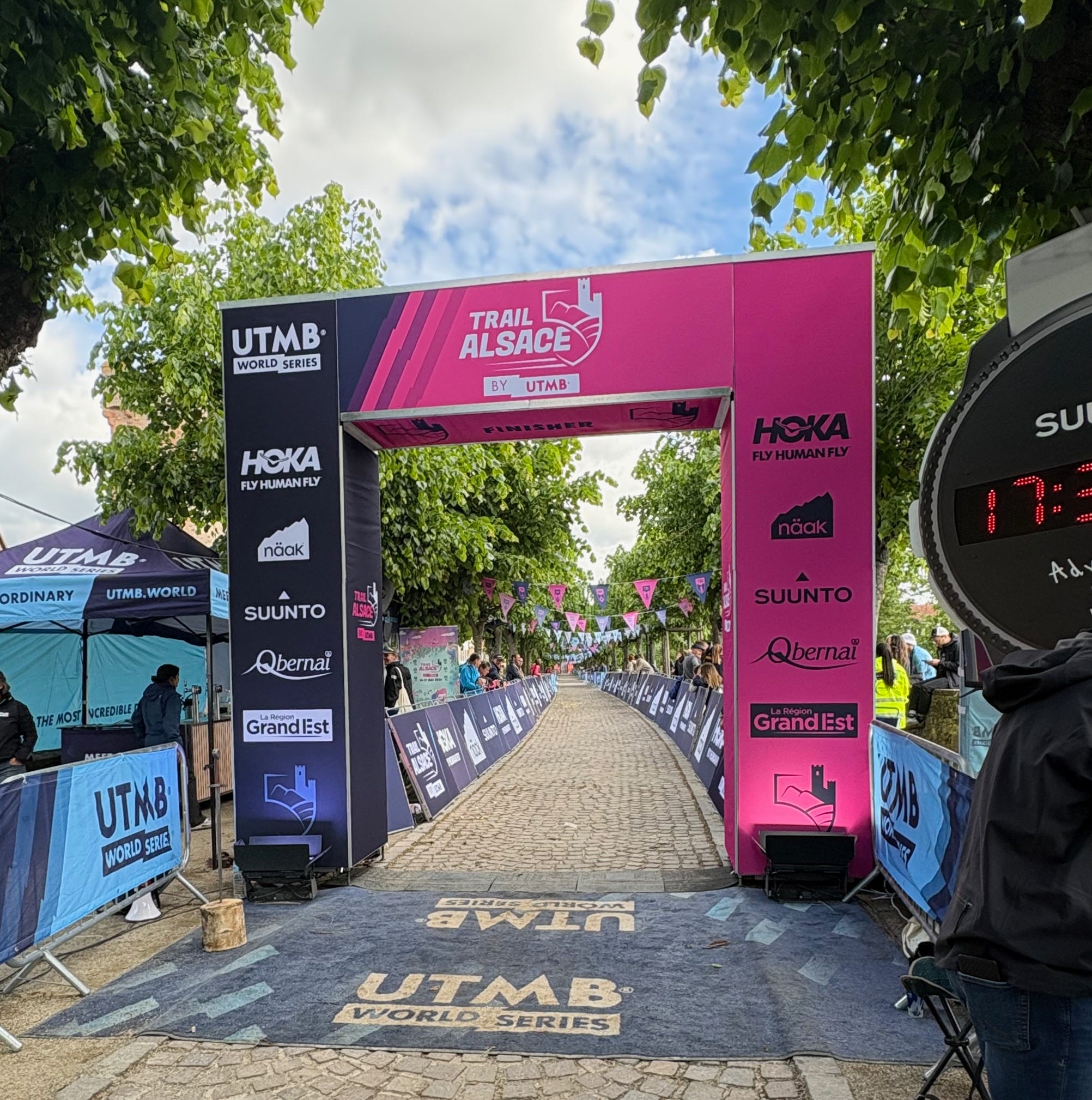
“It is still very easy to take in. Most of it happens around the finish area. A small stage on a meadow, no huge fuss, everything more relaxed and easy than stressful.”
That is not the image many runners carry in their heads when they think of UTMB races.
Trail Alsace exists in a world of its own. Even with up to 8000 participants across the event, it does not necessarily feel like a mass event. Partly because the races are spread across many distances, days and locations. Partly because Obernai itself sets natural limits. There is only so much space. The event cannot endlessly inflate without literally running into the walls, streets and edges of the town.
Benni noticed that the food and merchandise area was bigger this year than before, and that the event has clearly become more professional. But he also felt that it may already be close to its spatial capacity.
“It still feels manageable. The whole town seems to be behind it, and it never feels completely overcrowded.”
This is where Alsace becomes interesting as a race, and even more interesting as a story. It sits between worlds.
It has the UTMB logo, but not the UTMB vibe. It has thousands of runners, but not the feeling of being swallowed by a crowd. It has elite athletes, but the center of gravity is elsewhere. It has a global visibility, but the experience on the ground is surprisingly local.
For Maria, that mattered in a different way.
Trail and ultra running can be intimidating from the outside. The words alone are enough to build a wall: ultra, mandatory gear, cut-offs, night sections, altitude, poles, nutrition plans, drop bags, GPX files, DNF. The sport has a habit of talking about itself as if hardship were the entrance fee. Before people even start, they are often made to feel that they need to become a certain kind of person first.
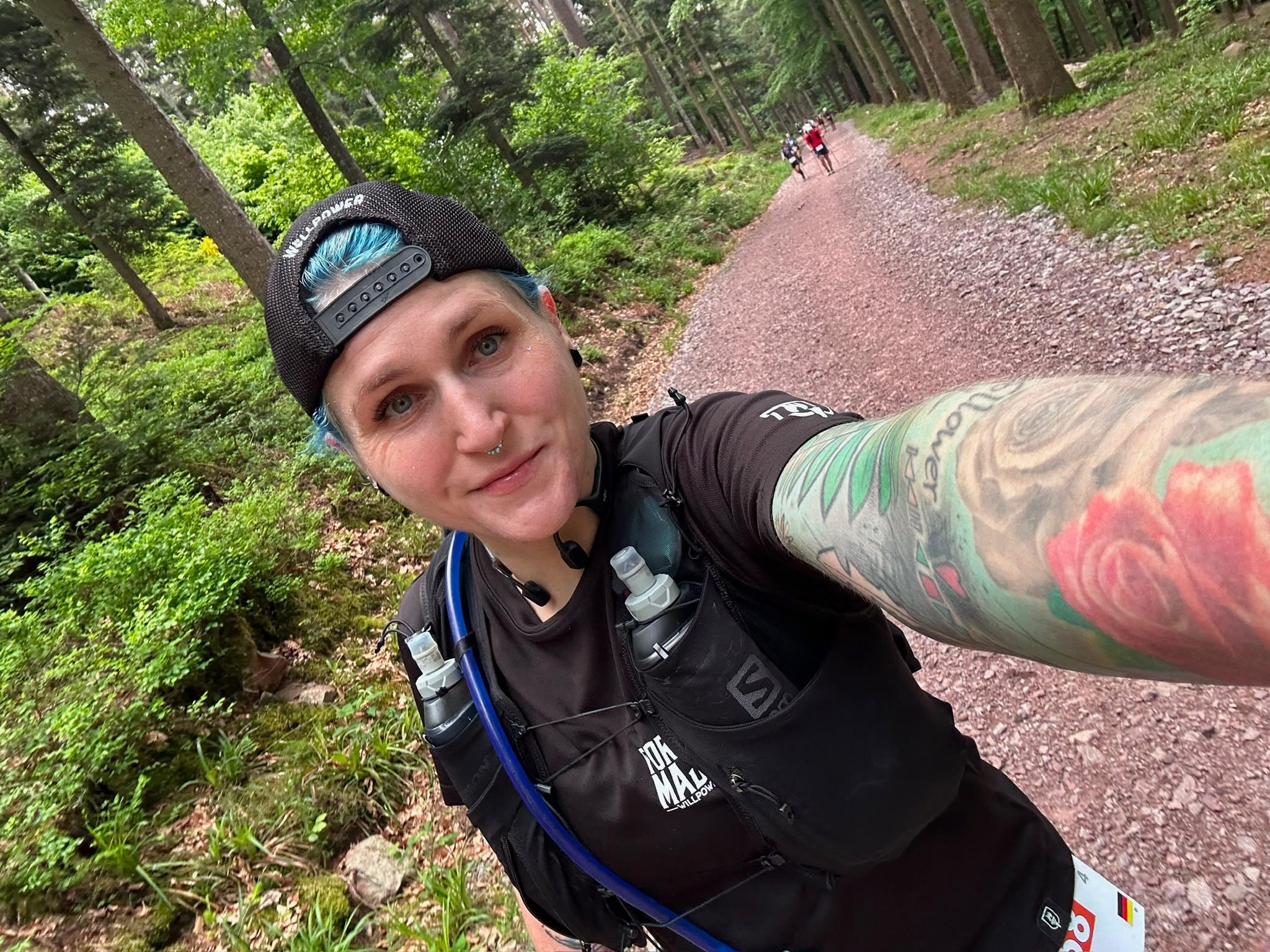
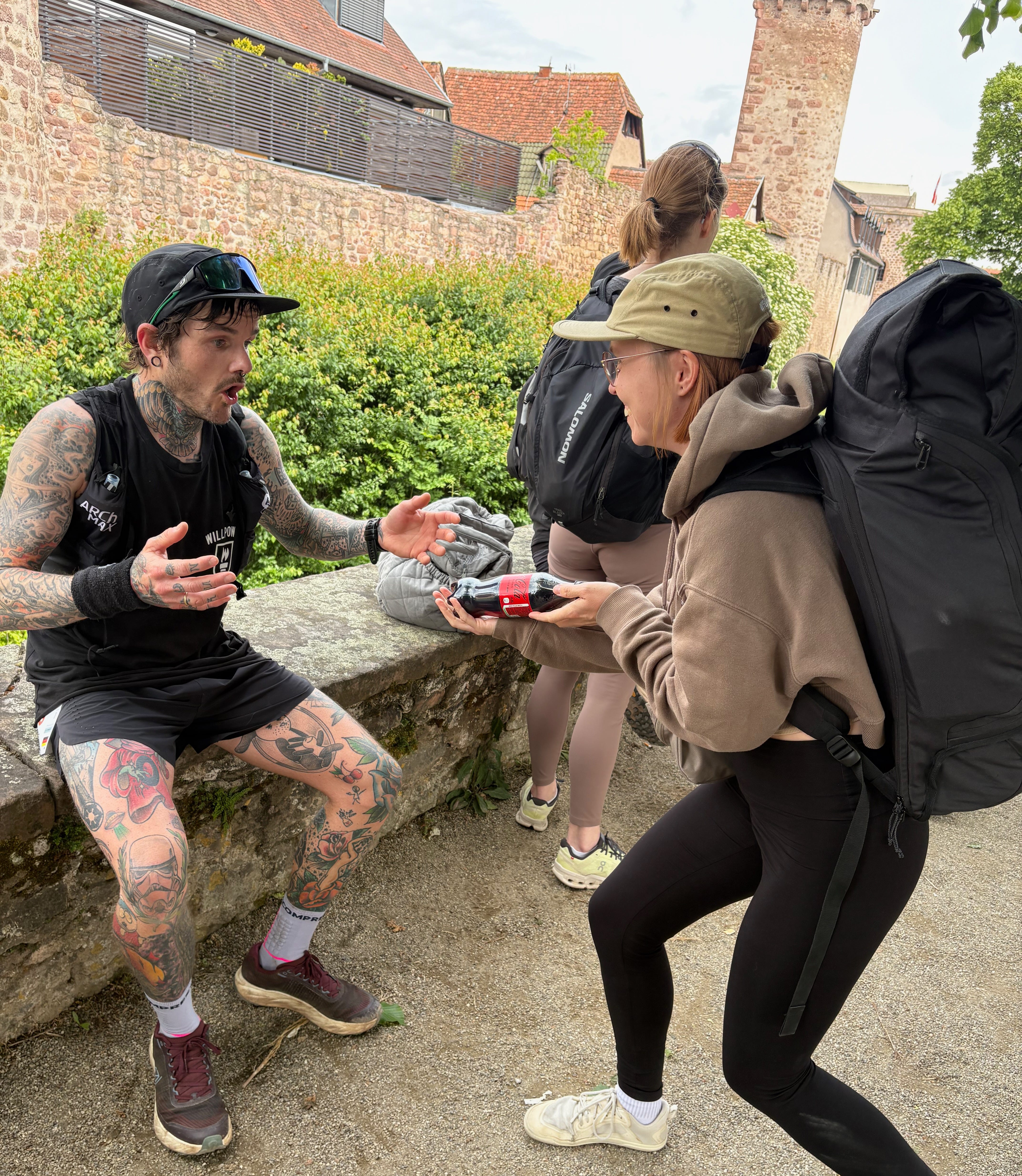
Maria did not arrive in Alsace as someone who already felt fully at home in ultra trail running. To be more precise: this was her first ultratrail. The 50k distance, which in the toxic language of the sport is often treated as “small”, even though it is still a super long day on foot through hills, forests, villages and fatigue.
“When I thought of the term ultra trail,” she says, “I thought of hours and hours somewhere in the forest and mountains, maybe in bad weather, at least one night to run through, extreme effort, even suffering, physically and mentally.”
That was one part of her image. But she also thought of spending precious time with herself, growing beyond herself, and experiencing something raw, unfiltered and formative.
That is the pull of ultra running in a nutshell: it scares people and attracts them for almost the same reasons.
And Trail Alsace gave her a way in.
“A smaller ultra trail can be less intimidating,” she says. “In my case 50 kilometers, not immediately 100 or more. That does not diminish the effort or the achievement. Ultra is ultra is ultra. But it was not quite the same massive block in front of me.”
This is one of the strongest arguments for races like Alsace. They can lower the emotional threshold without reducing the seriousness of the experience. A 50k in the Vosges is not easy. It still requires training, patience, humility and the willingness to be out there for a long time. But it does not arrive with the same mythological weight as Chamonix. It gives runners a chance to discover the sport before being overwhelmed by its most dramatic images.
Maria had a plan: start calmly, stay disciplined, and do not get carried away early. This sounds simple, which is why almost everyone fails at it. Fortunately, her race started with a long climb, which helped a lot. She likes power hiking, and she found a rhythm that was quick enough to feel like racing but controlled enough to trust.
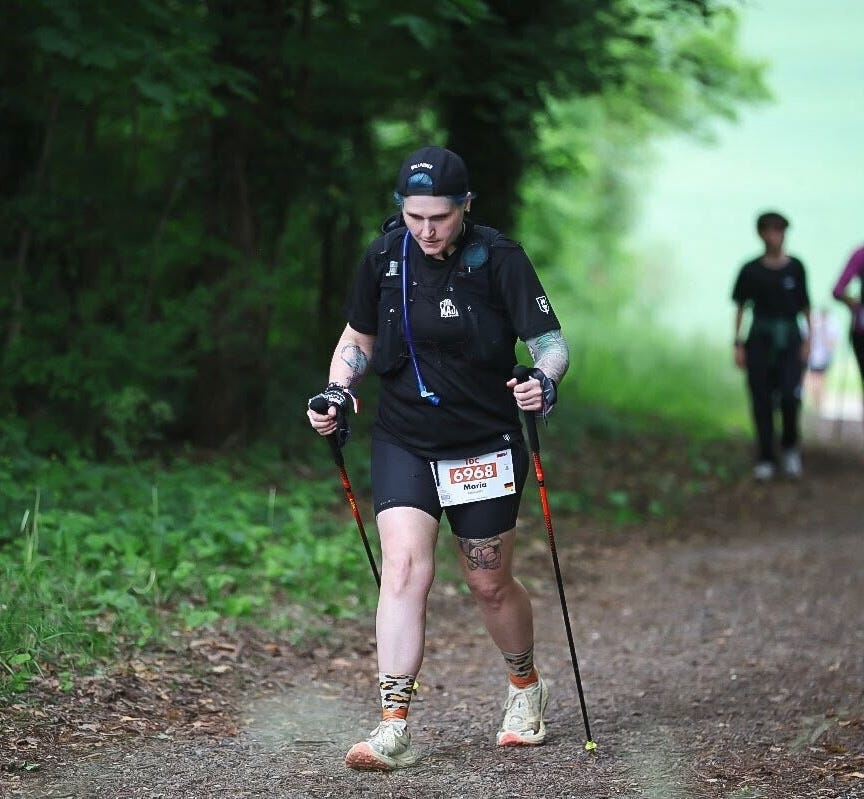
“I came into situations where I passed people who were breathing much harder than I was,” she says. “That gave me a lot of courage, pride and confidence for what was still to come.”
This is exactly the part of ultra trail running you cannot show in photos or reels. You can only experience it. And such transformations are not always dramatic. They happen quietly, on a long climb, when your body gives you better news than expected. When the things you feared start to feel possible.
For Maria, the race had already started long before the start line. Training had changed her relationship to the challenge. She had completed her sessions, stayed healthy, done her strength work, respected rest days, and patiently watched the long runs grow longer. The race became less of a leap into the unknown and more the final expression of something she had already been building.
“During training I reached a point where I felt part of the bigger whole,” she says, “not just someone trying to keep up.”
That sentence cuts through a lot of nonsense around ultra running. Experience comes from making experiences. You cannot be experienced in ultratrail before doing your first one. At some point, everyone enters without the full credentials they imagine they need.
The question is definitely not whether you are already hard enough. Maria is almost suspicious of that idea.
“You do not have to be especially experienced or especially tough. Even if it seems obvious at first that you have to be a proper badass to run an ultratrail. I think the opposite is true. In training and in the race itself, you often have to be very gentle with yourself. With your body and with your head. You have to forgive yourself. You have to be kind to yourself.”
Let that sink in. This is probably the most honest thing anyone can say about preparing for an ultra and it comes from a debutant.
The sport likes to sell toughness because toughness looks good from the outside. But a long race is full of small negotiations, corrections, concessions, and acts of care. Eat before you are empty. Walk before you are broken. Rest before pride turns into ignorance. Let the mistake happen. Then take the next step.
Maria does not romanticize the process, though. During long runs, she sometimes sat crying in the forest. Because she felt weak, her stomach hurt, she got lost again. Or because private life and training fatigue collided until everything became simply too much. But she kept going. Literally.
“One foot in front of the other,” a friend had told her before an earlier race. “You have practiced this for months. You can do it.”
At Trail Alsace, that practice became reality. But as Maria said:
“Ultra is ultra is ultra.”
There was an ankle roll, a short moment of fear, then the pain disappeared. There was the difficult stretch between kilometers 30 and 40, when everything started hurting and fatigue became heavy. She got through it with stubbornness, focus and the ability to keep the finish in sight.
And then came Obernai.
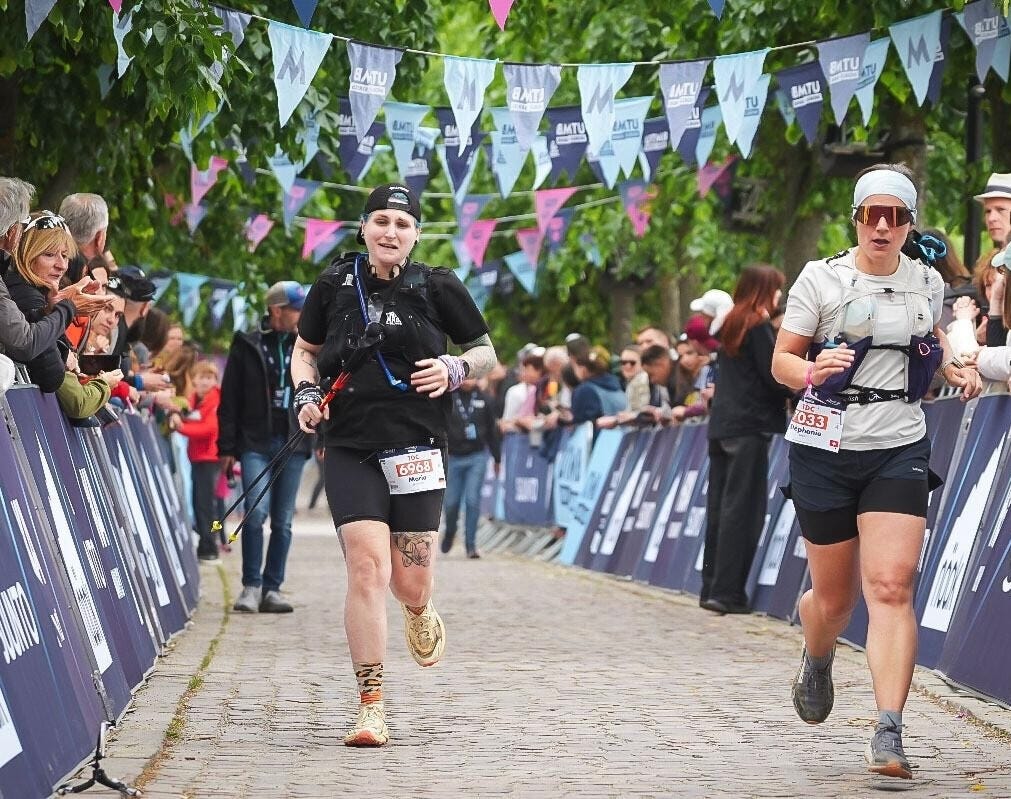
She remembers the finish vividly: the unpleasant temporary metal bridge over the road, then the cobbled path, barriers on both sides, trees, colorful bunting, people everywhere. They cheered as if she were winning the race, even though she was somewhere in the later part of the field.
That is another thing YouTube often gets wrong. It teaches us to look at the front, although trail and ultra running are usually much more revealing near the middle and the back. There, the performance is less legible from the outside. Nobody knows exactly what it cost someone to arrive. Nobody knows whether this was a comeback, a first time, a personal dare, a private rebuilding, a day stolen from doubt. Yet the crowd cheers anyway.
“In Obernai,” Maria says, “that personal character of the race stood out for me, despite it being organized by a large commercial company like UTMB.”
This tension never fully disappears. Trail Alsace is organized under the umbrella of a large commercial company, yet much of what you feel on the ground is personal, local and sincerely warm. There are several thousand participants, but the race never seems to lose itself in its own size. It remains close enough for people to stand at the barriers in Obernai and cheer for someone finishing her first ultratrail with the same enthusiasm they would give to a winner.
In other words: Thank God it’s not Chamonix.
Chamonix has its place. Of course it does. It is the master image of the sport, a stage that has produced some of its most defining moments. But the constant comparison can make every other race seem like a miniature version of something else. That is unfair to the races and also unfair to the runners.
Trail Alsace does not need to be Chamonix. It should not try. Its strength lies elsewhere.
It is in the way Benni talks about returning every year because the race still feels real and heartfelt.
“A genuine and very well-organized event with a lot of passion,” he calls it, “where everyone can feel welcome. Whether as a runner, or just hanging out on the grounds, or out on the course.”
It is in the way Maria speaks about fear becoming trust. About the community feeling like a family. About people not biting. About learning that she was capable of much more than she had thought.
It is in the landscape, which does not need to intimidate in order to matter. Middle mountains instead of high alpine death traps. Forests, vineyards, villages, castles, rolling runnable trails, the Vosges opening and closing around you. A place where the distance can still be serious, but the vibe does not have feel threatening.
This could be exactly what newcomers need from ultra trail running: not a watered-down version of a bigger race, not a copy of a myth, not an event pretending that 50 kilometers is the ‘bambino run’. They might need a place where the door feels open. A race big enough to make the day special, but small enough to let them breathe. With a finish line that does not ask them to become someone else before crossing it.
Trail Alsace is still young. Its relationship with UTMB, the region and the surrounding race culture will remain worth watching. It should be watched critically, fairly and without pretending that branding has no consequences.
But for Maria, the answer to the more immediate question came long before any debate about logos, sponsors, rankings or race politics. Can a race like this give someone a meaningful first encounter with ultratrail? Can it open the door without making the threshold feel impossibly high?
Her answer is simple:
“I’m capable of far more than I ever thought I was.”
That is not Chamonix speaking.
Thank God.
Comments
Nothing yet. Say the first thing.
Sign in to join the conversation.