

A recent survey of 176 therapists found that over a third were unsure or did not believe that more clinical experience leads to better client outcomes.
We shouldn’t be surprised, given that various studies confirmed their suspicions. Simon Goldberg and colleagues found that on average, clinical experience not only plateaued, but had a slight decline on outcomes over time.1
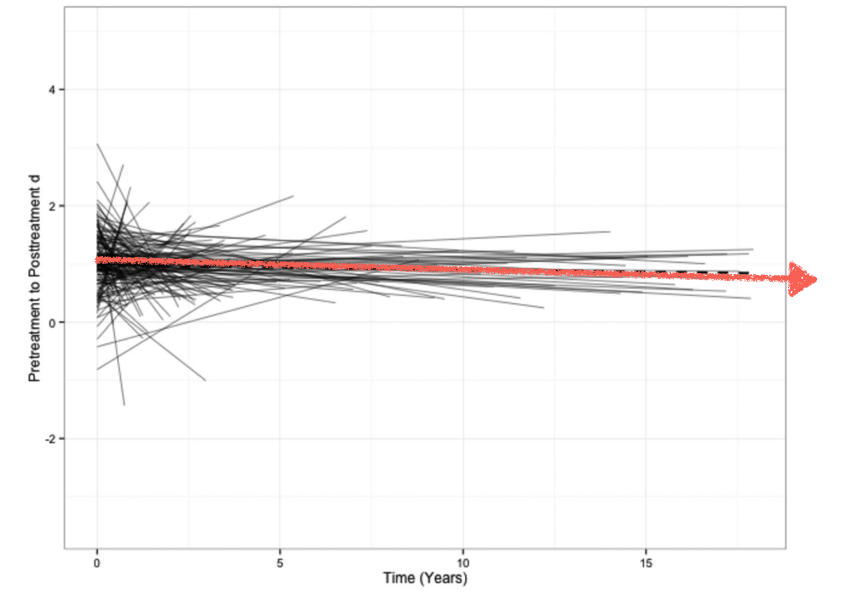
There was even a replication study in Germany that found similar results as the Canadian sample that Goldberg et al. studied.2 In our original Supershrinks study based on a sample of UK therapists, we also found that clinical experience was not a significant predictor to performance. 3
A recent study by Saadet Zumbul and Dennis Kivlighan caught my attention. The 2026 paper is titled: Therapist Trainee Experience and Client Outcome: A Within-Person Analysis of Hours of Experience, Client Order, Initial Client Distress, and Treatment Length4
When we read a peer-reviewed journal article, most of us eye the abstract and maybe skim through the Discussion section. For the purposes of understanding and clarity about the experience-outcome relationship, we will have to get into the weeds. Because the conclusions that are drawn can vary if we don’t.
I’d walk you through in-detail what this new study found, how it differed from previous studies, and why I came to a slightly different conclusion.
The study by Zumbul and Kivilghan is compelling because it is the first study to look at not only the between-person association of the experience-outcome relationship, but importantly, also at the within-person level of analysis.
What does this mean?
Between-person association: Compares between different people to each other at a point in time.
Within-person association: Tracks the same person across time.
This is an important distinction. Sometimes, completely opposite findings can occur if you muddle these up.
Take an extreme example on the relationship between alcohol intake and IQ. The between-person analysis might yield a positive relationship i.e., higher IQ people tend to drink more. Yet, at the within-person level of analysis would show that drinking impairs your cognitive ability.
This type of ecological fallacy is called Simpson’s Paradox (I don’t think this has anything to do with Homer).
Even though Goldberg’s and Germer’s (G & G) studies both examined the data longitudinally, it was still a between-person analysis. This is the case because only a static pre-post measure of the Outcome Questionnaire-45 (OQ-45) was employed as the outcome variable for each client, as opposed to dynamically tracking the session-by-session continuous trajectory within the same clients over time.
A second consideration of the difference between G & G studies and Zumbul and Kivilghan’s (ZK) is how clinical experience was calculated. In both G & G studies, experience was calculated by the number of years/days in the profession and cumulative cases. ZK argued that the mere passage of time may not be a reliable indicator of experience.
A licensed professional who has not regularly seen clients over the years may not have more experience than a trainee seeing five clients per week.
ZK proposed a different way to operationalise experience. Instead of tracking the time elapsed since first seeing clients, they based their analysis on
the actual number of hours spend in direct client contact under clinical supervision.
Plus, in order to track the within-personal level of analysis, ZK have outcome measures at every 8th session (OQ-45), compared to GG’s pre-post outcomes.
So, where did they find such a cohort? In a counselling service in a major US university. They had a 16-year pool of data consisting of
192 clients
Seen by 45 doctoral-level therapists, with at least their third year of doctoral training
Average age: 28
Caseload average: 4.5 clients per therapist
Unlike both G & G studies, ZK’s cohort of therapists are more homogeneous. They delivered a psychodynamic approach to therapy. Treatment length averaged 60.51 (SD: 35.29) sessions. And—this is a big AND—they were clinically supervised by a total 16 supervisors, with individual weekly supervision (60 mins) and biweekly group supervision (120mins).
We will return to the supervision piece later on. For now, let’s get to the results.
Here’s what ZK found in their study regarding the experience-outcome relationship:
Therapists trainee experience was associated with reduced client distress on the OQ-45. Cohen’s d = 0.31 i.e., small-to-moderate effect.
The effects of experience on client outcome was moderated by client’s initial distress levels (i.e., therapists trainees’ experience was more impactful for clients who started with higher distress levels) and moderated by treatment length (i.e., as therapists gain more experience, they took shorter amount of time to achieve good outcomes).
Contrary to expectations, interaction between client order and therapist trainee’s hours of experience did not predict client outcomes. In order words, if a given therapist saw 50 clients, one would expect to get better outcomes with your 50th client, compared with with your 1st client.
As we look at each of the three findings, bear in mind that most previous studies found either no relationship or negative association between therapist experience and client outcomes.
First, the statistical method employed arguably made a difference. They analysed the actual time spent in client interaction, rather than the mere passage of time or number of cases. In addition, given the similarity between therapists in ZK’s study compared with previous experience-outcome studies, there were fewer confounding factors to contend with.
Second, regarding the moderating factor of client’s initial distress levels, as measured by the OQ-45, this result seems to suggest that the most experienced practitioners were more impactful for clients with more distress. This makes sense, and as the researchers pointed out, is consistent with past research, that differences between therapists (therapist effects) are larger with clients with higher baseline severity.
Regarding the moderating factor of treatment length, it would be misleading to conclude that briefer work is better than longer-term sessions. Rather, it’s possible that as experience increased, these therapists became more efficient. It’s also possible to imagine that clients who engage in further sessions might have entrenched difficulties, which needed more time to work with, as the researchers highlighted.
Finally—and this is the important piece of the puzzle—as the authors put it, “there was no interaction between client order and therapist trainees’ hours of experience in predicting client outcomes.”
What does this mean?
Client order captures the intuitive expectation that a trainee is likely to achieve better outcomes with their 10th or 50th client than with their first or fifth.
ZK initially hypothesised that there would be an association between therapist trainee experience and client improvement such that the relationship would be stronger for later clients.
It looked like clinical experience only helped with that specific client and didn’t make them better at future ones. Recall that this was a psychodynamic cohort, with an average of 60 sessions. This is much longer than the typical number of sessions seen in various naturalistic settings of about 4-6 sessions. Given the average length of treatment, I suppose what this means is that the yield of experience only benefit the specific cases.
But why would experience translate to specific clients and not generalised to others? Isn’t the point of experience meant to be the transfer and generalisation of skills?
This is where the details are important. As you might recall, all the therapist trainees were not only receiving individual and group supervision, weekly and biweekly respectively whilst they were seeing these clients, their sessions were also recorded and reviewed with their clinical supervisors.
This is an important component. If you are a clinical supervisor, how often do you actually review session recordings with your supervisees? If you are receiving supervision, do you have such a practice with your supervisor, aside from the mandate during your post-graduate training?
This is why in our workshops for clinical supervisors, I recommend them to review not only session recordings, but using a particular method called the Impact of Session Grid (ISG) to break down the therapy hour into chunks, zooming in only specific interactional patterns, highlighting significant markers and potential areas to work on.
RELATED:
Here’s two resources on the use of the Impact of Session Grid (ISG):
For the first time, I’ve made this section of the course Structure and Impact (S&I) freely available to all. Two videos walking you through the use of the ISG when reviewing a therapy session recording.

Here’s an example of how I use the ISG to analyse one of Esther Perel’s sessions from her podcast, Where Should I Begin.
When we don’t specifically coach for performance—that is by zooming in on the specific nature of the therapeutic conversation (rephrase) and help increase the odds for good outcomes whilst systematically tracking client outcomes—it’s very easy to discuss about endless things, and get caught up with our theories and wide-ranging explanations, and still not made a dent in improving client’s lives.
But wait. ZK’s study seems to suggest something that we can easily brush off. Supervising therapists, even with the in-depth details encompassed by recording, reviewing and reflecting on specific cases, doesn’t generalise. It can help improve of the success rate for specific cases but doesn’t help to improve therapist’s ability in general.
This is a real issue highlighted by education researcher Robert Haskell in his book Transfer of Learning.5 He says that if you can only perform a set of tasks in its original circumstances, this should be considered merely training.
If you can gain knowledge and skills and the ability to adapt them to a range of unfamiliar situations, this should be called education.

In other words, while you coach for performance in clinical supervision, it is also important to zoom out and coach for development.
Here’s a distinction that I make with clinical supervisors between coaching for performance and coaching for development:
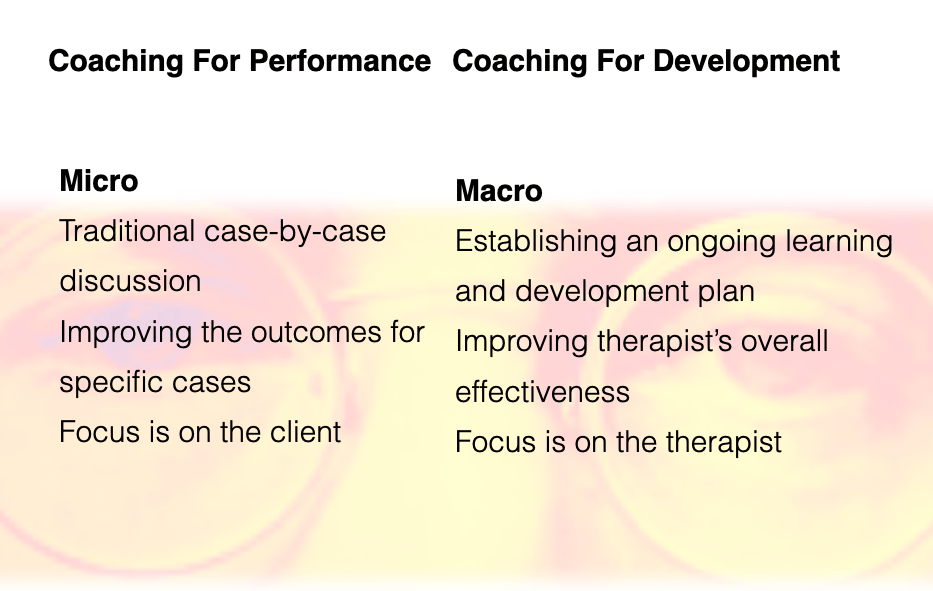
It is not that one is better than the other. You need the undulating process of moving between these two perspectives. Getting caught up in either/or—coaching for performance or coaching for development—is not the answer.
If you are too abstracted and focus solely on the development of the therapist while not anchored in one’s actual caseloads/the people that they meet, you’d end up being too removed and detached from reality.
If you are too zoomed in and focused on coaching for performance, you’d run the risk that learning doesn’t actually transfer. You miss the bigger picture. Real learning needs to be paired with instruction for generalisability.
So, in Zumbul and Kivlighan 2026 study, if we were to examine this from a learning perspective, using Haskell’s classification regarding transfer of learning,6 we can see that therapist trainees were able to transfer learning only up to a certain point i.e., Levels 2, 3 or 4 at most, and unable to extend to far or creative transfer i.e., Levels 5 and 6.
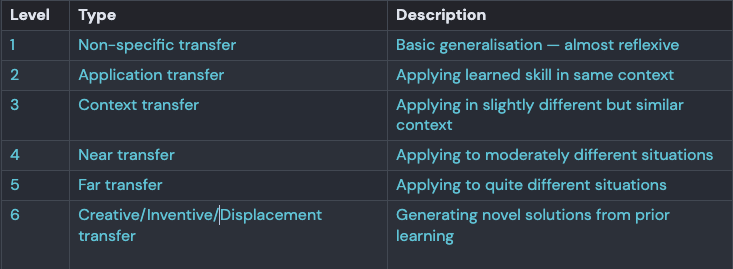
Let’s look into Haskell’s distinction between Training and Education briefly, as this may provide some clarity:
Training Model:
Case-specific
Protocol adherence
Technique application in familiar contexts
Likely produces levels 2-3 transfer of learning
Education Model:
Explicit teaching of underlying principles
Targeted practice of transferring learning across different case types and contexts
Building abstract conceptual frameworks that generalise
Likely produces levels 4-6 transfer of learning
In short, we have to get to the micro, so that we can get to the macro. If we really want to get better, coaching for performance also needs coaching for development.
There are other aspects of ZK’s study that I’m curious about that, likely due to space, were not addressed:
What was the differences between the 45 therapists (therapist effects) in this cohort? (Perhaps the caseload of average 4.5 clients/therapist is too small for such calculations?)
Were there differences between the 16 clinical supervisors?
Were therapists ‘feedbacking’ and discussing with their clients using the OQ graphs at every 8th session point of measurement?
In addition, if we know the degree of differences between therapists, I would also be curious to know if there were some therapists who were able to generalise their learning to other cases.
Much like Goldberg et al’s study that showed that on average, most don’t improve over time, there were about 39% who actually did improve with experience.
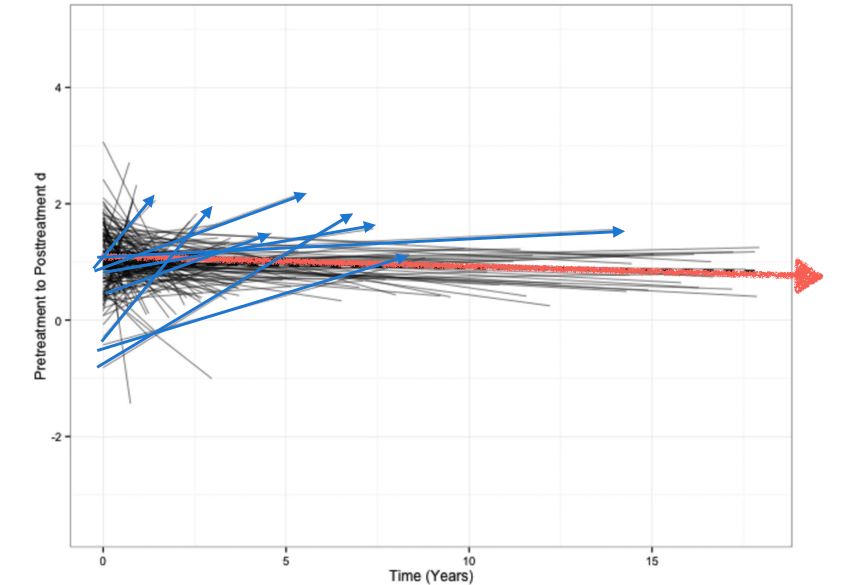
While ZK’s paper was framed as an examination between the effects of experience on outcomes, I wonder if it’s not actually about clinical experience per se. If experience was to bear fruit, it would look something like this:
Experience —> Learning —> Transfer of Learning/Generalisation
Authors of the book, The Myth of Experience, Emre Soyer and Robin Hogarth point out that experience can be defined in three fundamental ways:
Process
Product
Personal
Experience is a process we go through; experience is a product of what we get from it, directly from an experiential and preferential level.
However, in most situations we are operating in what Soyer and Hogarth calls a wicked learning environment. Compared to a kind learning environment, a wicked one is where the resulting lessons are constantly shifting, feedback loop isn’t as tight as one wishes it to be, and objectives can shift across time. Thus our experience is, in Soyer and Hogarth’s words
… constantly subject to a variety of filters and distortions.
They add,
In particular, there are two crucial questions that can be invaluable to us when grappling with wicked learning environments:
Is there something important missing from my experience that I need to uncover if I hope to fully understand what is happening?
What irrelevant details are present in my experience that I need to ignore [emphasis mine] to avoid being distracted from what is happening?
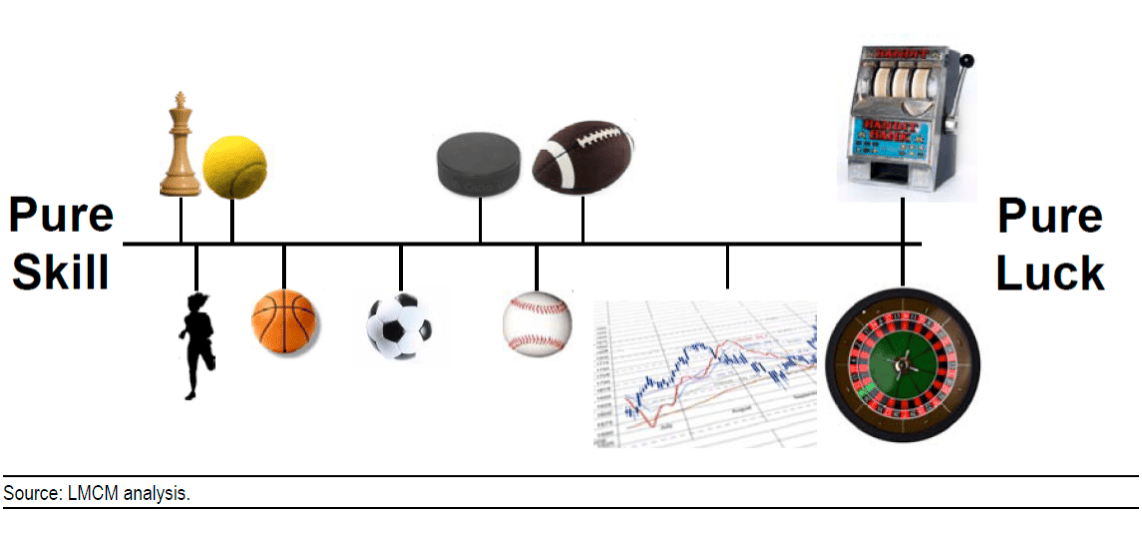
Think of the difference between Chess and Poker. The former is bounded in a kind learning environment, whereas the latter is mixed with skill and luck within a wicked environment. You can make a good decision in poker and still lose that game.
RELATED
Returning to ZK’s study in question, look at the atypical and intense features of weekly individual and biweekly group supervision, using sessions recordings, and the findings that experience transfers only within clients and not to other clients seen later on.
In addition, given what we know of the existing literature on experience and outcome, the bleak absence of positive findings in clinical supervision on client outcomes, and the issues of transfer of learning, I wonder if this is more of a study on the effects of being in a rich training environment, as opposed to a study about the relationship between experience and outcome.
The researchers did in fact point this out in the conclusion.
Our study suggests that a training environment characterized by observation and feedback can increase the relationship between therapist experience and client outcome.
If it were to be a study about clinical experience, perhaps if the same group of therapist monitored their outcomes for three years after their trainee-ship period. I suspect that would be a more appropriate representation of clinical experience. But of course, this makes such a study difficult. Would therapists still systematically track their outcomes? Would researchers be able to follow-up with them?
As a thought experiment, imagine if these same therapist trainees kept their client contact hours, removed the intensive supervision with session recordings used, and replaced it with generic weekly check-ins, or even clinical supervision as usual (without review of recordings). From a research perspective, what if there was a control group?
What do you think we would find?
As the saying goes, more research is to be done.
For now, we must ask ourselves, what levels of transfer of learning should we expect of ourselves and in our professional development efforts?
“When we learn from history (if, indeed, we do), it involves transfer.”
—Robert Haskell, Transfer of Learning, p.33
YOUR TURN: What do you think about the influence of clinical experience and client outcome?
A Special In-Person 2-DAY Workshop: 26-27th of Nov”26:
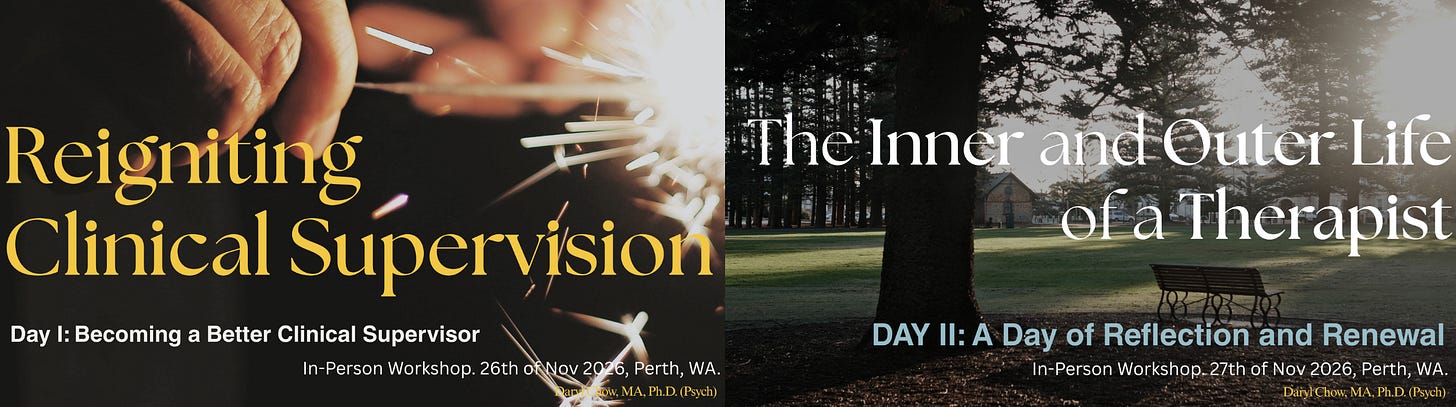
I am running a workshop in Perth!
Some have asked why Perth? Why not somewhere like in Melbourne or Sydney? For a long time, I have felt compelled to do something more locally and home ground.
- Day I is for clinical supervisors and those aspiring to be;
- Day II is for all therapists, which is a day of reflection and renewal.
- Special August Rates is available til the end of the month.
- Use the Promo Code FPDAUG (Note: Discount is automatically applied if you are attending BOTH DAY).
- Certs will be provided for CPD hours where eligible.
I hope you will join us.
Register HERE.Thanks to Sandra Ebrada and Raphael Inocencio of Psychological Association of Philippines for inviting me to speak at your conference. You guys are a super-friendly bunch. I love that!

Daryl Chow Ph.D. is the author of The First Kiss, co-author of Better Results, The Write to Recovery, Creating Impact, and the latest book The Field Guide to Better Results. Plus, the latest book, Crossing Between Worlds.

You might be interested in my other Substack, Full Circles: Field Notes on the Inner and Outer Life. FC is a return to soul and sanity, beyond the hollow promises of self-help tips and tricks.

Goldberg, S. B., Rousmaniere, T., Miller, S. D., Whipple, J., Nielsen, S. L., Hoyt, W. T., & Wampold, B. E. (2016). Do psychotherapists improve with time and experience? A longitudinal analysis of outcomes in a clinical setting. Journal of Counseling Psychology, 63(1), 1–11. https://doi.org/10.1037/cou0000131
Germer, S., Weyrich, V., Bräscher, A.-K., Mütze, K., & Witthöft, M. (2022). Does practice really make perfect? A longitudinal analysis of the relationship between therapist experience and therapy outcome: A replication of Goldberg, Rousmaniere, et al. (2016). Journal of Counseling Psychology. https://doi.org/10.1037/cou0000608
Chow, D. (2014). The study of supershrinks: Development and deliberate practices of highly effective psychotherapists [Doctoral dissertation, Curtin University].
Chow, D., Miller, S. D., Seidel, J. A., Kane, R. T., Thornton, J., & Andrews, W. P. (2015). The role of deliberate practice in the development of highly effective psychotherapists. Psychotherapy, 52(3), 337–345. http://dx.doi.org/10.1037/pst0000015
Hat Tip to Zumbul Saadet for sending me the paper.
Zumbul, S., & Kivlighan, D. M. (2026). Therapist trainee experience and client outcome: A within-person analysis of hours of experience, client order, initial client distress, and treatment length. Psychotherapy, 63(1), 48–61. https://doi.org/10.1037/pst0000612
Robert Haskell’s work on Transfer of Learning deserves a seperate article to talk about more in detail. That’s coming up in the near future.
Comments
Nothing yet. Say the first thing.
Sign in to join the conversation.