
Everyone online is chanting the same line right now.
The next 24 months are a race to master AI and get positioned, learn certain skills and get rich, move before the robots take your seat.
And on the surface, it tracks. Models are eating whole job categories faster than people can retrain for them. The cost of making an image, an app, a company, is sliding toward zero by the month. And the people who move now look like they’ll pull away from everyone who waits.
I don’t want to scare you or sell you urgency. Most of what gets said about this is speculation. And I expect half of it to age badly.
But the moment a warning becomes a chorus, I get suspicious. Choruses tend to be wrong in the same direction, at the same time, for the same comfortable reasons.
So I kept walking the other way. And I kept bumping into a fighter pilot.
His name was John Boyd. In the 1950s the other pilots called him “Forty Second Boyd,” and the name was a dare. He’d bet anyone $40 that from a losing position, with their jet locked on his tail, he could flip it around and land the kill shot inside 40 seconds. He ran that bet for years against the best the Air Force had. The story goes he never once paid out.

Good bar trick. What he did with it a few years later is my point.
Boyd went digging into a puzzle from Korea. American F-86 jets were destroying Soviet MiG-15s at a lopsided rate, when the MiG was, on paper, the better plane. It climbed faster. It turned tighter. And it kept getting shot out of the sky.
What Boyd found rewired how militaries think about winning. It’s also the whole skeleton of the next two years of your life. I’ll tell you exactly what he saw. But I have to set one piece in place first, or the punchline lands soft.
You’ve been handed a frame where the next 24 months are a race. A race is something you can lose this year and run again next year. What’s actually in front of you behaves more like a door with a spring on it. Some doors, once they shut behind you, have no handle on the far side.
Let me show you which door you’re standing in.
If you’ve been carrying a low hum of dread lately, a sense that you’re supposed to be sprinting toward something you can’t name, I want to tell that, that dread is accurate. You’re picking up a real signal. But, you’ve just been reading the label wrong.
Think about a lobster.
A lobster grows by outgrowing the shell that keeps it alive. The armor becomes a cage. So it does something that looks suicidal. It crawls under a rock, cracks its own shell open, and drags its soft body out into open water. For hours it has nothing between its flesh and every predator around it.
That soft stretch is the most dangerous window in a lobster’s life. It’s also the only window where it can grow. The danger and the growth are the same event. There’s no path where the lobster gets bigger while staying safe inside the old shell.
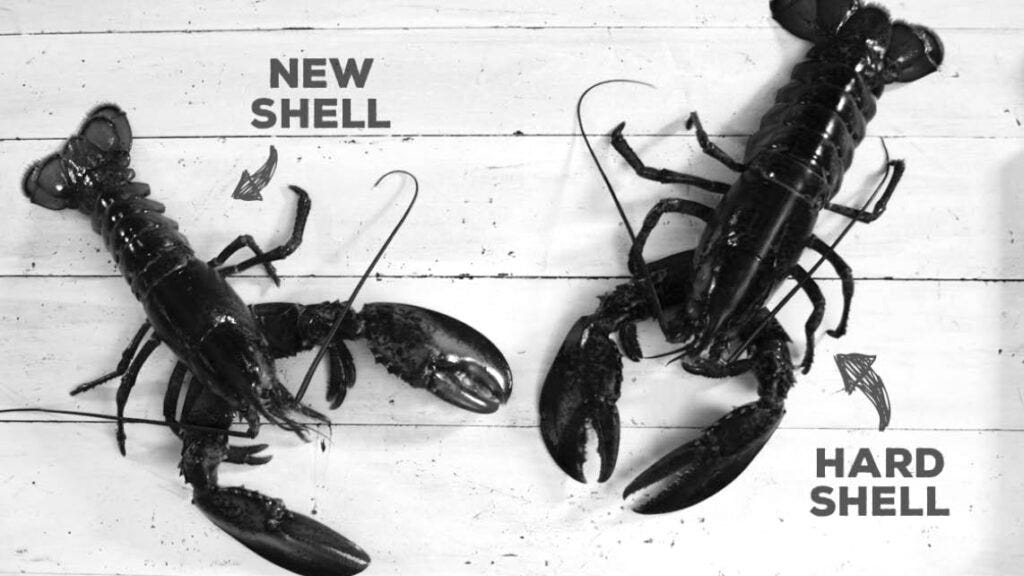
Most of what you’re feeling is the pressure of a shell that stopped fitting like a job that felt like solid ground, the degree you bought with four years and a pile of money. Or the identity of “the person who’s good at X,” where X is the exact thing a model now does in nine seconds for the price of a coffee.
That shell protected you for a long time. But, lately it pinches, and a quiet voice keeps telling you to crawl under a rock and split it.
Good news buried in that: “you’re pre-molt.”
The discomfort you’ve been medicating with podcasts and half-finished courses is the exact thing a soft body feels right before it gets bigger. It doesn’t prove you fell behind.
But I didn’t title this “the next 24 months will set you free.”
A molt is not a guarantee.
Plenty of lobsters die mid-molt, soft and exposed, or never harden right and stay vulnerable for good. The window cuts both ways. I’m not trying to add drama to boost the open rate on emails. Biology really does frame the moment like this.
So, I want to ask you, “how do you harden into the new shell instead of dying soft in the open?”
To answer it, you have to see why “forever” is even on the table.
Take a paperclip and a strong magnet. Rub the clip along the magnet a few dozen times, then pull the magnet away.
The clip is a weak magnet now. It stayed changed after the thing that changed it was gone. Heat it past a certain point and the magnetism vanishes in an instant, and cooling it back down won’t bring it back. The change ran one direction. The system carries its own history, and only some outside force can rewrite it.
In Physicists, it’s called hysteresis. Where a system ends up depends on the path it took, and some thresholds are one-way doors.
Your mind does this.
Hard.
There’s a stretch in early life where a brain absorbs language almost for free. A kid dropped into a new country at five comes out a native speaker, accent and all. Drop a 35-year-old into the same country and they’ll grind ten times harder for a quarter of the fluency, and keep their accent till they die. The window shut because a system that used to be soft hardened along the road it traveled.
Identity works the same way. This is where it stops being a fun physics fact and starts being your life.
I’ve written before about how the mind crystallizes in my past newsletter here:
You absorb beliefs to survive childhood. You repeat behaviors until they run on their own. Then you spend decades defending the self those behaviors built, because that self feels like reality itself instead of a stack of choices you could still revise. Past a certain density, the crystal barely dissolves. People stay in the dead job, the dead marriage, the dead worldview, because the version of them that would walk out no longer exists, and growing a new one feels like dying.
Now drop a once-in-a-species technology shift on top of a mind built like that.
For the next couple of years, the tools to learn anything, build anything, reach anyone are stupidly cheap and getting cheaper monthly. The molt is available to everyone at once. Which means the people who harden into a sovereign new shell during this window will pull away from the pack at a speed we’ve genuinely never watched before.
The ones who stay soft, who let it pass while promising to get to it later, end up on the wrong side of a one-way door. Watching a gap that compounds. Holding a shell that no longer protects them and a body too soft to grow another.
That’s the “forever.” A path-dependent system crossing a line it doesn’t reset from.
So far I’ve told you the window is real and the stakes stick. That’s the easy part. Everyone selling you a course agrees that far.
The hard part is that the thing about to catch most people will feel like relief.
A man named Jakob von Uexküll spent his life on a question most people never think to ask.
“What does the world look like from inside another animal?”
His favorite example was the tick.
A tick climbs to the tip of a branch and waits. It can wait an absurd length of time, reportedly years, in a kind of suspended state. For practical purposes it’s blind and deaf. Its whole reality runs on three signals: the butyric acid mammals give off, the warmth of a body, the feel of hair. A mammal passes under the branch, the tick smells it, drops, finds heat, burrows, feeds. That’s the world. Three notes. Everything else that exists, the color of the sky, the noise of a whole forest, never shows up for the tick. It doesn’t ignore those things. It has no organ to register that they’re missing.
Uexküll called that bubble the Umwelt. The self-world. Every creature lives inside one. Yours is far bigger than a tick’s, but it runs on the same rule. You perceive only what your senses and your concepts are built to catch. The rest may as well not exist.
The reason why this is the most important idea in the letter is “your Umwelt can shrink.”
There’s a model of the brain that’s quietly become one of the most useful ideas in neuroscience. It’s called predictive processing.
In simpler terms, your brain is a prediction machine. It’s constantly guessing what’s about to hit your senses, and what you “see” is mostly the guess. Reality only gets a vote when it disagrees with the prediction. That disagreement has a name. Prediction error. And prediction error is the only thing that forces your model of the world to update.
Your worldview changes only when reality contradicts it.
No contradiction = no update.
That means the model keeps running its old guesses, getting more confident and perceiving less.
If you look at what the next two years of technology are built to do, you’ll find:
Feeds show you what you already agree with.
Tools finish your sentence before you’ve finished thinking it.
Software sands every rough edge off your day so nothing surprises you, frustrates you, or proves you wrong.
The whole machine is aimed at driving prediction error to zero and handing you a world with no disagreement in it.
A world with no disagreement is a world where your model stops updating. Your Umwelt stops growing. Then it shrinks, because the muscles of perception waste away like any other muscle you stop using.
This is the trap.
Read it slowly, because it’s the reverse of what you’ve been warned about.
The tick on the branch is at peace. The person three years deep into a perfectly tuned feed, all want anticipated, and every friction removed, feels fine too. Comfortable. And maybe a little bored in a way they can’t name. Their world has quietly narrowed down to three signals and they’ve lost the organ that would notice what dropped out.
Let me give the cost a name so we can fight it. Borrow it from software engineers.
It’s called “technical debt.”
Every time you build something the fast, sloppy way, you take a small loan against the future, and one day the interest comes due and the whole system turns impossible to change.
You’re running up perception debt.
Each time you let a machine do your noticing, hand off the call, let algos sand the edge off a disagreement, you’re taking out a tiny line of credit on your own cognition. It feels like a gift. It accrues quietly and unaware. Then one day you go to update your read on the world, to catch the obvious opportunity sitting right in front of you, and the faculty isn’t there. The interest came due. You can’t see it. Someone with no perception debt looks at the same room and clocks a door you can’t even register.
The freed and the trapped will stand in the same room, looking at the same future. One sees a hundred open doors. The other sees three signals and feels calm.
Which loops us back to the pilot.
Remember the Boyd story I parked at the top.
Here’s what he found.
The MiG was the better aircraft by almost every number that mattered. But the F-86 had two boring edges.
A bubble canopy, so the pilot could see in every direction.
And hydraulic controls, so he could switch from one maneuver to the next faster, even when each single maneuver was slightly worse.
Better vision. Faster transitions. That’s the whole list.
Boyd worked out that a dogfight goes to the pilot who can run a full cycle of “seeing, understanding, deciding, and acting faster “than the other guy can run his. Do that a few times and your opponent is always reacting to a situation that’s already gone. He’s flying against your past. You’re operating in his future.
Boyd named the cycle the OODA loop.
Observe,
Orient
Decide
Act.
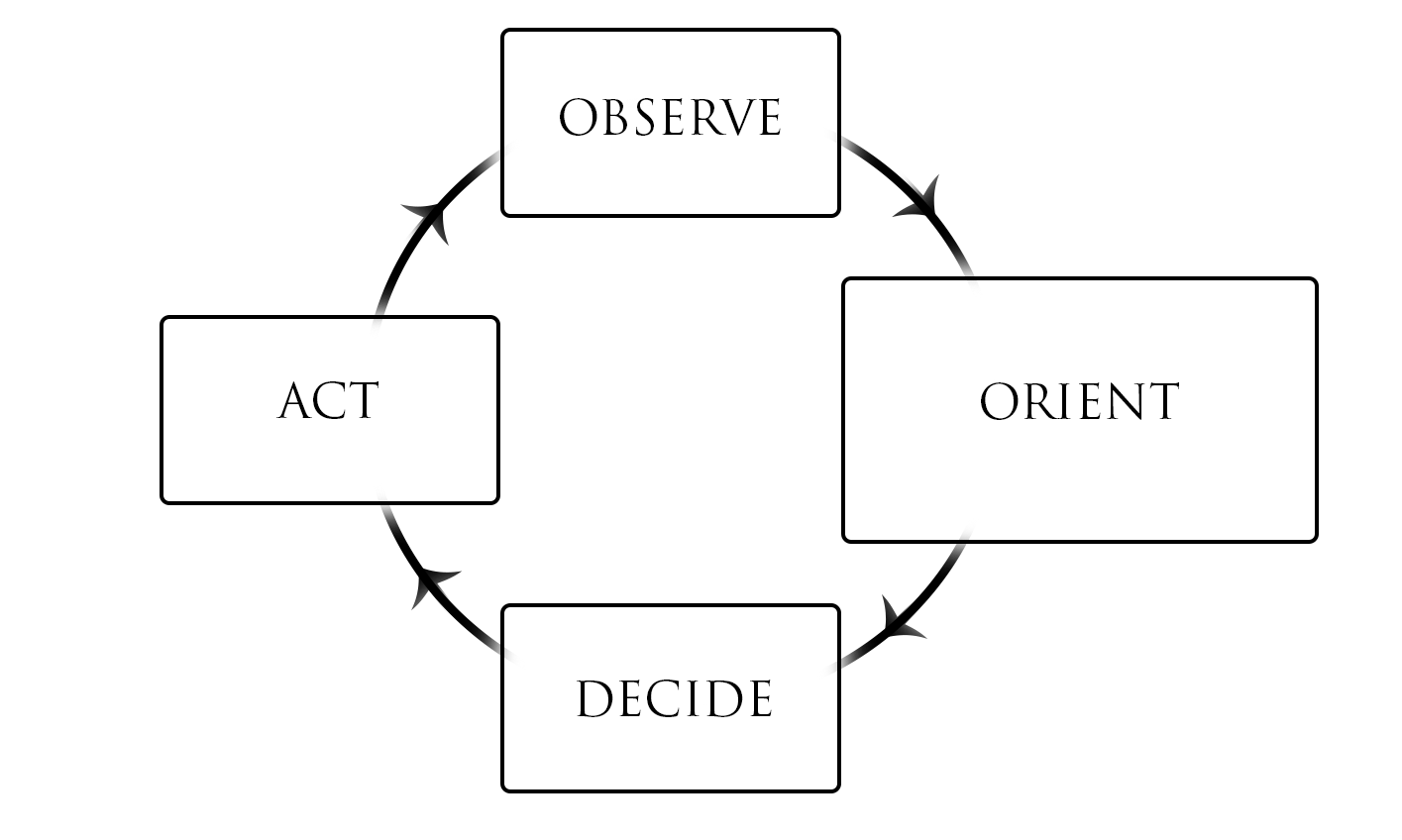
Get inside the other person’s loop and you win, even in the slower jet.
Now I want to point a flashlight at one step, because this is where the next 24 months get decided for you personally.
Observe is gathering raw information. Decide and act are choosing and doing. Boyd argued the step that actually wins fights is the quiet one in the middle. Orient.
Orientation is where raw observations run through everything you are like your experience, culture, hard-won mental models. It’s the part of you that takes the same facts everyone has and sees the thing they can’t. Boyd called it the big one. The point where the whole loop lives or dies.
Now watch what people are racing to automate.
They keep the doing close, because doing feels like work and handing off work feels like cheating. And they happily give away the orienting, because thinking is uncomfortable and a machine that hands you a ready-made take feels like a gift.
So they outsource the one step that was theirs alone, and cling to the steps a machine does better.
A person who outsources their orient step still gets to act. They stay busy and feel productive. But they’re a doer running inside someone else’s loop. The model decided what mattered, framed the options, set the orientation. The human pushed the button. From outside it looks like someone making choices. Inside Boyd’s frame, it’s a tick answering three signals, fast and completely captured.
The freed version is almost embarrassingly simple to say and hard to live. You keep orient. Fiercely. You let the machine help you observe wider than a human could and act faster than a human could. But the step where raw reality runs through the specific weirdness of your one life stays yours. That’s your bubble canopy. That’s what lets you see the door the calm, comfortable, perception-indebted person beside you never registers.
So. The window is real. The trap is perceptual and it wears the face of peace. The thing worth defending with your life is your own orientation.
What do you actually do about it, starting tomorrow, with a pen?
The goal here has nothing to do with becoming a monk who swears off every tool. That’s just trading one shell for another.
The point is to keep feeding your brain the one thing the whole world is now built to starve it of. Prediction error. Disagreement. Friction. You name it. It must keep your model alive and growing while the molt window is open.
I’m doing this on a regular basis and have seen miraculous results.
Run this for the next 24 months and you can make the door swing your way. The whole thing is just structured ways of paying down perception debt faster than you rack it up.
Pull out paper. This is built to be reread, not skimmed.
1) The daily error tax.
Once a day, on purpose, take in one thing that disagrees with you. Read the smartest person arguing the opposite of what you believe. Follow the account that makes your jaw tighten, the honest and well-reasoned one. The instinct will be to close the tab. That instinct is the sound of your model refusing to update. Stay in the discomfort five minutes and ask one question: what would have to be true about the world for this person to be right? You don’t have to agree. You have to stay soft enough to model it. Cheapest thing on this list, and almost nobody does it.
2) Orient before you outsource.
Hard rule for any real piece of work. Before you open the AI, write your own orientation first. Your raw take, your framing, your angle, in your own words, even if it’s three ugly bullet points. Then bring in the tool to observe wider and act faster. The order is the whole game. The day you start opening the chat box before you’ve thought is the day you pulled the canopy off your own plane. I write every one of these letters by hand for exactly this reason. The research and the grunt work, fine, hand it off. The seeing stays mine.
3) Widen the Umwelt weekly.
Block 90 minutes a week for a field you have no reason to study. A creator reads marine biology. An engineer reads poetry. A finance guy reads how medieval cathedrals got built. It feels like a waste, which is the point, because cheap dopamine trained you to read “no immediate payoff” as “waste,” and that feeling is the trap talking. Every field you add is a new set of sense organs. Your edge lives at the intersections only you happen to stand on. Digging deeper into the one thing a machine already owns won’t get you there.
4) Build in public to get real error.
Reality is the last honest source of prediction error, because reality doesn’t care about your feelings and won’t file down its edges to keep you comfortable. Publishing your ideas and your work where strangers can ignore it or tear it apart is the fastest way to find out where your model is wrong. The likes, the silence, the one brutal comment that happens to be correct, that’s pure signal. A private journal can’t argue back. The internet will. Treat every post as an experiment that returns data on where your map and the territory split.
5) The monthly molt question.
Tattoo this somewhere. This is the diagnostic.
Once a month, sit down and answer:
What’s one belief I held last month that I no longer hold? Write down the belief and what changed it.
If you can answer it, your model is alive.
If you go a month and the honest answer is “nothing,” pay attention. Three months in a row of “nothing” and you’re calcifying. Three “nothings” back to back is a fire alarm wearing the costume of a good mood.
That question is the whole letter squeezed into one line. Everything else is just keeping the answer from being “nothing.”
Heraclitus said it twenty-five centuries ago:
You can’t step in the same river twice.
The water has moved on, and so has the person standing in it. Reality never stops flowing. A model of the world stays strong only while it keeps learning and updating, matching the river as it moves.
Shunryu Suzuki put the other half in one sentence I think about constantly:
“In the beginner’s mind there are many possibilities, but in the expert’s mind there are few.”
The expert holds a dense, finished model, tuned to the point where it’s already ruled on what’s possible. The beginner sees a hundred open doors because nothing has hardened yet.
We spend our whole lives chasing “expert” and calling it growth. We’re about to do it with AI that can make us feel expert about everything, instantly, while quietly bricking up every door we didn’t already know was there.
The whole game for the next 24 months is to stay, on purpose, a little bit of a beginner. Keep your shell soft while everyone around you hardens into comfort. Pay the error tax. Guard your orientation. Widen the world. Answer that monthly question with something other than “nothing.”
Thank you for reading.
– Darshak
P.S. If this made you uncomfortable in a useful way, good. That was prediction error. Reflect upon it, and then send it to the one person you know who’s gone quiet on the branch.
Comments
Nothing yet. Say the first thing.
Sign in to join the conversation.