
Hey
I’m a little embarrassed to admit it but I’ll do it anyway. It feels right to do so.
Last week I was scrolling through old photos on my phone, and I stopped on one from two years ago. Me, standing in front of a building somewhere, smiling at whoever was holding the camera.
I have no memory of it. I couldn’t recall the building, or the day or who took that picture.
It just felt like…a photograph of a stranger wearing my face. I sat with it longer than I want to admit, trying to drag the day back up out of wherever it went. It wouldn’t come. Then a worse question showed up.
If that day is gone, how many others left with it? How much of the last three years actually made it inside me?
So I opened my calendar and went back, week by week. Tasks I ran. Places I visited to. People I met.
What bothers me is I’ve been doing everything right. As per my plan of life like a waking up routine, habit tracking, goals tracking, journal writing and even mindful eating. And it had been quietly erasing me while I patted myself on the back for it.
I spent the next few days trying to understand why this happened. What I found changed how I see my own life, my work, and every year I have left. I’m giving you all of it in this letter.
But I have to begin with a man who lost what you and I still carry. Because what took him in a matter of days is taking you, me and everyone slowly, through the exact same door.
In March 1985, a 47-year-old Englishman named Clive Wearing got a headache.
He was one of the finest musicians in Britain. A conductor and Renaissance music scholar who produced for the BBC, and who had staged the first authentic modern performance of Monteverdi’s 1610 Vespers. He thought it was flu.
But, later the doctors found it was herpes simplex encephalitis. Within days the virus had eaten his hippocampus.
What survived is almost worse than what died.
He can still play piano. He can still conduct a choir. He can still speak with the fluency of a man who spent his life on the radio. What he cannot do is hold a moment. His episodic memory runs somewhere between 7 and 30 seconds before the floor gives way.
But why am I sharing this story?
The reason is his notebook.
Clive kept a diary. Every so often he would surface into what felt to him like the very first conscious moment of his existence, and he would write it down with the shaking triumph of a man breaking the surface of a lake. Then twenty minutes would pass. He would surface again, find handwriting on the page he had no memory of producing, conclude that whoever wrote it must have been unconscious or dead at the time, cross it out, and write the entry again.
Awake. At last. For the first time. Crossed out. Awake, properly, now. Crossed out. Awake, perfectly, overwhelmingly, finally.
Hundreds of pages of it. The same sentence, in the same hand, with the same astonishment, every single time. A forty-year life recorded as one morning, written five hundred times, each version murdering the one before it.
Just look at his diary:
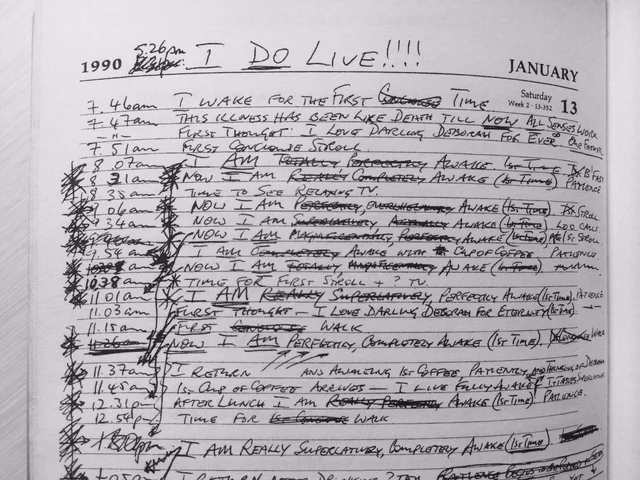
Whenever his wife Deborah walked into the room, he’d greet her like a man returned from a war. Nine minutes later she’d come back from the kitchen and he’d greet her exactly the same way. He’d have the same tears, because the last nine minutes never happened for him. And just like those nine minutes, neither did the twenty-two years before them.
Now do something for me,
Open your calendar. Go back three years. Pick a week at random and read it.
That week happened to you. You were there for all 168 hours of it. Your hippocampus was intact, fully staffed, working perfectly.
Account for it.
But, instead of the to-dos and meetings, recall the week. What were you like? What was your state of mind? What were you working on? Who crossed paths in your life that made a difference?
I’m afraid, you can’t. Nobody can.
That makes us all Clive Wearing in some way or the other. He’s forced by a virus and we by the habit of ignoring the real world experience being tied in a digital leash.
Before you decide that this letter is about gratitude or presence or slowing down, I want to say it’s none of those things.
You are neither depressed nor ungrateful. That queasy drop you feel when a birthday arrives and you think again, already?, that flicker in the shower when you realize you cannot reliably tell 2023 from 2024, that photograph on your phone of a place you have no memory of standing, all of it is a reading off an instrument.
The instrument is calibrated correctly.
Everything you are working toward will be delivered into a subjective lifespan that you are, right now, without knowing it, cutting roughly in half like the money, the body, the business and the person you want sitting across from you at sixty. All of it gets deposited into an account, and the account has a length, and the length is not the number on your gravestone.
Wealth stored inside a life you didn’t experience is a receipt for a meal you never ate.
And the behaviours doing the cutting are the exact behaviours you have been praised for since you were four years old.
So, I share six ideas. It will absolutely reframe your perception on life. And a practical approach on giving a meaning to life.
You are running two clocks and they disagree violently.
Psychologist Claudia Hammond calls the collision the holiday paradox. A three-hour flight delay is agony while you’re inside it and takes up almost no space when you look back. A week in Lisbon evaporates while you’re living it and then swells, in memory, into something that feels like a month.
Live, the delay is long. Remembered, it’s nothing.
Live, the week is nothing. Remembered, it’s long.
Two clocks. The felt clock and the remembered clock.
And they run in opposite directions because they measure different things. The felt clock measures how much attention you’re paying to time passing. The remembered clock measures how much got written down.
Hammond has estimated that an ordinary fortnight of adult life produces something like six to nine experiences worth committing to memory. On holiday, that’s six to nine per day.
Remember that ratio. Fourteen days of your normal life contain about as much recorded existence as one day of an unfamiliar one.
It reminds me of French speleologist Michel Siffre’s most dangerous experiment to experience it.
In 1962 he sealed himself in a subterranean glacier cave with no clock, no calendar, and no sunlight. He went down on 16 July and planned to come out on 14 September. When the team called down to say his time was up, Siffre was bewildered. By his own reckoning it was around 20 August. He had another month to go.
Twenty-five days had simply not registered.
Ten years later he tried again, harder.
Midnight Cave, Texas. 205 days underground, February to September, wired to electrodes, alone except for a mouse he tried to befriend with jam.
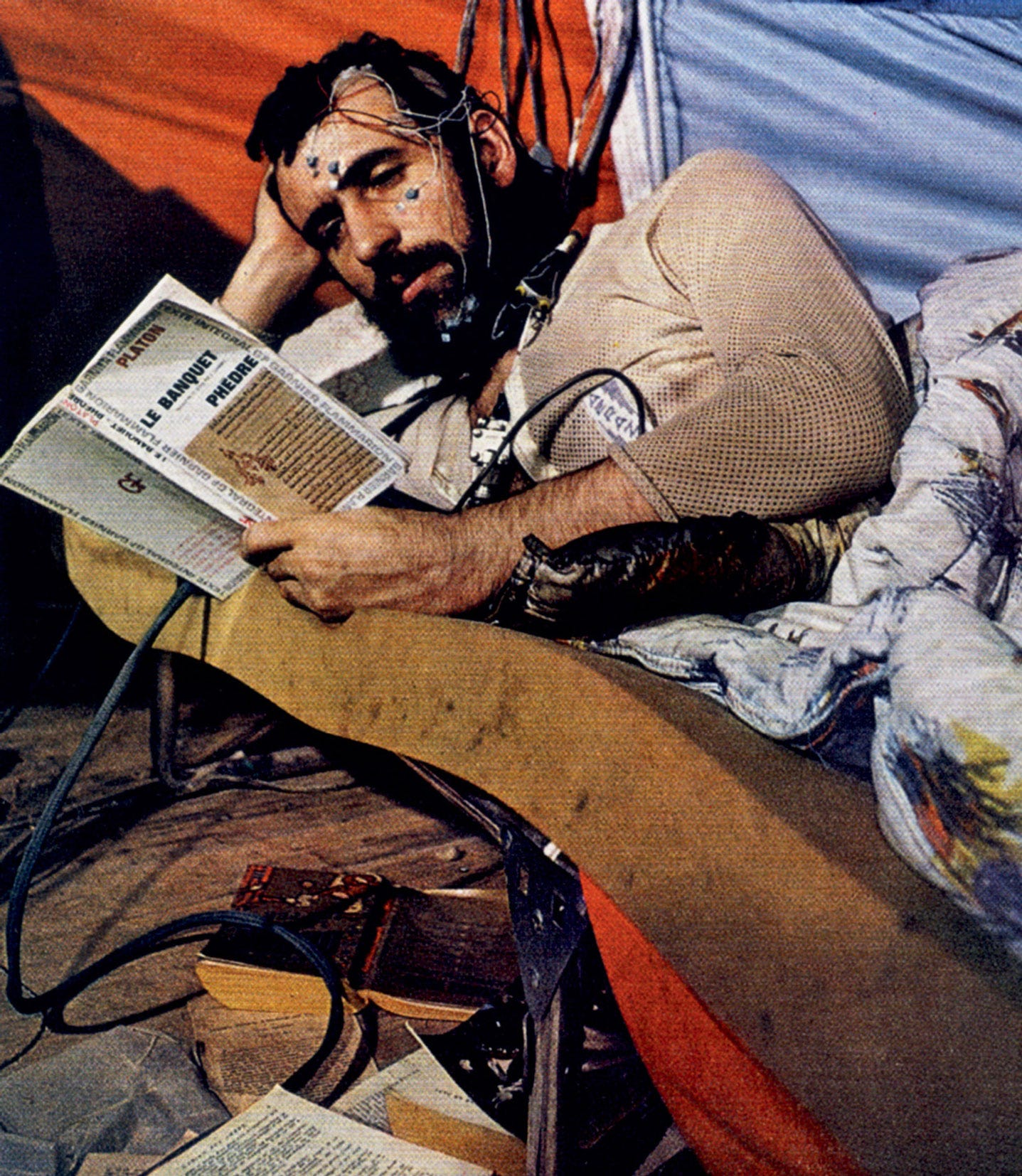
When they told him it was over on 5 September, he thought it was still mid-August. Three weeks gone. He said afterwards that when you are surrounded by night, your memory stops capturing time. He couldn’t tell a two-hour sleep from an eighteen-hour one. Some of his “days” ran 36 hours, some 52, and from the inside they felt identical.
One long day.
So, what was the cave actually measuring?
Only one of those two clocks ever issues you a life. The felt clock is a sensation, gone the instant it passes. The remembered clock is the ledger. When you are seventy and you sit down and ask what happened, you are reading the ledger. There is no other document.
Which means the thing you are spending is not time.
The thing you are spending is encoded time. The portion of your hours that made it to the page.
You do not have eighty years. You have however many of them got written down.
So, what you can do about it?
What happens if you point a security camera at an empty hallway and leave it running for eight hours?
Comments
Nothing yet. Say the first thing.
Sign in to join the conversation.