
The best thing that can happen to you is to lose something you can’t picture living without.
I know how that reads. Like something printed on a mug in an airport.
But sit with where you actually are for a second.
Maybe you torched a business you spent years building.
Maybe a relationship ended and took your sense of who you are with it.
Maybe you woke up one ordinary day and realized the life you’re living was designed by a version of you that you don’t even like anymore.
Whatever put you on the floor, you’re there now. And every instinct you have is screaming the same command:
** get back **
Back to the income. Back to the body. Back to the momentum you had before the whole thing came apart.
That instinct is the exact thing keeping you down. Stay with me and I’ll show you why.
In December of 1849, a 28-year-old writer stood in a freezing square in St. Petersburg, hands bound, waiting to be executed.
His name was Fyodor Dostoevsky. His crime was belonging to a circle of young men who met to read banned books and argue about a better Russia. For that, the Tsar sentenced them to death by firing squad.
They marched the prisoners out into the snow. A priest offered a final cross to kiss. The first three men were tied to the posts and hooded. Dostoevsky stood in the next group, which meant he had maybe sixty seconds left to live.
He later wrote that he spent those seconds doing a strange arithmetic. He divided up the time he had left. A few moments to say goodbye to the men beside him. A couple to think about his own life. The rest to look around and take in the world one last time. He stared at a church dome catching the sun and thought that in a minute he would be part of that light, part of everything.
Then the drums rolled for the soldiers to raise their rifles, and a horseman came tearing across the square with an envelope.
The sentence was commuted. The whole execution had been staged on the Tsar’s orders, theater designed to break them. One man in his group lost his mind on the spot and never got it back.
Dostoevsky was loaded onto a sled that night and sent to four years of hard labor in a Siberian prison camp.
AND this was the turning moment in his life.
He came back a different writer entirely. The man who walked into that snow had published one decent novel and a handful of forgettable stories. The man who came out of Siberia wrote Crime and Punishment, The Idiot, and The Brothers Karamazov. He became one of the few novelists people still argue about two centuries later. The collapse handed him a life the comfortable version of him could never have reached.
That gap, between the man who was almost shot and the man who wrote the greatest novels in the Russian language, is the entire subject of this letter.
Because there are two kinds of comeback, and almost everyone reaches for the wrong one.
The first kind is restoration. You claw your way back to your old baseline, your old numbers, your old self, and you call that winning. Most people who try this either fail, or they succeed and find themselves rebuilding the exact life that collapsed on them the first time.
The second kind is what happened to Dostoevsky. You use the collapse as raw material. You let the old version die all the way, and you come back as someone the old you had no way of becoming without first being destroyed.
This letter is about the second kind.
And there’s a real mechanism underneath it, borrowed from a place you wouldn’t expect.
Most of your life, you are protecting something. Your self-image. The story of who you are.
You defend it the way your body defends against a virus, because an identity under threat feels exactly like physical danger. Same racing heart. Same heat in the chest.
I keep coming back to this in my writing: you adopt a goal, you act toward it, the behavior becomes automatic, and eventually it hardens into “I am the type of person who.” Then you spend years guarding that sentence, even when it’s quietly ruining you.
This is why change is so hard when life is comfortable. You have too much to protect. The half-decent job. The relationship that’s fine. The identity that mostly works. There’s always a reason to wait.
Rock bottom removes the thing you were protecting.
When you’ve already lost the job, the money, the relationship, the reputation, there’s nothing left to defend. The self you spent a decade guarding is on the floor with you, and for the first time you can look at it honestly. You can finally ask the question comfort never lets you ask:
was I even building the right thing?
Carl Jung rightly said,
“There is no coming to consciousness without pain.”
This is why people describe their worst year as the one that saved them. The loss did the demolition they were too scared to do themselves. The bottom is the only place where you owe nothing to the person you used to be.
There’s a Japanese craft called kintsugi.
When a bowl breaks, instead of hiding the cracks, they fill them with gold. The repaired bowl is worth more than the original was, and everyone can see exactly where it broke.
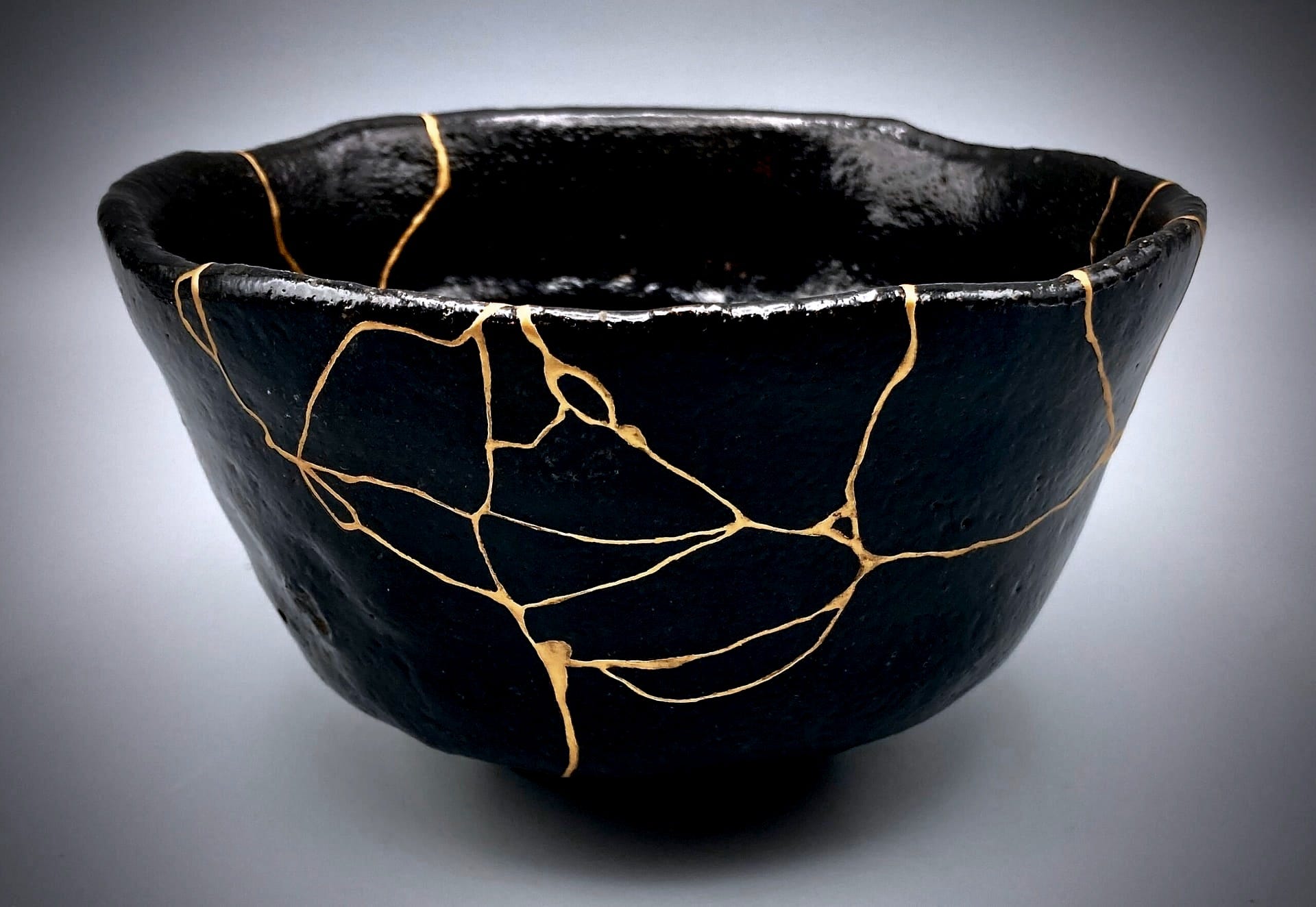
You’re a broken bowl right now. Most people spend their whole comeback gluing the pieces back so nobody can tell.
The work in this letter is about the gold.
Every serious lifter understands what almost nobody applies to their actual life:
When you train hard, you don’t get stronger in the gym. You get weaker. A hard session tears the muscle down and leaves you below where you started. Sore, depleted, worse than when you walked in.
The strength comes later, during recovery.
And if the recovery is done right, your body does 2 things:
patch you back to your old level.
It overshoots and rebuilds you slightly stronger than before, bracing in case a stress that big ever happens again. Sports scientists call this supercompensation.
Draw it as a line. It drops below baseline first (the workout), climbs back up through recovery, then peaks above where it started.
The same curve governs every real comeback. The collapse is the workout. It drops you below baseline, and it’s supposed to. The months that follow are the recovery, the unglamorous middle where nothing looks like it’s working and you feel weaker than the person you were before the fall.
That middle is where almost everyone quits. They feel the soreness and assume the damage is permanent. They look at the dip in the line and think it’s the new floor, when it’s just the bottom of a curve.
Two things wreck supercompensation in the gym, and both have exact equivalents in a comeback.
The first is training again too soon. You pile a second heavy stress on a body that hasn’t recovered, and instead of overshooting, you spiral further down. In a life, this is the guy who loses the business and panic-launches a worse one a week later. The guy who gets out of one relationship and sprints into an identical one a month later. He never let the recovery happen, so he just digs the hole deeper.
The second is never training again at all. You get so afraid of the soreness that you stop applying any stress, and your body settles permanently below where it was. In a life, this is the person who plays it safe forever after one bad fall. They protect the wound so carefully that the wound becomes their personality.
The overshoot only happens in the narrow band between those two mistakes. Enough recovery to rebuild. Enough new stress to grow.
“Difficulties strengthen the mind, as labor does the body.” — Seneca
So the whole game is learning to read your own curve. Knowing when you’re in the dip and need to stop reading it as the end. Knowing when recovery is done and it’s time to load the bar again.
How you actually do that is the rest of this letter.
I built a three-phase protocol I run on myself, the same one I’d hand to a friend who lost everything and called me at midnight. It takes one evening to start and a few months to finish. Each phase maps onto the curve: the drop, the recovery, the overshoot.
Phase one is the part everyone wants to skip. Skip it and the comeback collapses a second time, usually inside a year.
Let’s start there.
Comments
Nothing yet. Say the first thing.
Sign in to join the conversation.