
Disclaimer: this article and every article on my Substack do not represent the opinions of my employer, or any affiliated organizations and public bodies I volunteer with or serve on. These posts are my private opinions in my individual capacity.
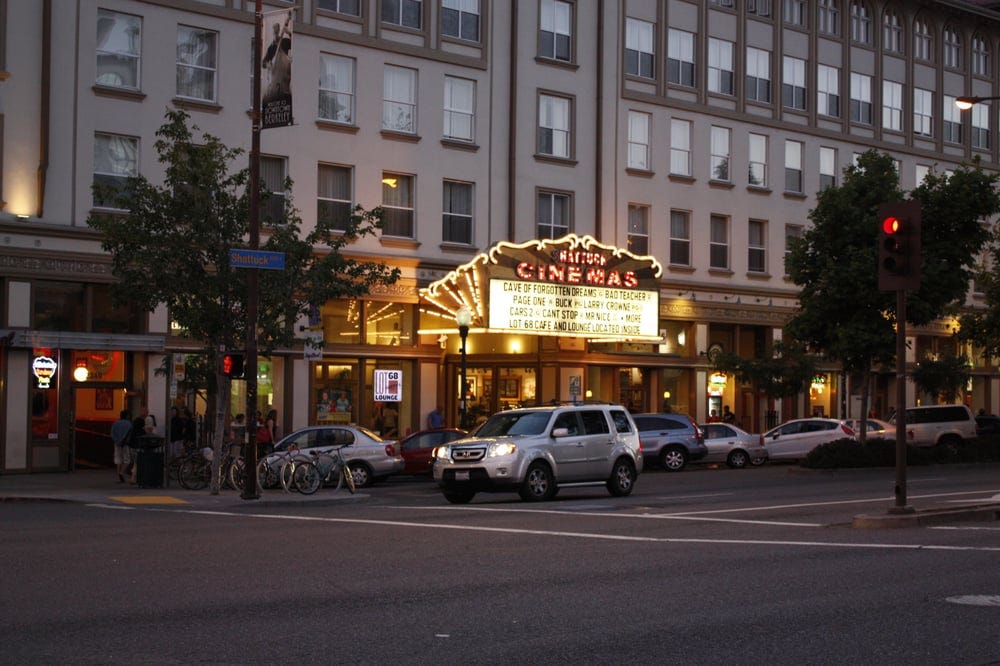
Like other urban areas, downtown Berkeley had many movie theaters, and now it has none. With the rise of streaming and cheap, widescreen LEDs, movies are more accessible than ever to the general public. Streaming is becoming more economical for families since it’s pay-by-program, rather than per person at the cinema, and that’s excluding concessions.
Movie theaters have long been difficult to operate because companies distributing the movies take about 80% of the ticket sales revenue, and theaters overwhelmingly rely on concessions for income. The popcorn, snacks, pre-credit advertisements, and 20% of the ticket price fund the jobs at the theater, the rent being paid, and the capital costs like seats and lighting.
Corporations like AMC and Century built modern theaters with lots of food, seats, big screens, and put hundreds, if not thousands, of independently-owned theaters out of business decades ago. Since the 1970s, studios and theaters have depended more on younger audiences for high-volume ticket sales, but young people now watch programming on their phones nonstop.
Although cinemas were declining in frequent patronage, which was essential for a theater’s survival, people still go to cinemas at least a couple of times a year, particularly for the big-budget movies. I, like millions of others, stepped into the theater this year to see Superman, K-Pop Demon Hunters, and Avatar on the big screens, Wicked and several classics at a neighborhood theater in Oakland.
There’s actually been a measurable resurgence of youth attendance at movie theaters who are looking for a reprieve from endless scrolling. Young people seem to swell theaters for culturally cool movies like Super Mario Bros., Spongebob and Minecraft.
Cinemas provide unique entertainment in an era where urban commercial districts are becoming nothing but restaurants and cafes. They help the local economy by drawing people into neighborhood businesses before and after the picture.
Berkeley attempted to save its local cinemas through development projects and landmarking. Both of which have failed, and our downtown — finally ripe with a high density of young people who could walk a block and watch the movies — is worse off because of it.
I won’t be pointing any fingers of blame at our loss of theaters in Berkeley. It’s pointless. Oakland lost almost all its downtown theaters. Most city centers in the Bay Area lost their theaters. It’s easy to break every issue down into pro- or anti- housing and preservation, but reality is always harder.
I’d like to see a cinema in downtown Berkeley again that I can go to a few times a year instead of venturing to neighborhood cinemas in Oakland. Most communities would like at least one centrally-located theater to go to.
How did we get here, and what can be done?
After years of losing cinemas citywide, a small, off-and-on downtown theater (Fine Arts) in 2002 was redeveloped into a cinema-themed apartment building with a new cinema built in it. But the old cinema owner could not raise the capital to equip the theater, so the screen auditoriums lay dormant in the apartment complex to this day and are probably used for storage.
Shattuck Cinemas, owned by the Landmark corporation, closed after a long, slow death. It was the prettiest of our three big theaters, but Landmark always sent the big box office films to the California Theater, its other theater a block away. Shattuck Cinemas was targeted for a new housing project that had originally been planned as a 17-story apartment with a revamped theater, featuring 10 modern screen auditoriums.
We didn’t realize it at the time, but this was Berkeley’s last chance at remaining a cinema town. Modern theaters with IMAX or large-format screens and large sound systems are the only for-profit theaters being expanded or proving very profitable post-pandemic. They’re successful at drawing crowds when playing big box office movies because streaming has not yet replicated these immersive experiences. Emeryville’s AMC theater had long been successful at stealing Berkeleyans and Oaklanders away from our older, local theaters.
But the project became a massive, political tug of war between people who wanted to preserve a historic landmark and people who wanted a modern theater with housing on top. Voter referendums, lawsuits, hours of testimony, and millions in non-theater community benefits. The project couldn’t handle it, and financing collapsed after 7 years of battle. Another developer later bought the site, and Landmark Corporation closed the cinema down. The developer demolished it for a small apartment complex. As of now, it’s a gruesome metaphor for that period of Berkeley civil war with no winners: a big pit in the ground.
A year before Shattuck Cinema’s demise, the California theater was closed in 2021 by Landmark Corporation, which also shuttered a dozen others, including cinemas in San Francisco. The property sat in limbo before a developer bought it and proposed a housing tower over it with the theater converted into a playhouse. This development failed, and the site is now back in limbo. Since then, Landmark has shuttered other California theaters, including its Albany theater just outside of Berkeley.
Lastly, the United Artists theater, a popular theater with a grand Art Deco lobby, closed after its owner, Cineworld, filed for bankruptcy and shuttered 39 locations nationwide. A developer had already bought it, intending to turn it into apartments with the Art Deco facade mostly preserved. This has spurred a preservation group to fight for the theater building to be preserved as a landmark.
And that’s how we lost all of our big theaters, except for one small, independently-owned neighborhood one. Most theaters outside of downtown have not been targeted for development, but they’ve ceased being movie theaters nevertheless. My neighborhood theater, Oaks Theater, had its exterior preserved in the 2010s, and it is used as a climbing gym.
There’s a lesson here, and it’s not relitigating the past.
The best public services are paid for by the public. A big mistake we made, among many, was depending on unfunded mandates from borrowed capital to fund what was increasingly a public, not necessarily profitable, desire.
Understanding this, local governments should subsidize nonprofits or small local for-profit companies to acquire at least one movie theater. This is what nonprofits are best at: things that aren’t life-and-death essential public services, but are still pleasant, yet not easily or always profitable.
What Berkeley should have done was use a low-interest loan to help a non-profit cinema company purchase and operate a movie theater. It could be funded through a bond measure, and I’d happily vote for that.
The New Parkway Theater in Oakland has successfully pulled this off. It’s an independent theater with a variety of concessions, very comfortable seating, and a showing of the latest blockbuster movies. It saved a dying downtown theater through community support. For non-IMAX movies, I usually go to the New Parkway.
Independently run, they depend on the generous donations of community members and patrons to operate. The New Parkway also doubles as a community space and has an expansive concessions stand and comfortable couches — better than even big corporate movie theaters. I go to the New Parkway and young people who now reside en masse in downtown Berkeley would certainly patronize it as well.
A non-profit or publicly-subsidized small cinema can show a variety of programs that a corporate cinema can’t, such as niche films and historic films. Those programs attract a crowd of movie buffs who actually care about films and are less likely to whip their phones out during a movie.
While many have dismissed the death of movies as inevitable, cities need a diversity of things to do beyond just eating and sleeping. Our urbanizing districts have mostly become high-density residential communities with restaurants. In addition to cinemas, we should have more playhouses, concert venues, bars, lounges, and night markets. They don’t all require subsidies like a cinema, but require some vision vibrancy beyond just population density.
We should raise a modest tax to either purchase or subsidize the current owner of the California Theater, to transform it into a non-profit or independently-operated movie theater in Downtown Berkeley. If not this one then possibly the vacant venue at Fine Arts. Although I’m not tied to any one venue.
I don’t think most theaters should be preserved, but cities should have at least one. I’m willing to work with the preservationists like Save United Artist on this task and pro-housing and pro-preservation people should see common ground here.
The California Theater seems like the obvious choice since the housing project has failed this year. The city could offer to buy the parcel and deliver it to a nonprofit or local cinema company with a low-interest loan, or the city could help fund a theater in a new building, and not just mandate it without a subsidy like the flop that was Fine Arts Theater.
“Theater deserts” are becoming common throughout small-town America. They will also hit parts of urban America unwilling to support movie theaters. I’m not looking forward to a future where children and community members just sit inside and scroll all day.
Where Berkeley lacks in cinemas, it excels in playhouses, but the market didn’t make our playhouses happen by itself. The city issued low-interest loans and bond measures to help playhouses like our famous Berkeley Rep. Berkeley is considering a tax measure to help playhouses and performing arts in 2026.
I think helping a single cinema company get started downtown should be included.
No posts
Comments
Nothing yet. Say the first thing.
Sign in to join the conversation.