
Welcome, dear reader.
The most dangerous assumption in a major compliance rollout is that day one will be clean.
France appears to understand this. The country is not postponing its e-invoicing reform. Instead, it is preparing companies for what large regulatory programmes look like in real life: unavailable platforms, routing failures, rejected invoices, fallback channels, reporting delays and internal systems that are not perfectly aligned on the first day.
That makes France the centre of this issue. But the larger theme goes far beyond one country. Compliance is no longer only a legal requirement implemented through software. It is becoming an operating capability - and increasingly, an intelligence problem.
Our work with AI is therefore moving far beyond the creation of another chatbot. We are exploring Compliance Intelligence: how laws, technical specifications, tax authority guidance, validated interpretations, deterministic rules and audit evidence can be transformed into trusted, structured and usable knowledge. In that model, the language model is not the authority. It is the interface to verified authority.
In this issue:
why France’s 1 September 2026 deadline still stands - and what serious preparation now means;
why LLMs should not act as direct decision engines for legally relevant outputs;
why countries need control over the intelligence behind tax and compliance systems;
whether AI could allow large enterprises to replace traditional software vendors;
and why creativity sometimes begins when profit stops being the only target.
Know someone responsible for France, POS, e-invoicing, fiscalization or AI governance? Forward this issue to them before you continue.
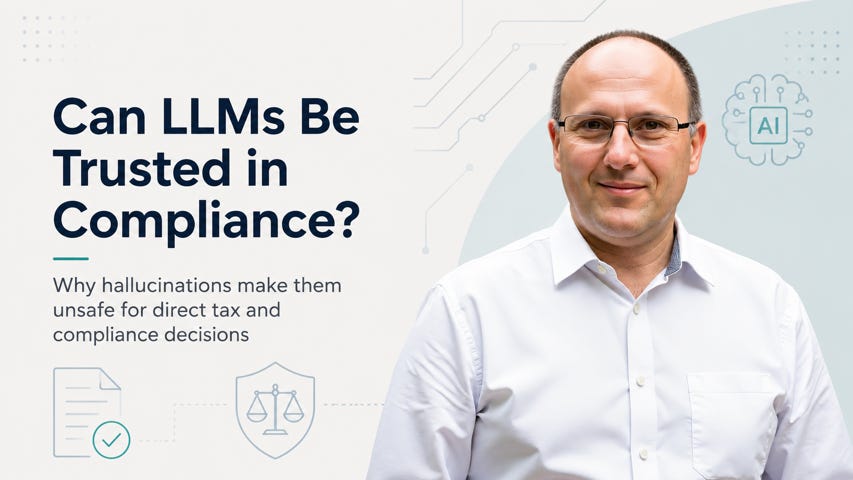
One question is becoming increasingly important for everyone working with tax, fiscalization, e-invoicing, POS systems and compliance automation: Can large language models be trusted to perform compliance-related tasks?
My current answer is clear: not as direct decision engines for legally relevant outputs.
The problem is not that LLMs are weak. The opposite is true. They are powerful, fast and often convincing. They can search, summarize, explain, compare and draft. They can help people navigate a difficult regulation or understand a technical specification much faster than before.
But the same fluency creates the risk. A language model can produce an answer that sounds complete and professional even when part of it is wrong, unsupported or invented. In ordinary communication, a non-zero risk of an incorrect sentence may be manageable. In tax and compliance, the output may influence a VAT calculation, a fiscal receipt, an e-reporting message, an audit trail or a legally relevant decision.
Compliance requires more than plausibility. It requires repeatability, traceability and evidence. The same transaction, the same facts and the same applicable rule must lead to the same result. A probabilistic answer cannot quietly replace a deterministic control simply because it sounds intelligent.
The boundary should therefore be explicit:
LLMs can help discover, summarize and explain official material.
LLMs can support drafting, comparison and user interaction.
Validated rules and deterministic services should calculate or decide legally relevant outputs.
Every important answer should remain connected to its source, version, interpretation and audit evidence.
This does not reduce the role of AI in compliance. It defines a safer and more valuable one. The real opportunity is not a chatbot that merely talks about regulation. The opportunity is an architecture in which AI can interact with structured legal knowledge, controlled interpretations, executable rules and an evidence layer.
That is one of the concepts we are now researching. It is not a quick feature and it is not ready to become the decision engine of a business-critical tax process. There is still a long way to go. But the direction is becoming much clearer: the language model should make trusted compliance intelligence accessible, not become the source of truth itself.
Read the full analysis: The Compliance Risk AI Cannot Talk Its Way Out Of
If your AI and compliance teams are debating where AI should advise and where deterministic controls must remain in charge, forward this section to them.
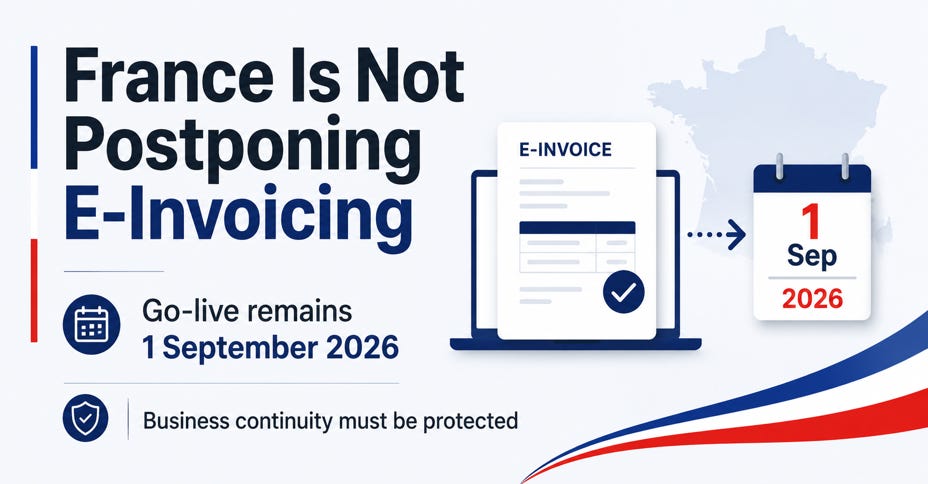
France has made one thing clear: the e-invoicing reform is still moving toward 1 September 2026.
The French tax administration has published practical start-up guidance for mandatory e-invoicing. The formal message is simple: companies must continue preparing to receive electronic invoices, and companies already covered by the issuing obligation must be ready to issue them through the approved infrastructure.
But the most important message sits behind the formal deadline. France knows that go-live will not be perfect.
Platforms may be temporarily unavailable. Routing may fail. An invoice may be rejected by a buyer. The same document may move through more than one channel. E-reporting data may arrive late. Finance, accounting, ERP, POS and operational processes may not yet be fully aligned.
The administration is not pretending that these scenarios will disappear. Instead, it is distinguishing between two very different behaviours: a company that encounters real start-up problems, documents them, continues implementation and corrects them - and a company that simply waits, avoids the new system or uses complexity as an excuse.
That distinction changes the real preparation question.
The question is no longer only: Is the platform connection ready? The more important question is: What happens when the connection, routing, status or downstream process does not work as planned?
Fallback procedures when an approved platform or internal integration is unavailable.
Duplicate controls when the same invoice moves through alternative channels.
Status handling for rejected, refused, corrected and re-routed documents.
E-reporting delays, correction logic and reconciliation with accounting records.
Evidence storage showing what failed, when it failed, which alternative process was used and how the issue was corrected.
Clear instructions for finance, accounting, operations, customer service and IT - not only for the project team.
This is where the reform stops being a technical integration project and becomes an operating model. A connection can be tested in a laboratory. Operational resilience can be proven only when the organization has defined how people, systems and evidence work together under imperfect conditions.
The guidance also sends a pragmatic signal about business continuity. A genuine commercial document arriving through a fallback channel should not automatically stop payment, accounting or the wider business process. But that flexibility is not a loophole and it does not change the target model. Alternative channels are continuity mechanisms, not a substitute for the approved electronic process.
France is therefore not delaying e-invoicing. It is preparing companies for the messy reality of go-live.
The best-prepared companies will not be the ones assuming everything will work perfectly on 1 September 2026. They will be the ones that have designed, tested and documented the exceptions.
Read the full analysis: France Is Not Delaying E-Invoicing - It Is Designing the Messy Start
Forward this section to the person who owns your France go-live plan. The real test is not whether the happy path works - it is whether the organization knows what to do when it does not.

I am proud to share that I have joined the AI for Developing Countries Forum as CEO and representative of Fiscal Solutions.
For us, AI is not only a tool for reducing costs, automating processes and improving efficiency. AI is becoming essential infrastructure. Its benefits should not be reserved for the largest companies and wealthiest countries, and its most critical layers should not remain understandable or controllable only by a small number of global platforms.
This is especially important in tax and compliance. When a country digitizes tax administration, it is not merely building portals, forms and reporting channels. It is creating a digital nervous system for the economy - one that touches invoices, receipts, transaction data, validation logic, risk signals, audit trails and enforcement decisions.
The strategic question is therefore not only: Which AI model should a country use? The deeper question is: Who controls the intelligence that interprets and applies the rules?
Governments should be able to understand, govern and develop the systems that interpret their own tax and compliance requirements. Depending entirely on external intelligence can create a new form of technological and regulatory dependency, particularly for developing countries with limited bargaining power and fewer local alternatives.
Learn more about the AI for Developing Countries Forum
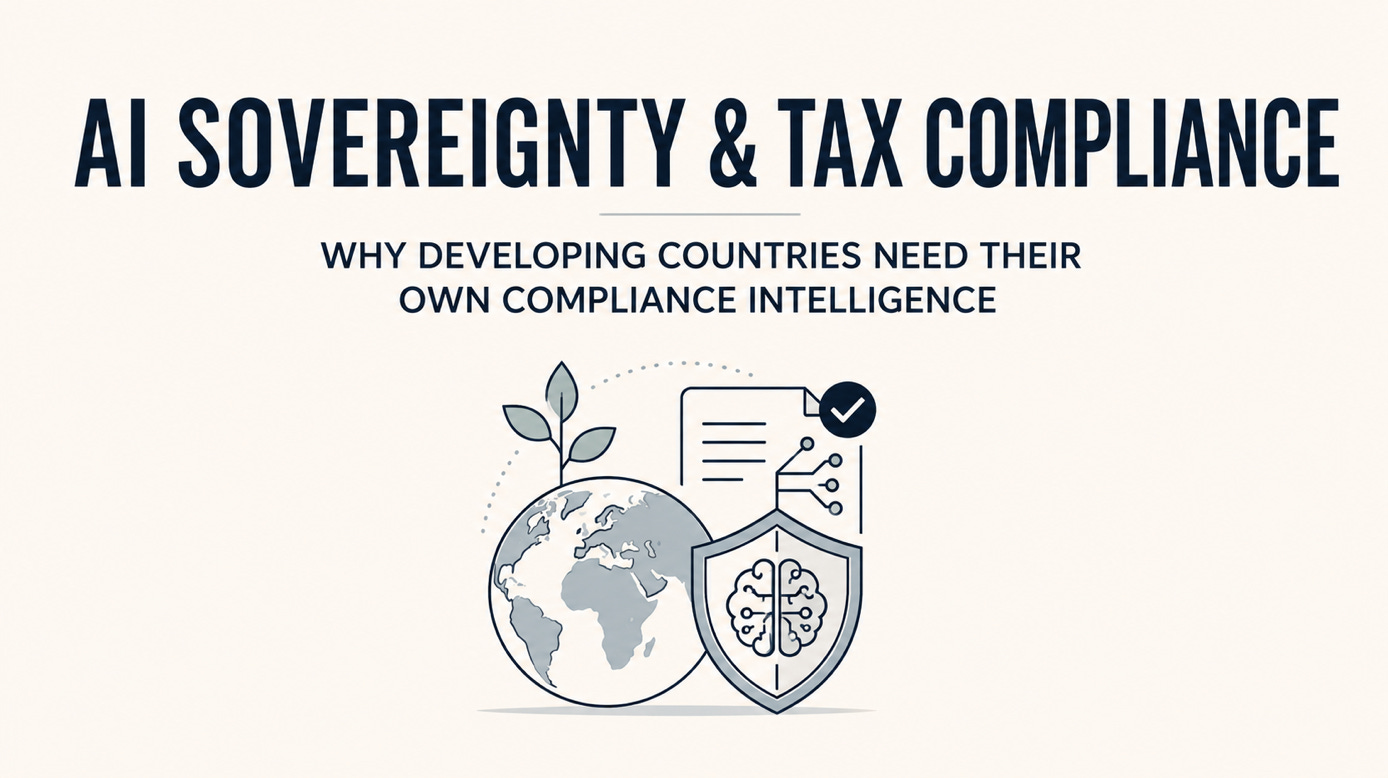
The missing layer is what I call Compliance Intelligence.
Compliance Intelligence connects official laws, technical specifications, tax authority guidance, certification requirements, validated interpretations, business processes, data models, validation rules and audit evidence into one trusted, source-grounded system.
In such an architecture, the language model is not the authority. It is the interface to authority. The authority remains the official source, the accepted interpretation, the deterministic rule and the auditable compliance model.
Sovereignty does not mean rejecting global technology. It means deciding deliberately which layers can be sourced from the market and which layers must remain under national or institutional control. A country may use international cloud services, open-source models or commercial AI tools while still owning the legal knowledge, rule definitions, evidence standards and governance mechanisms that make the system trustworthy.
For developing countries, this architecture could improve access to knowledge, taxpayer service, regulatory consistency and domestic revenue. But the value will be sustainable only when local institutions can understand, validate and control the intelligence on which their tax systems depend.
The countries that own their compliance intelligence will own a meaningful part of their economic future.
Read the full article: AI Sovereignty and Tax Compliance
Share this with someone working in tax administration, public digital infrastructure or AI policy. The debate about AI sovereignty becomes much more concrete when the intelligence applies legal rules.
You know fast fashion and fast food. Retail Talks is our format for fast analysis.
As soon as something important happens in retail or retail technology, we take one topic and discuss it in no more than 20 minutes. The goal is not simply to repeat the news. We ask what sits behind it, what it changes, which risks it creates and how it could influence the future of retailers and technology providers.
In the latest episode, we discuss whether AI is beginning to challenge not only SaaS products, but also the role of traditional enterprise software vendors. Starbucks has publicly signalled that it plans to replace two major enterprise software solutions with internally developed capabilities. Is that an isolated decision, or an early sign that AI will make it easier for large companies to build, adapt and operate more software themselves?
For software companies serving large enterprises, this is not an abstract question. It goes directly to product strategy, defensibility, implementation models and the value a vendor must continue to provide when development itself becomes cheaper and faster.
Watch Retail Talks and explore all episodes
Join us live every Wednesday at 3:00 p.m. CET on Substack, LinkedIn, YouTube and X.
Know a software founder, product leader or enterprise architect thinking about this shift? Send them the episode and ask whether their current business model is still defensible.
Profit is excellent at optimization. It teaches the mind to notice opportunities, compare returns and act quickly.
But when profit becomes the only objective, it can also place boundaries around imagination. Every idea is forced to justify itself too early. Every experiment is measured before it has had time to become interesting. Innovation remains inside a frame - a profit frame.
Some of the most important ideas appear when the mind is temporarily free from a business target. You explore because the question itself is irresistible. You connect things that do not yet belong together. You experiment without knowing whether the result can be sold.
Then something changes. You begin to see possibilities everywhere.
The rare skill is to preserve that state of mind while still understanding how business works. When you can do both, you become more than someone who recognizes opportunities. You become an incubator for ideas that did not exist before.
A question for you: When was the last time you explored an idea without asking immediately how it could make money?
Fiscalization is still managed by many companies as a series of urgent, country-by-country projects. That approach creates duplicated solutions, rising costs, delayed rollouts and compliance risk.
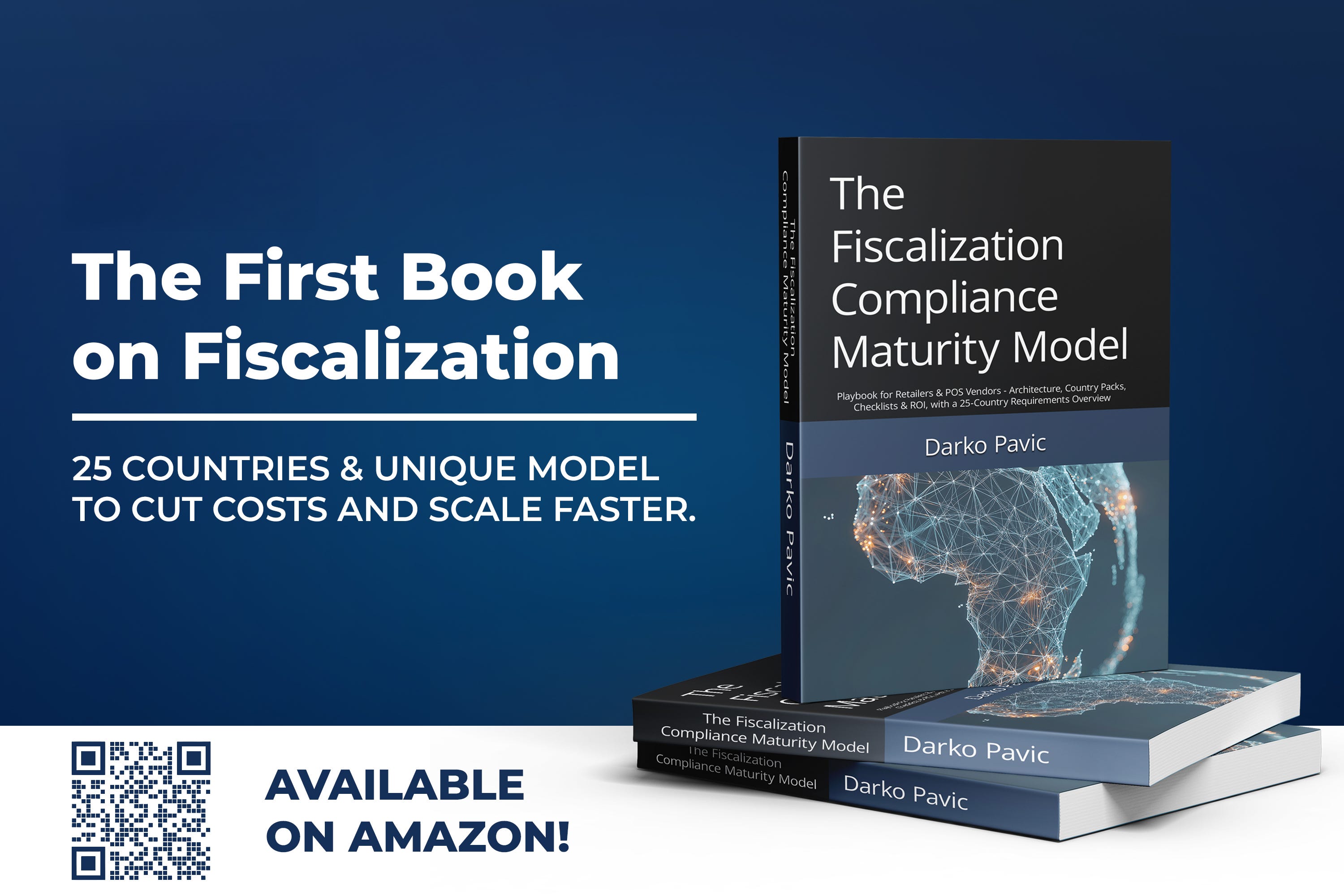
In The Fiscalization Compliance Maturity Model: A Playbook for Retailers & POS Vendors, I introduce a practical four-level framework - Reactive, Fragmented, Connected and Strategic - that helps organizations assess where they are today, define the maturity level their strategy actually requires and identify what they should improve next.
The book goes far beyond theory. It includes:
a step-by-step roadmap toward scalable, repeatable compliance;
guidance on architecture, middleware, certification and regulatory monitoring;
team structures, responsibilities, KPIs, ROI models and implementation checklists;
practical lessons for both retailers and POS software vendors;
and an extensive appendix explaining fiscalization models across 25 countries.
It is written for retailers, POS providers and compliance teams that want to reduce risk, accelerate international rollouts and turn fiscalization from a recurring burden into a durable business capability.
Order The Fiscalization Compliance Maturity Model on Amazon
France’s message is operational: do not design only for the perfect transaction. Design for the exception.
The AI message is architectural: do not make a probabilistic model the source of legal truth. Build trusted knowledge, deterministic controls and evidence around it.
And the sovereignty message is strategic: the institutions that depend on compliance intelligence must also be able to understand and control it.
These may look like different topics, but they point to the same future. Compliance is becoming infrastructure. The companies and countries that treat it as a capability - not a last-minute project - will be able to move faster with less risk.
If one idea in this issue was useful, please do not only save it. Forward the newsletter to one person responsible for retail, POS, e-invoicing, fiscalization, tax technology or AI governance. That is the best way to help these ideas reach the people who can use them.
I would also like to hear from you: What is the biggest exception your France programme has not yet tested - or which part of compliance intelligence should never be outsourced?
Reply to this email or leave a comment. The strongest ideas often begin with a practical disagreement.
Thank you for reading, and I hope to see you at the next Retail Talks.
Darko
P.S. Future of the High Street grows mainly through readers who forward it. Subscribe or share the newsletter here.

Comments
Nothing yet. Say the first thing.
Sign in to join the conversation.