
This month we are hosting a series about technology and its effect on human culture, inspired by our first special edition, Technê. One of the main questions discussed in this eighth issue centres on time. Technology promises to ‘save time’. But what happens when a faster, more efficient machine takes over the human task of engaging with the world? What relationship with the fabric of things is lost, with our creativity, with each other? The book charts some of the everyday fundamental tasks our hands can still remember, from working with a scythe to to hanging out washing on a windy day. In this online series, as a counter balance, we look at ways of disengaging from seemingly unstoppable force of the machine with our human capacity for imagination and feeling.
We begin with a long form essay, based on an interview with the philosopher and ‘techno-sage’ Jacques Ellul, by artist and filmmaker Jan van Boeckel. The essay is intersected with quotes from his documentary The Betrayal by Technology (a format which works, it has to be said, better on the physical page than the digital screen).
There is also a rare chance to buy Issue 8: Technê with details at the end of the post.
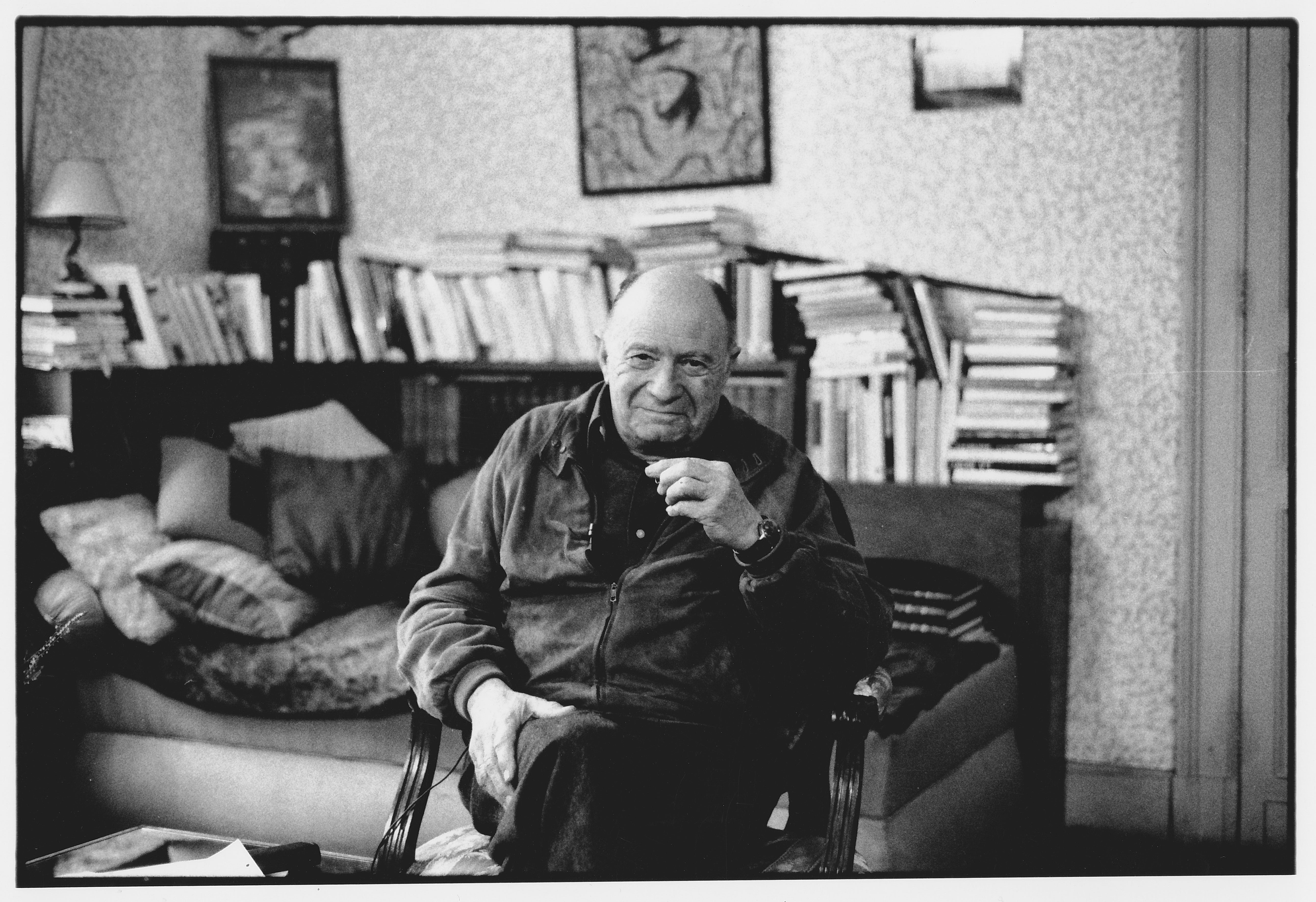
FRENCH PHILOSOPHER JACQUES ELLUL (1912–1994) wrote almost 60 books and many hundreds of articles. He was one of the first to argue that technology is the decisive factor that determined the character of Western society in the 20th century. In his first book on the subject, La Technique (‘The Technological Society’), which went largely neglected by the general public, he described how technology had become autonomous, growing beyond our control to wield decisive influence over human society and behaviour. In a provocative article he even insisted that Hitler had in fact won the war, as unlimited technical thinking, guided almost exclusively by considerations of efficiency and goal-directed rationality, now holds sway almost universally, at the expense of other values which may have guided human action. In technological society, all forms of human activity, whether personal behaviour or organised social and economic activity, have become fundamentally adaptive to this dominant logic.
For this reason, Ellul preferred the term ‘technique’ to ‘technology’, indicating by it not a particular machine or procedure but rather ‘the totality of methods rationally arrived at and having absolute efficiency… in every field of human activity.’
He argued that technology has become an environment: the technological milieu – our technotope – is not only the place where we live, but it also makes living possible and forces change; it obliges us to transform who we are because of the problems arising from the milieu itself.
*
Amsterdam, 1996: Ivan Illich sighs. ‘I never watch films; the images just keep haunting me.’ Some weeks earlier we had sent him a copy of our documentary on French philosopher Jacques Ellul, his great friend and teacher, who had died in 1994. Six months before, in 1993, Illich had travelled to Bordeaux (a city where Ellulonce served as deputy mayor), to give an address in his honour, expressing his gratitude to ‘a master to whom I owe an orientation that has decisively affected my pilgrimage for 40 years.’
We were two young Dutch film-makers who had been hoping that, when Illich saw the film, he would be more inclined to accept our request to make a documentary portrait of him as well. ‘Did you receive our film on Jacques Ellul?’ we ask. ‘Yes, yes, and I am very thankful for it; I immediately forwarded it to friends in Santiago de Chile and I am sure that they will make great use of it!’
‘But did you like it?’ we press, assuming the Austrian philosopher and theologian would be eager to see one of the very few documentaries that has ever been made about his close friend. And then there is the revelation: I never watch films. Illich was in no way interested in developing an active working relation with modern media.
An hour or so earlier he had given his presentation at the Doors of Perception conference on the theme of ‘speed’. When he entered the stage, no-one in the audience could fail to see the tumour about the size and shape of a small head of cauliflower on the right side of his face. From the very start, it was clear which perspective he would pursue. He opened his talk this way: ‘From the tone of those lectures I have heard so far, it is obvious that I am addressing people imprisoned in the age of speed.’
The author of Medical Nemesis (1975) told us that his doctors had advised him in the strongest possible terms that the tumour needed to be removed if he was to survive. But he refused to have the operation, in accordance with his critique of professionalised medicine. He had waged a bet with the physician concerned; every year that he was still alive, he would get a bottle of wine. By that time, he had collected twelve or so.
Illich was the one who pointed out that, at most schools, teaching is confused with learning (Deschooling Society, 1970), who stated in 1978 that the real speed of cars is just 3.7mph, if you factor in all the social and economic costs (Energy and Equity). (In countries deprived of a transportation industry, people manage to achieve the same, he would add triumphantly, walking wherever they want to go.) And in Silence is a Commons (1983), he would articulate his view that computers are doing to communication what fences did to pastures and cars did to streets.
As Illich acknowledged in his Bordeaux address of 1993, Ellul helped him grasp how technique (Ellul’s more precise term for technology) has become the determining factor in our society:
More and more, people live their lives as in a nightmare: They feel themselves ensnared in unspeakable horrors, with no means to wake up to the light of hope. As in certain nightmares, the terror transcends the expressible. Ellul’s recognition of the established status of globalising technique allowed him to foresee in the 1950s what today is palpable but now irremediable.
The concept of la technique entered Illich’s awareness in 1965 in California, when John Wilkinson – who, following the strong recommendation of Aldous Huxley, had just translated the book – gave him a copy of Ellul’s 1954 work The Technological Society. Since then, Illich said, the questions raised by the concept of la technique had constantly reoriented his own examination of our relation to objects and to others. It permitted him to identify – in education, transport and in modern medical and scientific activities – ‘the threshold at which these projects absorb, conceptually and physically, the client into the tool; the threshold where the products of consumption change into things which themselves consume; the threshold where the milieu of technique transforms into numbers those who are entrapped in it; the threshold where technology is decisively transformed into…the system.’
For Illich, Jacques Ellul was one of a select few modern thinkers who understood that the place of the sacred is now occupied not by this or that artefact, but by la technique, the black box we worship. He declared in his lecture that it would be rational in today’s world to prioritise examining the effects of la technique on one’s own flesh and senses before looking at current and future damages to the environment:
Existence in a society that has become a system finds the senses useless precisely because of the very instruments designed for their extension. One is prevented from touching and embracing reality. Further, one is programmed for interactive communication; one’s whole being is sucked into the system. It is this radical subversion of sensation that humiliates and then replaces perception. We submit ourselves to fantastic degradations of image and sound consumption in order to anaesthetise the pain resulting from .’having lost reality.
Technology will not tolerate any judgment being passed on it. Or rather: technologists do not easily tolerate people expressing an ethical or moral judgment on what they do. But the expression of ethical, moral and spiritual judgments is actually the highest freedom of mankind. So I am robbed of my highest freedom. Whatever I say about technology and the technologists themselves is of no importance to them. It won’t deter them from what they are doing. They are now set in their course.
They are so conditioned. For a technologist is not free. He is conditioned. By his training, by his experiences and by the objective which he must reach. He is not free in the execution of his task. He does what technology demands of him. That’s why I think freedom and technology contradict one another.
City dwellers live in a completely dead environment. Cities consist of brick, cement, concrete and so on. People cannot be happy in such an environment. So they suffer psychological problems. Mainly as a result of their social climate but also as a result of the speed at which they are forced to live. Yet man is specifically suited for living amidst nature.
So man becomes mentally ill. And for the relief of those psychological illnesses there is human technology, just as there is medical technology.
But human technology must enable man to live in an unnatural environment. As in the case of deep sea diving. Divers have a deep sea diving suit and oxygen cylinders in order to survive in an abnormal environment. Human technology is just like that.
(This excerpt, and all others in block quotes are from the film The Betrayal by Technology).
Comments
Nothing yet. Say the first thing.
Sign in to join the conversation.